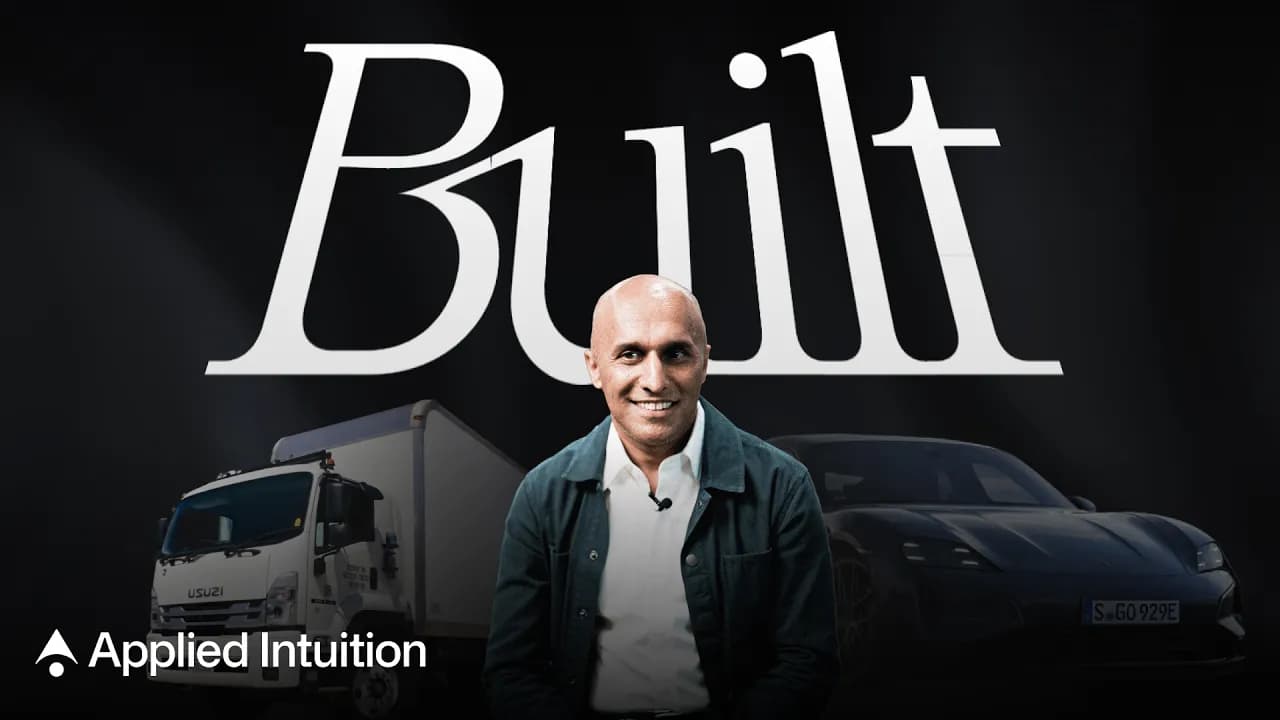
The real AI revolution isn’t software. It’s farms, mines, and trucks. | Qasar Younis
In a Nutshell
Qasar Younis, CEO of $15B Applied Intuition, argues the real AI revolution lies in physical AI transforming farms, mines, construction, and trucking—industries facing labor shortages (e.g., farmers averaging late 50s)—via autonomous vehicles for 18/20 top automakers, DoD, and more, delivering safer, abundant mobility without hardware. In 5-7 years, L2++ autonomy (Tesla-style, cheap/no HD maps) and L4 (Waymo-style) will be ubiquitous globally, slashing accidents (30K+ US deaths/year) and filling dangerous jobs, while broader optimism predicts net suffering drop from solving diseases like cancer. Success stems from radical pragmatism: stay quiet building for customers, prioritize speed/technical mastery/follow-up/laughter, listen to naysayers emotionlessly for truth-seeking decisions, and draw from diverse experiences (Pakistan farm, Detroit GM/Bosch, YC) over narrow Silicon Valley paths.
These notes were generated by AI and may contain inaccuracies.
Mark Andreessen quote-tweeted Qasar Younis's first tweet: "This is the best AI CEO. Nobody knows." > "Our best work is done alone and quietly. Every minute you're writing something for public consumption. You're not focusing your very limited time that you have on your customers and your product."
"You're building a lot of the future that we're going to be living in. What does the next couple years look like?"
"Us solving some of these impossible problems like cancer are directly going to be related to this AI boom. net suffering in humanity overall should go down significantly."
AI is coming just in time to save us. Real impact of AI in next 5-10 years in farming, mining, construction—industries needing autonomy. Average age of farmer in late 50s; in 10 years, major implications.
Anxiety about AI stems from misunderstanding. Advice: spend time understanding AI's limitations, then actively use technology for good.
Guest: Qasar Younis (corrected from "Caster Ununice"), co-founder and CEO of Applied Intuition. $15 billion company growing quietly for decade. Adds AI to vehicles: cars, tractors, planes, submarines, mining rigs. 18 of top 20 automakers as customers, plus biggest global construction, mining, trucking companies, and Department of Defense. Like Waymo or Tesla without hardware.
Qasar born on farm in Pakistan, grew up in Detroit, engineered at GM and Bosch, started companies before Applied Intuition.
Sponsor: Omni for AI analytics with semantic layer, knows business definitions. Test queries, validate reasoning, lock permissions. Free 3-week trial at omni.co/lenny. Used by Perplexity, DBT, Buzzfeed.
Sponsor: Vanta for SOC 2, ISO 27001 compliance with AI automation. Completes questionnaires 5x faster. Customers save $500,000/year, 3x more productive. $1,000 off at vanta.com/lenny.
If things go well, next couple years with physical AI.
Broader AI like industrial revolution: despite negatives (child labor, monopolies, wars), unimaginable benefits—broader healthcare access, goods, heating/cooling homes. Example: 1940s POW letters from Germans amazed by lit-up American towns, cars everywhere; 80% of German towns lacked electricity in WWII.
Positive: technology access for all, personalized AI coaches (not generic ChatGPT). Solving cancer tied to AI boom. Net human suffering down significantly; fundamental optimism.
Physical AI: free/near-free mobility via self-driving cars transformative—e.g., in Rwanda, 2 hours from hospital. Negativity from those in good circumstances; more positives on society's edge.
Next 20 years: bad taken-for-granted things disappear, diseases, inaccessibility to services gone. Example: free global messaging vs. past expensive calls/handwritten letters from Pakistan.
AI brings abundance at near-free cost.
Anxiety from videos like Chinese robots with nunchucks, stock market reactions.
Separate: societal technical shift anxiety vs. public investor stock reactions.
Root of fear: misunderstanding. Advice: understand AI to see limitations—e.g., YouTube videos where Gemini or ChatGPT fail to recognize upside-down cup.
Nunchuck robots: pre-programmed, $15 million video, not sentient. Compare to car factories with advanced robots for 25 years—no anxiety there because gap understood (welding robot programmed specifically).
Humans fill unknown gaps with fear. Learn technology to see edges.
Society: every technical shift harms some (e.g., WhatsApp killed companies/jobs), but steer toward good. Remove "AI" emotional label; focus on technology for good as founder, employee, citizen.
Investor selloffs: not nuanced. From Harvard MBA, saw high finance reality—not deep math, but quick AI consultant apps mimicking products (e.g., Figma-like in weeks vs. years/500 engineers). Markets price in "vibe coding" risk, causing selloffs. Recent calibrated investor: time to buy.
Anxieties different: fight fear by learning technology (e.g., outside Silicon Valley bubble, like in Michigan).
Self-driving cars are robots; nunchuck robots scary, but self-driving car mishaps already dangerous.
Self-driving stats: supremely safer than humans. In 20-30 years, view human driving like post-industrial child labor—normal then, exploitative now.
US: 30,000+ die yearly in accidents (Stalin: one death tragedy, million statistic). Car accidents devastate families; human driving doesn't make sense—people die.
Tesla FSD now much better, nerve-wracking before.
For truck drivers, miners: intelligence as helping hand in dangerous tasks incredible. Trucking: not enough people want jobs. Focus: people die in trucking accidents.
Monkey brain: rustle in bush = snake (evolutionary). New tech triggers fear.
Mines autonomous: awful jobs where people die; evidence—nobody clamors for remote mine work.
Software AI advances (models writing 100% code). Hardware: robots walking around doing things.
Spectrum: already robots—Roomba vacuums, coffee machines. Question: how fast to general-purpose robots with little guidance?
2006 analogy (pre-iPhone 2007): flip phones exist, when Star Trek phone? 5 years later: Uber, WhatsApp, Instagram, Snapchat for millions. Hard to conceive without app stores, dual cameras, social comfort.
Robots: fast but form unpredictable. Early: bang-for-buck—self-driving cars, intelligent mining vehicles (50-60 years engineering already done, add intelligence).
Not just humanoids (monkey emotional bias); pragmatically, intelligence into existing things. New applications in 5-7 years.
Every car company working on Tesla FSD-like product or Waymo-like (lots of sensors/compute/maps vs. Tesla: few sensors, no maps/high
No high fidelity maps, cheaper compute, and the Tesla version of a product—this is called an L2++ product—will be available everywhere because it's cheaper and doesn't require HD maps. The Waymo product functions better in a geographically constrained area. In 5 years, both L2++ and L4 technologies will be much more ubiquitous globally, not just in the Bay Area or parts of China, with companies working on this worldwide.
Nav systems used to cost thousands of dollars and were highly desired. We're at that moment for L2++ systems where people are willing to pay thousands for a semi-automated vehicle. In China, downward pricing pressure is already making autonomous products nearly free. In 5 to 7 years, every car will have some level of autonomy, like everyone buying a car gets FSD with it.
Average people will use self-driving constantly without questioning it, similar to how nav systems led to CarPlay and Android Auto emerging naturally—plug in your phone for free navigation and apps, now ubiquitous.
Full autonomy will become expected, leading to a clear decrease in injuries and deaths because intelligence helps with driving. This applies beyond consumers to construction, mining, defense—every vertical with big physical machines where humans team up with machines for productivity unlocks. Viewing machines as physical agents unlocks hard-to-imagine productivity.
OpenAI, Moloch, and the OpenClaw revolution are great but impact a small part of society. At Detroit airport, few know OpenClaw; people live in the physical world where AI impact will be in farming, mining, construction, self-driving trucks.
Industries need autonomy now. Trucking jobs aren't fought over; average farmer age is late 50s (58). In 10 years, many retire; in 20 years, bigger problem across verticals. McDonald's or mine quarries can't hire because tradeoffs aren't worth it—long-haul trucking meant family sacrifice in 1980s/1990s, but now families choose Uber/DoorDash to pick up kids.
Physical AI revolution fills gaps rather than automating entire industries away—replacing with robots is too complex soon, and society will differ by then. Read history books on industrial revolution (well-documented last 150 years) to understand positive societal outcomes despite downsides to mitigate.
Don't pump brakes on technology—US economy stutters, hurting lowest labor market most. US growth last decade from Mountain View, Sunnyvale, Bay Area new frontier technologies, not Detroit. Braking frontier tech for fear hurts marginalized most. Europe vs. America stats explicit.
Fear of China (e.g., nunchuck robots) drives no brakes. House of Huawei book: Huawei amazing tech, but quarter of 200k employees Communist Party members; goal isn't profits/shareholders but extension of state—Huawei means "China's ambition".
Don't compare companies apples-to-apples: OpenAI vs. DeepSeek is OpenAI vs. Chinese government; Apple vs. Huawei is Apple vs. Chinese government. Not for-profit independent groups.
Chinese EVs lauded vs. Munich/Detroit/Tokyo/Seoul, but Rivian (US EV) makes great products but loses money, low valuation—not top 50/100 Bay Area companies. EV/automotive tough business; Chinese aren't assessed as businesses needing profits, public investors hammer others.
America building great EVs without profit pressure would field wow products. Comparisons off because not assessing businesses equally.
Can China succeed without America failing? Free markets prove everyone can succeed over 100 years. China not in open/free markets, but no need for antagonism—warrants attention, not one-to-one comparison. Nuance missed by average person consuming "China bad".
First tweet "Hello, I'm going to start tweeting" got 2M views; Elon replied, Mark Andreessen quote-tweeted "best AI CEO nobody knows, follow for free alpha"; El Gil calls most successful quietest AI company.
Counter to "build in public": stayed quiet, built, then shared story. Philosophy: radical pragmatism. Inspired by Berkshire Hathaway, not Silicon Valley darlings. Known in ecosystem (YC COO), personal networks with Elon/Mark—no need for brand early.
Naval (investor/friend): fame is tool for recruiting. But for them, not hard requirement 10+ years ago. Co-founder Peter Lewig and speaker get little emotional satisfaction from public things.
Focus every minute on customers/product, not podcasts/posts. But 2024/2025 reality: even known companies need broader message—contrarian but pragmatic, fits psychology.
Immigrant from Pakistan, grew up Detroit/Warren Michigan, outsider feeling breeds mainstream skepticism—many founders' psychology. As YC COO/outsider narrative conflicted; advice from Mark/Elon: leave baggage, pragmatically get message out on physical AI, society changes.
Seen full economic spectrum; ideas worth sharing beyond company promo for debate/discussion.
Successful companies show traction early, sustain decade+. To founders 2 years in struggling: if market info not giving specific path, reset—foundation wrong (co-founders, market, life phase). Seen in thousands of YC companies.
To alumni starting companies: first 3 years a zero—build founder muscle like craftsman. First table wobbly? Keep going. Early founders pressure for instant success miss learning. Third company most successful—not random; funds focus multi-time founders.
What love about advice: often best ideas come from when
Start with low expectations, play around, tinker without aiming to build the next Google. This approach led to discovering the current path, exemplified by Open Claw.
It's deeply very very important and you should give it your all. And it's also not that important.
Hold these conflicting views in balance.
Approaching the company by staying quiet helps. At YC, became COO but told Sam Altman (president) not to announce it for a year to avoid pressure from partners or public scrutiny like "why were you COO only for six months?"
Be honest: what people think matters and impacts you. It's easy to pivot before raising money or hiring employees. After hiring, employees join a specific mission—changing direction erodes credibility, like switching hills in war.
Once public, the startup becomes your identity, making pivots harder.
Our best work is done alone and quietly.
This is a core value for pragmatic reasons, allowing work in peace.
Company Core Values
Meta values: radical pragmatism, best work done alone and quietly.
Derive values from reasons for success when gaining traction:
- Speed above everything.
- Never disappoint the customer.
- Technical mastery.
- High output matters.
- Laugh a lot (keeps grounded, provides subtle feedback, fosters behavior framework).
- Half the work is follow-up (taking notes and following up is the business).
In weekly new team meetings, discuss values in depth.
Laugh a Lot is my new favorite company value.
Book by Stripe Press on maintenance highlights its value. Focus on craft, product quality, listening to customers for higher success likelihood, then scale.
Roots in automotive engineering: building complex machines at scale (cars every 30 seconds, cheap, globally competitive). Factory success is safety and maintenance, not complex—keep eye on handful of things done really well.
A man who cannot command himself is not fit to command others.
Maintain yourself, team, company; products emerge from the system. Think of company as a machine: focus on hygiene, tuning like car enthusiasts detailing under the driver's seat.
The score takes care of itself.
Joe Montana is an investor (Series D). Valuation takes care of itself.
Office is clean because everyone does weekly cleaning zen (influenced by Japanese schools where students clean). Clean your desk—avoid narrative traps like "I'm a Stanford software engineer doing AI."
Company (almost 10 years old, 1000+ engineers) never spent raised capital—functioning business without it. Connected to cleaning office, being aware of surroundings, no shoe policy (Japan-influenced).
Direct line between being quiet, alone, cleaning desk, and well-written software.
Take best of Japan, Germany, China, Detroit, Silicon Valley.
Great artists steal.
Be humble, learn from everything, be well-rounded leader.
Charlie Munger: never met very successful person who doesn't read all the time.
Read old books (time filters noise). In life, read 50-100 books max—avoid low-quality. Consume pillars of human ideas, interpret for business/technology.
Reading Malcolm X's autobiography will make you a better founder.
Like cleaning zen to clean code—not one-to-one, but well-rounded understanding of society/history builds better products.
Metaphor for LLMs: diverse data makes understanding rich/nuanced.
Similar to Mark Andreessen in thinking/content consumption.
Mark is a mentor; consumes content outside industry, making him better investor.
Website has long, unconventional list.
Examples:
- Autobiography of Malcolm X.
- High Output Management (Andy Grove).
- Vibe Coding (company reading).
- The Emperor of All Maladies (cancer book—changes framing).
- Made in America (Sam Walton, written on deathbed).
- My American Journey (Colin Powell).
- Guns, Germs, and Steel.
- Collapse (same author).
- SPQR (Roman history—picked due to knowledge gap).
Approach: identify areas unknown (philosophy, history, Jansenism, feudal Japan), find best book, fill blanks.
Mark's barbell: today's news (X) and 10-year-old books. Influence got speaker on X.
As company grows influential, responsibility to propagate ideas to AI founders, tech leadership, world.
VCs now personal brands (A16Z, John Doerr) creating gravity, influencing founders/companies.
Encourage leaders to listen to naysayers, avoid positive reinforcement cycles.
Ideal: input competing ideas, shake them out emotionlessly—best idea wins.
Founders often block this due to media/tribal views demanding hard stances.
Take inputs from customers, employees, competitors, investors, society—impacts strategy. Not arrogant; not contrarian for sake.
Emotions unhelpful for rational decisions—Midwest roots.
Speak up.
Everyone must share (even junior from Zucks, Waymo, Tesla, Chinese company)—one idea can be key.
Truth is what stands the test of time.
Find best idea, go full bore. Truth-seeking culture: best idea wins.
Companies fail despite talent because best ideas not surfaced/adopted, or momentum drowns new signals (market changes).
Example at Google (late 2000s/early 2010s): apex predator. Facebook emerging (1000 people vs Google's 15-20x size, billion monthly cash flow).
Google couldn't fight Facebook because Google is not Facebook—like gorilla can't fly by not being gorilla.
Large companies build momentum/culture/direction; can't pivot when market changes.
This happens consciously/unconsciously due to employees, culture, work focus—can't hear market changes over wall of sound.
Small companies risk founders having a rigid view that leads the entire company astray, even if they're in the right market solving the right problem but just 10 degrees off course. Fear of failing and losing drives humility to listen to others who point out the misalignment, allowing course correction. Once this becomes culture, it's hard to lose because everyone focuses on winning rather than a preset path.
In practice, companies claim to listen to all opinions rationally but almost never do, or they're too nice to challenge each other. The middle way balances openness with confident execution after debate. Be humble to listen, but once decided, walk decisively down that path.
Company values explicitly state move fast, move safe. Managers are assessed, compensated, and promoted on adherence to these values. Under speed, they measure decisiveness. The system holds conflicting tensions: openness vs. quick decisions. Founders get paid to know when to bluff, hold, or fold—eventually deciding without more information.
Removing Emotions from Decisions
Pretend nobody's feelings would be hurt and emotions are not involved. What would you do if nobody cared? That reveals the right path, then address downsides and help people feel okay.
Emotions stem from preset views tied to ownership. Fundamentally, emotions are frameworks from life experiences not optimized for product decisions. A heuristic: the same decision by multiple people yields consistent results, removing emotional filters for raw, repeatable classification.
Trend in AGI discussions: emotions potentially create consciousness. Michael Pollan's new book on consciousness argues it's not just more intelligence but emotions. Reducing human thought to associations of ideas, facts, words, letters undermines complexity. Creativity masters the simple, while technical mastery handles the complex—computers excel at the latter.
Philosophy: consume broad inputs, remove filters, see things honestly. Build company culture ignoring idea origin, then leaders decide—and must be right.
Founders love credit, but success requires being right: evidence is a sustainable standalone business. Advice targets venture-backed AI companies in Silicon Valley and Bay Area founders.
Many CEOs lack great taste—artistic or operational (e.g., HR policies)—due to limited exposure. Example: grow up in Cerrito, go to Berkeley, start company immediately without employee experience.
Qasar spent over a decade in large organizations like General Motors or Bosch (100,000+ employees). In the bowels, you learn bureaucracy, disconnected leadership, antiquated tools—vital for leaders creating policies and culture. Many founders never experienced the bottom.
Similar to not consuming art like Brassai or Picasso. Good founders could excel at many things, discerning good from bad via understanding humans and life. Narrow life experience limits this; backpacking the world intuitively builds better founders, though no peer-reviewed research confirms.
Qasar welcomes book recommendations (some favorites came randomly), novel off-mainstream research, opinions on physical AI impacting mines, farms, construction sites, robo-taxis. Find him online, especially Twitter.
Subscribe on Apple Podcasts, Spotify, or favorite app. Rate or review to help others find it. All episodes at lennispodcast.com.
Keep Lenny's Podcast in your library
Save the videos and channels worth coming back to, and find them again in one place.