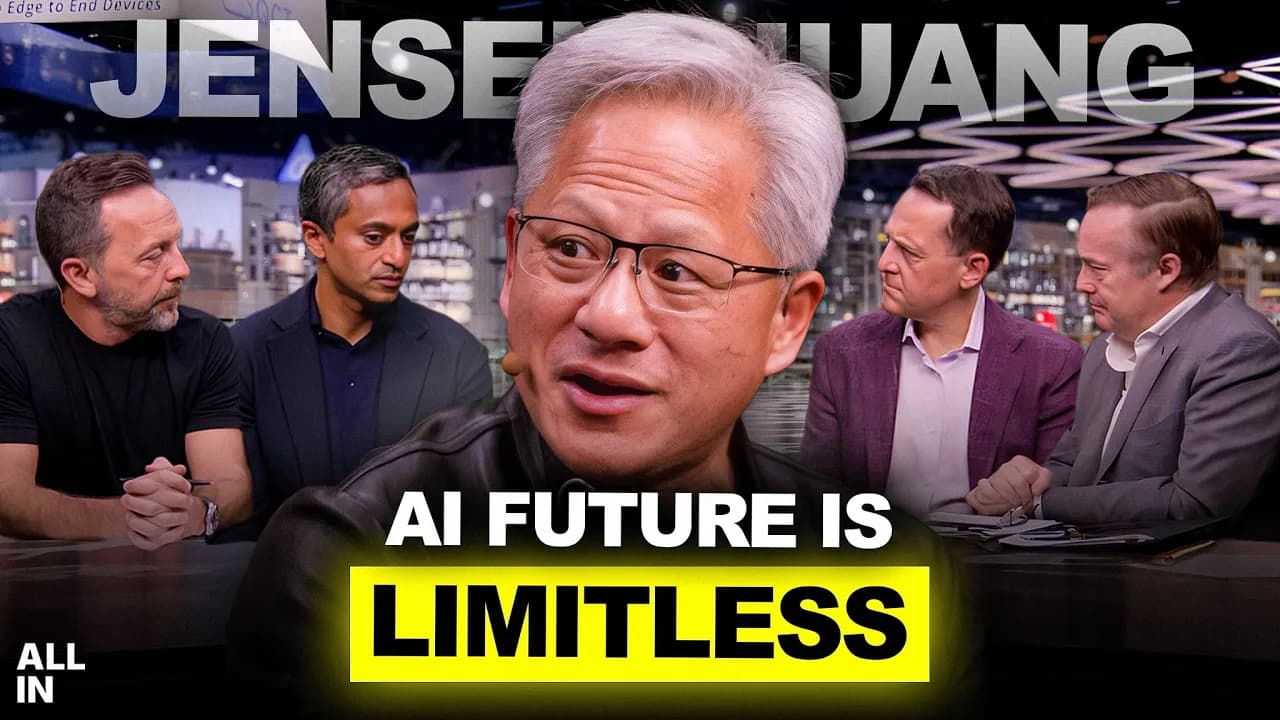
Jensen Huang: The Mindset That Built NVIDIA
In a Nutshell
Jensen Huang reveals Nvidia succeeded despite starting with the wrong 3D graphics algorithm, learning OpenGL from textbooks after nearly failing, proving that the ability to confront reality and learn matters more than initial technology choices. Nvidia's core vision is accelerating algorithmic domains through specialized hardware, creating a universal function approximator via deep learning that will reinvent the entire computing stack from processors to applications. The key mindset is approaching new challenges with "how hard can it be" rather than fear, combined with systems thinking to orchestrate agentic AI systems, as physical AI and robotics represent the next $100B+ industry.
These notes were generated by AI and may contain inaccuracies.
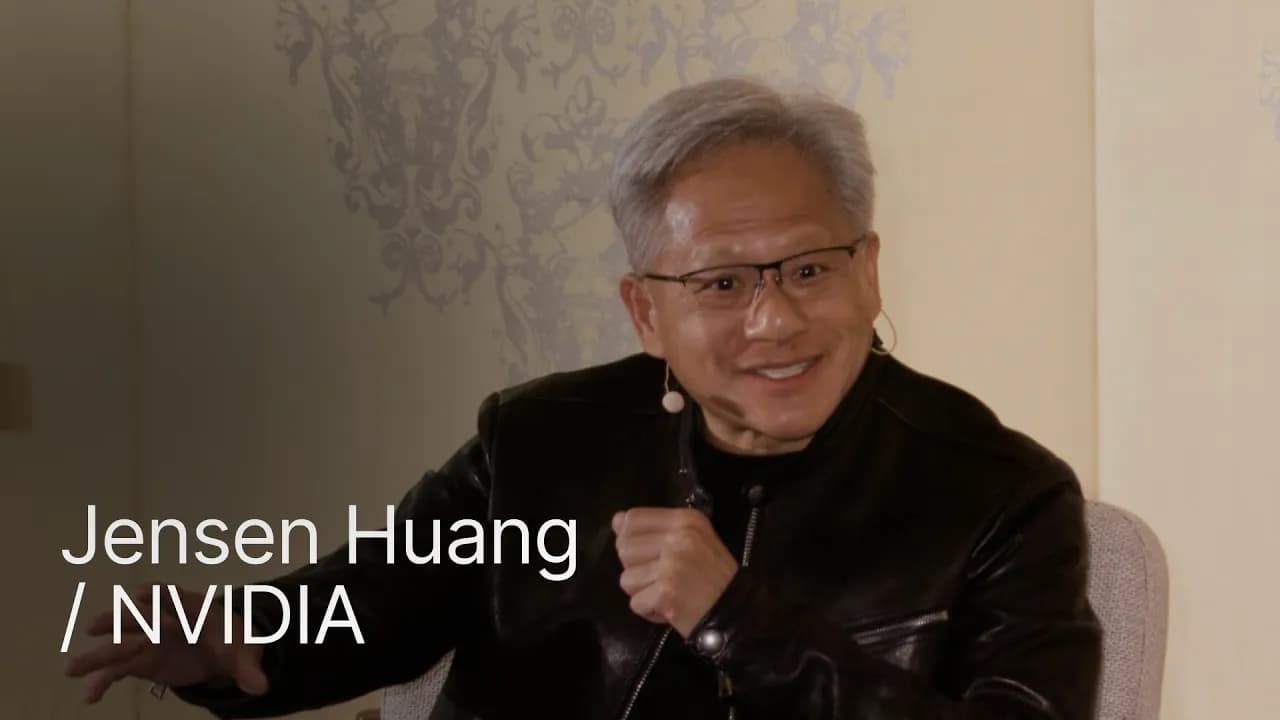
Jensen Huang, founder and CEO of Nvidia, joined Startup School 2026 as a speaker. The session began with recognition that attendees were positioned for success, and Huang expressed delight at being present for the event.
For students familiar with Nvidia primarily as an AI company, Huang emphasized that the company's original technology choice was fundamentally incorrect. Nvidia started with the concept of reinventing 3D graphics, based on the philosophy that general-purpose computers (CPUs) could be augmented with accelerators to solve otherwise difficult problems. The first problem chosen was 3D graphics, with the vision of transforming every personal computer into a game console.
In 1993, when the PC was emerging, Nvidia's concept was to design a system that would fit into personal computers and convert them into game consoles. The team developed new algorithms they believed would work, having reasoned through the problem thoughtfully before starting the company to build it.
By 1995, Nvidia discovered their algorithm was exactly wrong, and the technology that founded the company was fundamentally flawed. This realization came almost too late, as 35-40 other companies were already building 3D graphics for PCs. Huang confronted the company with the reality that they wouldn't survive without acknowledging the failure and working toward the correct algorithm.
A critical additional problem emerged: not only had they chosen the wrong technology, but none of the team knew how to implement it correctly. Huang described this as a pivotal day, with only a couple hundred dollars in his pocket.
Huang went to Fry's Electronics and purchased three textbooks on OpenGL and pipeline design. He brought these back to the company and gave them to the engineers. From this foundation, Nvidia reinvented computer graphics, became the world leader in modern computer graphics, and invented most major breakthroughs in the field over the subsequent 25 years.
Huang noted the irony that everyone assumed Nvidia started as world leaders in 3D graphics, when in fact they learned it from textbooks. The company started, raised money, and then bought textbooks to learn the correct approach.
The fundamental lesson Huang drew was that technology changes continuously, and as long as founders can confront reality and maintain the ability to learn, the specific technology itself doesn't matter. Since this experience, Nvidia has continued inventing new technologies they had never done before, approaching each challenge with the attitude of "how hard can it be?" While it always proves much harder than expected, this learning mindset remains central.
Nvidia's expertise spans multiple algorithmic domains including particle physics, fluid dynamics, molecular dynamics, image processing, inverse physics, and deep learning. The company's core insight was that it's possible to augment CPUs to solve problems that are otherwise too difficult. Huang emphasized that Nvidia's real focus became accelerating algorithm domains rather than simply building great chips.
Huang articulated his belief that great companies are built on a unique perspective about the world that founders deeply believe in, rather than just technology or market timing. While having the right technology for the right market at the right time makes success easier, the high-level vision and unique perspective are what truly matter. Nvidia's vision was that accelerated computing would be important, and this realization was fundamentally about algorithms rather than chips.
A pivotal moment came through Nvidia's partnership with Sega, who had contracted the company to build the game console after Saturn, which became Dreamcast. Because Nvidia's algorithm and technology were fundamentally flawed, Huang traveled to Japan to inform Irimajiri-san, Sega's CEO at the time, that they could not fulfill the $12 million contract.
Huang advised Sega to choose another company but explained that Nvidia still needed the money. Irimajiri-san recognized the honesty and trust in the relationship, providing $5 million that kept Nvidia alive and gave Huang time to discover the correct approach. This money proved crucial for the company's survival.
Sega sold their Nvidia stake the moment Nvidia went public. At IPO, Nvidia's valuation was $300 million in 1999, which Huang noted was "real money" at the time. The company's current valuation exceeds a trillion dollars.
When AlexNet emerged, Huang viewed it through Nvidia's lens of looking for algorithms that could solve difficult problems. The breakthrough realization was that AlexNet represented something much more fundamental than a single algorithm—it demonstrated deep learning as an approach that allows learning any function, essentially a "universal function approximator."
Huang began telling people 15 years ago that Nvidia had discovered the universal function approximator, capable of learning almost any function when given answers. This insight extended beyond precision-critical applications, as most interesting problems are imprecise by nature.
The day Nvidia realized they had a universal function approximator, the question became what this meant for the entire computing stack: processors, middleware, algorithms, and applications—what Huang now describes as the "five-layer cake." This industrial stack would need reinvention together. The approach involved asking fundamental questions like "If this, then what?" and "If this can get better, then so what?"
Huang described his approach as starting with curiosity and seeking answers directly. When answers from immediate colleagues prove unsatisfying, he pursues discovery independently. If the information domain proves important to the company, he learns extensively to share insights with the organization.
Huang views the CEO role as being in service of the company and its people, empowering them with insight rather than applying conventional management techniques. This represents a personality-driven approach rather than a management methodology.
Huang compared being CEO to surfing, requiring understanding of the waves, reading the wind, and having good timing. These skills cannot be developed without direct experience. The CEO must learn to surf by understanding the waves through hands-on engagement.
Huang shared wisdom about organizational design: founders build companies like F1 race cars that they will personally drive. The organization should be adapted to fit the founder's working style rather than forcing the founder to adapt to conventional structures. When Huang was asked what would happen to Nvidia's unconventional approach when he eventually leaves, he responded that the next CEO would reshape the company to fit their personality.
Huang identified systems thinking as likely the most useful future skill. As low-level tasks become automated agentically, people need greater ability to think abstractly about systems: identifying problems to solve, understanding constraints, mapping inputs and outputs, and analyzing information flow rates.
Nvidia already implements coarse-level recursive self-improvement through agent systems. Every use improves markdown files, updates long-term memory, and processes information into compacted forms or knowledge graphs. The agent's capabilities improve continuously and asynchronously.
The critical challenge Huang identified is achieving fine-grained control over agents. Current conditioning through RAGs, conditional inputs, and prompts produces outputs that are too coarse. The goal is specific control where changing one word in a plan file creates a precise delta difference—one pixel, one triangle, one component in a CAD file, one layer, one via, one connection—while regenerating everything else accordingly.
Huang discussed the importance of people controlling their own personal AGI rather than outsourcing to cloud-based agents. Nvidia's involvement stems from needing to understand agents as the new software paradigm and how this processing affects computer architecture.
Nvidia must live 5-10 years in the future because building systems takes three years, ramping takes two years, and products need 10-year usability. This requires understanding agentic systems at the first-principles level: workload characteristics, algorithm evolution, bottlenecks, Amdahl's law problems, scaling behavior, concurrency, sandboxing, MCP handling, working memory, and long-term memory architectures.
Nvidia uses agents internally to accelerate operations, with autonomous code running in sandboxes throughout the company. Different teams use various tools including Codex, Cursor, and Cognition, allowing experimentation to learn optimal approaches. This internal usage helps discover how to make agent technology work better.
When chain of thought reasoning emerged from Stanford approximately eight to ten years ago, Nvidia analyzed its effectiveness for reasoning tasks and scalability. The implication for computer vision became clear: reasoning from prior knowledge could reduce data requirements for training self-driving cars.
This insight led to creating "Alpaca My," described as the world's first thinking self-driving car. With only a million or couple million miles of training data, it achieves excellent performance because, like humans, it leverages prior knowledge rather than requiring extensive specific training data.
Large language models require memory, prior knowledge, tools, and ways to network with other agents. Prior knowledge enables humans to decompose unfamiliar situations and build understanding from known concepts. This capability becomes relevant when agentic systems emerge, allowing early indicators to be reasoned about for future positioning.
When OpenCL emerged, it was recognized as the operating system that would hold large language models. OpenCL represented a Linux moment where everybody could build their own AI. Nvidia committed all of its engineers to support open source AI development, telling Peter that Nvidia's engineers were his engineers. The same approach was taken with the Hermes team.
Cloud services like ChatGPT and Claude should be used as much as possible, but companies need to build their own domain-specific AIs. Tools available for building custom AI include Hermes, open Claude, LangChain, and deep agent. The software is smart, making adaptation relatively easy. The goal is to encourage every company to build their own AIs, with innovation potentially emerging from open source development.
Text represents intelligence. Words are thoughts, and the ability to try thinking without words demonstrates how fundamental language is to cognition. Market markdown files may seem trivial but represent intelligence in text form.
AI automates cognitive tasks. When a task involves phone calls where someone provides responses and all necessary information is available, that task will be automated. Every single job will change, with new jobs emerging alongside automation. The evidence shows AI and automation create jobs rather than destroy them.
AI eliminates tasks but not necessarily jobs. The purpose of a job contains many tasks, some of which can be automated while others cannot. Software engineering jobs have increased 10% year over year despite automated coding. Radiology jobs increased 20% even though AI automated scan reading, because the patient backlog enabled hospitals to admit more patients, requiring more staff. Paralegals are growing because law firms can process more cases with AI assistance.
Generating video marked a pivotal moment for robotics development. The original work on progressive GANs and conditional GANs led to driving simulators completely generated by neural networks. When articulation could be generated in video, it became clear that robotics articulation was achievable. Physical AI requires understanding physics laws including causality, friction, and tension.
Physical AI development involves creating world foundation models that understand physics and how the world works. The ChatGPT moment for robots occurred a couple of years ago when robots could walk and reinforcement learning could be applied with physics grounding. The development process mirrors agentic systems: creating environments for learning and evaluation, real-to-sim simulation, physics-grounded simulation, and generative physics simulation using Isaac Sim and Cosmos.
Self-driving cars were identified as the first robotics application with sufficient market size, standardized technology for scaling, and real economic value. Nvidia chips are deployed in Waymo, Tesla vehicles and data centers, and Mercedes vehicles and data centers. Alpaca Myo was open-sourced to enable applications in agriculture, mail delivery, and warehouse AMRs. The robotics, autonomous vehicle, and physical AI business generates nearly $10 billion and is expected to become one of the world's largest industries within less than 10 years, representing the next $100 billion business.
Open source enabled the mobile cloud industry through Linux, Kubernetes, TensorFlow, PyTorch, early versions of Caffe, Torch, and Theano. Without these open source foundations, modern AI would not exist.
Simple tasks like coding will be automated away. Hard problems in physics, chemistry, biology, computer science, computer engineering, and systems thinking will persist. AI serves as a tool for increased ambition in solving large, difficult problems. The scale of challenges is no longer limited by coding capacity or engineer count. Deep tech, deep science, understanding technology-social issue intersections, and identifying market gaps remain valuable. Systems thinking becomes increasingly important for orchestrating millions of autonomous agents.
When Nvidia was founded, there was recognition of extensive knowledge gaps with no YouTube or YC resources available. The fear of raising money stemmed from uncertainty about answering investor questions. The key realization is that knowledge gaps always exist and technology constantly changes. This represents the greatest time in 60 years to start a company due to the complete reset of computing technology.
The critical attitude is approaching new experiences, technology, markets, and dynamics with "how hard can it be" rather than imagining difficulties that create anxiety. Learning is the single greatest superpower. The approach involves believing in the ability to learn, maintaining resilience to overcome challenges daily, and getting started rather than being paralyzed by fear or lack of confidence. Each day requires overcoming that morning's challenges, not solving everything at once. Persistence leads to outcomes like Nvidia's success.
Keep Y Combinator in your library
Save the videos and channels worth coming back to, and find them again in one place.