Timeless Principles for Fast-Changing Times — Asymmetric Bets, Identity Diversification, and More
In a Nutshell
The core message is that success comes from ruthless prioritization—selecting what truly matters, eliminating everything else, then automating the few high-leverage activities that remain. The most important takeaways are to book a real mini-retirement (e.g., a two-week trip) as forced leverage to build systems that make you replaceable, diversify your identity so your self-worth isn’t tied to one role or business, and use AI tools like Claude or ChatGPT for rapid strategic thinking instead of chasing endless efficiency on the wrong things.
These notes were generated by AI and may contain inaccuracies.
Exclusion is the essential element. Drucker noted that there is nothing more absurd than perfecting a job that should not be done at all. Artificial intelligence allows you to do this throughout the day. The tools are accelerators and magnifying tools, but they may magnify things that are pointless. The correct sequence is: Select, eliminate, then automate.
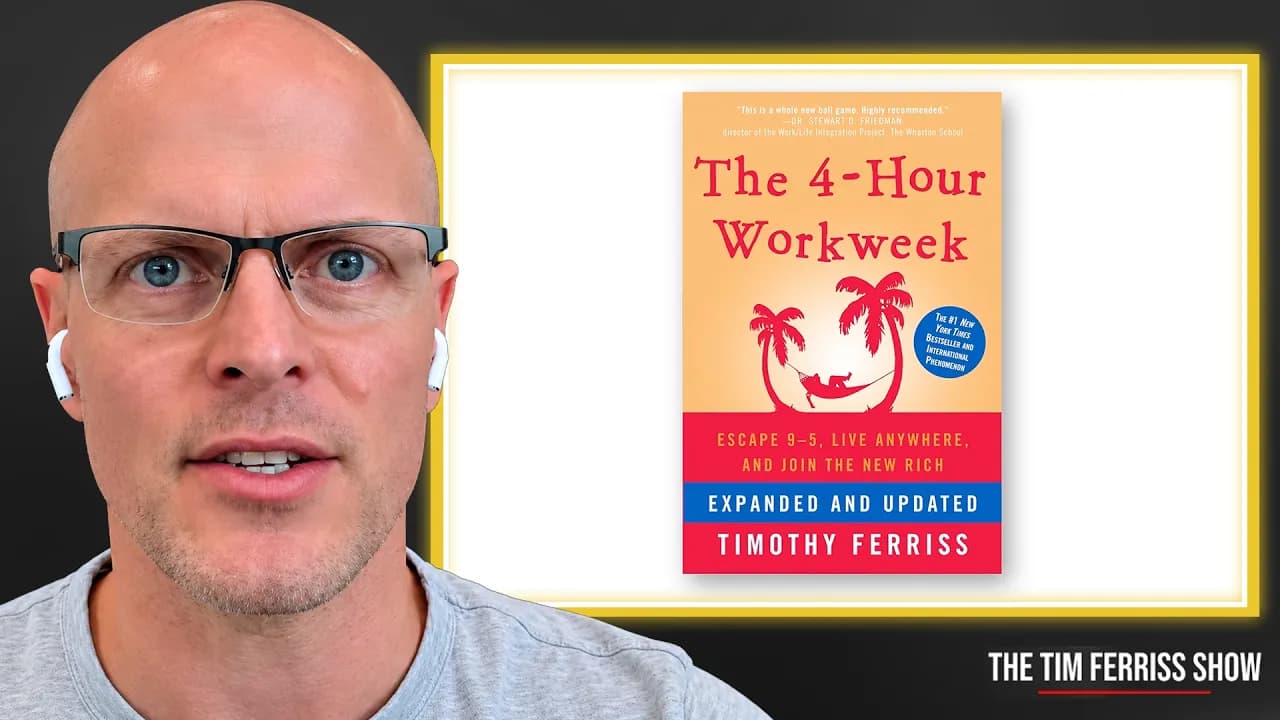
When running Brain Quicken, a sports nutrition company, the speaker worked 14-hour days and the business ran him. The framework from The 4-Hour Workweek is an abbreviation (D.E.A.L.): Definition, Elimination, Automation, and Liberation. The first step that opened the door to exclusion and then automation was applying 80/20 analysis to clients. The speaker was spending almost all time with high-demand, low-return clients while neglecting the best customers who were easy to deal with. The foundation is determining how you want your life to look, because without that, the rush and pressure to grow the business in abstract terms can take over everything.
The Effective Manager by Peter Drucker is recommended. Doing the right things matters far more than doing things well. Searching for "Dreamlining" provides a tool that allows defining what you want to do, what you want to be, etc., in a financial and tangible way. This gives a target monthly income based on the ideal lifestyle. The reason this is a target monthly income is that without it, you expose yourself to human weaknesses and tendencies that served our interests well thousands of years ago, but do not serve us well now.
The first things automated were related to the supply chain and operations. Automation essentially boils down to documenting what you do. In the near future, large language models will record work steps on screen, monitor work for a few hours, and determine exactly what is being done. At that point, whether through delegation to people or by using AI agents, a lot can be automated. However, it should be limited to the very few things identified that make a difference and are considered Archimedes' levers that guide toward the target monthly income.
A useful trick is to use a tool like Whisper Flow for voice dictation. Put AirPods in, go for a walk, and talk about what worries you, what you might want to do, the limitations of the job, and the pressures faced. Talk for about 10 minutes. Stop every two minutes to allow the tool to catch up. Put that in a note on the phone. Copy and paste into ChatGPT or Claude, or the preferred language model, and ask what to do next based on what it knows. For example: Three to five years from now, what might I aspire to achieve? The information and insights gained are amazing. This helps guide toward the types of skills to develop, creating a safety net of transferable skills that can be employed in any future that may arise.
Uncheck the default box that says "Use my information to train the model." The model draws from everyone's experiences, not just what has been entered. It literally requires 10 to 15 minutes of effort. It is strategic thinking in your pocket, just as Waymo is the most experienced driver in the world. OpenAI is probably approaching one billion users. Take advantage of that.
Jeremy Roof of Garrett Realty Partners in Virginia Beach is on track to complete 50 deals this year, reaching 80 next year. He has become the bottleneck. Every call, every contract goes through his phone, even while on vacation with his parents. He is afraid that if he does not answer the phone he will lose a deal. The question is what is the first thing to cut, automate, or delegate over the next 90 days. The smallest test to prove that the business can survive for a week without him before taking his father on the trip of a lifetime to Alaska in May.
The final part is the journey. One of the most powerful things to do is take a mini-retirement, a term used in The 4-Hour Workweek. A shorter example would be the week-long trip with his father. Ideally, make it two to four weeks, because then you will not be able to work as a firefighter and come back to find a huge mess that needs fixing. The goal of the exercise is to improve systems, to identify and eliminate, to automate certain things, and to empower people not previously given sufficient authority. Before leaving. When coming back, small bad things will happen, and maybe some bigger bad things will happen. But the systems developed allow moving from 50 trades to 100, then 200, then 300 trades.
If managing 80 deals on your own is successful, what happens if you win the game? You will get more deals. Looking ahead three, four, or five years, it will inevitably collapse. It is unsustainable. What is proposed will seem terrifying, which is understandable. An exercise called identifying fears was presented at TED. It allows raising the emergency brakes and is similar to setting goals, but it is called setting concerns. It can be found online.
It is very useful to practice what is called poverty. Everyone here belongs to the wealthiest and most influential 1% in the world. Kevin Kelly, the founding editor of Wired magazine, spends a week each year camping inside his living room in a sleeping bag. He drinks bad coffee, instant coffee, maybe some oats and beans, and that is it. It could cost $10 a week for food. You will then realize how comforting that can feel. Even if obstacles are encountered, or deals are lost, or half of the current deal flow is lost, if it allows creating systems that lay the foundation for reaching 100, 150, or 200 trades, then that is a winning deal.
The benefit of that single decision: book a flight to Alaska, pay for it, invite your father, and apply all this extremely useful sunk cost. Sometimes sunk cost is really useful. Now you are in a difficult situation. If you can spend two weeks, then do so. This will change your life. It will prove that the sky will not fall when you do that, but you will have to think deeply and do some hard work beforehand.
In a culture obsessed with optimization, automation, and expansion, what should never be improved upon, and where does the pursuit of efficiency actually separate us from what matters most? Efficiency and improvement are overused. If watching daily life, as if there were a security camera in the house, the question would be: What is this man doing? It is like a broken Roomba vacuum cleaner wandering around the house and forgetting socks three times in the first hour. The reason this can be gotten away with is nothing new. The speaker has always been like this. Peter Drucker's book The Effective Manager illustrates this very eloquently. Effectiveness is doing the right things. Efficiency is doing things the right way. Always focus on choosing goals first.
If adept at choosing these unequal bets, there will be a large margin for error and a large margin for what is unexpected in the future. An asymmetric bet is something where the downside is really limited, but there is great potential for the upside. Richard Branson's book Losing My Virginity is recommended. It is full of adventures. Branson was incredibly risky. He risks everything and does all this craziness. However, it actually really focuses on reducing risks. If studying how Virgin Atlantic started, the question was not how to become like British Airways. The question was how to make the downsides so minimal that they are worth the risk. He contacted Boeing directly and negotiated a deal structure that is the craziest imaginable. Limit employment and rental contracts and everything else to just one year. He could eventually resell the aircraft to Boeing at the original cost if necessary. It was essentially risk-free. Everything was in his favor. Mini-retirement is a good example of this.
Efficiency can separate us from what really matters. Efficiency is an imprecise tool. It can give a false sense of progress because we are getting better at doing something, regardless of what that something is. A concrete example: A friend was asking how to use artificial intelligence to improve "A," "B," and "C," and one of them was writing. The answer given was that if using "A," "B," and "C" to formulate two different versions with very different tones than what had been written, then yes. Order only two copies. Do not order five copies. If ordering five copies, it will create much more work than if writing it from scratch. That pursuit of efficiency only appears on the surface, but it ends up creating more work.
Oliver Burkman in his book 4000 Weeks is recommended. These books are among the best ever read. Every book mentioned has been reread at least four or five times. Anthony de Mello's book Consciousness has probably been read 50 times. The word "priorities" in the plural is a relatively new thing. It has been a "priority" linguistically for a very long time. Just one thing. This might be related to identity and cognitive dissonance with identity in the past, present, and hopefully the future. The sole priority must be known. It comes down to choosing goals, so what is it? Is it work? Is it your son or daughter? Is it your life partner? Is it something else? Is this mental health problem actually the most dangerous thing, the biggest landmine in your life or the life of someone loved? What is that one thing? Complete clarity on that, not forever but for the coming months 1, 2, 3, 6, explains a lot. It makes decision-making much easier.
People often stand in their own way. When needing to automate something or make it more efficient, there can be a deep attachment to self-worth, and it can be hard to let go of that. The first resource is the book read almost every year, at least once, and maybe twice, Consciousness by Anthony de Mello. "Risks and Promises of Reality" was the initial subtitle. It helps become aware of the stories and beliefs that govern life. Because everything else depends on that. It might be related to identity. "I am (S), I am (P)." Paul Graham, who co-founded Y Combinator, which helped create Dropbox, Reddit, Airbnb, and other companies, writes short articles. One about "stickers" or nicknames simply says that the more labels you put on yourself, the more stupid you become. The more artificially restricted, the more fragile a vessel created. If these beliefs and reaction patterns are controlling life, they should be able to be seen. Awareness is a very great starting point. The second thing done repeatedly in life is recognizing that what was done when The 4-Hour Workweek was published is completely different from what was done five years later, and completely different from what is done now.
Diversifying identity works like an investment portfolio with stocks, bonds, cash, and real estate. The goal is to prevent everything from being interconnected and falling apart or concentrating in a way that may reach zero. When self-worth becomes tied to the growth of a business and becomes too focused, it creates psychological risk. Creating a sense of progress in other areas helps avoid this concentration.
Rock climbing serves as a concrete example. The speaker is not good at it and moves like a can of Coca-Cola being dragged along a wall, but the goal is not to reach the Olympics. The activity provides genuine enjoyment and measurable progress with coaches. It is not expensive. After a bad day of writing on an 870-page book that was shortened to 350 pages, having rock climbing as a separate asset prevents self-worth from plummeting into an endless spiral.
Richard Branson was asked on Necker Island what single piece of advice he would give to people wanting to become more productive. His response was to exercise every day. Branson stated that exercise gives him three to four extra hours of productivity each day. This type of activity functions as a multiplier for everything else.
A practical method to align identity with the single priority concept involves listing all labels one might give themselves, such as employer or mother. After creating this list, the next step is to ask which single category would be chosen if forced to select only one. This exercise continues the emphasis on prioritization and choice.
If the chosen category is mother, this creates clear trade-offs when a demanding client wants a 7pm meeting that conflicts with a committed family dinner. The decision means saying no to the client. Life consists entirely of trade-offs with no magic solution that makes everyone happy. The cost of answering the call represents the alternative trade being made.
When asked what single action an agent should take before going to sleep that night to protect their most important watches, the recommendation is to return to written notes, as the pen is trusted more than memory. Even without a trip to Alaska, booking time for retirement is the one step that automatically resolves many other pieces.
The Freedom app at freedom.to blocks social media accounts and distracting websites. Since the customers of these platforms are advertisers and user attention is the product being sold, blocking these platforms is recommended. Social media apps have not been used on the speaker's phone for approximately five years, which is described as equivalent to ten years of free therapy.
If social media use remains necessary, the recommendation is to access it only from a laptop. Photos and videos can be captured on a phone and then transferred to the laptop. Friction becomes beneficial when applied intentionally to create barriers.
Archiving emails older than six months or three months allows quick identification of the most frequent contacts. After archiving, contacting these frequent correspondents to ask if they expect anything creates a smaller, manageable inbox. The inbox should not function as a to-do list, as reopening emails creates repeated reminders of unfinished tasks.
Sam Korkos, who runs Levels, has a complete system for inbox management: if a response will take two minutes, reply immediately. If a response will take 30 minutes or 15 minutes, schedule it on the calendar. This transfers the to-do list from the inbox to the calendar. All recommended actions can be completed within a few hours.
An original copy of The 4-Hour Workweek from 2007 was presented for signing. This first edition represents the thirty-third printing from the early publication period.
Keep Tim Ferriss in your library
Save the videos and channels worth coming back to, and find them again in one place.