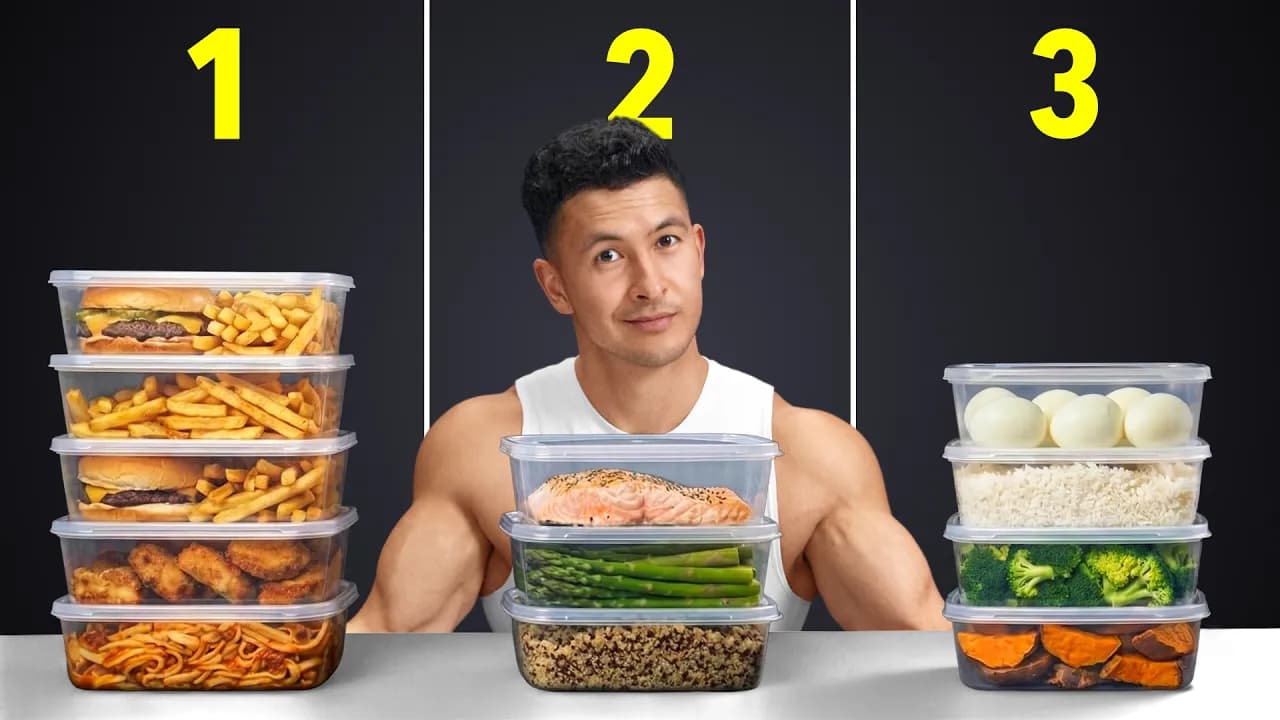
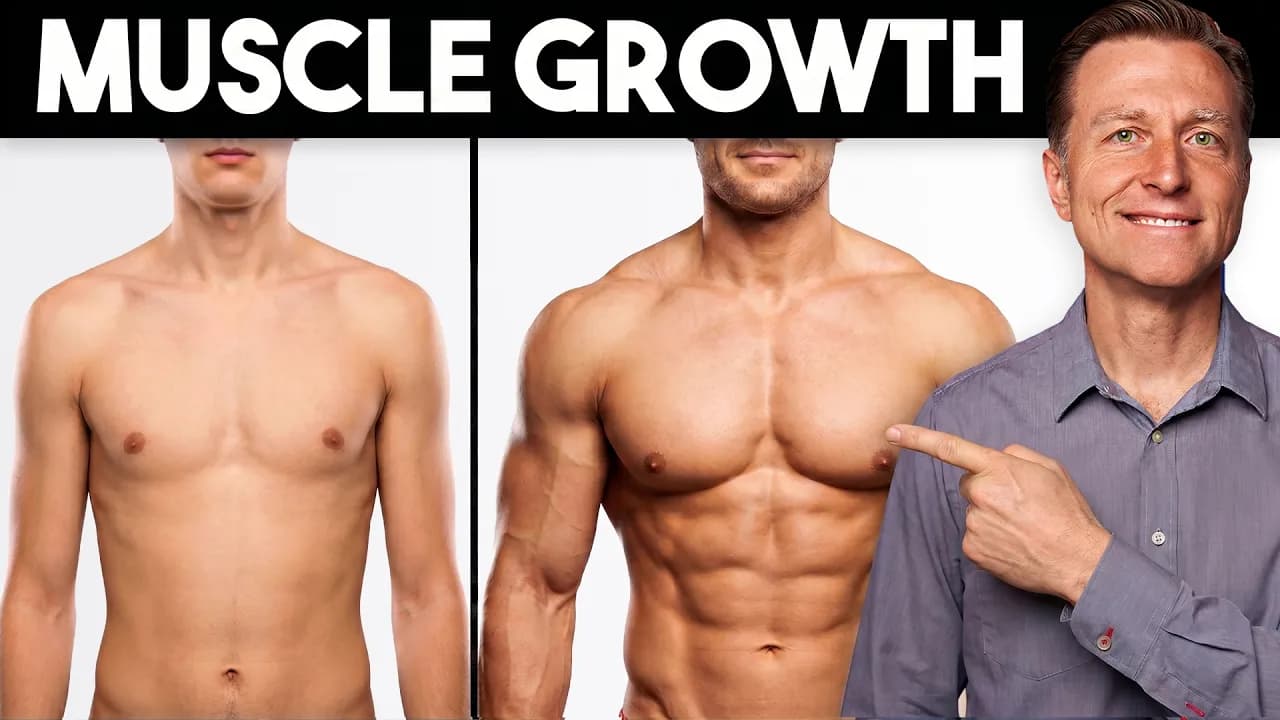
We Were Wrong About Carbs for Muscle Growth!? (new study)
In a Nutshell
A new meta-analysis of 11 studies found no significant muscle growth difference between high-carb versus high-fat diets when calories and protein are matched. Fundamentals for gains remain 4-6 protein-rich meals daily with a caloric surplus, while fat needs are modest (~0.25-0.33 g/lb body weight) and the rest can be carbs or fats. Individuals should experiment over months with varying carb/fat ratios while tracking performance and recovery to find their personal optimum, rather than following the traditional "max carbs, minimize fats" bodybuilding approach.
These notes were generated by AI and may contain inaccuracies.
The long-standing claim that you want as many carbs as possible has been challenged by a new meta-analysis. The analysis compared carbohydrate and fat intakes of various levels and found no statistically significant effect on muscle growth of eating more carbs or more fats. This represents a huge win for mixed diets. The question remains how to determine if you personally benefit from more carbs, more fats, or something in between.
Four to six meals per day of high-quality protein form the core of pretty much each meal. Sufficient overall calories above maintenance are required to gain at your best rate and actually put on body weight. These two fundamentals represent non-negotiable ingredients for muscle growth. All people have made their best gains on this combination of four to six meals with protein at the core and enough calories to gain weight.
Protein intake of about a gram per pound of body weight per day serves as a really good middle number. Fat as an essential nutrient requires something like a quarter grams of fat per pound per day as a good idea. For someone weighing 200 pounds, this means about 200 grams of protein and at least 50 grams of fat. Typically, the target would be more like 75 grams of fat, representing a fourth to a third of body weight in fats.
The vast majority of the bodybuilding community and serious fitness community recommends 200 grams of protein for someone weighing 200 pounds, with maybe 75 grams of fat. The rest should be carbs, filling the remaining calories. The approach keeps fat on the low end and fills the rest with carbs. This has been the claim for a long time.
Carbohydrates have several advantages that fats seemingly don't. Carbs help secrete insulin, which is very anti-catabolic and reduces overall muscle breakdown while being mildly anabolic and slightly increasing muscle building. This combination means the presence of insulin leads to gaining a substantial amount of muscle over the long term.
Carbs provide a lot of workout energy, allowing harder training and more muscle gain. Carbs can also give big pumps, which psychologically makes training more enjoyable and maintains consistency. Cell swelling has an effect on hypertrophy, though this may relate more to tension and damage than carbs specifically.
If glycogen drops substantially below a third of typical storage levels, muscle growth machinery checks glycogen before turning on after a lifting session and doesn't activate nearly as much. If fully loaded with glycogen or not below a third of typical levels, muscle growth occurs maximally from every training session. If glycogen drops really low, the molecular machinery designed to make gains happen does less than usual.
A new meta-analysis from Menno Henselmans and colleagues included 11 randomized controlled trials. The studies compared carbohydrate and fat intakes of various levels while keeping calories and protein the same. This is critical because protein has the biggest effect on muscle growth outcomes, and without keeping protein levels equal, valid comparisons cannot be made.
Resistance training interventions lasted at least 6 weeks, with group differences in carbohydrate intake ranging from pretty high carb to pretty decently low carb. Muscle size was measured directly as the outcome, not inferred from growth pathways. Studies checked for supplement differences, ensuring comparisons were only between carbs versus fats within the same calorie and protein constraints.
The average sample size per study was about 20 people, robust enough to detect some effects. The average intervention duration was about 8 and 1/2 weeks, allowing detection of big effects though subtle effects might remain undetectable. This meta-analysis design can definitively rule in or rule out claims that eating more fats or more carbs is more beneficial.
There was no statistically significant effect on muscle growth of eating more carbs or more fats. A slight directional effect benefited more carbs, but the effect was teeny tiny and could represent total error or random chance. In practical terms, there's no convincing evidence that raising carbohydrates and dropping fats from 50/50 will cause more muscle growth.
The paper argues that for most resistance training, glycogen doesn't get depleted much below 40%. Since anti-anabolic effects kick in below a third or even less of glycogen, this threshold is almost never reached. Eating enough carbohydrates to replenish glycogen to normal levels means a lot of fats and a lot of carbs can still work totally fine.
The meta-analysis doesn't show that low carbs are ideal. It doesn't demonstrate that there might not be fine-grained differences in growth for pros or people on growth hormone who have compelling reasons to eat more carbohydrate and less fat. It doesn't refute that every pro bodybuilder eating lots of carbs and very low fats could still be doing the right thing.
The study doesn't show that in a caloric deficit, more carbs might not be best because glycogen gets depleted already in deficits. If more carbohydrates are eaten during a deficit, staying above the line below which more muscle is lost becomes possible. The study doesn't rule this out because everyone in the studies was roughly at maintenance.
Whatever effect exists of more carbs versus fewer fats on muscle growth, the magnitude has to be pretty small. If carbs do have an advantage, it's not going to be a huge advantage, though it could be a small one. Small advantages over time can make big differences, but won't make differences in terms of months.
Most studies were conducted on trained lifters, not just untrained individuals. Roughly an even amount of carbs and fats checks all the boxes for basic muscle growth. Whether eating a little fewer carbs or a little more carbs, great muscle gain occurs either way.
For someone eating 3,500 calories with 1,000 calories from protein, 2,500 calories remain to split between carbs and fats. Whether doing 1,200 calories of each carbs or fats, or 600 calories in fats and 1,900 in carbs, all options and everything between are likely to produce similar amounts of muscle growth in the medium term of months.
Mixed diets with carbs and fats in very good proportion to each other make traveling and restaurant eating much easier. Getting enough protein without worrying about the carb-fat ratio allows living life while still checking all boxes for muscle growth. There's no need to request removal of all fats and only carbs at restaurants.
Some people enjoy and feel better on higher-fat diets with less brown rice and more avocado. According to the study, this can be a workable approach for gaining substantial muscle without problem.
To determine personal optimal carb-fat ratios, cap calories to whatever slow gain rate is sustainable. Eat the required amount of protein, then start at 50 grams of carbs with the rest as fats. Do a month of this to experience low-carbing. Add 50 grams of carbs a month later while subtracting 20 grams of fat to maintain calories. Continue this progression: 100 grams carbs, 150 grams, 200 grams, 250 grams, 300 grams until reaching approximately 60 grams of fat minimum.
Each progression phase should last about a month to obtain good data without fluctuations muddying results. Track strength progression, pumps, soreness and healing time, workout energy, sleep quality, sex drive as a proxy for androgenic hormones, and overall fatigue indicators including how many weeks of progression occur before needing to deload.
If honestly no difference exists between 150 grams, 200 grams, and 250 grams of carbs, all options represent the right answer. This means flexibility exists - on some days more carbs and fewer fats can be eaten, on other days higher fats and lower carbs work fine as long as staying within the personal range of optimality.
When adjusting fats, healthy fat sources should be used rather than bad fats or junk food. Healthy fats include nuts, nut butters, olive oil, and canola oil. The majority of fats should come from these healthy sources rather than saturated fat or processed foods.
For pro bodybuilders using growth hormone and insulin, experimentation with carb-fat ratios is still recommended. Starting from 50 grams of carbs isn't necessary. If currently eating 75 grams of fat and 400 grams of carbs, try taking fats down to 50 grams while increasing carbs, or increasing fats to 100 grams per day while reducing carbs somewhat. Some people discover higher fats work better for them, while others find 50 to 75 grams of fat optimal.
Keep Renaissance Periodization in your library
Save the videos and channels worth coming back to, and find them again in one place.