What Did Ancient Humans Do all Day Before Jobs Existed?
In a Nutshell
For 99% of human history, hunter-gatherers worked only 15-20 hours per week on survival tasks, spending the rest on social bonding, storytelling, art, music, and leisure. Archaeological evidence shows they were healthier, better nourished, and created sophisticated art, jewelry, and instruments long before agriculture. The shift to farming ~10,000 years ago trapped humans into harder labor, poorer health, and eventually the modern system of jobs and long work hours.
These notes were generated by AI and may contain inaccuracies.
For 99% of human history spanning roughly 300,000 years, people woke up without alarms, schedules, or obligations. The question "What should I do today?" was not hypothetical but the reality of every morning. Modern humans spend approximately 90,000 hours of their lives working, which represents roughly one-third of waking existence dedicated to employment. For the overwhelming majority of human history, there was no employment, no wages, no boss, and no career ladder.
In 1963, archaeologist Richard Lee conducted a landmark study tracking daily activities of the !Kung San people in Botswana, one of the few remaining groups living in a manner resembling pre-agricultural human life. Adults spent approximately 2.5 days per week acquiring food, totaling roughly 17 hours. The remaining time was spent doing whatever they wanted. This pattern appears consistently across anthropological studies of hunter-gatherer societies including the Hadza in Tanzania, the Ache in Paraguay, and the Martu in Australia. These groups, living in completely different environments on different continents, all show the same result: approximately 15 to 20 hours per week spent on survival activities. Modern workers typically work twice that amount.
Skeletons of ancient hunter-gatherers differ dramatically from those of early agricultural populations. Farmers were shorter with bones showing signs of nutritional deficiency. Their teeth were riddled with cavities from grain-heavy diets. They exhibited arthritis in their spines from repetitive labor and died younger. Ancient human skeletons were taller, stronger, had healthier teeth, and showed less joint damage. The bones indicate ancient humans engaged in less repetitive physical labor than early farmers.
Archaeological discoveries reveal activities that would not exist if survival was a constant struggle. In 1994, explorers discovered Chauvet Cave in southern France containing paintings created roughly 30,000 years ago. Horses, lions, and rhinoceroses were rendered with perspective, shading, and movement. These sophisticated artworks required skill, planning, and time spent deep inside caves by firelight painting for beauty and meaning rather than survival. In Blombos Cave in South Africa, archaeologists found 100,000-year-old perforated shell beads with tiny holes drilled through sea shells for jewelry. The nearest coastline was 20 km away, requiring someone to walk 40 km round trip to collect shells, then spend hours drilling holes with stone tools. In 2008, researchers discovered a 40,000-year-old flute carved from a vulture bone in Germany featuring five perfectly spaced finger holes, demonstrating understanding of music and pitch. The maker spent significant time crafting an instrument not for hunting or defense, but for music. Across Europe, Africa, and Asia, archaeological sites from 100,000 years ago onward contain decorative objects, elaborately crafted tools exceeding survival requirements, and items requiring hours of focused work with no immediate practical benefit.
A typical day began around dawn with the previous night's fire still smoldering. Someone would add wood. Breakfast consisted of leftover meat or fish from the previous day along with nuts or berries collected earlier. Breakfast was a social time for talking and loosely planning the day. Around mid-morning, a small group might leave to hunt or gather, but not every day. If a hunt was successful two days prior and food was stored, people might remain in camp working on tools such as sharpening spears, weaving baskets, or scraping animal hides. This activity was not work in the modern sense with clocks or supervisors. People engaged in these tasks because competence earned respect and making things well was valued.
When hunting occurred, it was not the frantic chase depicted in movies. Humans are persistence hunters who track animals at a steady jog for hours until the animals overheat and collapse. Humans are the only species that can do this effectively because they can sweat and regulate body temperature while running. Most animals cannot do this, allowing humans to outlast them. A hunt might take 3 to 6 hours including travel. After the animal was carried back and butchered, everyone ate. By early afternoon, the productive part of the day was essentially over.
What followed was what modern people find hardest to understand: nothing and everything. People rested, sat in the shade talking, played with children, and groomed each other to reinforce bonds. They made jewelry from shells, beads, or animal teeth. They carved designs into bones or stones. They napped. Anthropologist James Suzman documented that among the !Kung San, adults spend roughly 6 hours per day in what he called social time, not working or sleeping, but being with other people, talking, laughing, and telling jokes. In a world without money, police, or written contracts, survival depended entirely on relationships. If people did not like you, they would not share food when you were hungry. Enormous amounts of time were invested in bonds not because it was productive, but because it was how humans stayed human.
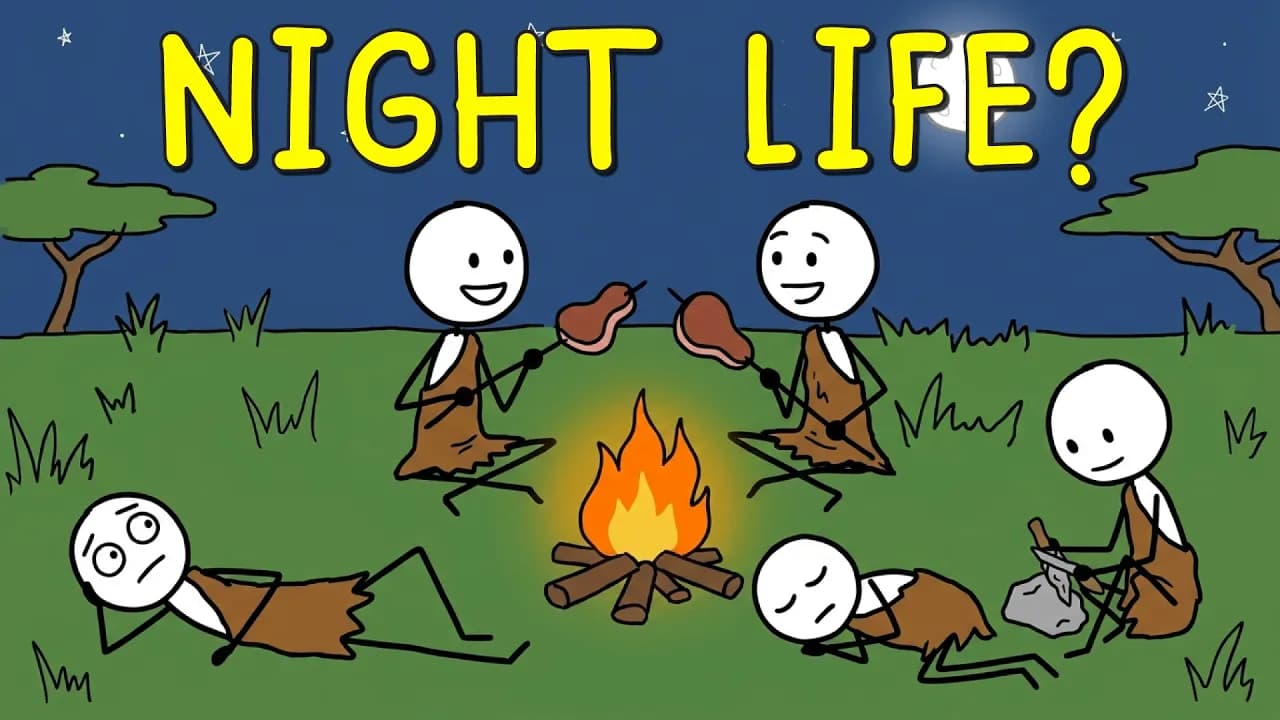
When the sun set, conversations shifted dramatically. In 2014, anthropologist Polly Wiessner analyzed hundreds of hours of conversation recordings from the !Kung San. During daytime, conversations were practical, covering animal tracks, plants ready for harvest, and complaints about sharing. At night around the fire, 81% of conversations shifted to stories including myths about how the world began, tales of ancestors who did impossible things, jokes, and adventures from far away. Wiessner argued that human culture was born in these nighttime gatherings where gods, spirits, the past, and the future could be contemplated when stomachs were full and people felt safe.
Before artificial light, humans did not sleep in one continuous block. Historical records from medieval Europe and sleep studies from the 1990s confirm that people slept in two phases: first sleep for about 4 hours, followed by a wakeful period of 1 to 2 hours in complete darkness, then second sleep for another 4 hours. They used the middle hours for reflection.
A full day consisted of approximately 4 to 6 hours securing food or making tools, about 6 hours in social interaction, storytelling, grooming, and playing, about 8 hours sleeping in two separate phases, and the remainder resting, sitting, watching clouds, doing nothing in particular, and existing without needing to justify existence through productivity.
Approximately 10,000 years ago, humans in the Fertile Crescent began planting seeds and domesticating animals. Agriculture created a trap: once farming began, more people could be fed, requiring more food production, which meant more farming. Within a few generations, populations exploded with no possibility of returning to hunting and gathering because there were too many mouths to feed. Farming required far more labor including plowing, planting, weeding, harvesting, storing, and defending crops from animals and raiders. Skeletal evidence shows early farmers worked harder, ate worse, and died younger than the hunter-gatherers who preceded them. Population growth continued, and with larger populations came specialists including toolmakers, potters, weavers, inventors, soldiers, priests, and administrators. Eventually, the concept of jobs emerged where time belonged to someone else in exchange for resources. By the time cities were built, the original human lifestyle was gone, replaced by schedules, obligations, and the need to work most waking hours just to survive.
Today, people spend 90,000 hours working while ancestors spent significantly less. Modern sleep occurs in one block, and waking at 2:00 a.m. is called insomnia, whereas ancestors slept in two phases and used the middle hours for reflection. Modern life involves chasing an illusion of greatness, achievements, wealth, and success by standards society invented. Ancestors woke up every morning already free, already enough, and at peace with nothing to prove. They did not need to become successful because they were already living the life modern people work their entire existence to retire into. Modern people make art if they can find time after their job. Ancestors made art because they had time. Humans traded freedom for food security, leisure for population growth, and time for productivity.
Keep Axen in your library
Save the videos and channels worth coming back to, and find them again in one place.