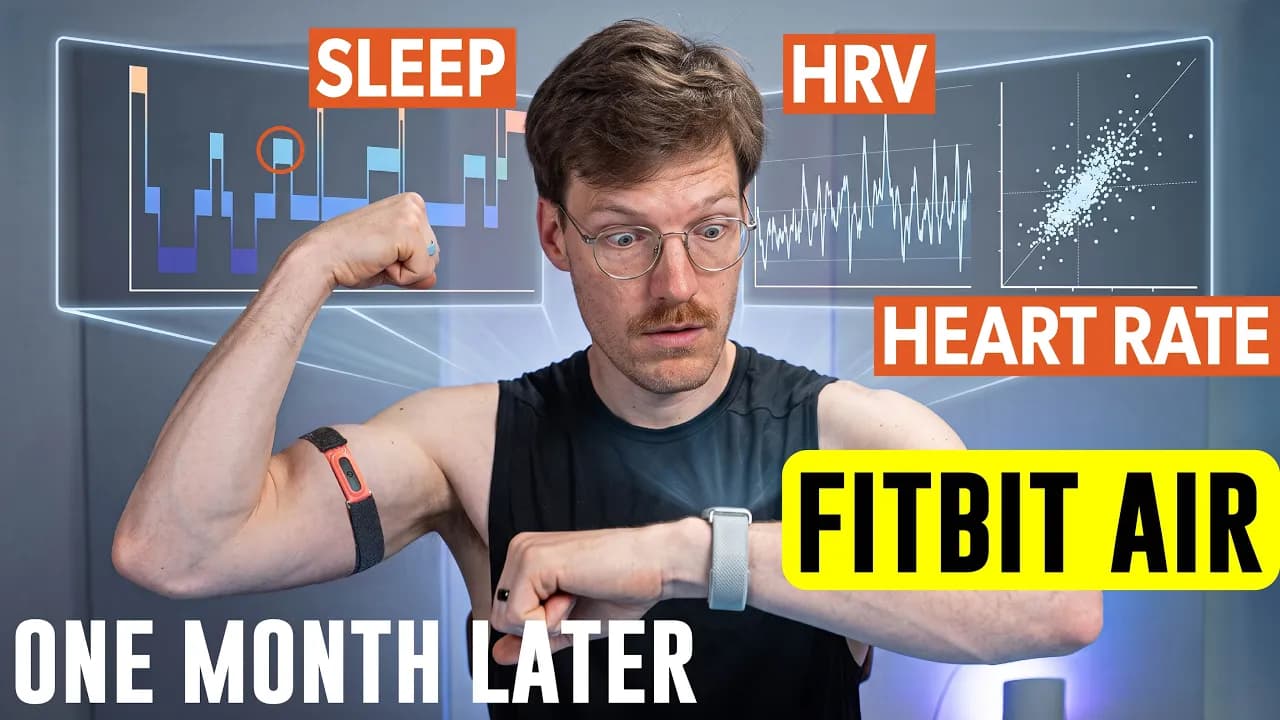
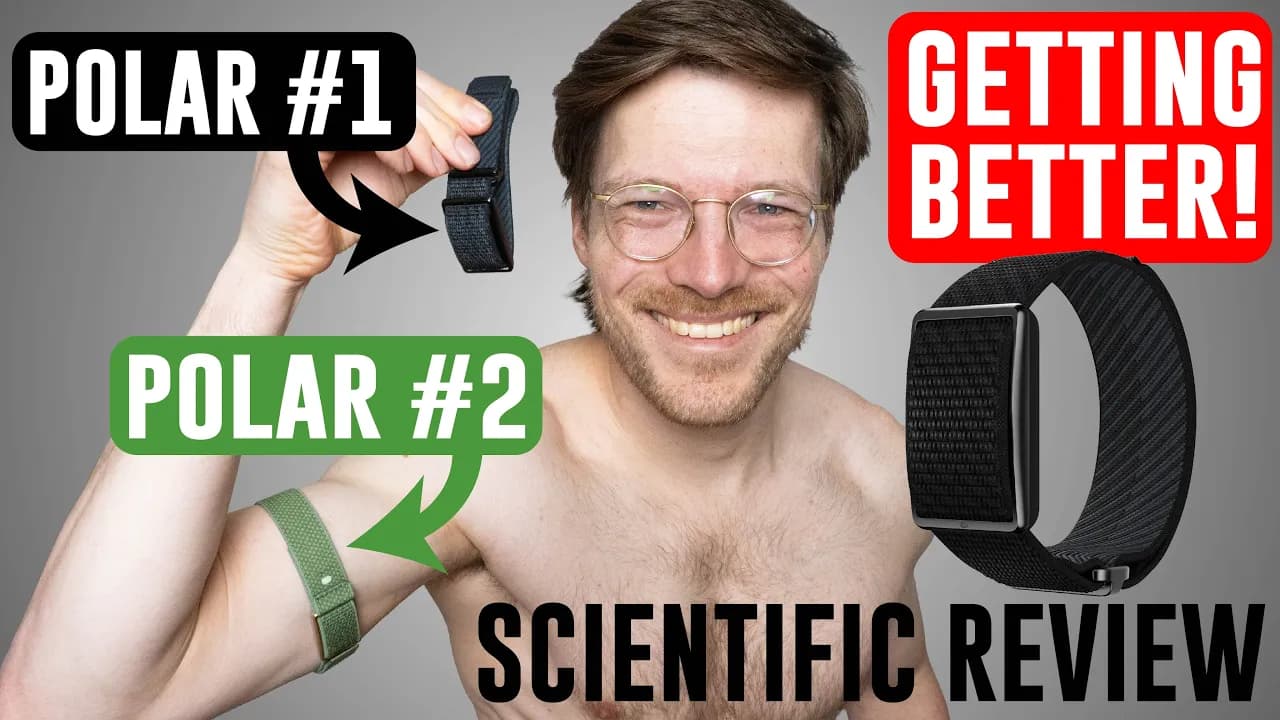
WHOOP Heart Rate UPDATE! (Scientific Review)
In a Nutshell
Whoop’s updated heart rate algorithm improves biceps-based tracking, lifting outdoor cycling correlation from 0.90 to 0.97 and overall cardio score from 96 to 99. Running, cycling, and hiking all show tighter agreement with ECG references, while weightlifting remains only modestly better and still under-recommended. The strap now competes with cheaper screenless rivals, so its value hinges on whether the subscription justifies the marginal accuracy gains.
These notes were generated by AI and may contain inaccuracies.
Whoop announced a major update to its heart rate tracking system this summer. The analysis compares the old algorithm with the new one using data going back several months to determine if heart rate tracking performance has improved, worsened, or stayed the same.
The analysis focuses on the Whoop device when worn on the biceps, which is the recommended way for any wearable device that supports that position. The user has been using Whoop for 2154 days, wearing it on the biceps for almost the entire period.
The Polar H10 ECG chest strap serves as the reference measurement, with Polar H10 data placed on the horizontal axis and Whoop belt data on the vertical axis. Perfect agreement would show all points on or near the blue line.
For stationary or indoor cycling, both algorithms performed well. The old algorithm achieved a correlation of 1.00, while the new algorithm achieved 0.99. The new algorithm had substantially more data points, while the old algorithm results were maintained from a previous review for consistency.
Example Sessions
A November 2026 biceps test (conducted August-November) showed a stationary bike training session with many intervals where the Polar H10 and Whoop Strap tracked almost identically. Some worst-case sessions showed deviation, particularly at the beginning when skin temperature was cooler in November, making initial blood flow measurements more difficult.
Affiliate links are provided for Whoop Strap, Fitbit Air, Amazfit Helio Strap, and Polar Loop on Amazon. The affiliate links do not influence the analysis or opinion presented.
For outdoor running, the new algorithm shows points closer to the blue line on average, with a correlation coefficient of 0.99. The old algorithm had some point groups far from the line. Example sessions generally showed reliable tracking with minor deviations.
The new algorithm shows a very slight improvement, though running performance was already good. Deviations were larger with the old algorithm.
Outdoor cycling shows the biggest difference between algorithms. The old algorithm had a correlation of 0.90, while the new algorithm achieved 0.97 on the biceps muscle. Almost all points fall on or close to the blue line, with only occasional low heart rate detection deviations.
Random cycling sessions look good overall with minor deviations. Some worst sessions showed one peak not fully discovered. These sessions occurred when weather got colder.
The biceps placement makes measurements easier, and the Whoop strap design allows for this easily. Devices with screens cannot be worn on the biceps due to movement difficulties during exercise.
Weightlifting shows minor improvement from 0.95 to 0.96 correlation. Both algorithms tend to detect lower rates in the higher heart rate range. The new algorithm has slightly smaller deviations, but the Whoop strap is not recommended for accurate heart rate tracking during weight lifting. Not all peaks are fully discovered.
A hiking trip showed a correlation of 0.99 with almost all points very close to the blue line. Most heart rate changes were detected with only slight deviation.
For cardio exercises only, the heart rate rating is calculated by averaging heart rate correlation and multiplying by 100. The old test from May 2026 received a rating of 96, while the new result is 99. Both receive a "great" rating, but the new algorithm is close to perfect.
The biggest improvement came from cycling results, which improved from just under 0.9 to 0.97 or higher. Running improved slightly, and spinning remained almost the same.
Whoop is no longer the easy recommendation it was two years ago due to increased competition in screenless wearable devices, including Polar Loop, Amazfit Helio, Fitbit Air, and Garmin Circa.
Whoop targets athletes and offers the "Healthy Age" feature as one of its most useful features, but requires an expensive subscription model rather than a one-time purchase.
The Fitbit Air offers better price-to-quality ratio at around $120 total (including biceps strap) compared to Whoop's subscription model. The Google Health app has some limitations but is fairly good and expected to improve.
The Amazfit Helio belt is very reliable for heart rate tracking. The Polar Loop is not recommended due to data reliability concerns, though it keeps data within the European Union. The Garmin Sorca connects well to the Garmin ecosystem and has a useful button.
If interested in Whoop and seeking measurement confirmation, the app is well-designed and useful, with reliable data when worn on the biceps. However, it is one of the most expensive options due to the subscription model.
For exercise, wear on the biceps is recommended. For sleep stage tracking, wrist placement is acceptable.
The data shows improvement, primarily for more difficult exercises like cycling, with some improvement in running as well.
Keep The Quantified Scientist in your library
Save the videos and channels worth coming back to, and find them again in one place.