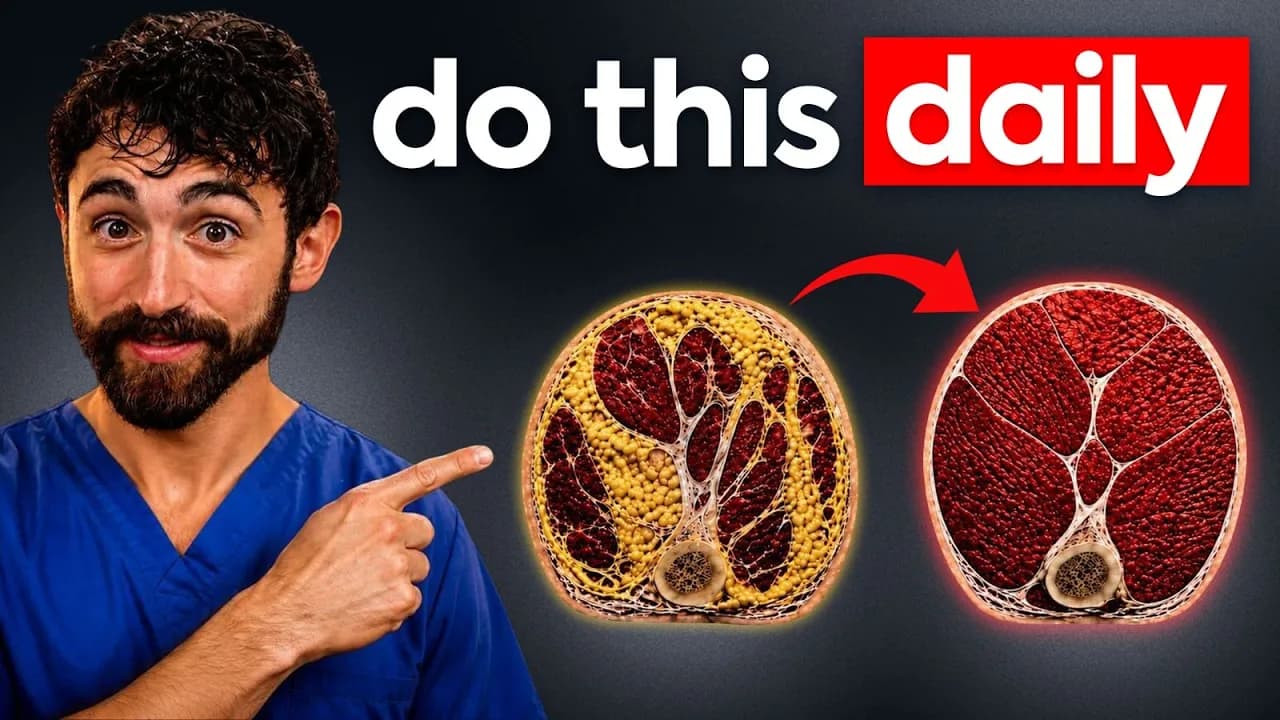
Why Aging Muscles Shrink — And How to Stop It
In a Nutshell
Aging muscles paradoxically overactivate mTOR, the growth signal, which blocks autophagy and causes junk buildup, leading to sarcopenia despite higher growth cues—suppressing mTOR (as shown in fly and mouse studies) restores muscle quality and function. Exercise spikes mTOR short-term for growth but lowers chronic overactivation long-term, rejuvenating muscles molecularly while enabling inter-organ signaling for broader health benefits like higher NAD levels. Key strategies: resistance training, ample protein, 5g daily creatine monohydrate, 0.5g sarcosine, 1.5-2g omega-3s, and 500-1000mg oleuropein to combat muscle loss.
These notes were generated by AI and may contain inaccuracies.
Muscle loss with age affects mobility, metabolic health, and independence. Advice is to build muscle, lift weights, eat protein. Paradox: in aging muscle, the build and grow signal is higher, yet muscle shrinks.
Chapter 1: Aging muscle paradox, new findings, why they make sense. Chapter 2: How exercise makes muscles young while building them. Chapter 3: Muscles are much more than mechanical. Chapter 4: High-yield strategies for muscle health with aging.
References, extra nuance in Stay Curious Metabolism newsletter.
Paper in Proceedings of the National Academy of Sciences.
mTOR is a protein complex that positively regulates growth pathways, the big red go button for growth, critical for building muscle.
In aging muscle and sarcopenia (age-related muscle wasting), mTOR activity is higher, not lower. Older adults show higher mTOR expression.
Paradox: older muscles slam the muscle growth button but waste away.
mTOR promotes growth but suppresses cellular recycling (autophagy), which clears damaged proteins and dysfunctional components.
Chronically elevated mTOR stalls cleanup, causing accumulation of molecular junk, dysfunctional proteins, increased biomarkers of cellular senescence.
mTOR is a double-edged sword: promotes growth, blocks renewal. In aging muscle, chronic mTOR overactivation leads to quality deterioration; molecular damage overpowers growth, muscles waste away.
mTOR overactivity correlates with muscle loss.
In fruit flies (Drosophila), pathways conserved to humans.
Proxy for muscle function: climbing ability declines sharply with age.
Silencing mTOR pathway by blocking upstream dEfl1 preserves muscle function into old age (6 weeks in flies).
dEfl1 presses the mTOR button.
Muscle structure: young muscles have dense organized actin filaments; old muscles show degeneration (black space). Suppressing dEfl1-mTOR makes older muscles look young.
Similar for autophagy, cellular senescence markers.
Summary: elevated dEfl1 and mTOR impair recycling, accumulate junk, drive deterioration. Suppressing lifts finger off mTOR button, improves quality, resumes renewal, slows aging.
Exercise has complex relationship with mTOR.
Short-term (post-workout): spikes mTOR for growth.
Long-term: suppresses basal dEfl1-mTOR overactivation.
Exercise signals growth and restores recycling/renewal. Growth and cleanup.
In older mice, endurance and resistance exercise reduce mTOR levels vs. sedentary controls, increase autophagy, reduce cellular senescence.
Exercise rejuvenates muscles at molecular level.
Muscles are not purely mechanical; largest endocrine organ in body.
Secretes hormones like thyroid/adrenal glands, non-hormonal messengers like small extracellular vesicles.
Vesicles carry cargo telling other organs how to express genes/make proteins.
Inter-organ communication (muscle to heart, brain, fat) affects heart attack handling, depression/mental health.
Strong associations between lean muscle mass and higher NAD levels (energy molecule linked to cognitive resilience, Alzheimer's prevention).
Muscles are nodes in signaling network regulating overall health (liver, heart, brain).
Resistance training essential.
Protein critical.
Creatine: increases muscle power, promotes hypertrophy, supports fat loss.
Mechanisms: pulls water into muscles (growth stimulus), activates satellite cells, increases long filamentous proteins for muscle fibers.
Protocol: 5g creatine monohydrate daily with food to reduce bloating/GI upset.
Momentous Creatine Monohydrate (third-party tested for heavy metals/banned substances, pure unflavored micronized). Mix into Greek yogurt or creatine ice cream (recipe below).
Discount code: stay curious for up to 35% off at livemomentous.com.
Sarcosine: unusual amino acid, levels decline with age/sarcopenia.
Pre-clinical trials: prevents age-related muscle loss.
Human equivalent dose: 0.5g/day. Research early, safe.
Omega-3s (long-chain): reduce inflammation, improve insulin sensitivity, enhance muscle protein synthesis.
Dose: 1.5-2g/day from seafood (sake/sardines) or supplement.
Oleuropein: in olives/olive leaves, activates mitochondrial calcium uniporter for calcium into mitochondria, unlocks energy production (declines with age).
Animal studies: improves muscle performance, increases mass.
Olive leaf extract, 500-1000mg/day (0.5-1g).
Muscle aging reveals body aging mechanics.
mTOR paradox, exercise rejuvenation.
Muscles are signaling powerhouses shaping thinking, aging, disease resilience.
Train, move, nourish intentionally.
Muscle foundational. Best time to build: right now.
Keep Nick Norwitz in your library
Save the videos and channels worth coming back to, and find them again in one place.