Exercise Erases 57% of Muscle Aging
In a Nutshell
Exercise prevents over half (57%) of age-related gene expression changes in muscle, particularly preserving mitochondrial energy production systems that normally decline with aging. Resistance training plus aerobic exercise at least three hours weekly maintains youthful mitochondrial function and muscle quality, not just size. Advanced compounds like SS-31, MOTS-c, and 5-amino-1MQ target the same NAD and mitochondrial pathways to potentially amplify exercise benefits and address the remaining 43% of aging changes exercise cannot reach.
These notes were generated by AI and may contain inaccuracies.
Picture two people. Both are 80 years old. One of them takes the stairs carefully one step at a time, rests at the top, spends most of their day in a chair. The other just got back from a morning run. Same age, same exact number of birthdays, but completely different bodies.
For almost all of human history, we chalked that up to luck or good genes or roll of the dice. Recently, scientists did something we've never been able to do before. They looked inside the muscles of people like this. All the way down to what genes were switching on and off. And they found a number I genuinely had to read twice. In people who stayed more active for years, more than half of the changes we always assumed were just aging weren't there. Not slowed down, not softened, just gone.
Which cracks open a huge question. If moving your body can keep your cells and mitochondria young, how much of aging is within our control? And how do we control it? The difference isn't just size. Have you ever heard of exercise non-responders? Over a thousand genes that have been quietly tuned down. The mitochondria become less efficient. He reduced his body fat from 21 to 13%. It changes the molecular code of aging inside your muscles. A huge chunk of their muscle just refused to get old.
Now, here's why this matters no matter how old you are. We tend to think of aging is like weather. It just happens to us. Somewhere in your 40s or 50s or 60s, your body just starts filing the paperwork for retirement. The best thing you can do other than complain is probably cash in on some senior discounts. That fatalistic model is like a snorkel in outer space. Both wrong and completely useless. Yes, your genes matter, but a growing body of evidence suggests that a surprisingly large fraction of biological aging, the aging that determines whether you stay strong, sharp, and independent, is modifiable, in your control. It's not fixed destiny, it's a dial you can turn. So, the real question isn't is exercise good for you? We all know that. It's how much of aging exercise can actually prevent.
So, to answer that, we need to go inside living human muscle. But first, a quick bit of background, because I want to show you what makes this paper a big deal. For decades, when scientists studied exercise and aging, they mostly measured what's easiest to see, like how big a muscle is. And then, the story was basically, exercise builds your reserve. You've heard that, right? Add up muscle and you're making a deposit into a account you're going to draw on later. It turns out that's barely the tip of the iceberg, because in this new study, just published in Nature Aging, researchers went into the muscle like never before. And what they found suggests exercise isn't just building a reserve you spend later, it's changing the ways your cells age in the first place.
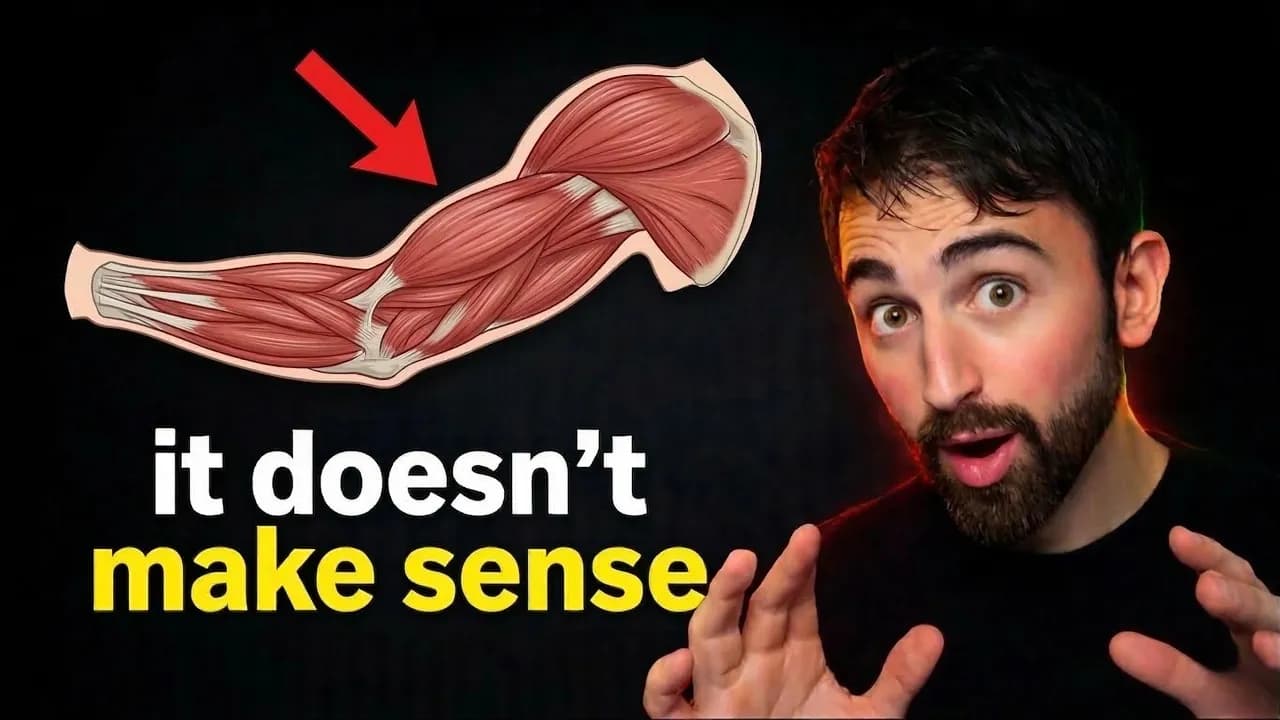
Or put another way, if we go back to those two 80-year-olds and compare their muscles, the difference isn't just size. Yes, size matters a little bit, but imagine taking a tiny cubic millimeter of muscle, diving down to the single muscle layer, and then to the level of mitochondria. What you find is that those little engines are fundamentally different in physically fit older individuals, they're operating with a much more youthful profile, a more youthful blueprint. So, it's not just bigger muscles, it's different quality muscle down to the mitochondrial level. That is a very different and much bigger claim.
Okay, now a quick road map for where we're headed in this video. In part one, we'll look at what actually breaks during aging. In part two, we'll explore the muscle that refused to age. In part three, we'll cover foundational tools for preserving youthful muscle and in part four we'll dive into the exciting frontier, advanced tools to support healthy muscle aging.
Okay, warm up over, let's begin. Part one, what actually breaks during aging? To understand what the researchers discovered, you first have to understand what actually goes wrong when muscles get old and it comes down to energy. When the researchers compared normally active older adults to younger adults, they found over a thousand genes that have been quietly tuned down and the single loudest signal was in energy metabolism. Specifically genes that build the machinery inside your mitochondria, the parts that actually generate power for your body, they were getting turned down as people got older. So, you know that thing that people always say, my metabolism slowed down when I got older. At the level of your genes, that actually appears to be literally true on average.
Let's get a bit more specific about what changed and I'm really going to try to resist the urge to give you jargon and hopefully give you an analogy that makes sense. So, there are two components I want to talk about, the energy delivery system and the energy generation system. Think of the body's energy delivery system like a fleet of trucks. The trucks are a molecule called NAD that carry high energy electrons. Every time you eat, those NAD trucks pick up energy from your food and drive it to your mitochondria. Here we're technically talking about processes like glycolysis and beta oxidation, but you see how I dispensed with those terms. The mitochondria are the power plants where your cells turn that delivered energy into ATP, the usable energy that your cells use to do virtually everything in your body.
And as you age, two things happen. First, you get fewer trucks on the road, maybe some of their tires pop, NAD levels fall, particularly in muscle and the brain. The second thing that happens is that the power plants themselves, the mitochondria, become less efficient. What's really happening here is that NAD levels are declining while genes critically involved in mitochondrial function, particularly components of the electron transport chain like complexes 1 and 4, are being turned down. So again, fewer trucks, less NAD, delivering energy to your mitochondria, and less efficient power plants, mitochondria, converting that energy into usable fuel. That's a big part of what's happening during cellular aging.
The good news is it doesn't. We're just getting started. So, part two, the muscle that refused to age. So, here's what the researchers actually did, and it's clever. They recruited 47 people. They had younger adults and older adults with three types of older adults, those who were highly trained, routine exercisers. They also had older adults who were just normally active, and they had older adults with significant physical impairment. So, older adults at three activity levels.
Then, instead of just doing a blood test, they took samples from inside the muscle itself and ran the kind of analysis that would have been science fiction not long ago. They assessed more than 24,000 gene readouts, 135 metabolites circulating in the body, 1,383 different fats. Basically, they had the most detailed molecular photograph of human aging and fitness at the muscular level that we've ever seen.
And here's the finding that stopped me. When they compared highly trained older adults to normally active older adults and impaired adults, more than half of the gene expression changes that normally come with aging simply weren't there. When you break down the numbers, it lands around 57% of those age-related changes were gone. Poof. Now, let me show you what that looks like with the data themselves, because there's one figure that tells the story. It's a little bit complicated. I'm going to walk you through it. Okay, you see four bars per panel, left to right. Young adults, then highly trained active older adults, then normally active older adults, then physically impaired adults. Here's the trick to reading it. Every time that second bar, the highly trained older adults, looks like the young people instead of the other older people, that's a piece of aging that basically never happened. And the pie charts on the right add it all up. And you can see more than half of it, more than half of that aging pie is gone, absent. Sit with what that means for a second. The calendar kept moving for these people. They still had birthdays, but at the level of their genes, a huge chunk of their muscle just refused to get old.
Now, I did promise you rigor, so we need to talk about one catch. Well, it's obvious, you can do the math. Exercise didn't preserve everything. The researchers then split the changes into two buckets. Obviously, the preventable changes, those that stayed at a youthful level in trained older adults, and the unavoidable changes, changes that showed up even in older adults who were highly trained. And here's the interesting part, although maybe it's intuitive. The stuff that exercise protected wasn't random. It was concentrated exactly in the energy machinery we talked about, the mitochondria. This is at the subcellular level the use it or lose it phenomenon. Mitochondria, cellular respiration, the power plants that deliver. In other words, one of exercise's biggest gifts isn't just building up bigger muscles, it's keeping the engine inside those muscles running efficiently decade after decade after decade.
So, that is the headline finding. Not simply that exercise builds up a reserve of muscle, but that it changes the molecular code of aging inside your muscles. And, as we've discussed elsewhere, those changes don't stay confined to muscles. The truth is muscles aren't just for lifting, they're endocrine organs. They secrete hormones. Muscles are signaling hubs that directly communicate with your heart, your brain, the rest of your body. That's one of the reasons exercise doesn't just make you stronger, it keeps your brain healthier. It lowers chronic disease risk, and it can literally help you stave off dementia. Basically, what I'm saying is squats aren't just for synapses. Man, I should really get that on a bumper sticker.
Now, let's turn from understanding the science to applying it. We'll start with free foundational tools that serve as the bedrock for this longevity strategy. Then, we'll pivot to more advanced tools, the exciting frontier of metabolic and longevity science. So, let's get to part three, foundational tools.
Now, I'll admit these foundational tools aren't exactly groundbreaking. But, before we get to the fancy stuff, we do have to build this foundation. So, first and foremost, no surprise, it's basically the topic of this video, exercise. More specifically, a combination of resistance training and aerobic exercise. Together, they preserve functionality, mitochondrial health, insulin sensitivity, and cardiovascular fitness. There's also a direct tie-in to the NAD delivery trucks that we already talked about in our story. Other research independently shows that lean muscle mass and VO2 max, a measure of aerobic fitness, are independently associated with higher levels of the enzyme that produce the NAD delivery trucks we talked about. So, once again, we're not just talking about building bigger muscles, it's also about preserving the body's energy systems at the microscopic level.
But, let's get practical. Aim for at least two resistance training sessions per week, hitting all major muscle groups. That could be two or three full body workouts, an upper lower split, whatever you prefer. And layer on regular aerobic training, like running, swimming, cycling, even brisk walking, or circuit style resistance training programs. Personally, I love doing these. 50 push-ups, 15 chin-ups, alternating jumping lunges, then a minute's rest, and repeat. I like it because it is a cardiovascular workout and resistance training workout in one. I just find it stimulating. Just find something you genuinely enjoy, because consistency beats perfection every time.
Oh, and I hope you don't think I'd forget to define what trained older adults were in this study. This was a test to see if you would stick around for that information. In this study, trained older adults were those that engaged in structured exercise practices for at least three sessions per week for at least 1 hour per session. So, 3 hours per week. It's not too bad. I think you can do that.
Finally, don't overlook what I call baby movements. A standing desk, walking breaks, or simple exercise snacks throughout the day keep your muscles active, improve blood flow, and help shuttle glucose from your bloodstream into your muscles. If you can build a habit of making some of those baby movements, mobility challenges throughout the day, all the better. Like, it's easy to sit down and put on a sock, but can you do it while standing on one foot and in a squat? I actually call these Rube Goldberg movements, after the famously over-engineered Rube Goldberg machines that accomplish simple tasks in absurdly complicated ways. But, when it comes to mobility this can be a fun inclusion in your day. The idea is to sneak little bits of functional movement into everyday life. If you can build a habit of doing this, they become a fun way to weave in mobility, balance, and muscle activation throughout your day. That's what I mean by baby movements.
So, if I had to summarize, lift a couple of times per week, including aerobic work, and keep your body moving and challenged throughout the day in dynamic ways with baby movements and Rube Goldberg movements. But, let's get on to foundational tool number two. This is nutrition. Now, I'm not going to get on my soapbox about the perfect diet because I don't think one exists, but I think I need to make one thing crystal clear. If you're eating a highly processed diet, you're undermining the entire longevity process. But, I can get more specific. Have you ever heard of exercise non-responders? It is a real phenomenon. Some people, in response to exercise, particularly aerobic training, show surprisingly little improvements, little gains in fitness compared to other people following the exact same program. Why? Well, the answer is a little bit complicated, but one factor that contributes is blood sugar, blood sugar regulation. Chronically elevated blood sugar changes the biology and changes muscle tissue. It actually modifies proteins in the extracellular matrix, kind of like the rebar around your cells, through processes like glycation, inflammation, and it can impair the growth of new blood vessels needed to deliver oxygen and nutrients to adapting muscles. I've actually written a whole letter on this here. But, simply put, bad blood sugar makes your muscles less able to remodel themselves in response to exercise.
All right, foundational tool number three is sleep. And admittedly, this is my personal Achilles heel. But, here's the key idea. Sleep isn't just passive. During sleep, the glymphatic system is becoming dramatically more active, helping clear metabolic waste products out of your brain that accumulate while you're awake. It's like sending street sweepers onto empty roads after the traffic dies down. If you're regularly awake, groggy, and unrested, depending on caffeine just to function, that's a signal worth paying attention to. And after you finish this video, I'd highly recommend checking out our masterclass on sleep. It's filled with practical things that I researched to help myself because good sleep isn't just about feeling better tomorrow. It's one of the foundational pillars of healthy aging.
But now, the moment you've been waiting for, the advanced tools. Okay, now that I filled my obligation and talked to you about lifestyle fundamentals, let's get to the exciting frontier. So, if exercise preserves youth by protecting mitochondria NAD, the body's energy system, the obvious question becomes, can we target those same pathways directly? And increasingly, the answer appears to be tyrosine glutamate serine. That's the amino acid code for a yes, y e s, tyrosine glutamate serine. Anyway, in what's to come, we're going to cover two mitochondria targeting peptides, a small molecule that does some pretty remarkable things to the NAD system despite having a truly terrible name. And we'll talk about several muscle-building therapies at the frontier of longevity science. To respect your time, I'm going to move through these rather quickly. But don't worry, if you want more, every subsection has a totally independent, highly referenced deep dive. 3,000-plus words per subsection. The links for those will be down below in case you want a lot more detail. I really like to think about this Stay Curious Metabolism ecosystem like a set of Russian nesting dolls, letting you go as deep as you want.
But let's begin. SS-31, the glue for your mitochondria. So, inside each mitochondrion, that's the singular, energy machinery sits on the inner membrane that's folded up like an accordion. And these folds keep everything organized and efficient. And they're held together by a special fat called cardiolipin that acts kind of like glue. But with aging and disease, that cardiolipin glue fails. Like, imagine trying to build furniture with weak glue. The construction will ultimately come loose. But there's an FDA-approved peptide called SS-31 that binds to the glue and powers it up. Like turning a glue stick into super glue, and it helps holds these mitochondrial folds together. It was approved for a rare mitochondrial disease called Barth syndrome, where in randomized controlled trials it does improve physical function. And in animals, it dramatically reduces scarring after heart injury. And people are now using it recreationally. The most common thing people over 40 report after using SS-31 is feeling like they have more energy, recovering better after workouts, feeling less fatigued, and being able to sustain activity for longer. In other words, they often feel like their mitochondria are working the way they used to when they were young.
But that brings us to a common partner with SS-31, something called, this is peptide number two, MOTS-c. MOTS-c is an exercise memo. Because here's a fact, your mitochondria have their own tiny little genomes from billions of years ago when prehistoric mitochondria fused with what would become our cells. And that little genome makes its own hormones, one of which is called MOTS-c. MOTS-c stands for metabolic optimization and training signal C. You made that up. It actually stands for mitochondrial open reading frame of the 12S rRNA type C. Okay, yes, I made that up. But my name is more descriptive than what the actual name is, which sounds like a bunch of gobbledygook. Anyway, here's the deal. During exercise, MOTS-c in your muscles spikes about 12-fold. And that's basically a chemical memo from your mitochondria being sent out to your muscles in the body to say, "Adapt." So, researchers asked the natural question, I'm sure you're asking, "What if you just give MOTS-c as a little injection?" Now, check this out. In one experiment, I'll be careful here, mice ran on a treadmill to exhaustion. In the control group of mice, about 16.6% of mice, less than one in five, could achieve the hardest workload, could max out the test. But after giving mice MOTS-c, every single mouse maxed out the test, 100%. Right now, this is the closest thing we have to a true exercise mimetic, a drug that imitates workouts. But of course, you and I aren't trying to cheat and replicate exercise, we're trying to amplify the work you're already putting in. As with SS-31 though, much of what we know about these peptides in otherwise healthy people comes from anecdotes. People in the background, bodybuilders and biohackers, experimenting. So, take what follows with a grain of salt. That said, I've seen some remarkably encouraging real-world stories, experiences when these compounds were combined with disciplined exercise programs and appropriate clinical guidance. One of the most striking examples I can think of is a 63-year-old gentleman who over the course of 3 months combined regular training with SS-31 and MOTS-c, and recovery-focused peptide stack sometimes called the Wolverine stack. More on that in this letter. Anyway, during that 3-month period, he reduced his body fat from 21 to 13% and get this, improved his mile running time from 9 minutes 45 seconds to 6 minutes and 55 seconds at the age of 63. Obviously, that's an anecdote and probably an outlier, but it's the exact kind of observation that makes me so excited to see randomized controlled rigorous human studies in this area conducted in the future.
But let's get on to the next compound. It's called 5-amino-1MQ. Plugs a leak in your fuel system. Okay, remember those delivery trucks, NAD? Well, as you age, an enzyme called NNMT quietly siphons off NAD. Like a group of hooligans slashing tires on a fleet of NAD trucks. Hooligans, really? Bro, your vocabulary needs some anti-aging. But now, there's a small molecule being studied, one of the few in the space that's being looked at as an oral, so you can just take it by mouth, not an injectable, that blocks this N N M T enzyme and helps restore healthy NAD levels. In animals, it boosts strength by roughly 40% even more than exercise in animals, but it stacks on with exercise to then improve strength 60%. It helps with fat loss. It protects against weight gain on a junk food diet. Basically, it's restoring the metabolism of youth. And honestly, I get asked all the time what my favorite peptide is. And while I can't choose 5-amino-1MQ because it's technically not a peptide, this is one to watch. And honestly, if you want to try it yourself, details on what I choose to experiment with and how to access it with a discount code Stay Curious are below. It's already becoming a favorite of our Stay Curious Metabolism community as people toy around with it.
But anyway, let's get on to compound four, those that turn up your own growth and repair pathways. There's a family of peptides you should know about that basically gently nudge your body's own growth hormone system towards a more youthful state. The growth hormone system overall supports not only muscle growth, but also tissue repair, visceral fat reduction, and deep sleep. Now, I'm not going to walk through the full alphabet soup of molecules like CJC-1295, ipamorelin, sermorelin, tesamorelin, MK-677, and so on. I will link down to a comprehensive deep dive below if you want all the details, but I do want to emphasize this is one area in metabolism longevity science where we're not just seeing anecdotes and really cool biology, but we actually do have some solid data including randomized controlled trial human data. For example, tesamorelin is one peptide that acts on this pathway that is FDA approved for reducing visceral fat in certain populations. It has been consistently shown to do exactly that. This is important because visceral fat isn't just stored energy. It's metabolically active tissue that secretes inflammatory molecules linked to insulin resistance, cardiovascular disease, cognitive decline, and yeah, it harms your muscles, too.
Now, what excites me most about these class of compounds, though, is their potential to influence multiple pillars of aging, healthy aging simultaneously. When used again, appropriately under good clinical supervision. Because think about this, if you can nudge your growth hormone pathway to act more youthfully, you're going to get bigger muscles. You're going to slash visceral fat. If you time it properly, you can take these peptides before bed. They can even support deeper sleep to help your brain perform its nightly maintenance. Remember the glymphatic system I talked about earlier? They can promote the development and preservation of healthy muscle function and may even rejuvenate one of the most overlooked organs in longevity biology, the thymus, which is a training ground for your immune system. And fun fact, adults with healthier thymuses tend to live longer and have less cancer and less cardiovascular disease. Now, admittedly, each of those systems deserves its own deep dive. Unfortunately, they all have one, linked below. But, the broader point is this. We're beginning to assemble a toolkit that doesn't simply treat disease. It aims to preserve and perhaps restore the biological capacity we associate with youth.
So, here's the pattern and the genuinely exciting part. We're starting to find molecular switches that not only amplify what exercise does for free, and you should do exercise, but amplify further and touch the corners of our biology that exercise just can't quite touch, the other 43%. So, let's go back to where we started, those two different 80-year-olds. One frail and fading, the other one still running, still exploring, still keeping up with the grandkids. For a long time, we assumed the difference between them was mostly luck. But, that's not really what
Biology reveals that the difference between two possible futures appears to be far more in your control than almost anybody realizes.
Keep Nick Norwitz in your library
Save the videos and channels worth coming back to, and find them again in one place.