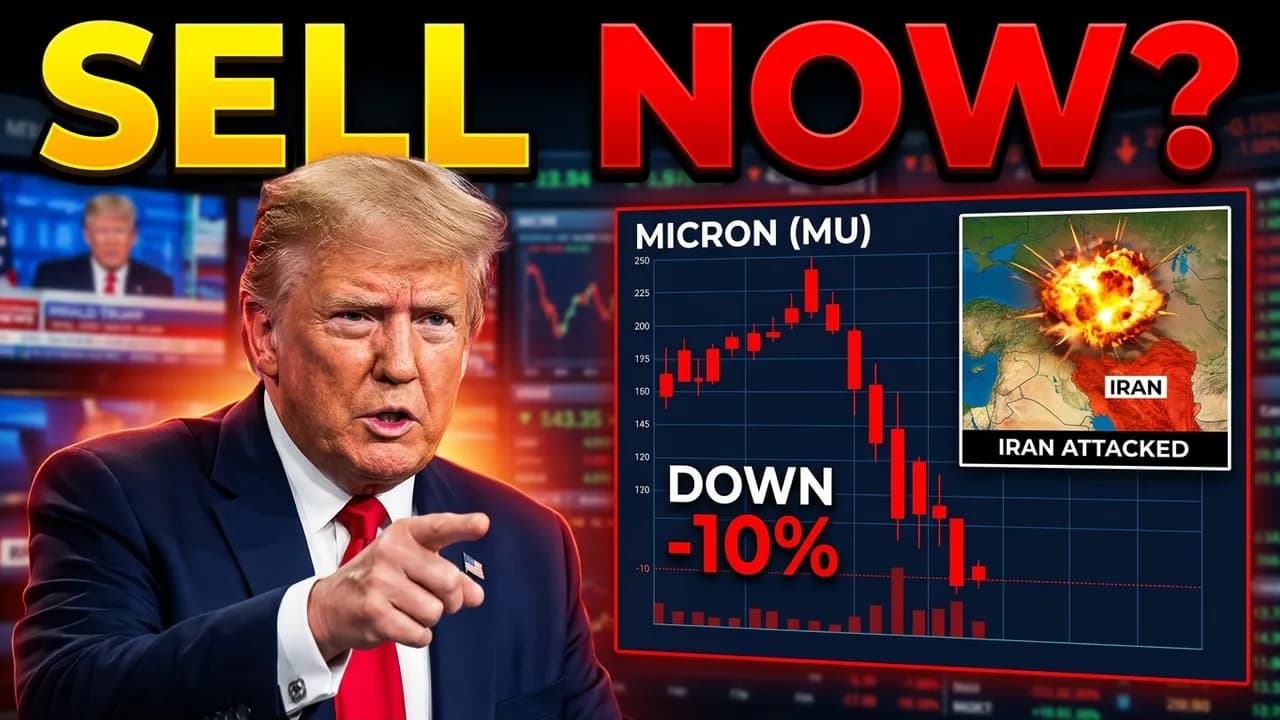
WHY ARE MEMORY STOCKS CRASHING RIGHT NOW?!
In a Nutshell
Memory stocks are crashing due to renewed oversupply fears, with SK Hynix leading a 4% drop in the KOSPI that triggered selling in Micron and peers. No fresh negative headlines emerged—only recurring concerns about Toshiba and China's new memory producer flooding the market, eroding the current sold-out pricing power that has driven strong profits. Traders should avoid leverage on dips, as Korean margin trading can amplify declines that may worsen before stabilizing.
These notes were generated by AI and may contain inaccuracies.
Micron Technologies began selling off during overnight hours, with acceleration noticed in the past 30 minutes. Initial investigation focused on wire services for any Micron-specific news, which turned up nothing. Attention shifted to the KOSPI index (South Korean market) as the potential driver, given its heavy weighting toward Samsung and SK Hynix.
The KOSPI opened approximately 0.6% lower around 5,734, then declined to roughly 5,641 (down over 2%) by 5:30 local time. SK Hynix led the decline, dropping about 4% early, while Samsung fell near 2%. The Korean Herald framed the decline as "AI and memory worries returning after Monday's rebound." Traders on X observed US futures rolling over, with the Nikkei slipping about 0.8%.
No single fresh headline emerged; rather, the same oversupply and competition concerns from the previous week resurfaced. A key observation: Korean retail investors rely heavily on margin trading, meaning if KOSPI breaks toward 5,629, memory names and NASDAQ futures could continue sliding into the US open.
A rumor circulated that North Korean leader Kim Jong-un may be deceased. Investigation traced the claim to Wan Jun, a Chinese dissident activist with a documented track record of false claims. The rumor alleged Kim suffered a brain hemorrhage and died in Beijing, with unverified follow-ups claiming his sister would take over or that China would send troops.
No government, including Pyongyang, and no major wire service confirmed anything. Kim's last confirmed appearances were October 10th and 11th, with state media photos released on the 13th. Additional posts claimed he appeared at a garment exhibition on the current day. Market reaction was minimal—the KOSPI drop was attributed entirely to AI and memory concerns, with neither the won nor dollar reacting to the rumor.
Historical precedent supports treating the rumor as noise. April 2020 death rumors barely moved Korean stocks. When Kim Jong-il actually died in 2011, the KOSPI dropped about 3.4% but recovered within days. The only real market risk would occur if a confirmed death triggered official mourning or a messy succession, potentially spiking Korean stocks and the won downward while pushing money into the dollar, yen, and gold.
The NASDAQ market hit lows of 715 before quickly recovering. Markets had become overbought within a very short period, with no new positive news. A potential peace deal signal with Iran was quickly reversed when attacks on Iran occurred, erasing sentiment gains. Markets still ended 1.2% in the green overall. The NASDAQ remained technically oversold and at the 700 support range.
Netflix and SpaceX are scheduled to report earnings after market close the following day. Micron became overbought intraday, with an overbought reversal observed on shorter timeframes.
A short position was taken on Micron during the intraday overbought reversal, moving from being down a few hundred dollars to $2,800 in profit. Profits were taken as the price approached the initial previous support range around 98.907. The stock continued selling off to lows of 90.01. A dip-buying long position was then established, with partial profit-taking executed while carrying a small position overnight.
SK Hynix from the South Korean market emerged as the primary driver pushing memory chip stocks lower. SK Hynix trades at a 5.7 P/E ratio with revenue of 122 billion and net income of 104 billion. Memory sector overall shows a 12 P/E ratio, 133 billion in revenue, and 84 billion in net income.
Toshiba potentially oversupplying the market with memory chips represents a major concern. China's new memory company is growing at an accelerated rate and could flood the market with cheaper alternatives. This could hurt demand for Micron, SanDisk, SK Hynix, and Samsung while also affecting profit margins.
Current healthy revenues and profits for Samsung and peers stem from being sold out, with demand significantly exceeding supply. Oversupply would eliminate this competitive edge. US companies cannot purchase Chinese memory, but South Korean market response to other markets buying Chinese memory remains to be seen.
Volatility should not be surprising given ongoing market conditions. Position sizing and exposure management are critical, especially for beginners. South Korean market participants should avoid using leverage or margin when buying dips, as declines can continue. The market can get significantly worse before improving, making risk tolerance essential.
Keep Ricky Gutierrez in your library
Save the videos and channels worth coming back to, and find them again in one place.