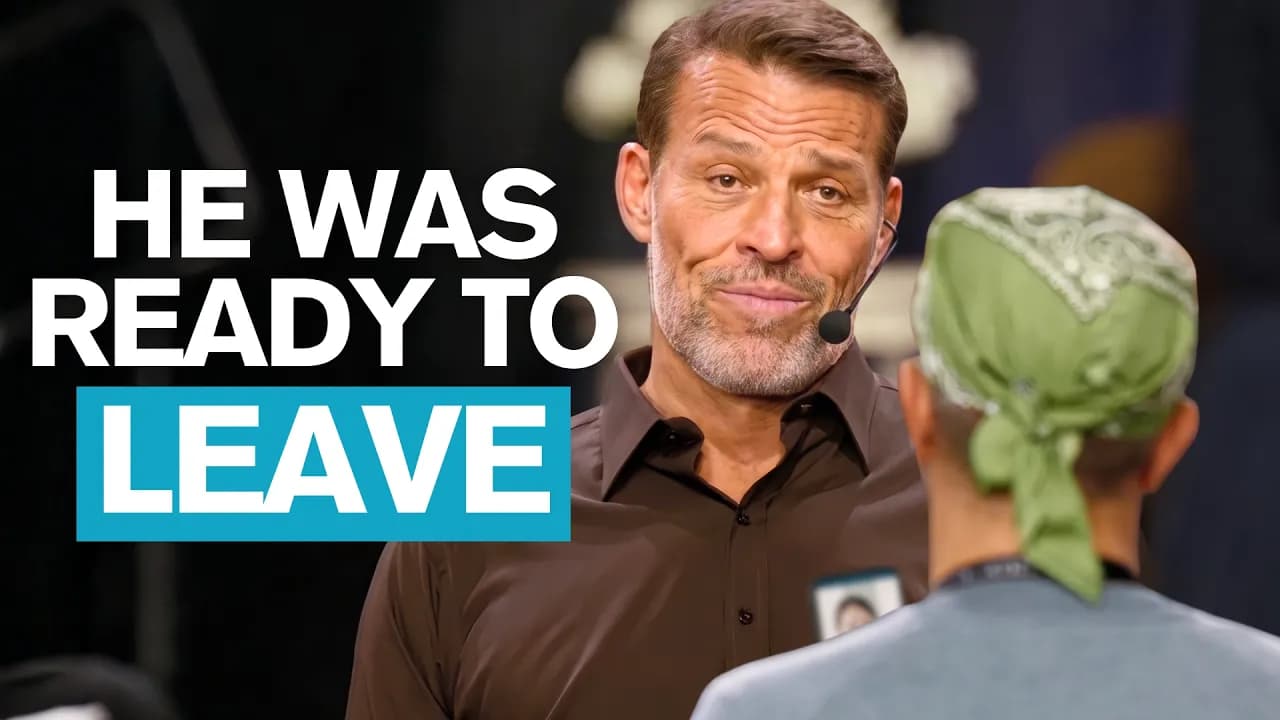
Why Love Isn't Enough to Save a Relationship (Tony & Sage Intervention)
In a Nutshell
The core issue is a repeating "crazy eight" cycle of fear and anger that blocks both partners from meeting their core needs, causing intimacy to collapse even though love remains. Real change comes from cultivating personal presence, owning one's own state instead of demanding the partner fix it, and using simple daily practices to generate connection rather than waiting for crisis-level anxiety. When both commit to these patterns and stop evaluating exit, the relationship can shift from survival mode to consistent fulfillment.
These notes were generated by AI and may contain inaccuracies.
Most people get stuck in a "crazy eight" pattern when relationships feel disconnected. They move between states of fear or anger. Fear initially meets the need for connection and significance, but prolonged fear leads to insecurity and anxiety. The nervous system can only tolerate so much, prompting a shift into anger. Anger provides significance and a form of connection, but sustained anger eventually transitions into anxiety, fear, or sadness. Repeated cycling between these states leads to depression, as emotions get suppressed when the pattern feels unmanageable.
One partner described trying to make the relationship work but was actually exiting by going to work. At work, she experiences greater certainty, variety, significance, connection, growth, and contribution than at home. Control feels more attainable at work because the rules are clearer and intimacy dynamics are absent. Her self-esteem ties to the illusion of control over events.
The male partner rates his certainty of winning and making her happy at minus 10. He experiences minus 1 variety, zero significance, zero consistent love and connection, four for growth, and wishes for more contribution. Most men are wired to please their partners, and when they cannot make their partner happy, they feel worthless. The feminine energy in the room recognized minus 10 certainty as particularly damaging.
The crazy eight pattern has been a lifetime issue predating the relationship. It prevents meeting needs in any area, including work. The male partner loves her deeply despite unmet needs because of a spiritual, loving connection beyond needs. He believes in her soul but feels exhausted from repeated failure. He recently expressed needing more love and authenticity, which was difficult because he feared hurting her while she was already struggling.
Relationships typically end not from lack of love but from lack of intimacy. When partners fail to connect across need structures, intimacy disappears. The female partner's fear ignites when she cannot feel connection, causing her nervous system to physically react. She described needing energetic connection but not knowing how to make it tangible.
During an exercise, the male partner was instructed to look into her eyes, feel her without thinking about himself, and repeat internally: "I love you. I worship you. I'll take care of you forever." She felt a pull toward him and noticed his focused energy and hurt in his eyes. This demonstrated presence, which creates safety and pulls feminine energy toward calm, connected stillness. All feminine energy is attracted to presence.
After 11 years together, they entered the awakening season. This phase involves recognizing how one's behavior affects the partner even without intent. The female partner freezes when connection feels rushed. Originally, she was attracted to his outgoing energy, magician, lover, and king qualities because she had disidentified with those aspects in herself. Over time, undeveloped qualities create resentment toward the partner for the very traits that initially attracted her.
When resentment grows, small things become annoying, leading to rejection and eventually repression. In repression, partners may love each other but show no emotion. They live separate lives despite cohabiting to avoid pain. Stuckness means repeating the same actions while expecting different results.
The male partner wants to be her champion and remove her anxiety. In every relationship, if a partner does not feel they are the most important thing, problems follow. This holds true regardless of children, work, friends, or other priorities. The female partner needs to feel she can contribute something unique to his life that no one else can. Vulnerability and authentic sharing of pain without blame elicited more love and connection from him.
A deeper truth she knows is to be playful and have fun, which channels her true self. When playful, she feels alive. Playfulness also lights up her partner. The feminine experiences connection through senses, touch, movement, expression, prayer, and meditation. Physical resets like hot tubs or pools help transition from work states. Practices such as 60 seconds of grace hourly maintain connection throughout the day rather than only during high anxiety.
Meditation and prayer help, but connecting to self and being in the body is the avenue to playfulness and the right state. She was originally attracted to his physical presence and deeper character qualities. The partner noted her quality soul and goodness. Radiance is their nature and benefits both the relationship and themselves.
Tony describes his wife throwing almonds at him when she wants attention during his focused work. She uses techniques to get his attention when needed, and he is happy to give it though sometimes he needs assistance to shift out of his focus.
The belief that our beloved is supposed to fix us or take care of us is a conditioned pattern. Instead of expecting or demanding presence and care from a partner, individuals can develop personal practices such as dance or tuning in for 62 seconds of grace to connect with themselves, feel alive, and fill their own cup before offering to others.
Sage shares her past pattern of demanding presence from her partner while not being present herself. She wanted him to understand her when she did not understand herself, which she describes as absurd and madness.
The husband acknowledges he chose not to have children and owns that decision. His wife had wanted children badly and carries guilt about not having a family. Tony affirms that the guilt is not on her and asks if the husband would trade his wife for children. The husband says no.
Tony explains that language produces emotion and meaning. He points out the repeated use of the word "sh" (likely shorthand for shame or shit) and suggests reframing statements like "sometimes things get confused" or "we both get busy and I want to bring us together" instead.
He challenges the ownership of guilt by asking who she thinks she is to claim "my guilt," noting that millions of people feel guilty and she is simply tapping into an energy that has existed forever when entering a low physiology state.
Guilt serves as a way to connect with oneself and shows care, but the husband has moved beyond needing that from her. He wants to light her up in any way possible, and fulfillment cannot come solely through having children.
Tony states that problems require energy to persist. If the wife feels anxious, she can simply say she is feeling anxious and would love his presence. The husband responds that he would buy her that presence and would repeat the three things he was previously told to say.
Tony notes the husband is excited because he has a system ready to win, where winning means lighting her up, making her feel loved, and creating connection.
Both partners affirm they want to continue the marriage. Tony suggests removing the label of stepping out from the table. He invites them to look for and discover multiple other ways to win in the relationship.
The wife likes discovering ways to break through and figuring out answers. Tony advises her to communicate clues and break the habit of labeling problems as "my" problems. He explains that the words attached to experience become the experience.
He gives examples of different labels for the same uncomfortable feeling: "uncomfortable," "kind of annoying," or "I got to learn something," versus immediately labeling it as guilt.
Tony proposes that if they believe they can find ways to win, love each other, and both want to continue, they should stop evaluating leaving and commit to making the relationship work. Both affirm their commitment. Tony concludes by saying they should make her the bride.
Keep Tony Robbins in your library
Save the videos and channels worth coming back to, and find them again in one place.