Why Your Favorite Exercise Might Be Useless For Muscle Growth
In a Nutshell
Many exercises fail to stimulate target muscles effectively for people with non-average builds like short torsos, long femurs, or long arms, leading to wasted effort and joint stress. The solution is matching movements to your specific proportions through stance adjustments, grip changes, and equipment modifications, or replacing mismatched exercises with better alternatives like belt squats, chest-supported rows, or pull-ups. No exercise is mandatory—individualization through testing and tweaking over full training cycles is essential for optimal muscle growth.
These notes were generated by AI and may contain inaccuracies.
The idea in the hypertrophy world is that exercises target the specific muscles you're trying to train, but your build doesn't always match the exercise as well as desired. People who are much taller or shorter than average, those with legs that are longer or shorter than average for their height, people with arms that are much longer or shorter than average, and those with torsos that are longer or shorter than average by a significant margin can experience a substantial mismatch where the target muscle isn't the muscle being stimulated the most. This mismatch can occur even with common exercises that are considered hardcore basics supposed to work well for everyone.
People who don't have a great match to the exercise can spend weeks, months, or years performing weight exercises that they could have either modified or replaced to get a better workout. The consequences include the exercise not hitting the target muscle well, hitting other muscles instead, causing joint stress, and creating high systemic overall fatigue from having to push hard due to poor efficiency.
If you have a short torso, squats can be really hard. The way to tell is you have to bend over a significant amount and essentially good morning the weight, and you don't feel anything in your quads. Because your short torso has to compensate so much for how much longer your femurs are than they are relatively in other people, the center of gravity can't be adjusted without falling forward or back. In order to maintain a center of gravity over your feet, if you have an incredibly short torso and relatively long femurs, you're going to have to lean over.
Technical Fixes for Squats
- Take a wide stance and point your toes really far out, which decreases the lever arm that your quads make and reduces how much you need to lean forward
- Maintain a completely vertical upright chest the entire time, which forces your knees forward
- Make sure your knees come forward as much as they can during the squat
- Do not use low bar squats; use high bar squats only, because low bar squats make it seem like you have an even shorter torso
The wide stance and toes-out position may give you significant adductor work if your adductors aren't flexible, but it will work better for your quads.
Squat Replacements
Belt squats are one of the best replacements because they don't rely on your torso length at all. The bar isn't unbalanced at the top, so you don't have to use your body to maintain center of gravity.
If you have very inflexible ankles, you're a short king, short queen, or even short god, leg presses and hack squats might be a bad match. The machine bottoms out for you, reaching its bottom position before you get a major tension stretch in your quads, or you can get that stretch and tension but have to come up on your toes, which limits drive and muscle activation through your quads.
Technical Fixes for Leg Press and Hack Squat
- Put your feet way lower on the platform, point your knees out and your toes out at 45 degrees, and let your knees track out as you go down
- Use weightlifting shoes, which extend the functional ability of your calves to be flexible and allow you to put your feet even lower on the platform for more quad range of motion while pushing through your heels
- On the leg press, place a pad underneath your butt/lower back to change the angle and get deeper
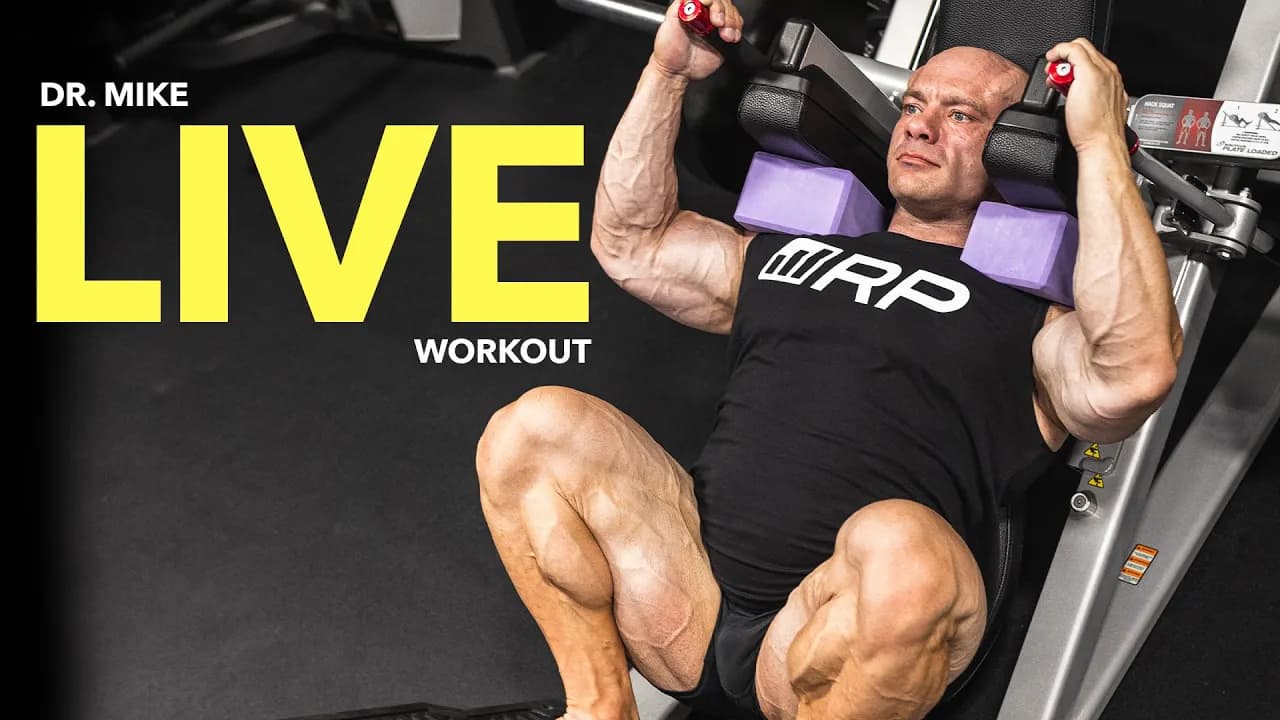
- On the hack squat, put yoga blocks underneath your shoulders to effectively make you taller and allow deeper range of motion
Most hack squats are pretty good, but most leg presses are angled wrong with range of motion cut short and back pads angled incorrectly. An Arsenal leg press with a back pad underneath is recommended as the world's best leg press.
Leg Press and Hack Squat Replacements
If modifications don't work, replace with other exercises rather than continuing with mismatched movements.
If you're too short for the pulldown machine, you have to climb up to reach it. If the machine is extra short and really bad, when trying to pull down for a peak contraction at the bottom by touching your chest, the machine bottoms out and you end up doing a top-end partial, stopping right in front of your face.
If you're really tall, you have the opposite problem: instead of getting a deep stretch at the top for your lats, the machine comes to a stop with half-bent elbows, eliminating the most hypertrophic part of the movement.
Technical Fixes for Short Individuals on Lat Pulldowns
- Use the double pin trick: put one pin into the middle of the rack and another on the actual weight needed, which pre-lowers the lat pulldown bar
- Use a V-bar attachment, which often has a declivity 3 or 4 inches lower than a conventional bar, allowing more lat stretch and easier grip without excessive jumping
- Perform lengthened partials: keep pulling to eye level even if the machine only allows that range, since that is the part of the range of motion that produces the most growth
Technical Fixes for Tall Individuals on Lat Pulldowns
- Try the straight bar instead of attachments that hang lower like the V-bar
- Try a wider grip to avoid bottoming out and still get a stretch
- Try leaning back through the entire movement, especially at the very top: stay vertical while pulling, then lean back a little as you come back up to touch, which stretches the back; alternatively, lean back 15 to 30 degrees from the beginning and stay leaned back, especially with a wide grip
Lat Pulldown Replacements
Pull-ups adapt to every single body mechanic and are never wrong. Assisted pull-ups can be used. Some assisted pull-up machines work better than others. For short individuals wanting a peak contraction, cable attachments can be hung off the assisted pull-up machine to get huge range of motion and peak contraction at the top while going all the way to the bottom.
Some people's wrists and elbows don't turn out in a way that allows them to feel force through the forefinger area while feeling almost no force through the pinky area of the palm during barbell curls.
Technical Fix for Barbell Curls
Try a few different grip widths—narrower grip or wider grip—to find one that works well for your particular wrist and elbow flexibility.
Barbell Curl Replacement
Use the easy bar attachment to cables or the easy bar curl bar itself. The easy bar, whether using the inside or outside grip, works well for people without superior wrist and elbow flexibility. You can use the easy bar consistently and potentially never barbell curl at all.
If you have a very long torso, bent rows require significant effort from your spinal erector musculature to keep yourself in an upright back locked-in position. Over the course of reps, your back starts to round progressively more, or your effort to keep it from rounding becomes exponentially higher until you're failing because you're rounded over and the row isn't working anymore, not because you can't pull the bar to yourself.
If you have very long arms, you run into a problem where having to pull all the way up to your tummy causes you to lose leverage advantage. Pulling the first half of the row from the bottom is really easy, but pulling the second half is extremely difficult and you feel like you can generate almost zero tension at the belly. This is problematic because the bottom parts of movements close to the stretch cause more growth, but tension is being taken away from that bottom part.
Technical Fixes for Bent Rows
If spinal erectors are the limiting factor, do more deadlifts, more stiff-legged deadlifts, more good mornings, and more flexion rows so that when performing conventional bent-over rows, spinal erectors are not a limiting factor.
If the top portion is really tough, stay more upright in the bent row—even a 45-degree bent row makes the lockout part of the top easier.
The advanced version is to start the bottom of every rep fully bent over at 90 degrees, then at the top rise up to touch your tummy so you finish at 45 degrees. This improves leverage advantage as you come up.
Bent Row Replacements
Any row machine that gives you chest support eliminates the spinal erector problem almost entirely. For tall individuals with really long arms and a really short torso, replace rows with partial rows or a superset of regular rows to lengthened partials: do as many strict reps as possible until you can't touch your tummy, reset the weight briefly, then pull the weight halfway up for as many reps as possible. This provides more work in the lengthened position.
If you have really long arms, a really short torso, and very flexible hamstrings, you can run into the ground before your hamstrings are painfully stretched under maximum load during stiff-legged deadlifts.
Technical Fixes for Stiff-Legged Deadlifts
- Proudly push your chest up especially at the bottom, which causes the hips to tilt significantly and creates a massive stretch at the bottom
- Functionally reduce your arm length by taking a very wide grip such as a snatch grip or super snatch grip, which can take approximately half a foot off your arms
- Use two cues together: arch your back at the bottom while pushing your tummy out, and at the same time push your hips and knees back so your knees are straighter
- Put smaller plates on the bar (such as using 25s as the biggest plates) to increase range of motion by two or three inches
- Perform deficit stiff-legged deadlifts by standing on a platform if smaller plates aren't available
The mind-muscle connection is critical during stiff-legged deadlifts. Your body just cares about lifting the weight from point A to point B, but for hamstring size the goal is the opposite—you'll know it's working when your hamstrings are painfully stretched at the bottom of all reps and three sets later you can't walk for a week.
Stiff-Legged Deadlift Replacements
If nothing works, do good mornings instead. 45-degree back raises done right are also effective. Smith machine hamstring leans allow you to push your knees back, tighten your core, and fry the hamstrings.
Exercises are always and everywhere individualized and selected to the person. There is no exercise you have to do. There are no must-do exercises—that is a myth.
If you try an exercise and you don't love it right away, do not abandon it immediately. Try an exercise for at least a program lasting 4 to 8 weeks, which is a mesocycle's length. Tweak it, change the technique, change your positioning, change some grips, and see if you can get the most out of the exercise. Sometimes an exercise starts out feeling not so great, but changing the way you're pulling or pushing or changing grips makes it a phenomenal exercise.
Don't be a primadonna and abandon an exercise because it isn't good enough immediately. The worst case scenario is switching to another movement if modifications don't work.
When making technical adjustments such as reminding yourself that feet need to be wider and lower on the leg press, use pinned notes to check off items so the reminder appears when logging the exercise each week.
With the combination of understanding your own body and making appropriate adjustments, the formula exists to grow all the muscle you want, except for one thing: effort. That part is always on you.
Keep Renaissance Periodization in your library
Save the videos and channels worth coming back to, and find them again in one place.