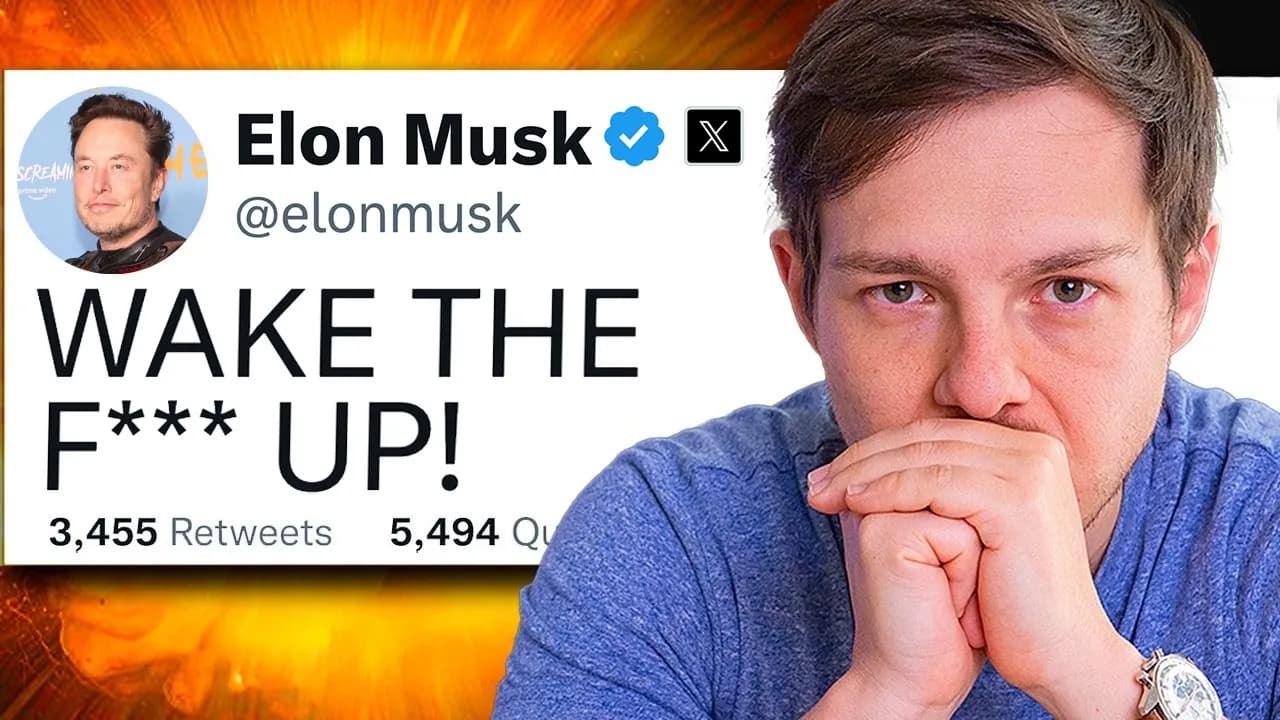
Will AI End Capitalism? (No!)
In a Nutshell
AI won't end capitalism because capitalism is defined by private ownership of production, not by labor or wages. Even when machines replace all work, scarce goods and preference-based value will persist, requiring money and markets to allocate them. The real shift is from labor-based to ownership-based income, making widespread capital distribution the key to avoiding a new form of feudalism.
These notes were generated by AI and may contain inaccuracies.
A poll on X and YouTube received nearly 100 replies and more than 60 comments asking whether artificial intelligence, robots, and automation will eventually eliminate capitalism. The debate reduces to a handful of core arguments.
Capitalism has operated for approximately two centuries through labor arbitrage. Companies employ people, pay wages, and sell what workers produce at a higher price than the wages paid. The difference constitutes profit. If AI and robots perform every task better and faster than humans, no room remains for this arbitrage.
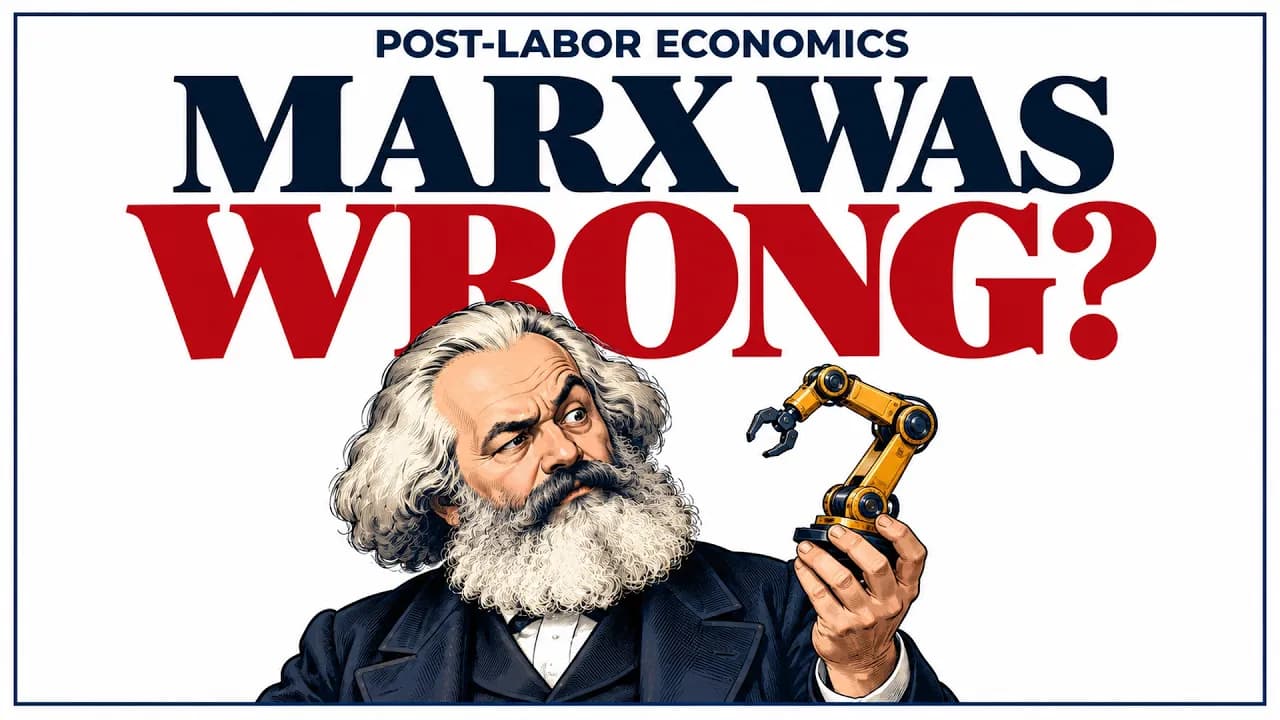
Karl Marx wrote in the 1850s that once labor ceases to be the great source of wealth, labor time ceases and must cease to be its measure. When human labor is no longer the primary source of wealth, the value system based on human labor loses its meaning.
Wages serve dual purposes: they represent costs to companies but also provide customers with purchasing power. If machines replace jobs, the question arises of who will purchase everything that machines produce. Capitalism requires customers, and customers need salaries or alternative forms of income.
A "copying machine" that produces anything from raw materials that are virtually free would drive prices and profits to zero. Markets exist to regulate scarce items through price signals. In an abundance scenario, the market would have no role to play, resembling the economics depicted in Star Trek's 24th century where "money doesn't exist."
Greek economist Yanis Varoufakis argued in his 2023 book "Technical Feudalism" that capitalism ends not through abundance but because a small number of people will own all artificial intelligence technologies. Markets are being replaced by platforms, and profit is being replaced by rent. Every seller on these platforms pays rent to owners, analogous to feudal arrangements. AI model owners may eventually need no one else.
The conclusion that capitalism itself will end rests on a misclassification. Many confuse capitalism with work or money itself. The Encyclopedia Britannica defines capitalism as a system in which most means of production are privately owned, production is directed, and income is largely distributed through the workings of markets. Notably absent from this definition are references to work or money.
The word capitalism indicates focus on capital—accumulating and owning things that produce value such as land, factories, patents, and now data centers and robots. When machines take over jobs, work represents only one input. When work disappears, only capital remains. AI will not end capitalism but will end the salary system.
Capital and markets serve as the basic mechanism for allocating and coordinating human resources, determining what is produced, where it goes, and who receives it without centralized management. In 1945, economist Friedrich Hayek described prices as a mechanism for transmitting information about scarcity and demand across millions of people.
The assumption that money will disappear rests partly on the labor theory of value, which states that value derives from the work required to produce something. This theory underpinned the Marx quote mentioned earlier. However, value does not necessarily originate from work. Two identical houses built with equal labor have vastly different values depending on location—one on the beach versus one in the middle of nowhere. Mainstream economics began abandoning the labor theory of value in the 1870s.
A second fallacy holds that money is merely a form of debt created by banks through loans, repaid from salaries. When salaries disappear, the system supposedly collapses. The Bank of England describes money as a special type of globally trusted debt instrument. What makes something money is not its source but its function.
Money performs three essential functions:
- Medium of exchange: can be exchanged for things
- Unit of account: measures the value of things
- Store of value: can be saved for later
Anything performing these three functions qualifies as money—whether gold coins, bank deposits, or cigarettes. In 1945, a British economist documented how prisoners of war used cigarettes as currency despite equal Red Cross parcels and minimal work, demonstrating that money's utility persists regardless of its source.
Some goods and services will become so cheap that price becomes irrelevant, but cheap does not mean unlimited. Scarcity management remains necessary through several forms:
- Time: limited to 24 hours daily
- Location: beaches are limited, only one Paris exists
- Preference: millions want the same view or table
- Attention: competition for focus
Economists call these competitive commodities whose value derives from rarity. One cannot 3D print a second Manhattan or place everyone at the front of the line.
Even in hypothetical futures with copying devices spread throughout the universe, rare items become the primary objects of competition. Money allows expression of "intense desire"—how much one wants something—unlike lotteries or government distribution systems that cannot capture preference intensity.
Capitalism still needs customers, but customers need income rather than salaries specifically. What comes next is "Capitalism 2.0," where income derives from ownership rather than labor, and capital becomes the determining factor. If a small number of people own all capital, Capitalism 2.0 will resemble feudalism.
The solution is not abolishing capital but distributing ownership so each family owns a portion of productive machines. Successful ownership distribution would eliminate hardship—working multiple jobs to pay rent or living one medical bill away from financial ruin—while preserving economic agency: the ability to own homes, save for the future, and choose how to spend money.
Keep David Shapiro in your library
Save the videos and channels worth coming back to, and find them again in one place.