Post-Labor Economics vs Communism
In a Nutshell
A post-work economy is the opposite of communism: it expands private ownership and capital returns rather than abolishing property. It rejects state control of production and UBI as a final solution, instead using tools like sovereign wealth funds (Norway, Alaska) and pension funds to give households direct dividend income from market-owned assets. The goal is a higher capital-allocation ratio so families earn more from property than from wages or government transfers, making them less dependent on the state.
These notes were generated by AI and may contain inaccuracies.
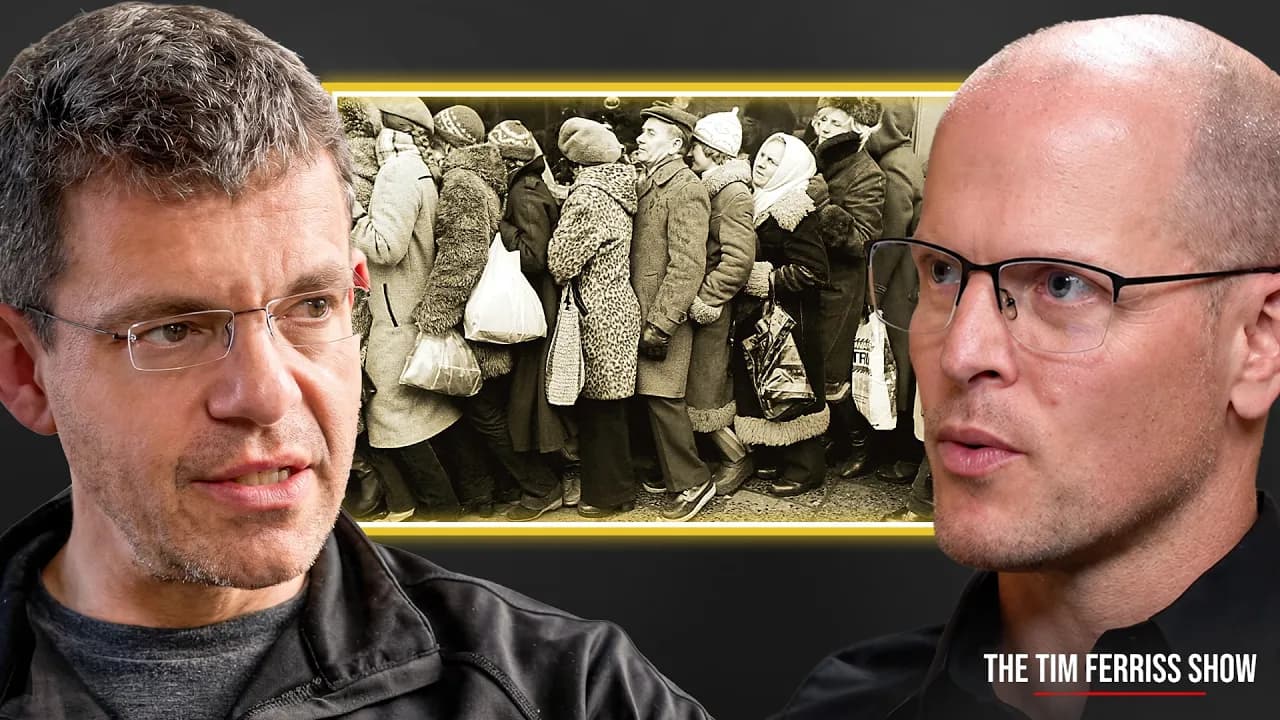
A post-work economy is not communism. Ownership, the right to own property, and why the goal is to reduce dependence on the state. One objection to the post-work economy stands out more than others. He says that the post-work economy is nothing but communism with a new name. This objection often comes from people who grew up in the Soviet Union or Eastern Europe. This date is important. If you or your parents have lived under that system, any plan to reorganize the economy may seem like the beginning of something terrible. This fear is understandable. When the Soviet Union forced its farms to become collective farms in the early 1930s, the famines that followed killed millions. So, when someone with this history hears the term "public wealth fund," it may sound like the first steps back to the Soviet Union. This reaction is not actually related to the facts. It concerns what people have experienced, and it deserves a clear answer. The answer is that the post-work economy points in the exact opposite direction. He is a supporter of capital. It is based on ownership and the right to own property, and one of its basic design principles is to make people less dependent on the state, nothing more. It is helpful to be precise in the comparison. Marxism, socialism, and communism are not exactly the same thing.
Marxism is Karl Marx's theory of history and economics. Socialism and communism are the names given by 20th-century countries to the systems they built based on his ideas. Those systems shared three basic characteristics. The first was state ownership of the means of production. The state owned farms, factories, and mines. The second was central planning. In the Soviet Union, a state planning committee decided what was produced, how much, and what it would cost. The third was to treat everyone as financially dependent patients of the state. Your job, your housing, and your income all came from the government; there was nowhere else for you to go. Marx and Engels stated this explicitly. In the Communist Manifesto, they wrote that the theory of the Communists could be summarized in one sentence: "The abolition of private property."
The post-work economy was designed around a completely opposite goal. One of its core design principles is to avoid reliance on financial transfers. Remittance dependency is when a household's income comes from government payments rather than from work or property. In this case, the family is a financially dependent patient of the state. Its income depends on budgets, elections, and politics, and it owns nothing that generates revenue for it. Reliance on remittances is already on the rise. In 1970, about 8% of Americans' personal income came from government transfers. Today, that figure is around 19%. Part of that is due to social security and medical care for an aging population, but the trend is clear. The income system has already begun to outpace wages, and automation could push this figure to much higher levels. For this reason, Universal Basic Income, or UBI, is not the perfect solution.
Universal basic income may play a role in the post-work economy, but treating it as the whole of the post-work economy is a misclassification. Basic income is simply a financial transfer. It is a flow of money with no basis behind it, and a future government could cancel it by vote. It can be a bridge, but it cannot be the destination. The post-work economy points towards ownership instead. One of its key metrics is called the capital allocation ratio or CAR. It divides the family's income from property by its combined income from wages and transfers. Note where the transfers go. It falls under the same category of wages. The goal is for the property income to grow until it equals or exceeds the sum of the two. A family that reaches that point is not a recipient of state aid. Rather, she is the owner.
A second misunderstanding comes from the opposite direction. Some argue that if machines do all the work, then capitalism must end because everything then becomes property and ownership. This idea turns things upside down. If property and ownership are the basis, then that is still capitalism. Capitalism means private ownership of capital with markets that determine prices. When work disappears, capitalism does not end. Instead, ownership becomes more important than ever. Marx built his entire theory around labor. From his point of view, value comes from the work done in things, and one day the workers will take control of the means of production. The post-work economy starts from the opposite premise. Human labor is no longer a binding constraint, so the question becomes: Who owns the machines?
Ownership comes in more than one form. There is private property such as your home, your savings, or your retirement account. Then there is collective ownership, such as cooperatives and companies owned by their employees. There is also public property such as a solar power plant owned by a city. There is also joint ownership, such as a fund that pays dividends to the residents of a state. Each of these is a form of ownership, and each of them falls within the market economy. This leads us to sovereign wealth funds. Norway's sovereign wealth fund exceeds $2 trillion and owns about 1.5% of all listed stocks in the world, spread across thousands of companies. But Norway does not run those companies. They buy their shares on the open market just like a pension fund, and these companies continue to compete for customers like everyone else. In fact, Norway is prohibited from buying a controlling stake in any of the companies within its sovereign wealth fund. Alaska has done something similar since 1976. Its permanent fund is worth nearly $90 billion, and since 1982, it has been paying dividends to almost every resident of the state. The governor who pushed for the establishment of that fund was a Republican.
If you grew up under the Soviet system, the government fund might seem the same to you. So, here are three questions that differentiate between them. Who decides what gets produced? In the Soviet Union, it was the planners who did that. In Norway and Alaska, however, the market decides. Secondly, can you own the property yourself? Under Soviet communism, you could not own a company, a farm, or shares in an institution. In Norway and Alaska, you can own all of that, and the fund owns its shares alongside you. Third, does your entire source of income depend on the state? In the Soviet Union, it was the same. In Alaska, dividends are considered additional income on top of everything people earn and own. The sovereign wealth fund is merely a shareholder. While communism sought to abolish shareholders. The United States is already doing this on a large scale. State and local pension funds for teachers, police officers, and firefighters hold investments totaling approximately $6.5 trillion, with stocks making up the largest portion of their assets. No one describes the retirement of a teacher as communism. Therefore, a post-work economy is not communism. Communism sought to abolish private property, while the post-work economy wants everyone to own more property. He doesn't want the state to run the factories, and he doesn't want families to live on government checks. It is a pro-capital, pro-property system, designed to make people less dependent on the state. If there is an accurate description of it, it is capitalism with more capitalists.
Keep David Shapiro in your library
Save the videos and channels worth coming back to, and find them again in one place.