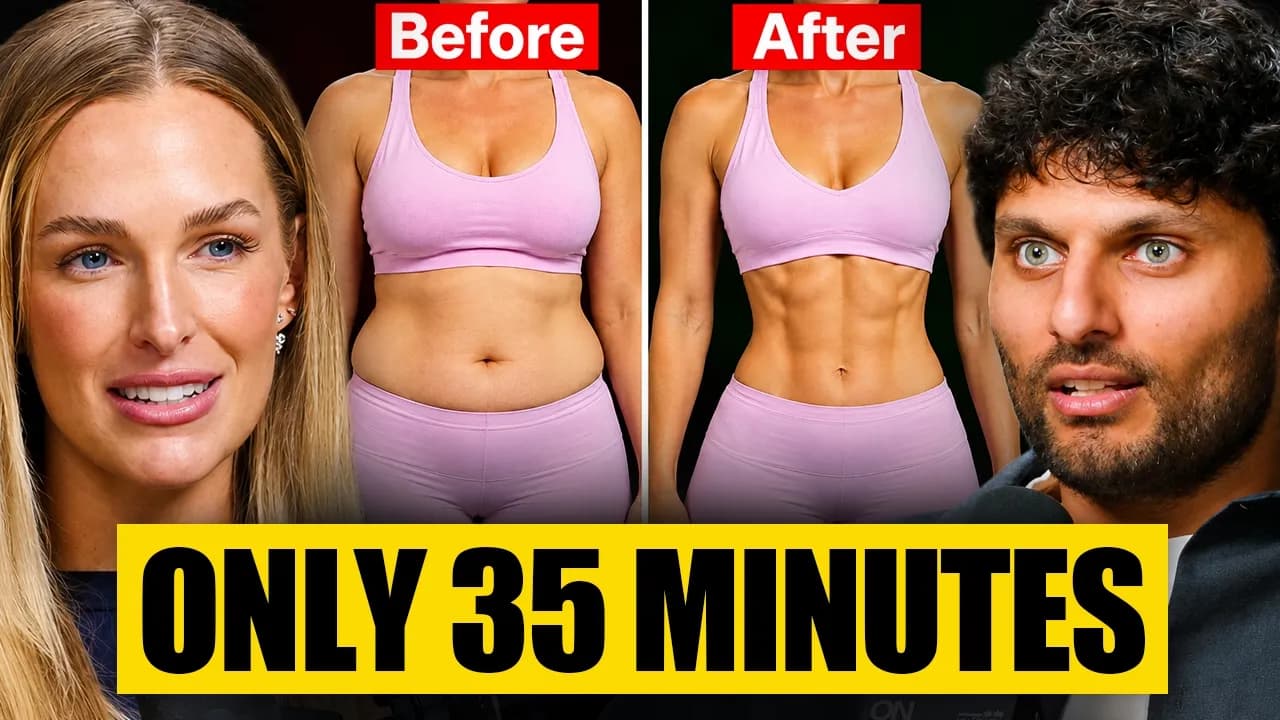
Women’s Fitness Expert: What You NEED To Know About Dieting & Exercise | Dr. Stephanie Estima
In a Nutshell
Dr. Stephanie Estima argues that women should stop pursuing "skinny" through calorie restriction and excessive cardio and instead prioritize building muscle, bone density, and connective tissue strength through heavy lifting. She identifies four female fitness archetypes and stresses that progressive overload training three to four times weekly—targeting glutes, lats, delts, and adductors with 10 sets per muscle group weekly—combined with adequate protein, carbs, and calories produces better body composition than restrictive approaches. Key supporting habits include 10-11 hour overnight fasts, creatine, collagen, magnesium, vitamin D, zone 2 cardio plus sprinting for VO2 max, and deceleration training to prevent falls and injury.
These notes were generated by AI and may contain inaccuracies.
Dr. Stephanie Estima states she is on a mission to undo the terrible advice women have received regarding health and fitness. She wants women to stop being losers and stop trying to lose all the time. Instead, the focus should shift from losing to gaining: how much muscle can be gained, how much bone density can be gained, and how much connective tissue capacity from joints, tendons, and ligaments can be gained. The goal is building a body that women love, trust, and enjoy living in.
We've been sold a lie that our worth is the number on the scale.
The number on the scale is described as merely a reflection of one's relationship with gravity. Society tells women that fitting into a certain dress size means they are worthy and have arrived. Women can be strong, capable, and competent, but this cannot be achieved when starving themselves, over-exercising, and not prioritizing recovery.
The pursuit of skinny at all costs is described as a bad thing with devastating consequences, including bone disease like osteoporosis. Current online dialogue promotes being as small as possible or achieving the Pilates body. Being obese is worse than not being obese, but the issue arises when slimness is valued at the expense of everything else. Women who prioritize being slim are less likely to lift heavy weights, resulting in lower bone density over their lifetime and likely under-consumption of calories.
At age 40, fitting into a smaller dress size does not constitute winning if osteoporosis develops by age 65. Society tricks women by basing worth solely on how small they are.
Dr. Estima has an undergraduate degree in neuroscience and psychology from the University of Toronto. She became a fitness instructor and personal trainer while pursuing that degree. She attended the Canadian Memorial Chiropractic College in Toronto and has been in practice for 20 years, seeing tens of thousands of patients. The same pattern of struggling with weight and self-worth kept appearing.
Personally, she grew up struggling with her weight, trying to control her eating and doing excessive cardio to maintain what she thought was the ideal body type. She competed in a figure competition, reaching 11% body fat. Women have approximately 10 to 13% essential body fat, and going beneath that causes problems. A healthy body fat percentage for most women is 18 to 25%. She lost her period for two to three months before stepping on stage, developed hormonal issues, and it took a long time for her period to regulate again. She gained all the weight back and felt like a total failure, believing the science had failed her.
In the weeks before the competition, people complimented her appearance despite her starving, being overworked, not sleeping, and not having her period. This created confusion about hitching worth to external validation rather than internal standards.
This discussion is intended for women and the men who love them. It targets women who have been doing the good girl thing and following strategies they thought were correct but still lack the desired body composition. It also addresses women in midlife (40s and 50s) whose previous strategies are no longer working as effectively.
Dr. Estima is 48 years old and a mother of two with a stepson.
Four archetypes describe women in their fitness journeys.
Overwhelmed Olivia
This woman wants to do the right thing but encounters conflicting information on social media. One source says plants are trying to kill you, while another says plants are great for fiber and phytonutrients. Fitness advice conflicts between light weights with high reps versus bringing muscles close to failure to build muscle. She experiences infobesity and analysis paralysis, becoming scared to start anything new and risk reinforcing her self-perception as a failure. The approach is not to get her from A to Z but to provide quick wins from A to B, such as a goal of 5,000 to 7,000 steps per day.
Skinny Fat Sophia
The most common archetype seen. The technical term is TOFI (thin on the outside, fat on the inside). She does not present as obese but shows loss of bone and muscle because she avoids heavy weights, preferring Pilates, yoga, or walking, while also calorically restricting. When given more food and heavier weights than 2-pound dumbbells, she often reports losing fat and weight by eating more, which challenges her previous beliefs. Spot reduction is impossible; overall adiposity is reduced through strength training combined with a caloric deficit.
Exercist Emily
This woman has no problem getting to the gym and working intensely at the squat rack. Her issue is a mismatch between high exercise effort and insufficient caloric intake because she remains scared of gaining weight. Dr. Estima identified as this archetype after her divorce while raising young children ages five and three, using lifting to work through grief while still under-eating.
Dialed In Diana
The pinnacle archetype. This woman has made peace with her demons, enjoys movement as self-tending, views food as nourishment rather than punishment, and does not restrict calories after eating too much. She fuels to nourish her lifts, recovery, and for pleasure. Food is recognized as a source of joy, exemplified by sourdough bread in the morning. The goal is for every woman to reach this state while giving herself grace with recovery.
Women may oscillate between archetypes, which is normal.
A caloric deficit can be created by consuming fewer calories or increasing output through cardio, weight lifting, or walking. Dr. Estima finds it easier and healthier for women to focus on increasing calories out through more daily movement rather than restricting calories in, as the latter is difficult to sustain long-term and can drive hunger hormones. This approach ensures sufficient calories for building muscle, bone density, and collagen.
Women need to heal their relationship with carbohydrates. Carbs can be restricted temporarily for certain populations, such as women with type 2 diabetes or PCOS, to improve insulin sensitivity and glucose disposal. Low-carb or ketogenic diets are supported for specific goals and transient periods, such as reversing metabolic issues, losing weight, or improving menstrual cycle regulation. However, staying low-carb indefinitely leads to consequences including thyroid malfunction.
Symptoms of thyroid issues from insufficient carbohydrates or calories include always feeling cold, very heavy bleeding during the menstrual period (first three to seven days), and hair shedding, particularly the lateral third of the eyebrow becoming sparse.
Carbohydrates are needed for mood, sleep, and gym performance. Bread and omelets consumed before weekend training enhance performance. The carbohydrate-insulin model of obesity has largely been disbanded, but online sources still promote fear of glucose spikes. The actual problem is overconsumption of carbs, fat, and total calories, not carbohydrates themselves.
The host encourages viewers who haven't subscribed yet to hit the subscribe button, noting that the algorithm shows many regular viewers haven't subscribed yet.
Women often fear that engaging in progressive overload training—heavy weights, more volume through additional sets or repetitions—will cause them to bulk up and resemble physique competitors or bodybuilders. This fear is largely unfounded. It is comparable to saying that driving to the grocery store would make someone equivalent to Lewis Hamilton as a Formula 1 driver. For 97 to 98% of women, bulking is nearly impossible due to hormonal differences. Women have significantly less testosterone than men—approximately 10 to 20 times less—so even with identical training, women cannot build the same amount of muscle mass.
When women first begin lifting weights, they may feel thicker because the muscle becomes slightly swollen and there is typically a layer of fat sitting on top of the muscle. As body fat decreases, muscles become more visible. Some women interpret this initial swelling or inflammation as "bulking" and stop training, but this sensation is temporary and not actual muscle hypertrophy.
Long fasts of 20, 24, 36, or 72 hours were once believed to be the key to weight loss by drastically reducing calorie intake. However, fasting does not teach sustainable eating habits for non-fasting periods. The female body is particularly sensitive to nutrient availability because it constantly evaluates whether conditions are safe for pregnancy. Ovaries contain approximately 100,000 mitochondria per oocyte and scan the environment for safety signals. Extended fasting can trigger a famine response, signaling the body that it is unsafe to produce an egg or support pregnancy, which may shut down the menstrual cycle.
A more suitable fasting window for women involves stopping food intake 2 to 3 hours before sleep, sleeping 8 to 9 hours, creating a 10 to 11-hour overnight fast, then eating upon waking. Pushing the eating window later to 11:00 AM or noon often makes it difficult to consume adequate total calories, protein, carbohydrates, and fats within the restricted period.
Women may avoid lifting heavy weights because the practice feels unfamiliar and they fear injury. Social media promotes images of "muscle mommies" lifting heavy, which can feel intimidating for women in their 40s and 50s who grew up with 1990s beauty standards exemplified by Kate Moss. Moving from cardio machines to free weight sections, deadlifting platforms, or weight machines can feel overwhelming.
Building muscle does not require heavy weights exclusively. Progressive overload can be achieved through increased volume, greater workout density by reducing rest periods, or other intensity techniques. Multiple approaches exist to make workouts more challenging beyond simply adding weight.
The belief that protein must be consumed within 15 minutes after training to replenish glycogen and initiate muscle protein synthesis is largely false. Muscle protein synthesis continues for 10 to 72 hours post-workout depending on training status. As long as total daily protein and calorie intake are sufficient over a 24-hour period, immediate post-workout nutrition is not critical.
Ideally, some food should be consumed before training—a combination of protein and carbohydrates to raise blood sugar and provide available substrate. However, when training early in the morning around 6:00 AM, eating can feel uncomfortable. In such cases, ketones can serve as fuel. Ketones provide neural drive for large muscle groups and help maintain a sympathetic state during training. Performance is consistently better when food is consumed before workouts, though schedule constraints may prevent this during the week.
Exercises such as squats, deadlifts, presses, and pull-ups are not inherently male exercises simply because men typically perform them. These are fundamental human motor patterns that benefit both men and women equally.
For body composition goals, women should aim for three to four days per week of strength training, alternating between upper and lower body sessions while considering push and pull muscle groups.
Specific muscle groups should be prioritized to develop curves and an hourglass shape. These include:
- Deltoids, particularly the lateral delts referred to as "bread buns"
- Back muscles, especially the lats called "angel wings" for creating a V-taper that makes the waist appear slimmer
- Glutes, including gluteus maximus, medius, and minimus
- Adductors, the inner thigh muscles
- Pelvic floor and core muscles more broadly
Spot reduction is impossible, but spot building is achievable.
Each of these muscle groups should receive approximately 10 sets of exercises per week. Training two days per week can still produce excellent results provided the muscle is taken close to failure—one to three repetitions from failure is sufficient. Signs of approaching failure include reduced range of motion, slowed repetition velocity, and increased subjective perception of weight difficulty, with effort rated at eight or nine out of ten.
Female and male pelvises differ significantly. The female pelvis is wider and shallower to accommodate childbirth, while the male pelvis is narrower. This difference creates a larger Q angle in women—the angle measured from the anterior superior iliac spine to the patella and tibial tubercle. The wider pelvis causes the femur to angle more medially, resulting in women being more knock-kneed. This anatomical difference affects every movement pattern including walking, jumping, squatting, lunging, and running.
Because traditional exercise cues are often based on male anatomy, women may find standard squatting and lunging positions uncomfortable. During movements like lunging or squatting, women experience greater shear forces on the medial knee, increasing risk for ligamentous injuries, particularly ACL tears. The gluteus medius, known as the "upper shelf" muscle, helps counteract the femur being pulled inwardly and provides stability.
Most women find a wider stance with feet turned outward more comfortable and effective for achieving full range of motion. This external rotation compensates for the female femur's tendency toward internal rotation. When decelerating during squats, lunges, or split squats, the femur, tibia, and foot internally rotate and pronate. Women need sufficient control from hip stabilizer muscles to prevent excessive medial knee tracking and shear forces.
ACL injuries often occur when athletes are fatigued from overtraining and inadequate recovery. A single awkward step can generate shear forces before ligaments and tendons stabilize the joint.
Athletes practice stick-and-land drills before games to absorb forces through connective tissue rather than joints. For non-athletes, deceleration capability is essential for fall prevention. Preventing a fall requires rapid hip flexor activation to get the leg in front, tibialis anterior engagement for dorsiflexion to clear the floor, glute activation to brake, and adductor and abductor muscles to stabilize if falling sideways.
Dr. Stephanie Estima takes foundational supplements plus additional ones driven by research interest. For the general population of women, she recommends focusing on tier one supplements rather than an overwhelming list.
Magnesium glycinate is recommended as the easiest form to absorb. It supports relaxation, sleep, and muscle recovery. Typical dosing is 250 mg at lunchtime and another dose in the evening.
Habit stacking is used to maintain consistency—magnesium is kept beside salt and pepper so it is taken when preparing lunch, and a second bottle is placed in the bathroom for evening use. When traveling, supplements are placed on the hotel desk to pair with existing routines.
Omega-3 fatty acids are well-established in the literature for reducing inflammation and supporting cognition. A daily dose of 2–4 g is suggested. Capsules should be stored in the fridge to prevent spoilage. Habit stacking is again recommended by placing the bottle beside commonly reached items such as fruit in the refrigerator.
Vitamin D3 paired with K2 is recommended at a minimum of 4,000 IU per day. Despite its name, it functions more like a prohormone and is important for sex hormone and reproductive hormone production, inflammation control, and cognition. Daily intake is advised year-round, even for individuals living in sunny climates.
Creatine is highlighted as particularly valuable for women, moving beyond its former reputation as a “bro supplement.” Dr. Darren Candow described lifting weights as building the cake and creatine as the icing. A baseline dose of 3–5 g daily is recommended, paired with resistance training for performance and strength gains.
During perimenopause, higher doses up to 10 g can be used on days of poor sleep to support cognition, awareness, and alertness because creatine has difficulty crossing the blood-brain barrier. Observed effects of consistent use include fuller-looking muscles, sustained workout energy, and absence of performance degradation when intake is missed.
Collagen receives criticism for its low leucine content and limited role in muscle protein synthesis, but Dr. Estima emphasizes its value for joints, tendons, and ligaments (JTL). A daily dose of 10–15 g is typical. It can be added to coffee despite heat concerns if that ensures adherence. Collagen supports fascia, skin, hair, and nails in addition to connective tissues. Hydrolyzed type 1, 2, and 3 forms are preferred.
Electrolytes are taken primarily on heavy cardio days such as extended tennis sessions in heat. Vitamin C is paired with collagen to enhance absorption and serves as a general water-soluble antioxidant with no risk of overdose.
Whole foods are the primary protein source in daily life. Protein shakes are used mainly while traveling or when falling short of needs.
Cardio is viewed as essential for health span and life span rather than as punishment or a means to get skinny. The goal is to balance resistance training with cardiovascular work instead of extremes of only lifting and walking or excessive chronic cardio.
For women with PCOS (now termed polyendocrine metabolic ovarian syndrome), muscle contractions during training improve glucose disposal even when insulin sensitivity is impaired. Zone 2 cardio supports endurance, while high-intensity efforts such as sprint interval training (SIT) or HIIT—characterized by 10–20 seconds of maximal effort repeated several times—can enhance long-term glucose disposal despite temporary cortisol and glucose spikes.
Cortisol spikes are contextual and necessary; the cortisol awakening response is a normal physiological pattern, and training-induced spikes reflect sympathetic drive required for high effort. Normal, predicted spikes in glucose and cortisol during exercise should not be feared.
Sprinting is identified as the movement most commonly abandoned with age yet critical to maintain. It directly trains VO2 max—the body’s capacity to take in and distribute oxygen. Without training, VO2 max declines approximately 10% per decade, mirroring the 1% annual muscle loss that occurs with inactivity.
Practical sprinting options include track work or indoor “Norwegian 4x4” intervals on a bike or treadmill: four minutes at 85–95% of maximum heart rate followed by three minutes recovery, repeated four times.
A study of postmenopausal women (average age 58) showed a 10% VO2 max increase after eight weeks of sprinting. The same cohort achieved 69% mitochondrial efficiency gains compared with 49% in 18–30-year-olds, illustrating substantial upside potential even later in life.
Jumping and hopping are recommended for bone density and knee strength. Use-it-or-lose-it principles apply: stopping these movements leads to loss of capacity. Weighted vests and plyometrics increase strain magnitude and rate on bone to drive positive reformation.
Plyometrics (plyos) and isometric holds—such as standing on toes to contract the gastrocnemius and load the Achilles tendon—serve as accessible entry points. These mechanoreceptor-stimulating actions signal tissue remodeling. Progression can move from isometrics to small hops and full jumps.
Deceleration—the ability to stop safely—is the counterpart to acceleration. Tendons and ligaments must absorb kinetic energy to prevent joint overload. Change-of-direction training is more predictive of athletic success than vertical jump or acceleration tests. For aging adults, deceleration capacity determines whether a trip or loss of footing results in a fall.
The X-plank is presented as both a diagnostic test and training exercise for hip stability and mobility. Performed in a side plank position with the top leg lifted (abducted) and held for 30 seconds, it challenges glute medius, core, and shoulder integrity while testing balance. If the full version is inaccessible, a modified knee-stacked version reduces load while still recruiting the target musculature. The exercise can be progressed from 10-second holds upward and performed in varied environments such as airports.
In cultures where people sit on the floor, eat on the floor, and toilet on the floor, fall risk is almost zero. Western populations can benefit from more floor sitting. A key mobility test involves standing up from a seated position without using hands. The test is performed with feet crossed in both directions. Momentum can be used, but the goal is to rise unassisted. This movement recruits ankle mobility, quadriceps for knee extension, and glutes for hip extension.
Recommended bodyweight movements include push-ups, bodyweight squats, and glute bridges. A large bag of cat or dog food can be used for loaded walking lunges. Bodyweight squats should eventually progress to weighted variations once technique is solid.
Sleep is viewed as the single most important controllable factor for health. The Eight Sleep Pod uses AI to adjust bed temperature based on billions of hours of sleep data. Members report up to 34% deeper sleep and falling asleep up to 44% faster. The system adjusts separately for each side of the bed.
Women who have given birth face unique challenges related to the pelvic floor. The pelvic floor is a hammock-like sling of muscles running from the pubic bone to the coccyx (tailbone), known as the pubococcygeal or PC muscles. These muscles work constantly to keep pelvic organs in place. Women have three openings in this sling (urethra, vagina, anus), reducing surface area for contraction compared to men who have one opening. Hormonal changes during menstruation, pregnancy (relaxin hormone), the weight of the baby, and birth itself can alter pelvic floor strength and load absorption capacity.
After clearance from an OBGYN or midwife, women should avoid returning immediately to extremely heavy loads and high intensity. Kegel exercises involve contracting and relaxing the pelvic floor muscles and are beneficial for weak pelvic floors. They can be performed throughout the day without equipment. For tight pelvic floors where relaxation is difficult, Kegels may worsen symptoms. A pelvic floor physiotherapist can provide diagnosis and guidance.
The book The Betty Body includes "transformative sex" in the subtitle to address the taboo around women enjoying their sex lives. Permission is given to desire sex and to investigate causes of low desire or libido. One patient sought treatment for mechanical low back pain but later revealed the real issue was pain during intimacy when getting on top of her husband. After treatment, she reported being able to engage in that position without pain, highlighting how addressing physical limitations can restore sexual function.
GLP-1 medications and hormone therapy (MHT or menopause hormone therapy) provide benefits such as improved sleep, mood, and reduction of night sweats and hot flashes. However, these medications do not replace the need to go to the gym, build a healthy plate, or set boundaries. Lifestyle medicine must be combined with medication. There is no "easy button"—work must still be done.
Sleep is considered S-tier recovery because growth hormone and IGF-1 surge during sleep, muscles grow, and the brain clears itself. Sauna use (infrared or traditional Finnish) is described as "lazy cardio" and supported by studies from Finland. Electrolytes are important when sweating heavily. As estrogen declines in midlife, the body's ability to regulate salt also declines.
Muscle receives significant attention, but tendons, ligaments, and joints are often overlooked. Without adequate connective tissue capacity, movements like squatting become impossible with age. To strengthen tendons and ligaments, emphasize the eccentric portion of lifts. During the eccentric phase, the muscle lengthens and the tendon is stretched, prompting the tendon to create more tensile strength. This is stretching under load, not passive stretching. Pilates is valuable for pelvic floor health, posture, and muscle endurance but does not build sufficient muscle mass or load capacity on its own.
The most frequent Instagram questions concern skincare, hair, and workout outfits. The biggest training-related question is how to gain muscle and lose fat simultaneously.
The routine includes vitamin C and SPF in the morning, and a form of vitamin A in the evening. NAD and urolithin A are also used; urolithin A targets senescent (zombie) cells that contribute to inflammation.
At nearly 50 years old, the speaker reports feeling better in her body than in her 20s. Weight training began as a means to look better and build muscle but continued because it taught self-love, patience, and how to reframe failure. Harsh internal dialogue from earlier decades would never be said to another person.
Belief exists in a force greater than ourselves that protects and teaches through repeated lessons until surrender and learning occur.
On the last day, the measure of a life well-lived would be having family, including grandchildren and great-grandchildren, gathered to share what they learned and will pass to future generations. The motivation for all work is to give children a better life, shortcut unnecessary hardships, and pass on values that improve the world through family and professional contributions.
Women have historically been treated as little men in medical and fitness contexts. Science-backed, nuanced communication helps counter overwhelming and often conflicting health information. Individual needs change across life stages; what is true at age 33 may differ at age 55.
Additional content is available on the podcast Better with Dr. Stephanie, featuring solo episodes and interviews with thought leaders in science and health. The website is drstephanieestema.com. The upcoming book is titled Nothing to Lose: Build the Dream Body You Want Today, Gain the Strength and Mobility You'll Need Tomorrow. The current book is The Betty Body: A Geeky Goddess Guide to Intuitive Eating, Balanced Hormones, and Transformative Sex.
Overwhelmed individuals unsure where to start, those afraid of lifting weights, and those still exercising emotional issues are not behind. They are enough and should practice self-compassion.
Keep The Diary Of A CEO in your library
Save the videos and channels worth coming back to, and find them again in one place.