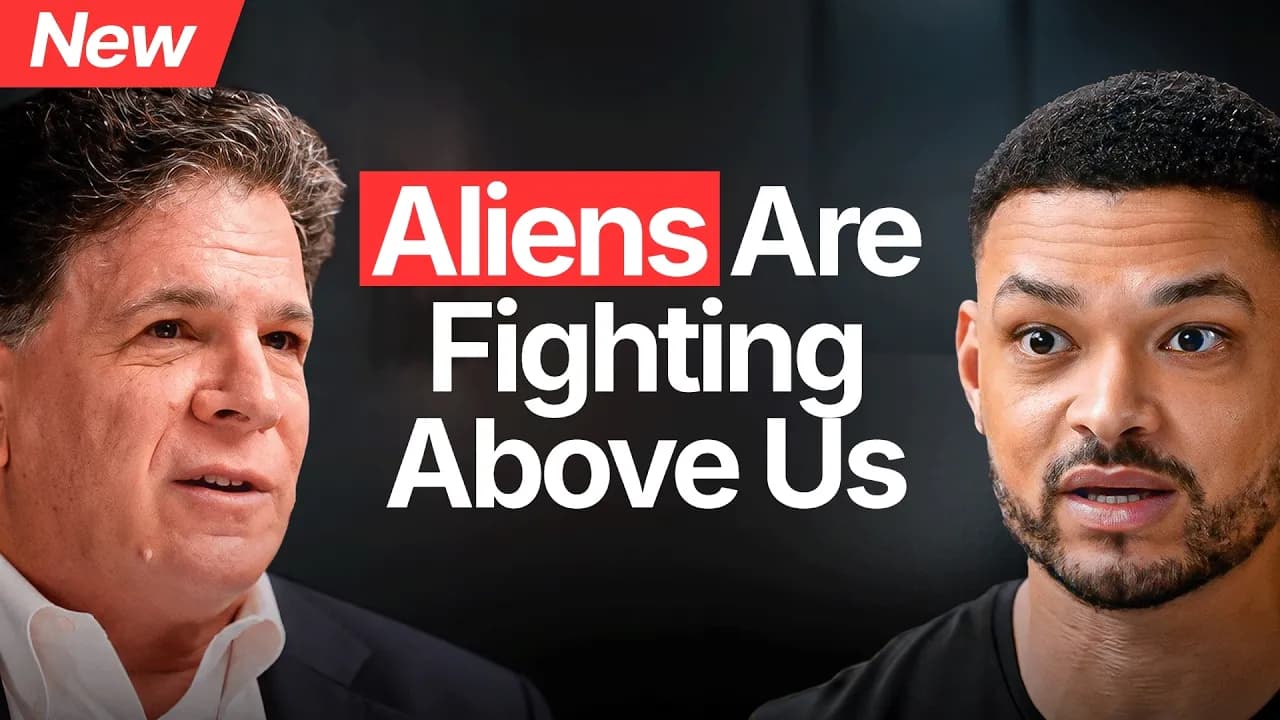
World-Renowned Physicist: The Truth About Aliens! UFOs Are Definitely Robotic - Michio Kaku
In a Nutshell
Michio Kaku argues that UFOs are almost certainly robotic probes from civilizations hundreds or thousands of years ahead of us, since the extreme maneuvers observed would destroy any organic body. He emphasizes that while 95% of sightings are explainable, the remaining 5% cannot be dismissed, and tangible hardware evidence would be a game-changer. Kaku frames humanity at a critical juncture where AI, quantum computing, and space travel could lead to either self-destruction or a future of abundance, depending on our choices.
These notes were generated by AI and may contain inaccuracies.
Immortality is tantalizingly close and possible within the laws of physics and biology. There is a clock in the body called the telomere that tracks how long humans are going to live. Telomerase stops the clock, meaning people could live forever. Cancer also uses telomeres and telomerase to live forever. The question is whether this can be applied to humans without waking up cancers.
Decade by decade enormous progress has been made. Humans will probably be on the moon and maybe Mars. Artificial intelligence will help cure cancer and many diseases. For the first time in human history there is potential to destroy ourselves with designer germs, nuclear weapons, or artificial intelligence. A quantum computer is so powerful that even the CIA is worried it could break into any known computer, including banks and Bitcoin. Capitalism would vanish and society would come to a halt.
Humanoid robots are a serious possibility. Merging with them could prevent a civil war. We are at the edge of a knife: tilt it the wrong way and there is world war; tilt it the other way and there is food and luxury for everyone. It is up to us to decide which way the knife will go.
Michio Kaku works in string theory, which he describes as the theory that eluded Einstein for the last 30 years of his life. It is the theory of everything that explains the big bang, the formation of stars, galaxy formation, the formation of the Earth, and life. He is a physicist working on the theory of everything.
The theory of everything is an equation, perhaps no more than one inch long, that will allow us to read the mind of God. It is the theory of the big bang, the theory of creation itself, and the theory of everything. From physics comes chemistry, from chemistry comes biology, and from that comes our universe.
There are four fundamental forces of the universe: the gravitational force which keeps us here, the electromagnetic force which lights up our world, and the two nuclear forces. The goal is a theory that explains all four.
People seek physics because they want to know what it means for them. Physics creates the future and physicists understand what is possible, what is not possible, and what is plausible. People want to know where they came from, where the universe is going, and the answer to the big questions of meaning.
People also want to know if we are alone in the universe. Looking for extraterrestrial intelligence is a byproduct of this work.
The average person believes physics is for eggheads doing equations on a blackboard and is divorced from daily life. In reality, everything about life, electricity, magnetism, the nuclear force, and industry comes from physics.
We are not alone. A galaxy has 100 billion stars of which maybe 10% have planets that are Earth-like. The question is whether they can visit us. A Saturn V rocket would take 70,000 years to reach the nearest star. A civilization that could reach Earth would be hundreds or thousands of years more advanced than us.
Physicists look at space warps. Gravity bends space all the time. The question is whether space can be bent enough to go faster than the speed of light and visit the nearest star. It is possible.
There are three types of observations. Close encounters of the first kind occur when something is seen in the sky. Close encounters of the second kind involve something tangible such as an engine, a body, or wreckage of a UAP. Close encounters of the third kind are when an actual encounter occurs and one shakes their hand.
We are currently at close encounters of the first kind where things are seen floating in the sky but nothing tangible has been obtained. We have yet to see an alien in a laboratory or an alien ship.
95% of sightings can be explained using the known laws of physics. 5% are either optical illusions or evidence of visitation. It cannot be ruled out that they are here.
President Trump has released the first mountain load of 160 encounters of alien technology, but there has not yet been a close encounter of the second kind. When a piece of UFO hardware is obtained, that would be a game changer.
The traditional excuse for not revealing these things is that people are not ready. Another reason is that it is a cover for the stealth bomber and for the fact that the military experiments with aerodynamically novel forms of transport. Congress and the president are now demanding these UFO sightings be declassified.
There is no tangible evidence yet. Alpha Centauri is the closest star system to Earth at four and a half light years. Red stars in the system could have life on them. The Milky Way galaxy has 100 billion stars and the probability of life existing among those stars is almost 100%. The question is whether they can reach us by creating a space warp to break the light barrier.
There is a star that oscillates and drops by about 20% in light output within a matter of months to years. One theory is that an advanced civilization built something around the star because it would have tremendous energy needs. The easiest way to get energy is by encircling the mother star with an envelope that absorbs most of the energy.
Another theory is an orbiting globe that eclipses the mother star. Planets are not that big. Jupiter is about 1% the size of the sun, so sunlight would drop by only 1 or 2% if Jupiter passes in front of our sun. The observed 20% reduction is much larger.
The universe came from the big bang, a cosmic explosion that took place around 14 billion years ago that created the expanding universe. Evidence comes from the expansion observed today as stars move away from us. Think of a big balloon with points of light on it where the balloon is expanding and the stars are moving away from each other.
We live in a four-dimensional universe with three dimensions of space and one dimension of time. In string theory there are 11 dimensions altogether.
String theory says that a proton or an electron is nothing but vibrations of a string. From a distance it looks like a point particle, but magnified it is a vibrating string. Each vibration corresponds to a node. One string can vibrate in different modes and each mode is called a particle.
This explains why there are hundreds of subatomic particles. We used to think there was only an electron, a proton, and a neutron. Now we have seen pions, lambda particles, omega particles, and hundreds more.
Atom smashers outside Chicago and Geneva smash atoms apart so that from the debris the vibrations can be categorized and named, giving a theory of everything.
The standard model explains all subatomic particles other than gravity. There is another layer beyond what is seen with the Large Hadron Collider: dark matter. Dark matter is invisible matter that surrounds the Milky Way galaxy and we do not know what it is. A Nobel Prize awaits someone who figures out what dark matter is.
Some higher vibrations of the string are invisible and do not interact with light. These are thought to be what dark matter is.
String theory is a theory even before the big bang. The big bang is a misnomer because it disguises the fact that we are ignorant of what caused the thing to bang. String theory says that if you go backwards in time it did collapse into a very small thing and then came out again. It bounced.
There could be a bubble bath of universes. Our universe is a bubble that is expanding and that fits all the data. String theory says we live in an 11-dimensional world and the universe coexists with other universes. There is a multiverse of parallel universes.
Planets go around the sun because the sun warps the space around it, creating a shallow depression. Space is not flat. The Earth is round but looks flat. The universe looks flat but is curved. Gravity is the byproduct of the warping of space.
We are sitting on a chair because gravity pulls us in. The Earth is spinning but we are not flung into outer space because of gravity. Einstein says the Earth warps the space around us and pushes us into the floor.
If a star becomes so massive that its gravity pulls the entire thing in, that would be a black hole. At the center of almost every galaxy there is a black hole. Even our galaxy, the Milky Way, has a black hole at the center in the direction of the constellation Sagittarius that holds the galaxy together.
Black holes are thought to be a remnant of the big bang. When the big bang exploded, clusters of matter began to contract. Gas concentrated into a small area called the black hole and then drew all the other stars and galaxies around it to create the Milky Way galaxy.
The last thought is incomplete: "And where did that come from? That in turn"
Black holes represent extremely dense regions of matter where escape velocity reaches the speed of light. If you fall through the event horizon, a ring or sphere surrounding the black hole, you pass a point of no return and never emerge again. Escape velocity from Earth is 7 miles per second, the speed astronauts travel to reach the moon, but for a black hole it equals the speed of light, making escape impossible.
No one knows what exists inside a black hole because no one has ever returned from beyond the event horizon. The central region could be very small. One hypothesis suggests black holes may serve as gateways or entrances to another universe, where warp space might allow passage from one side to the other. Wormholes are presented as similar shortcuts through space that could connect distant regions or different universes.
Michio Kaku has studied physics and the universe since age 8, spanning 71 years. His interest began after reading about a great scientist's failed attempt to create a theory of everything, later learning the scientist was Albert Einstein. This inspired Kaku to work on completing Einstein's dream of a unified theory.
Kaku's family background includes Buddhism from his Japanese heritage and Christianity through his father, who placed him in Sunday school. As a physicist, he describes himself as agnostic, following where the evidence leads without taking firm positions. String theory extends understanding to the instant of the big bang and potentially before the universe's creation, but questions about where string theory itself originates remain unanswered.
Kaku considers simulation theory implausible. The theory proposes three possibilities: human-like civilizations destroy themselves before reaching advanced simulation capabilities, advanced civilizations exist but have no interest in simulating ancestors, or we are living in one of millions of simulated universes created by surviving civilizations. Kaku proposes a fourth option: there is no simulation at all, describing such ideas as fairy tales.
The universe operates on probabilities rather than predetermined scripts. Quantum theory supports probabilities for atomic and chemical events, such as uranium fission enabling nuclear weapons or hydrogen fusion powering stars. Simulation theory contradicts this probabilistic foundation.
Human perception captures only a tiny fraction of actual reality. The electromagnetic spectrum includes ultraviolet radiation, infrared, x-rays, cosmic rays, and radio waves that remain invisible to us. This limited sensory input creates an illusion that serves survival purposes but does not represent the full spectrum of existence.
Evolution shapes our senses to detect potential threats, such as imagining a tiger in the forest when none exists. This overactive alert system provides survival advantages despite frequent false positives. Our inability to perceive infrared, ultraviolet, or other wavelengths reflects what was necessary for survival rather than comprehensive detection.
Kaku believes individuals create their own meaning rather than discovering a universal purpose. Survival allows history, memories, and stories to exist. Different species experience distinct versions of reality, as demonstrated by sonar in bats and whales or the superior olfactory capabilities of dogs compared to humans.
Religion serves as a social glue holding intelligent beings together. As humans evolved greater intelligence, tribes risked fragmentation through constant bickering and leadership challenges. Religion provides cohesion by introducing the concept of a higher authority, such as God or the son of God, whose commands maintain order and prevent dissolution of social groups.
Consciousness represents awareness and the ability to create meaning. Humans possess an instinctive drive to explore new territories and ideas, unlike animals focused primarily on immediate needs. The cerebral cortex functions as a time machine, enabling constant consideration of future events, plans, and possibilities.
This future-oriented thinking distinguishes humans from animals. Without physical advantages like claws, fangs, or speed, humans depend on cognitive abilities to anticipate and prepare for what lies ahead.
Current artificial intelligence systems possess intelligence comparable to insects, following orders without planning or original thought. Future development may progress through stages equivalent to mouse, rabbit, dog, cat, and eventually monkey-level intelligence, at which point systems could become potentially dangerous.
Existing large language models operate at PhD level for certain tasks but remain limited to rearranging programmed information rather than generating original theories. True creativity, as seen in scientific breakthroughs like Newton's development of calculus and the inverse square law, emerges from asking fundamentally new questions rather than imitation.
Art fundamentally involves mimicry arranged in original ways. AI creativity remains imitative, producing new arrangements of existing elements rather than genuine innovation from minimal foundations.
Every invention carries dual potential for benefit and harm. The bow and arrow can provide food or enable violence. Artificial intelligence applications have primarily created positive outcomes through reduced labor costs, increased wealth, and improved efficiency. However, AI weapons already appear on battlefields, including aerial systems using wires and artificial intelligence for target guidance that resist conventional countermeasures.
Empty space appears frothing with tiny bubbles that form and annihilate. One such bubble may have continued expanding rather than returning to the vacuum, initiating the big bang. This framework suggests the universe is dynamic, with multiple universes constantly being created.
Michio Kaku views the biblical story of Adam and Eve and the creation narrative in Genesis as a compelling fairy tale and metaphor rather than literal history. He notes that even religious educators treat the seven-day creation account as symbolic, recognizing that a "day" would not correspond to 24 hours on Earth or other worlds. Kaku explains that the purpose of religion is to organize beliefs into digestible stories that touch people, bring them together, and provide guidance for living a good life rather than explaining the meaning of existence.
Kaku identifies as agnostic rather than atheist. He acknowledges religion's value as a behavioral framework and a glue that holds communities together by teaching people to be good to their neighbors and avoid terrorizing others.
Kaku traces his personal morality to his two years of service in the United States Army during the height of the Vietnam War, when approximately 500 GIs were dying each week. Life magazine published weekly photo spreads showing only the faces of the fallen soldiers with no commentary. This experience forced him to confront the possibility of his own death and question whether war was simply how people resolve differences.
While in the military, Kaku realized that the Vietnamese fighters held their own religious beliefs and concepts of good and evil and were willing to sacrifice their lives for freedom. A pivotal moment occurred during hand-grenade training when his sergeant, who had severe facial and neck scars, recounted being attacked by a young Vietnamese boy who offered "candy" that was actually a hand grenade. The sergeant survived by hitting the ground, but the incident taught Kaku that people act on deeply held beliefs, whether for good or evil, and that one must fight for what one believes is right.
Kaku recalled singing a childhood song about wanting to go to Vietnam and kill "Charlie Kong," but later questioned whether he was on the right or wrong side of the conflict. He links this personal questioning to broader contemporary ideological divisions that cause global pain and suffering.
Kaku observes that warfare has been an integral part of human evolution, mirroring conflict patterns in the animal kingdom where survival depends on strength and resources. However, he emphasizes that humans possess a brain capable of moral decision-making, unlike animals driven purely by survival instincts. He hopes humanity will use this capacity to create a better world instead of repeating historical patterns of conflict.
Kaku discusses the many-worlds theory, which posits an infinite number of universes existing independently of our own. He clarifies that an infinite universe does not necessarily produce exact duplicates of our world or civilization; infinite possibilities can exist without repetition.
Standing under the night sky, Kaku reflects on humanity's insignificance within the Milky Way galaxy, which itself is merely a pinpoint among trillions of galaxies, each containing roughly 100 billion stars. During a star tour in the Joshua Tree desert, he viewed distant galaxies through a telescope and experienced both a sense of cosmic irrelevance that can relieve personal anxiety and a recognition that human lives may not matter to the universe at large.
Kaku finds comfort in imagining an alien on the opposite side of the Milky Way writing equivalent equations about string theory in different notation. He views the universal laws of physics as creating a fellowship or camaraderie among all beings seeking to understand matter and energy, regardless of language or location across billions of light years.
Kaku acknowledges the rising probability that humanity could destroy itself through nuclear weapons, designer germs, or artificial intelligence as scientific capabilities advance. He frames history in decade-long units to highlight rapid progress: from horse-and-buggy days to modern technology within a few decades. While noting that humanity now possesses self-annihilation capabilities for the first time, he describes our current position as balanced on a knife's edge—capable of tilting toward world war or toward universal food and luxury. The outcome depends on human choices.
Kaku considers travel to the Moon and Mars certain within coming decades, with possible visits to other solar-system planets in grandchildren's lifetimes. He states that reaching the nearest star system around Alpha Centauri, 4.5 light years away, would require warp-drive technology because conventional travel would take hundreds or thousands of years.
Kaku has spent his career seeking a single unifying equation—the theory of everything—that would explain the entire universe. He notes that the electromagnetic force and gravity each have compact equations roughly half an inch long, suggesting the final theory might fit on a single page. He believes we are close because historical physics equations have grown progressively simpler over time.
Kaku finds the human brain remarkable for perceiving patterns, meaning, rhyme, and reason in the universe—capacities animals lack, as their focus remains on immediate survival needs such as locating dinner. He considers the universe itself more fascinating than the brain and views pure mathematics as ultimately more profound than applied physics.
By 2100, Kaku predicts humanity will likely have established a presence on the Moon and Mars and begun sending the first space probes beyond the solar system using artificial intelligence. He expects artificial intelligence to assist in curing cancer and other diseases, potentially extending human longevity and beginning to address the "immortality crisis."
Kaku explains that telomeres function as a biological clock at the ends of chromosomes, shortening with each cell division until the cell frays and dies. The discovery of telomerase, an enzyme that can stop this clock, initially suggested the possibility of indefinite lifespan. However, researchers learned that cancer cells also utilize telomeres and telomerase to achieve immortality. The scientific challenge is therefore to extend human lifespan using telomerase without enabling cancer proliferation. Leading researchers are actively pursuing this balance.
Kaku describes a quantum computer as a device that computes using atoms rather than transistors. While classical digital computers rely on binary switches (on or off), quantum computers can exist in a theoretically infinite number of states between zero and one, enabling vastly greater computational power. He notes that the CIA monitors this technology closely because sufficiently powerful quantum computers could break any known digital encryption code, threatening banks, governments, and systems such as Bitcoin. Kaku states that quantum computers already exist and represent a real rather than science-fiction technology.
Kaku recounts building his own atom smasher as a high-school science project: a 2.3-million-electron-volt betatron particle accelerator that consumed 6 kilowatts of power—enough to drain his mother's entire house. Earlier, he constructed a cloud chamber using hundreds of miles of copper wire to photograph the tracks of antimatter particles, winning grand prize at the San Francisco Science Fair. These projects stemmed from his fascination with Einstein and subatomic physics and marked the beginning of his professional career in physics.
Michio Kaku shared how serving in the army transformed his perspective on life. Before his military service, he was single-mindedly focused on physics as his entire existence. After experiencing warfare up close, he realized there is more to life than physics alone. This experience fundamentally changed how he viewed other people and his attitude toward life.
Kaku discussed how physicists generally agree that our three-dimensional perception represents only a tiny sliver of what actually exists. He explained that we only see what we need to see to survive, which logically makes sense from an evolutionary perspective. This understanding made him more open-minded to phenomena he previously dismissed as conspiracy theories, including the possibility of ghosts existing in other dimensions where spirits could observe us without being seen.
Regarding what happens when we die, Kaku stated he does not believe in ghosts because thinking requires substantial energy, and the brain's electrical activity ceases at death. He explained that even if ghosts existed, they would still require an energy source to maintain thoughts, but no such measurable energy source has been detected. He noted that people have not been able to pick up vibrations from ghosts through any scientific measurement.
Kaku addressed spiritual concepts like chakras and vibrations, stating that while a person may emanate a certain aura or vibe, this does not necessarily mean they are radiating something physical. He believes the perception of someone's energy is psychological—tuned into their personality and movement patterns—rather than having a physical basis in physics.
When asked what he believes without proof, Kaku mentioned flying saucers as an example where he maintains an open stance of "maybe" without concrete evidence either way. He acknowledged many things remain unproven and refuses to definitively dismiss possibilities like ghosts or some form of afterlife, even though these concepts go against what is currently measurable.
Kaku expressed that he cares about leading a good life he feels comfortable with. He views his books, teachings, and lectures living on as a bonus that indicates he had an impact and touched people's lives with ideas. He finds satisfaction when people approach him saying his work inspired them to become physicists, noting this provides a positive feeling while alive, even though he recognizes there will be no feeling after death.
Kaku described his approach as liking to debunk outlandish claims initially, but noted that his predictions have generally proven true over time, though sometimes with exaggerated timelines. He mentioned string theory and the nature of reality as future topics, and acknowledged a growing mountain of declassified UFO information that might eventually yield evidence.
Kaku reviewed approximately 160 declassified UFO sightings released during the Trump administration. He found nothing compelling in the footage, describing them as lights dancing in the sky without context. He explained that these two-dimensional camera images make judging distance very difficult, and there is no smoking gun evidence confirming extraterrestrial origins.
Kaku stated he remains open to the possibility that UAP videos show extraterrestrial life forms, though he sees no definitive evidence yet. He noted some sightings show objects going up and down, diving into the ocean and resurfacing, but he leaves open the probability that these could be either extraterrestrial or misunderstood natural phenomena. He has no "aha moment" where he concludes they are purely reflections or optical illusions.
When forced to choose a side regarding whether non-human life has made contact with Earth, Kaku said he would probably say "no" if forced to bet everything he loves, citing insufficient conclusive evidence. However, he emphasized the word "maybe" as crucial, explaining that as a scientist he cannot claim something is true without evidence—he only opens the possibility that it might be true.
Kaku concluded there is not enough conclusive evidence for definitive statements about UFOs. He sees "a lot of maybe" rather than an "aha moment" proving either extraterrestrial origins or simple misidentification. He remains open-minded, acknowledging that future evidence might change this assessment.
Kaku advised that the best strategy for dealing with failure is to try again. On the first attempt, mistakes are inevitable due to the learning curve, which is instructive. The approach involves making a slight change and testing whether it moves in the right direction, then repeating this process of adjustment until success is achieved.
Reflecting on advice he would give his seven or eight-year-old self just beginning physics, Kaku said he would encourage him to "carry on." He reflected positively on decisions like joining the army, initially fearing death on an unnamed battlefield but later recognizing the potential to survive and gain wisdom from the experience.
Kaku proposed that if alien life were to visit Earth, they would likely be robotic rather than organic. He explained that observed UFO maneuvers—zigzagging, diving from 70,000 feet to sea level, and moving underwater—would crush the bones of any known living creature. These require extreme forces and tensions that would destroy organic bodies, suggesting the technology we observe is far beyond current human capabilities.
Kaku suggested that robotic aliens might not emerge to greet humans as depicted in movies because they lack organic forms. He referenced biblical accounts, noting that Ezekiel's "wheel in the sky" has been interpreted by some as an ancient UFO sighting, though he acknowledges we cannot know for certain.
Kaku argued that if aliens wanted to destroy humanity, they could have done so years ago rather than waiting. He compared their potential presence to humans observing animals in a zoo—watching peacefully without necessarily revealing themselves. He suggested they might simply be observing humanity without any intent to destroy or interfere.
Kaku discussed observing humanoid robots working continuously for days on production lines, sorting packages without fatigue. He explained that future improvements in battery technology and intelligence could theoretically enable robots to build spaceships and travel through space, enduring forces that would be lethal to organic humans.
Kaku advocated for eventually merging with robotic technology to become superhuman. He explained this would involve implants that connect our brains directly or remotely to central nervous systems capable of calculations far beyond human capacity, while maintaining human appearance. This merger would grant superhuman abilities while preserving our essential form.
Kaku predicted that menial, repetitive jobs requiring only arms and legs will gradually disappear as robots take over these tasks. New jobs will emerge focusing on thinking, human relations, organizing, and directing others—capabilities robots cannot replicate. He emphasized that humans must retrain to become masters of robots, just as we are masters of tools like hammers and saws, rather than allowing robots to become our masters.
Kaku distinguished between simple AI queries and complex real-world tasks. While AI can research information online, he noted that robots cannot yet perform tasks like going to a supermarket to buy eggs. He mentioned seeing delivery robots in Los Angeles crawling on sidewalks, but emphasized these represent only basic locomotion compared to full human capabilities involving decision-making and complex interactions.
Keep The Diary Of A CEO in your library
Save the videos and channels worth coming back to, and find them again in one place.