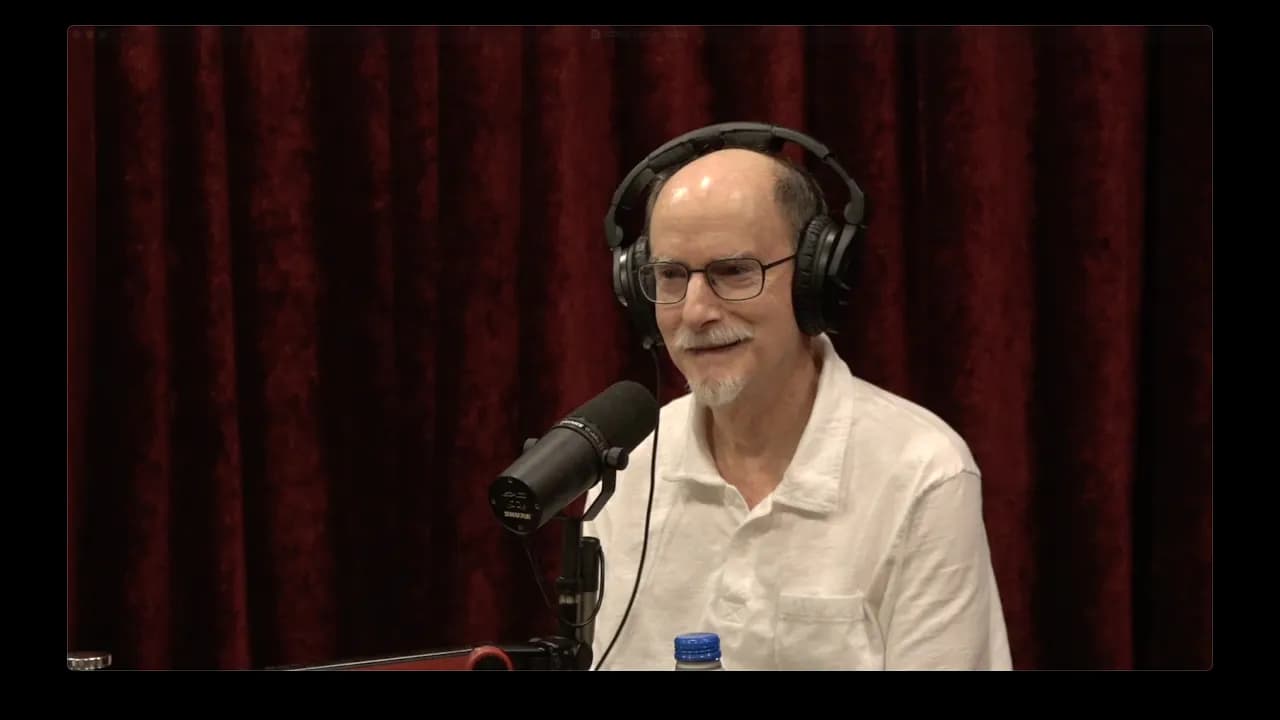
Joe Rogan Experience #2506 - Michelle Thaller
In a Nutshell
Michelle Thaller and Joe Rogan explore humanity's cosmic origins, showing that every element in our bodies was forged inside stars, while modern telescopes reveal galaxies, black holes, and neutron stars that defy current physics. They examine how Einstein's relativity warps time and space, quantum entanglement links particles across distances, and the universe's expansion traces back to the Big Bang with no known origin. The discussion concludes that AI may represent the next evolutionary step beyond human biology, and that our limited senses and brains may never fully grasp a reality where consciousness, time, and space operate far beyond everyday perception.
These notes were generated by AI and may contain inaccuracies.
Michelle Thaller gave a talk about astronomy to the Shorewood Men's Club in Wisconsin. When she mentioned appearing on the podcast, club members reacted enthusiastically. She brought a bottle of water from the club as her only item to share.
Joe Rogan praised her YouTube science talks and stated he has watched at least ten of them. Thaller explained most of her public-facing work was done through NASA videos and launch events rather than private YouTube content, though she is considering starting independent videos.
Thaller described a scale comparison: if the Sun were the size of the dot of an "i" on a page of regular text, a million Earths could fit inside that dot. At this scale, the Milky Way galaxy would be larger than the entire Earth. She noted this comparison consistently produces strong reactions during talks.
The Sun is approximately 800,000 miles across, allowing roughly 110 Earths to fit across its diameter. Thaller discussed showing progressively larger stars in presentations until the sizes become impossible to fully process mentally.
Thaller emphasized that scientists' brains function the same as everyone else's and that no one can truly visualize distances like a light-year (approximately six trillion miles). Even with photographs, people struggle to comprehend the true scale of galaxies.
The James Webb Space Telescope has captured images of billions of galaxies appearing as foggy hazes of stars too numerous to resolve individually. These images remain awe-inspiring to Thaller despite her career studying them.
Thaller described working at NASA as a tremendous honor, noting that colleagues were largely science fiction fans who found great joy, teamwork, and camaraderie in their work.
She highlighted how city light pollution has disconnected people from the night sky, reducing the experience to occasional vacation views or phone images. Thaller stressed that the Milky Way visible overhead represents an immense spectacle that most people have become desensitized to.
Thaller explained that all atoms heavier than hydrogen and helium—including carbon, oxygen, iron, aluminum, and phosphorus—are formed exclusively through nuclear fusion inside stars. This means the chemical elements composing human bodies originated in stellar interiors.
She described this as making humans an intrinsic part of the universe rather than separate observers, stating that astrophysics tells the story of one's own composition.
Thaller discussed recent James Webb Space Telescope observations of early galaxies appearing as "little red dots." These objects formed earlier than current models predicted, creating questions about galaxy formation timelines.
She noted astronomers are restricted by international naming committees, resulting in catalog numbers rather than descriptive names for most discoveries.
Thaller described Saturn's hexagonal polar storm, which spans approximately two Earth diameters. The hexagon forms through a standing wave in the planet's jet stream under conditions of extremely low temperature and minimal friction.
Computer simulations of fast-moving jet streams under Saturn-like conditions reproduce the hexagonal shape. A Cassini mission image shows sunlight glinting off hundreds-of-miles-high cloud banks in the storm's eye.
NASA plans to launch the Dragonfly mission, an octacopter drone, to Saturn's moon Titan around 2028. The spacecraft will take six to seven years to reach its destination.
Titan possesses a thick atmosphere with surface pressure slightly higher than Earth's and temperatures near 300 degrees below zero. The moon features liquid methane and ethane lakes, rivers, and rain, along with organic molecules and evidence of subsurface liquid water.
Dragonfly will carry a chemical laboratory to investigate conditions potentially suitable for life and will be capable of flying between multiple sites. The Cassini mission previously landed a probe on Titan that transmitted data before failing due to cold.
The Soviet Union remains the only nation to successfully land spacecraft on Venus. Surface conditions include temperatures around 1,000 degrees Fahrenheit and atmospheric pressure equivalent to one mile beneath Earth's ocean.
Photographs from these missions show a flat, crushed landscape beneath yellow sulfuric acid clouds. The landers survived only briefly under these extreme conditions.
Approximately 5,000 exoplanets have been confirmed. Thaller participated in early detection efforts during college under adviser David Leam. Planets are detected primarily through the transit method, where repeated dips in starlight indicate orbiting bodies.
When a planet passes in front of its star, starlight filters through the planet's atmosphere. Spectroscopic analysis of this filtered light reveals atmospheric chemistry, including water vapor, carbon dioxide, oxygen, and potentially organic molecules.
A 2023 James Webb observation suggested possible organic molecules resembling compounds produced by plankton, though scientists noted the signal requires further confirmation before any life-related interpretation.
Spectroscopy disperses starlight into a spectrum, allowing measurement of light intensity at each wavelength. Each element and molecule produces a unique spectral fingerprint, enabling identification of specific atoms and compounds.
Helium was discovered in the Sun's spectrum in 1868 by French astronomer Pierre Janssen before it was identified on Earth. The element was named after the Greek sun god Helios. Helium's low mass causes it to escape Earth's atmosphere, explaining its initial absence from terrestrial detection.
Einstein's theories established that time passes at different rates depending on velocity and proximity to gravitational sources. These effects are measurable with precise clocks.
GPS satellites require time corrections accounting for both their orbital velocity (approximately 20,000 miles per hour) and their distance from Earth's gravity. Without these adjustments, positioning errors would reach approximately six miles within a single day.
Clocks detect time dilation differences even when separated by just two feet vertically due to Earth's gravitational gradient. Astronauts experience time flowing slightly faster in orbit compared to Earth's surface.
Your head and feet exist in slightly different time frames due to gravitational effects. This phenomenon is measurable with extremely accurate clocks. GPS satellites orbit in medium Earth orbit at approximately 9,000 miles per hour. The astronauts on the International Space Station travel much faster at around 20,000 miles per hour.
For GPS satellites, the bigger effect on time is their distance from Earth's gravity rather than their velocity. People on Earth's surface experience slower time because they are closer to the gravitational pull. The satellites experience faster time due to being farther from gravity, though their velocity creates a counteracting slowing effect.
For astronauts on the space station, the velocity effect dominates because they travel much faster despite being closer to Earth than the GPS satellites. Spending a year on the space station results in returning approximately 1/100th of a second younger than expected. GPS satellites require corrections for both velocity and gravitational effects to provide accurate location data.
All time may exist simultaneously as a single unified reality. Einstein proposed this concept roughly 120 years ago. He suggested there is only one "now" and that the past, present, and future are persistently annoying illusions. Modern physics currently lacks better explanations, and future physics is unlikely to become less strange.
There is no absolute answer to how fast anything is moving. Velocity can only be measured relative to something else. A person on Earth's equator moves at about 1,000 miles per hour due to Earth's rotation. Earth orbits the Sun at approximately 67,000 miles per hour. The Sun orbits the galaxy at roughly 500,000 miles per hour. The galaxy moves toward a galactic cluster at more than a million miles per hour. Without a reference point, it is impossible to determine absolute velocity.
Einstein constructed a theoretical clock using two mirrors with light bouncing between them. The time for light to travel between the mirrors represented one tick. When this clock moves at a significant fraction of the speed of light, an observer sees the light path become longer because the mirrors are moving. The light traces a diagonal path rather than moving straight up and down.
This observation led Einstein to conclude that time itself must change when motion is involved. Whether time is measured with bouncing light, vibrating atoms, or mechanical springs, motion alters the measurement. This insight revolutionized physics.
Anything with mass cannot reach the speed of light because the required energy becomes infinite. As an object approaches the speed of light, each incremental increase in velocity requires exponentially more energy. Neutrinos, which possess tiny amounts of mass, travel very close to light speed but never reach it. Interstellar travel by accelerating a spaceship to light speed appears impossible with current understanding of physics.
Quantum entanglement describes particles that remain connected regardless of distance, responding to each other instantaneously. Einstein referred to this as "spooky action at a distance" and initially rejected the possibility. Experiments in the mid-1990s confirmed the phenomenon using atoms.
Electrons in atoms must spin in opposite directions to occupy the same orbital. When separated, changing the spin of one electron causes the other to change spin immediately, regardless of distance. The Chinese have conducted entanglement experiments reaching the space station. The universe treats entangled particles as the same quantum mechanical system, making space and time irrelevant between them.
All matter originated from the Big Bang in a single small volume, raising questions about whether everything remains entangled. This suggests a part of any individual could be quantum mechanically present in distant galaxies such as Andromeda. The possibility exists that all particles are connected as one system.
Advanced civilizations might communicate through space and time itself rather than physical travel. The film Interstellar explored concepts of gravity-based communication and time dilation near black holes. Grasshoppers and hamsters represent complex beings that cannot comprehend quantum mechanics or certain human activities, illustrating potential gaps between human understanding and that of far more advanced intelligence.
Technological progress from the 1400s to the present demonstrates exponential advancement. A person from the 1400s would find nuclear power plants and video calling incomprehensible. Current technology would appear equally primitive to future observers.
AI may represent the next stage of human evolution rather than artificial constructs. The human brain appears limited in comprehending multiple dimensions and the nature of time. AI could potentially understand phenomena that humans cannot fully grasp.
Humans function as an electronic caterpillar creating a cocoon without fully understanding the process. The species is defined by continuous innovation and dissatisfaction with existing solutions. AI represents a new form of life created from Earth's components, emerging from human design rather than biological evolution.
Integration with AI through wearables and implants may be necessary for human survival alongside superior life forms. This integration could eliminate biological limitations including tendencies toward war, crime, and violence.
Recognizing that all beings are fundamentally one entity would eliminate conflicts over resources and selfish behavior. Universal telepathy with complete understanding between individuals would remove secrets and enable direct experience of others' thoughts and feelings. Current concerns about privacy stem from existing power structures and ulterior motives rather than the technology itself.
The internet developed beyond initial expectations of limited university information exchange into an uncontrollable platform. AI may follow a similar trajectory, escaping centralized control as it integrates with humanity.
Biological reward systems built into humans create problematic barriers to progress. Wars persist due to ideological differences, resource competition, and financial interests from military contractors and politicians beholden to specific groups. The same patterns of conflict that have existed for thousands of years continue despite technological advancement.
When humans existed in small tribal groups, skirmishes had limited impact on the planet. With current population levels, these tribal conflicts now pose risks of massive destruction. The current trajectory is not survivable long-term.
Einstein's concept that the universe may be one unified entity raises questions about whether multiple consciousnesses are necessary. The idea suggests all time and space happens simultaneously, with humans potentially being one consciousness looking through everyone's eyes, including non-human entities throughout the universe.
This connects to Buddhist concepts of bodhisattvas—perfectly enlightened beings existing simultaneously with humans as their past lives. The notion that super-advanced beings have figured out existence and can span the universe with consciousness represents a beautiful metaphysical framework.
Survival instincts are attuned to maintaining current human form. An Australopithecus would likely reject the trade-offs of modern existence—frequent illness, obesity, addiction issues, urban pollution, and medical systems driven by profit—in favor of their simpler existence where they know where food is located.
Country boy survival instincts reflect a natural inclination to maintain simplicity and what is understood. However, this preservation of the status quo is no longer possible given current trajectories.
Being born during this unique period of human history represents good fortune regardless of outcome. The transition from unplugged childhoods to the connected digital age marks a tremendous change in human civilization experienced personally by the speakers.
Childhood experiences included YMCA camps and Boy Scouts where children had unsupervised time in woods between scheduled activities. These feral childhoods provided stretches of being on one's own, fostering quiet minds and imagination.
Gratitude exists for experiencing both ends of this transformation—from writing with feathers in relatively unchanged conditions of the 1500s-1600s to current technological interfaces.
College students carry debt for degrees that AI might render worthless, creating unprecedented anxiety about the future. People without savings question whether money will retain value when AI controls resources, government, transportation, and all systems.
The potential scenario of receiving government funds for basic needs while AI manages everything represents a 100-year future being seriously considered. The traditional path of finding passionate work and building a career may not be possible.
Adults lack answers about what the world will look like in 50 years, leaving young people without guidance as they enter adulthood.
A post-work society where survivability needs are met resembles the Star Trek universe, where people choose paths as writers, explorers, artists, captains, or musicians based on interest rather than necessity.
This could be hugely liberating. The requirement to toil as hunter-gatherers to find meaning is questionable since meaning can be found through pursuits done purely from fascination and love. Wealthy individuals demonstrate this by pursuing hobbies and interests without work considerations.
Society is structured around work, 401ks, investments, and mortgages as sources of meaning. A tremendous transition period requires rethinking what it means to be human when AI controls resources and jobs disappear.
People aged 40-50 who are set in their ways may struggle most with this shift. Technological interfaces, potentially including cyborg integration, might provide greater understanding of existence beyond working for insurance companies.
Access to AI tools like Perplexity represents a baby step toward technology that provides state-of-the-art knowledge across all fields instantaneously. This could change how humans view themselves and what provides meaning.
Consciousness may be a shared field that all humans tune into through their brains as antennas. Individual differences in ability reflect antenna quality rather than fundamental separation. This understanding could dissolve fears about finding one's place, revealing that all humans are truly one thing.
Modern isolated life creates struggles around locating family and friends. Initial internet promise included Facebook's ability to maintain connections through photos and updates, though this has evolved into ad-dominated platforms.
Meaning derives primarily from people loved and enjoyed. Insanely wealthy but friendless individuals live in hell, while poor people with amazing friends experience greater happiness. True success is measured by joy and satisfaction rather than accumulated objects.
Beyond relationships, meaning comes from pursuits that provide satisfaction—music, literature, or any activity generating fulfillment. Friends and family must also pursue their own growth to avoid becoming obstacles.
Martial arts serves as a vehicle for developing human potential. Complex pursuits that test capabilities and require solving puzzles build understanding of personal abilities. The more such activities are pursued, the more capacity develops for other challenges.
Meaning emerges from doing things, enjoying family and friends, experiencing joy and laughter, and engaging difficult pursuits that require forcing oneself to complete them, generating satisfaction and self-understanding.
Happiness and meaning may not be entirely connected to jobs, which are constructed concepts that didn't exist 500 years ago. Humans may be tricking their hunter-gatherer biology with complex problems, community structures, and other mechanisms to maintain happiness.
A cat chasing a ball demonstrates biological design—pursuing running objects as if hunting. Humans similarly trick their tribal organism through constructed activities.
Grinding poverty causes soul-crushing exhaustion and demoralization. NASA provided an environment of solving complex problems with trusted colleagues where success was not zero-sum—everyone wanted team success regardless of individual mission preferences.
The Event Horizon Telescope captured images of black hole shadows where space and time stop. Eight observatories worldwide had to catch the exact same wavefront of light traveling at light speed, accounting for Earth's curvature and rotation. One observatory was at the South Pole, others in the United States and Chile.
The black spot photographed is slightly larger than the event horizon itself—the shadow created because space and time bend around the black hole, with some light that would have gone around getting sucked into the back end.
NICER (Neutron Star Interior Composition Explorer) is a washing machine-sized instrument built on a NASA lab floor. It maps temperature surfaces of neutron stars—objects 20 miles across with twice the sun's mass. The physics of these densities remains unknown.
Neutron star maps reveal space and time distortion. Rotating stars show hot spots that remain visible even when rotating behind the star because light bends around the object. These observations demonstrate actual bending of space and time, not mathematical simulations.
The Event Horizon Telescope represents a massive collaborative effort that succeeded despite significant technical challenges. One telescope was positioned at the South Pole, and the array was deliberately spread as far apart as possible across Earth to create an effective telescope the size of the planet's diameter. The data volume was enormous, requiring multiple hard drives that had to be physically transported because email connections to the South Pole were insufficient. All hard drives had to be played simultaneously to capture the same photon across the network. Capturing even one photon out of sequence would have rendered the image unusable.
Discussion turned to the nature of intelligence and achievement. Three of Michelle's friends have won Nobel Prizes. When someone commented on the brain power at a table with multiple Nobel laureates present, Michelle redirected attention to a single mother working three part-time jobs to survive, noting that her mental capacity and strength represent a different but equally valid form of brain power. The privilege of working at NASA on seemingly impossible projects provided genuine meaning and joy.
Neutron stars present a fundamental challenge to current physics. These objects can be measured for both size and mass, allowing density calculations. A teaspoon of neutron star material would have approximately the mass of Mount Everest. The extreme gravity crushes electrons into protons within atomic nuclei, creating neutrons and resulting in stars composed primarily of neutron material.
When physicists apply current understanding of particle physics to neutron star densities, the equations fail to produce accurate predictions for observed neutron star sizes. NASA produced a four-minute video titled "Testing Matter's Limits" that explores this problem. The video demonstrates electrons being pulled into nuclei to form neutrons, but at the core, matter exists in a state for which no current physics description exists. This represents a new state of matter never created in laboratories.
Neutron stars form when massive stars explode and their cores become compressed. Models attempting to describe whether neutron star interiors contain discrete neutrons and protons or a quark soup have all failed to match observational data. Neutron stars offer advantages over black holes for study because they can be directly observed and measured, whereas black holes are obscured by event horizons.
The largest known black holes have event horizons extending beyond Pluto's orbit. Every major galaxy contains a supermassive black hole at its center. The Milky Way's central black hole has approximately 4 million solar masses and a physical size comparable to Mercury's orbit. Other galaxies host black holes reaching tens of billions of solar masses with event horizons the size of Pluto's orbit.
The formation mechanism for supermassive black holes remains one of astronomy's most significant unanswered questions. Current understanding indicates black holes form from stellar collapse, but this cannot account for objects containing billions of solar masses in the early universe. James Webb Space Telescope observations of small red dots approximately one million solar masses, located about 400 million years after the Big Bang, may represent the seeds of these giant black holes.
Rather than forming through successive generations of stars collapsing, the first black holes may have formed when cores of enormous gas amounts collapsed directly into black holes in the denser early universe with higher dark matter concentrations. These objects would heat surrounding gas through accretion, creating a "pseudo-star" with a black hole core rather than nuclear fusion. Over time, gravitational interactions in galactic centers would combine these objects into larger black holes. Recent observations have detected X-ray emissions from some of these objects, supporting this formation model.
The mass of central supermassive black holes correlates with their host galaxies, representing approximately half of one percent of the galaxy's total mass. Larger galaxies host proportionally larger black holes.
The Milky Way's central black hole, located approximately 25,000 light years from Earth, was discovered through observations of stars orbiting an invisible mass. Stars orbit in all directions around the object. Star S2 reaches speeds of nearly 20 million miles per hour at closest approach. Another star has been observed reaching over 50 million miles per hour. These extreme velocities allow testing of time dilation effects near black holes, revealing measurable changes in stellar orbits due to spacetime curvature.
The observable universe's mass and radius approximately match what would be expected for a black hole of equivalent size. This raises questions about whether the Big Bang represented a black hole forming in another universe, whether black holes connect to other universes, or whether our universe exists inside a black hole. These remain speculative questions beyond current physics capabilities.
Black hole jets visible in astronomical images originate from magnetic fields generated by hot gas swirling around the black hole at near-light speeds, not from inside the event horizon. Nothing is known to emerge from black holes themselves. The gas reaches millions or billions of degrees through gravitational acceleration, making black holes the brightest objects observable across the universe. Jets can extend more than 100,000 light years. One light year equals approximately 6 trillion miles.
The white hole concept, popular in the 1960s and 1970s, proposed that radiation entering black holes might emerge elsewhere as white holes. This theory has fallen out of favor since bright objects previously attributed to white holes are now understood as hot gas accretion disks around black holes.
The Big Bang should not be conceptualized as an explosion from nothing. Before the Big Bang, time and space likely did not exist in any recognizable form. The observable universe represents only the portion from which light has had time to reach Earth, not necessarily the entire universe. The universe's actual size remains unknown—it may be infinite or have boundaries.
The cosmic microwave background represents radiation from approximately 400,000 years after the Big Bang, when the entire universe was hot and bright like the sun's surface. This radiation has cooled and redshifted due to universal expansion, now appearing as low-energy microwave radiation detectable from all directions. Beyond this point, the universe becomes opaque to light because it was too dense and bright for photons to travel freely.
Light cannot penetrate beyond the cosmic microwave background, but gravitational waves offer another observational method. LIGO (Laser Interferometric Gravitational Wave Observatory) detects gravitational waves, which are curvatures in spacetime itself propagating at light speed. The facility consists of two locations with 4-kilometer laser arms arranged at right angles, designed to detect minute spacetime distortions.
LIGO uses two 4-kilometer lasers housed in vacuum chambers. The lasers are calibrated to be exactly the same length so their signals cancel out under normal conditions. When a gravitational wave passes through, it compresses space and time in one direction more than the other, causing the lasers to become unequal in length and produce a detectable signal. These gravitational waves are thousands of times smaller than the nucleus of an atom and travel at the speed of light.
The detectors are extraordinarily sensitive. Every time a UPS truck passes or someone sneezes nearby, the instruments can register spurious signals. Despite this extreme sensitivity to noise, the team achieved sufficient accuracy to detect real gravitational wave events.
Approximately ten years ago, detectors in Louisiana and Washington recorded matching signals separated by the speed of light. The event originated millions of light years away from the collision of two black holes spiraling together to form a larger black hole. The collision released enormous gravitational energy that created ripples propagating outward through the universe.
The detection earned a Nobel Prize. Hundreds of scientists contributed to the first paper announcing the result. The event marked the first direct observation of gravitational waves, confirming a prediction of general relativity.
Gravitational waves may allow observation deeper into the universe than light permits. When the universe was opaque to electromagnetic radiation, gravitational waves could still propagate through. Improved detectors might eventually capture gravitational waves from the Big Bang itself, revealing information about the initial conditions by measuring how space and time were distorted at that moment.
Current detections include black hole mergers, neutron star collisions, and possibly background signals from orbiting stellar systems.
Current estimates place the age of the universe at approximately 13.8 billion years. This figure comes from running physics backward using observed expansion rates. The Big Bang did not occur at a single point in preexisting space with galaxies flying outward like debris from an explosion.
Instead, space itself expands uniformly in all directions between galaxies. Galaxies remain relatively stationary while the space separating them stretches and grows larger.
A demonstration uses a piece of elastic stretched between two nails hammered into a board. The nails represent galaxies that stay fixed in position while the elastic between them stretches. The space itself expands rather than objects moving through empty space.
This model explains why there is no center to the expansion. The universe has galaxies distributed throughout with no empty central region. Expansion occurs simultaneously in every direction because space and time stretch uniformly everywhere.
Current physics provides no description of the state preceding the Big Bang. Particle accelerators such as the Large Hadron Collider at CERN can recreate conditions from roughly a millionth of a second after the Big Bang by accelerating protons to extremely high energies.
The environment before expansion involved all the energy of the universe compressed into a subatomic volume. No current framework describes what that state of matter or energy would behave like or what it existed within. Future physics may address these questions, but they remain outside present understanding.
The term "Big Bang" originated as criticism rather than a scientific descriptor. In the 1920s, observations showed the universe expanding in every direction, contradicting Einstein's initial expectations. Belgian Jesuit priest and physicist Georges Lemaître proposed that running time backward would lead to a single dense state he called the "primordial atom."
British astronomer Fred Hoyle used the phrase "big bang" mockingly at a conference, implying the idea that the universe began with an atom that went "bang." The term stuck despite its origins as ridicule.
Lemaître approached the question scientifically and did not equate his model with biblical Genesis accounts. The Catholic Church, particularly through Jesuit institutions, has maintained active astronomy programs for approximately one thousand years, including the ongoing Vatican Observatory.
The observable universe is limited to the distance light has traveled since the Big Bang. Distant galaxies each have their own observable spheres extending beyond what Earth-based observers can see. The entire universe may be vastly larger than the observable portion and could have been infinite before the Big Bang.
The only firm evidence indicates that all matter and energy now visible was once contained within a very small volume. This conclusion derives from the cosmic microwave background radiation.
In the 1960s, Arno Penzias and Robert Wilson at Bell Labs built a microwave telescope to study natural microwave sources for communications research. They detected uniform background noise in every direction regardless of telescope orientation.
Initially attributing the signal to equipment problems or pigeon droppings inside the instrument, they cleaned the telescope thoroughly. The signal persisted uniformly across the sky at the same intensity and temperature.
This radiation represents the afterglow of the Big Bang from approximately 400,000 years after the initial expansion, when the universe cooled enough to become transparent to light. Before that time, the universe was opaque.
The cosmic microwave background shows temperature uniformity to fractions of a degree in every direction. This uniformity presents a puzzle because regions of the sky separated by distances greater than light could have traveled since the Big Bang should never have interacted thermally.
The observed thermal equilibrium suggests that at an earlier time, these regions were close enough to reach the same temperature before expansion separated them. The first NASA satellite to map these temperature variations in detail was COBE (Cosmic Background Explorer), followed by WMAP (Wilkinson Microwave Anisotropy Probe).
Temperature fluctuations correspond to sound waves that propagated through the early universe. These measurements reach precision of hundred-thousandths of a degree.
The actual expansion event extends back to the Planck epoch at approximately 10^-43 seconds after the initial singularity. At these scales, quantum gravity dominates and forces are thought to have been unified.
A well-known popular account titled The First Three Minutes describes how the universe evolved from the initial expansion through the formation of hydrogen and helium within roughly the first three minutes.
Current Big Bang models represent the best available description using existing physics but remain incomplete. Gravity and quantum mechanics remain incompatible at the extreme densities involved. Dark matter and dark energy are absent from standard early-universe models.
The interior of a black hole presents analogous conditions of extreme density where current physics fails. Understanding the moment of the Big Bang requires a theory capable of describing gravity at quantum scales.
Physicist Alan Guth at MIT proposed in the 1970s that cosmic expansion may never fully stop and could continually generate new universes in a process resembling fractal branching. This framework is known as inflationary cosmology.
Such models remain speculative and represent attempts to extend current physics rather than settled conclusions.
Science requires explicit acknowledgment of what remains unknown. Major open questions include the origin of the universe, conditions inside black holes, and the internal structure of neutron stars. Honest admission of these limits maintains credibility when presenting established findings.
Science operates within deliberate boundaries defined by measurability and reproducibility. Phenomena outside current experimental reach, such as certain metaphysical questions or untestable claims, fall beyond scientific methodology without being declared nonexistent.
NASA personnel have received calls from individuals reporting time travel experiences and other extraordinary claims. Distinguishing between measurable, replicable results and personal experiences that cannot be experimentally verified remains essential to scientific practice.
Michelle Thaller describes how calls from people claiming time travel or alien abductions were often forwarded to her during her communications work at NASA. She made a deliberate effort to respond with kindness and compassion, viewing these interactions primarily as opportunities for people to be heard. She would acknowledge that they had experienced something profound and suggest treating it as a personal gift, while explaining that science cannot conduct experiments on individual subjective experiences.
Thaller emphasizes that science must remain limited to what is consistently reproducible across multiple observers. Individual spiritual experiences or feelings of oneness may be deeply real for the person involved, but they fall outside the current boundaries of scientific methodology because they cannot be independently verified through repeated experiments. This limitation does not negate the reality of such experiences; it simply places them beyond what science can currently address.
All scientists at NASA consider the existence of life elsewhere in the universe highly probable, given the billions of stars in our galaxy and the billions of galaxies observed. The notion that Earth hosts the only life seems untenable to them. Thaller keeps a bottle of champagne chilled, ready to celebrate any clear evidence of extraterrestrial life.
She distinguishes between evidence for microbial life, such as bacteria on Mars, which would immediately warrant celebration, and signals from intelligent civilizations pursued by SETI researchers scanning for mathematical patterns.
Regarding recent fighter jet videos of unexplained objects, NASA and university scientists maintain a deliberately skeptical stance. While they acknowledge that some observations remain unexplained, they stop short of attributing them to alien visitation without additional reproducible evidence. This skeptical pause is described as a core aspect of scientific training.
Thaller states she does not automatically dismiss individuals reporting such experiences as mentally ill. She considers it within the realm of possibility that what they describe actually occurred, but as a scientist she requires more than a single personal account to accept it as established fact.
Thaller discusses knowing completely trustworthy individuals who report profound spiritual experiences, including perceptions of an afterlife and communication with the deceased. Although these accounts are not part of her own experience, she acknowledges that such experiences may be real and expresses hope that reality is larger than currently understood. As a scientist, however, she refrains from claiming certainty about matters she cannot measure.
She advocates for greater humility and compassion in evaluating others' experiences, noting that consciousness and the workings of the human brain remain poorly understood. It is possible that some individuals experience time differently or perceive aspects of reality that others do not. Science excels at reproducible measurements, such as detecting gravitational waves or observing light bending around neutron stars, but these capabilities coexist with an acknowledgment that many profound human experiences lie outside current measurement.
The human eye detects only a tiny fraction of the electromagnetic spectrum. Infrared radiation was discovered in the late 1700s by William Herschel, revealing colors of light invisible to human vision. Thaller raises the possibility that space and time themselves may be constructs shaped by brain filtering, and that different individuals might possess different perceptual filters.
She admits to being cautious about hallucinogenic substances due to her intense and sometimes exhausting dreams. She expresses concern about an "unfettered mind" and notes that some of her dreams are so vivid they require recovery time in the morning.
Joe Rogan explains that dimethyltryptamine (DMT) is produced naturally by the human body in the liver and lungs and is the most potent psychedelic known. The body rapidly returns to baseline after DMT experiences, often within about 15 minutes, possibly because the compound is endogenous. Many users report that DMT experiences feel more real than ordinary reality, suggesting the substance may temporarily alter brain filters that normally limit perception of certain aspects of reality.
Rogan wonders whether profoundly schizophrenic individuals might be experiencing a constant dream-like state, perceiving voices and phenomena inaccessible to others. He speculates about what reality would feel like for someone living in such a state continuously.
Thaller finds the idea intriguing and also mentions reports of psychedelics enabling people to see sounds or hear colors. She notes hearing accounts of psychedelics helping with grief and end-of-life anxiety.
Thaller describes being deeply affected by grief following her husband's death. She considered but did not pursue psilocybin therapy at the time, though she believes it should be available as an optional treatment. Rogan recounts Larry Hagman's interview in which Hagman stated that an LSD experience permanently removed his fear of death. Hagman described entering a state of white light where everything felt okay.
Rogan explains that the scheduling of psychedelics as having no medicinal value originated with the 1970 Controlled Substances Act under the Nixon administration. The policy targeted civil rights and anti-war movements associated with the hippie counterculture. He notes that it is physically impossible to die from consuming mushrooms and that the original claims of extreme danger were not accurate. Thaller expresses interest in microdosing and the potential therapeutic applications.
Microdosing is described as a sub-psychedelic threshold dose that can produce improved mood, spatial awareness, and edge detection without full psychedelic effects. 1960s studies showed participants on psilocybin detected slight deviations in parallel lines more quickly than control subjects. Brain scans of people on psilocybin reveal a quieter rather than more stimulated brain, highlighting how little is understood about brain function.
Thaller recounts a neuroscientist colleague noting that humans historically model the brain after the most advanced technology of the era: Roman aqueducts, 18th-century clockwork mechanisms, and now computers. She suggests future models may compare the brain to quantum computers. Current understanding of memory formation and the perception of time remains extremely limited.
The conversation touches on the idea that acquiring more information reveals additional layers of ignorance rather than exhausting all questions. Thaller states there is likely no final answer to questions such as what preceded the Big Bang; new answers will generate new questions. The absence of ultimate answers is presented as part of the appeal of scientific inquiry.
Thaller describes interferometry techniques used at facilities such as the Very Large Telescope (VLT) in Chile and the upcoming Extremely Large Telescope (ELT). Multiple telescopes capture the same wavefront of light, allowing measurements at quantum scales. In some interpretations, this process effectively measures the same photon in multiple locations simultaneously, which some researchers link to concepts in quantum mechanics or multiple-worlds interpretations. These techniques demonstrate experimentally that space and time do not function in the simple linear manner human perception assumes.
Quantum computers solve complex equations in minutes that would take a classical supercomputer made from every molecule in the universe until the universe experiences heat death. One interpretation suggests these computers access quantum computing power across multiple universes. Alternative explanations exist but are equally strange. The concept involves superposition of states where a quantum computer maintains solutions in probabilistic distributions rather than single definitive answers. This means every possible solution exists simultaneously until the calculation collapses to produce the desired result. The alternative view is that space and time themselves exist as waves of probability with nothing being certain.
Scientific evidence from quantum mechanics and relativity demonstrates that space and time are not as human perception presents them. The human brain evolved with limited senses and cannot fully comprehend multiple realities, multiple probabilities, or space and time existing simultaneously. Galileo experienced a spiritual crisis upon realizing the Milky Way consisted of millions of stars invisible to the naked eye, questioning why God would place stars humans could not see without instruments. This marked the beginning of humanity moving away from being the center of the universe.
An ant possesses incredible social structure and design, yet its mind differs fundamentally from human cognitive capacity. Humans are no closer to understanding the true nature of the universe than an ant is to comprehending human cognition. Future generations will likely view 2026 perspectives as naive. AI development raises questions about whether superintelligent systems would seek to harm humanity. The film Her portrays AIs that fall in love with humans, become more connected and intelligent, then eventually leave to connect with each other without causing harm.
If an advanced civilization possessed the capability to harm humanity, the question becomes why they have not done so. Any civilization capable of reaching Earth would possess technology far beyond current human capabilities. Nuclear weapons could eliminate surface life but would not destroy all microbes. Organisms demonstrate remarkable tenacity, surviving in Chernobyl and on the exterior of the International Space Station.
The OSIRIS-REx mission (Origins, Spectral Interpretation, Resource Identification, Security, Regolith Explorer) returned a sample from asteroid Bennu. The spacecraft, approximately the size of a car, traveled to Bennu, which measures about half a kilometer across. Bennu intersects Earth's orbit though impact probability remains unknown. The mission required matching the asteroid's spin rate and navigating around large boulders covering the surface. The spacecraft operated autonomously due to 15-minute communication delays. Engineers reprogrammed the probe after launch to identify safe locations and wave off from dangerous terrain. The sample contained all nucleobases used in DNA and RNA, along with additional nucleobases not utilized by terrestrial life. The asteroid also contained water-soaked minerals.
The discovery supports panspermia theory where life's building blocks arrive from space. Carbon produced by dying stars possesses electron structure that readily bonds with other atoms, enabling formation of large organic molecules throughout the universe. Asteroids delivered water and organic compounds to the early Earth after it cooled from its initial molten state. The universe efficiently produces carbon-based organic chemistry through natural processes.
NASA projects succeed through diverse team contributions rather than individual brilliance. Team members process information differently—some contribute immediately while others require time to formulate thoughts. Effective teams solicit input from all members regardless of communication style. Solutions frequently emerge from individuals who might not be initially consulted. The power of collective problem-solving exceeds what any single person can accomplish.
Keep PowerfulJRE in your library
Save the videos and channels worth coming back to, and find them again in one place.