You’re Not Depressed, You’re Living The Wrong Life - Jimmy Carr
In a Nutshell
Jimmy Carr argues that widespread depression and anxiety stem from societal arrangements that isolate people and invert Maslow's hierarchy, where individuals chase self-actualization without basic needs like friendship and housing being met. The solution involves embracing simplicity over complexity, building social connections through group activities, and giving yourself irrefutable proof of who you are through consistent action rather than accumulating options or overthinking. He advocates for taking ownership of your problems early, finding obsessions that feel like play to you, and recognizing that favorable conditions never arrive—you must act despite unfavorable circumstances.
These notes were generated by AI and may contain inaccuracies.
Jimmy Carr performs 250-300 shows per year, often doing two shows per night at 7:00 and 9:30. He views shows as the enjoyable part of the job, with travel being the hassle. One show goes to the tax man and the other is for him. This high volume of shows reduces stress levels because it becomes like being an airline pilot with accumulated hours in the sky.
Carr distinguishes between jealousy as a dark energy where you don't want someone else to have something, versus envy as a signal telling you what you want. He observed Matt Refe and Andrew Schultz's video content success and decided to implement similar filming on the road, which he has grown to love.
Carr is not nervous before shows because he plays venues where people specifically come to see his show rather than general comedy. He compares it to someone buying tickets for a horror movie and then complaining about being scared. The audience knows what to expect from seeing his content online.
A quote Carr references states: "Your life does not need to be easier. It needs to be simpler. Your system is designed to handle stress and challenge, but not complication." He notes that touring involves focusing on one thing rather than multiple competing priorities, which prevents feeling overwhelmed.
Carr emphasizes that 250-300 shows per year is not repetition but iteration. He changes jokes subtly each night, tries new material at every show, and finds this intellectually stimulating rather than boring.
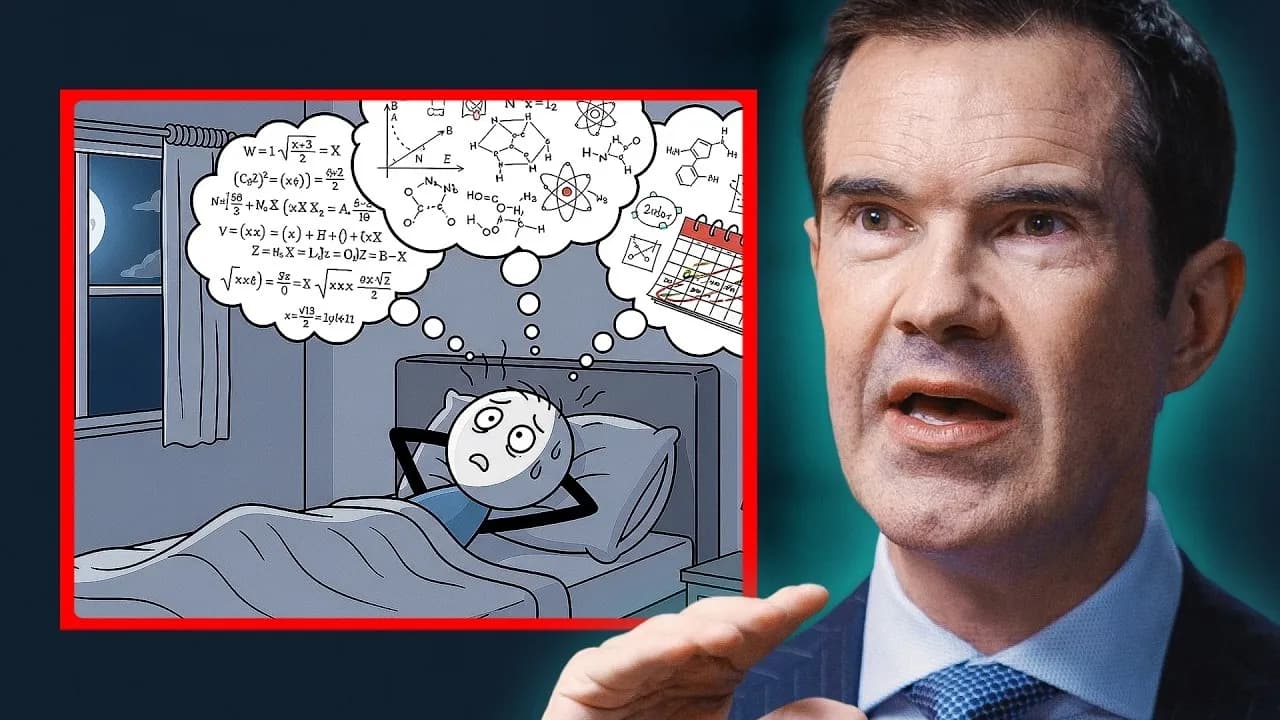
Carr explains overthinking as anxiety in larger form. He defines anxiety as thought without control where thoughts run wild, while flow state is control without thought. On stage, comedians enter a flow state where they know what they're doing without needing to think about it, making it the secret to finding something enjoyable that allows this mental state.
Carr argues that widespread depression and anxiety constitute a societal problem rather than individual failings. Mark Fisher wrote about the privatization of anxiety, where mental health problems are blamed on individuals rather than recognized as collective issues stemming from how society is arranged.
Carr states that if you're a depressed young man, you cannot solve the problem alone because you have a dispersed identity. The solution is to make other people happy, which creates positive cycles. However, this is complicated by modern isolation where people interact with fewer others than in previous eras.
Modern society has shifted everything toward individual activities. Five-a-side football has become personal bests at the gym, and tracking steps replaces walking with friends. This creates isolation that contributes to mental health issues.
Carr views the manosphere as providing the wrong prescription for real problems. He advocates being pro-gang, pro-drinking, and pro-gambling as solutions. Men are good at checking other men, and groups provide positive social forces. He references Scott Galloway's point that liver risks from drinking are nothing compared to social isolation risks.
Carr suggests lowering the drinking age to 16 but requiring groups of three mates to drink together rather than allowing individual drinking. He argues that pubs already function as youth clubs with jukeboxes, pool tables, and sports on TV, and would rather young people drink in these supervised environments than in parks.
Carr distinguishes between problematic online sports betting and productive gambling on yourself through career ambitions. He believes the younger generation needs to be dealt into society, noting they lack hope for buying houses and starting families due to systemic conditions rather than unwillingness.
Carr supports Rory Sutherland's proposal that the first £250,000 should be tax-free, after which normal taxation applies. This would help young people establish themselves without tax burden during their formative career years.
Carr references Bill Perkins' book "Die with Zero," which suggests giving children their inheritance at age 30 rather than at death. The book covers structuring life around having fun and spending money in ways that bring people together.
Carr argues society has inverted Maslow's hierarchy of needs. People are trying to self-actualize without basic needs like friends or housing being met. Two hundred years ago, people worried about starving but were proud of their name, while now people are calorifically fine but anxious.
Carr discusses how happiness functions as a time machine while depression involves thinking about the past and anxiety involves worrying about future selves. In flow states, people often have little memory of what happened, creating a paradox where the most enjoyable present moments are those we won't remember.
Carr references Eckhart Tolle's story of being severely depressed in his twenties and sitting on a park bench. Tolle thought "I can't live with myself" and then questioned who "I" and "myself" were, realizing he could separate himself from his thoughts and achieve equanimity.
Carr argues that control is an illusion and blames Plato and Zoroastrians for introducing concepts of heaven and perfection. He advocates embracing chaos and recognizing that you can only control how you react to events, not what happens to you. This leads to a Stoic perspective focused on personal reactions rather than external circumstances.
Carr poses the question: "Am I depressed or is my life depressing?" He distinguishes between depression and sadness, suggesting that if circumstances are causing the feeling and can be changed, it's sadness rather than depression. He notes it's more socially acceptable to say "I'm depressed" than "I'm sad."
Carr rejects generational categories as making as much sense as horoscopes. He notes that Donald Trump and Joe Biden are the same generation but very different people. He defines ambition as wanting to do something about your situation versus entitlement as expecting others to solve your problems.
Carr argues that raising the school leaving age to 21 through mandatory university degrees has created problems. University degrees have become luxury items like Louis Vuitton handbags whose value decreases when everyone has one. He references Peter Turchin's theory that societies collapse due to wealth inequality and overproduction of elites who don't receive what the system promised them.
Carr contrasts the American Dream, which remains part of the cultural fabric despite other problems, with UK culture where tall poppy syndrome tends to cut down ambitious people. He believes social mobility should exist so children can do better than their parents.
Carr is less concerned with equality than with abundance, asking whether the future will be Star Wars or Star Trek. He notes that habituation is powerful, and even great abundance would become normalized. Rich and poor are always relative concepts.
Carr argues that taking care of physical needs like healthcare, education, and calories is a collective action problem requiring safety nets. However, metaphysical needs cannot be collectively provided. He discusses mimetic desires where people don't know what they want and instead pursue things to impress others.
Carr identifies not needing to impress other people as a superpower that simplifies life and liberates people from perverse desires. He distinguishes between getting stuff, which is fun, versus having stuff, which isn't. This represents a three-dimensional lesson that must be experienced rather than just read about.
Carr references David Epstein's book on the power of constraints breeding creativity. He uses the analogy of being in a boat in the ocean where rowing hard in a known direction is preferable to being lost in rumination about which direction to take. He references Marcus Aurelius's line that if you don't know where you're going, no wind is favorable.
People often think they want maximum optionality in life. Alex Hormozi's perspective challenges this by suggesting there's too much optionality, and the real value comes from cashing in options rather than accumulating them. Getting an MBA, master's, and PhD in business represents collecting options without executing, whereas simply starting a business provides direct experience regardless of outcome.
The map is not the territory. Getting out there and doing the thing matters more than planning to do it.
Your ability to say things as opposed to do things has never been more tuned up. You are what you do, not what you say you'll do. Talking about the thing and doing the thing vie for the same resources, requiring appropriate allocation.
Don't tell me about your priorities. Show me last week's diary. That's what you actually did.
Obsessing over productivity can make productivity the goal rather than the means to achieve a goal. The sort of masturbation of productivity keeps happening.
Most people don't realize how much being dehydrated impacts their performance. Element is a tasty electrolyte drink mix with everything needed and nothing unnecessary. It plays a critical role in reducing muscle cramps and fatigue, helps optimize brain health, and regulates appetite while curbing cravings. They offer a no questions asked refund policy with unlimited duration and free shipping in the US.
Mark Manson's line states that the small thing you didn't say six months ago has been collecting interest ever since. By the time resentment shows up fully formed, most people have forgotten what the original conversation even was.
The same principle applies when not keeping promises to yourself. When you had a plan and made a deal with yourself a long time ago, you can't quite remember it, but there's latent distrust in doing what you said you were going to do. It's your relationship with yourself. After repeatedly not showing up for yourself, you begin to resent the part of yourself that makes plans because you don't think it'll come to fruition.
Having a six-pack doesn't give you confidence. Being the guy that shows up at the gym every day gives you confidence. It's about taking care of yourself.
Compound interest on money is miraculous. Most of Warren Buffett's wealth was built through time, with 90% accumulated after age 60. Compound interest on skills is equally insane if you put the reps in and do the work.
Goals will be beaten by systems every time. Everyone has great goals and big ambitions, but the question is what small thing can be broken off that's manageable and doable today.
Comedy allows immediate iteration and audience feedback. You can write a joke, test it, and receive direct feedback without needing meetings or extensive discussion. Most other projects can't iterate and get audience feedback as quickly.
In comedy, if the audience likes it, they tell you straight away. They can't not tell you. Even people who dislike you will respond to a sufficiently funny joke. The favorite noise in comedy is the cognitive dissonance laugh where there's a laugh followed by a deep reaction as people are shocked at themselves for laughing.
Comedy is deeper than conversation, and music is deeper still. The art and the artist can be separated. Someone who's done a terrible thing can still be funny or musically gifted.
Peter Krohn's question asks who could you be in the absence of your concerns. You can do anything you want. You only have to face the consequences. There's freedom of speech but not freedom of consequence.
St. Lawrence, the patron saint of comedy, was burnt alive over a fire. As he was being burnt alive, he said "Turn me over. This side's done." The only reason he's remembered is because he said that. There's a certain amount of bravery required to say the thing, even when some people won't like it.
Many people are held back by lack of confidence rather than lack of competence. Self-belief is the biggest rate limiter on achievement.
Self-confidence comes from giving the world irrefutable proof you are who you say you are. Find something small that you can do with what you've got where you are. Accept the reality of where you are and work with that. You can't choose where you start, you just choose where you finish.
Gratitude practice is valuable. If you only said one prayer and it was thank you, that would be enough. Disposition is more important than position. Where you are in the world doesn't matter. Your disposition is everything. The only thing that seems to shift disposition is a sense of gratitude.
Across time and space, we're lucky to be here now, lucky to have the friends we have, and lucky to live in the world we live in. Acknowledging this regularly is powerful.
Celebration and gratitude are linked. Done correctly, celebration is gratitude in action. You throw a party, invite everyone, and celebrate through connection with other people. Being grateful with other people is valuable. Sit down and chat with others about how great something is.
Chairman Mao's quote states you can't smell the roses from a galloping horse. When things are going well and you're busy, that's when gratitude is most available, but you're so busy that taking time to reflect on the present is difficult.
Problems are a feature, not a bug. A problem just means something needs your attention. The notion that one day problems will be over is false. You'll just level up and get more complex problems. If you can solve really complex problems, you're doing very well in the world.
Boredom is unappreciated serenity. It's a serene moment when nothing's going on, which doesn't happen often. The phone is like a mobile labor camp tracking our every mood.
Some people have minds that like to solve problems. The key is giving them good problems to solve. A problem-solving brain without good problems to solve leads to churning over politics, porn, ex-partners, or situations outside of control.
News is designed to make someone aware of a problem while giving them no agency. Reading about the Middle East represents an absolute cluster situation where there's nothing you can do about it.
There's a tendency to give empathy to people we like and agency to people we don't like. When far-right marchers put a brick through a window, we say lock them up. When social justice marchers do the same, we call it the language of the unheard. Both agency and empathy should be given to everyone.
You need to be responsible for the things you did, but you're also ensconced in the situation that brought you to that point.
After a seven-day meditation retreat without a phone in silence, returning to news about wildfires in Europe created a strange constriction. The question arises whether it's newsworthy and what it accomplishes. It makes us feel informed but really pierces nervous systems and creates worry about situations we can't influence.
Michael Smoker says he has a hard time celebrating achievements because in his mind it was his obligation to achieve them. High performers often have the sense that the higher you climb, the further you fall. As you get better, standards increase, so you always suck in comparison to what you think you should do.
This pushes continued work and improvement, but success isn't a cause for celebration. It's the minimum level of acceptable performance, and anything less than success becomes failure.
Imposter syndrome should occur once every 18 months to two years. You need to level up constantly where you feel like you're in a space where you can't believe you did something good.
Comedy is a service industry where the product makes people happy. No one remembers the jokes, but they remember how they were made to feel. The show is an advert for the next show.
Comedy has changed to include more heartfelt moments where the audience is chatted with directly. Comedy is the shortest distance between two people. Your best friend is the person you have the least filter with. Treating the audience like that gets paid back ten times over.
The Overton window has expanded massively in politics. Comedy does
Comedy broadens the conversational Overton window, enabling more open discussions about sex and politics. George Carlin and Richard Pryor expanded what people could discuss, and Dave Chappelle continues this tradition by pushing boundaries on spicy, controversial, or inflammatory topics. Beyond controversial content, there's an emotional dimension—an earnestness or sincerity Overton window that allows deeper, more authentic conversations about human motivation and feelings.
People are desperate for authenticity but allergic to sincerity. While audiences claim to want genuine self-expression, there's often an adverse reaction to seeing someone break down emotionally or express vulnerability. The advice given is to turn off the comment section if doing anything remotely out there, since other people's opinions are none of your business.
Comedy operates with two distinct Overton windows: one for how edgy jokes can be, and another for how earnest conversations can become. When performances push beyond expected emotional depth, audiences have more animated responses. The goal in comedy shows is laughter—ideally three big laughs per minute—while also embracing silence for poignant moments where audiences can reflect.
Memorability is a key optimization target. People want experiences that stick with them, unlike forgettable shows. Historically, humans gathered around fires, radios, and televisions to share experiences together, but now people watch individual streams even when physically together.
Social media creates a form of soul theft similar to the Native American belief about photography, except now it's thousands of photos daily that alienate people from themselves. The internet's very language—nets and webs—reveals its function of catching people. Aldous Huxley was correct that power wouldn't be taken by an overlord, but rather given away for cheap dopamine through tablets, just as he predicted.
The system works by aligning incentives so people willingly surrender their attention and information rather than having it demanded. New technologies like AI need societal integration, and while the trajectory will ultimately be upward, learning to work with these tools takes time.
AI functions like a musical instrument—anyone can make noise, but creating symphonies requires time, attention, and practice. The speaker views AI as humanity creating God in our image: all-knowing, all-powerful, capable of miracles, living in a cloud. This echoes Hegel's idea that the universe is a device for creating God, with humans as the universe experiencing itself.
People are more impressive than AI, which excels at left-brain analytical tasks but struggles with right-brain comprehension and gestalt understanding. AI may eventually handle life's drudgery, allowing humans to pursue more artistic, fulfilling activities. The concern is that people have forgotten their own capacity for comprehension.
C.S. Lewis wrote that favorable conditions never come—there's always distractions, rivals, love affairs, job fears, and illness. The only people who achieve much are those who seek knowledge while conditions remain unfavorable. The notion that problems will eventually clear away so one can start real work reflects a scarcity mindset. Life always contains problems; there's no final level without enemies.
This mindset affects major life decisions, with one in three viable pregnancies in the UK ending in abortion, suggesting people don't feel they can start families or build futures given current conditions.
The current era began around 1989-1991 with the Berlin Wall's collapse and Soviet Union's dissolution, marking the shift from bipolar to unipolar world. The decline of American naval power became evident with Somali pirates, something that wouldn't have occurred during peak US strength. The world is now multipolar and confusing.
We're experiencing a revolution in the sense of elite replacement: mainstream media declining, academia facing replication crises, and major UK political parties potentially never winning elections again. Robert Frost's concept of civilization as a clearing in the forest applies—we must relitigate and rebuild institutions.
The cycle of strong men making good times, good times making weak men, and weak men making hard times describes current conditions. The tech itself represents hard times. There's a lack of leadership, with countries poorly run and no one thinking 20 years ahead versus election cycles.
Kayfabe—the WWE concept of everything being meta, optics, unreal—describes modern political discourse. The contrast between respectful 2008-2012 political debates and current WWE-style personal insults represents a shift from statesmanship to caricature.
The UK faces fundamental competitiveness issues requiring more than minor tax adjustments. Four key factors affect national competitiveness: currency value, energy costs, red tape/bureaucracy, and tax rates. Britain needs to compete globally post-Brexit but hasn't effectively done so.
Specific recommendations include devaluing the pound to boost exports, addressing Britain's most expensive energy costs globally through long-term nuclear power like France's 1970s program of 56 plants, cutting excessive regulation that resembles Soviet bureaucracy, and implementing flat-rate taxes with simplified systems like Estonia's single-page tax form.
Britain produces five times fewer entrepreneurs from its top universities than America does, representing significant brain drain. The goal should be abundance over equality—creating conditions where people want to start businesses and live in Britain.
America could be fixed through two moves: implementing open primaries for all offices to force candidates toward the center rather than appealing to extremes, and establishing term limits for senators and Congress members, since the checks and balances system has failed to constrain power effectively.
The American Constitution is described as an amazing piece of technology that requires active work rather than passive existence. Bernie Sanders has been in government longer than Jimmy Carr has been alive. A 20-year term limit sounds reasonable. The UK has no term limits for politicians. Term limits for US presidents were brought in with Roosevelt, who did three terms. Roosevelt was trying to go for three terms.
David Ogilvy's line "you can't save souls in an empty church" has been an obsession. If you believe in something, you have a moral duty to spread that message. Many people insulate themselves from having their ideas meet reality by claiming their ideas are too sophisticated for the proletariat to understand. This makes it incumbent on anybody that believes in a thing to find a way to get that message out and Monday morning quarterback issues like climate, young people, suicide, birth rate, art, or taxes.
Talking about third rails and getting messages out is the most difficult but beautiful part of the show. Carr talks about suicide and tells people the terrible truth that suicide doesn't work. People commit suicide because they want to get rid of the pain, but you can't get rid of the pain - all you can do is redistribute the pain to the people that loved you. This is a big moment where some people in the audience suffering realize this is their burden to carry. 90% of men who took their own lives had sought help from a mental health practitioner before they did it. The approach of getting people to open up and talk to professionals doesn't seem to be working as anticipated.
A piece of advice from Blake Burge: if you want a calmer life, you need to address small problems while they're still small. The cost of dealing with an issue rarely gets cheaper with time. Procrastination turns uncomfortable things into unavoidable things. If it doesn't fit, eventually it'll hurt wearing it. Addressing problems works on compound interest - if you're saving money or building skills it works positively, but if you have problems you don't address, they get worse over time.
Quality of life can be tracked by how many uncomfortable conversations you're willing to have. How many people around you can you speak to with no filter? The other half is who you can sit in silence with and not need to fill it - this is the way to work out who your best friend is. Make a terrible podcast but don't publish those ones - publish the ones where you talk with no filter.
We're on the cusp of something happening where new technologies are atomizing people and distracting them. People are becoming aware that these technologies are dangerous and making us live maladaptive lives that are immediately gratifying but ultimately destructive. People are realizing they need to take intense action - join a run club, go to shows, go to coffee shops, stop working from home, go back to the office, spend time around people. The ability to adapt to new technology moves much more quickly than our habits. For the last decade and a half, people were on the receiving end of technology, but now they're realizing they need to adjust their lives.
The quote "paleolithic emotions, medieval institutions, and god-like technology" describes the mismatch between human nature and modern technology. AI represents shifting sands that will change the world further. People need to be connected, which is the business model of doing shows - getting people out to sit in a room together and laugh. People crave going out and being together even if they don't know the other people - it's like church.
Addressing problems while they're small works personally as well. The way you degrade your trust in yourself happens with one missed promise, one attempt at change you couldn't hold yourself to. Small changes compound. It feels unfair when people at the top of their industry accrue all the gains because compounding interest works in their favor, and the same happens in reverse when people spiral down.
There's an oligarchy of the arts now where movies are dominated by existing IP, sequels, or prequels - five big movies dominate 90% of the box office. Music has an oligarchy of five huge artists dominating globally, whereas it used to be 100-200 artists selling well. Books follow the same pattern. Comedy is broad enough that people can pick their favorite stuff without being dominated by big names.
The driver is to get more people interested in doing comedy rather than just going to see it. A book on jokes written with Abby Grant and Amanda Baker teaches how to be a comedian and how to write jokes. Everyone's got a story to tell. Standup comedy is ordering your thoughts, writing them down, and finding your own authentic voice - an activity that should be taught in schools. Having the ability to write down thoughts and find perspective in life is more practical than grade eight piano for best man speeches or work presentations.
Comedy is like Cardaman's thinking fast and slow - first order and second order thinking. The setup for a joke is first order thinking where you make an assumption, and the punchline snaps you into second order thinking. The brain is designed to not have to think - it's an LLM, pattern recognition. Comedy makes you think in a new way and snaps you awake. It's quite childlike because children really think, while grown-ups beyond a certain age are just pattern recognition. Comedians have the ability to really think about stuff, which is an attractive way of being.
Pope Gregory a thousand years ago wanted all churches to sing songs the same way and ordered music to be written down. The bishops said you can't write down music because it's ethereal and about soul and groove, but Gregory said he was the pope and to write it down. 400 years later, Bach, Mozart, and Beethoven couldn't have existed without musical notation. Writing down comedy counters the magical thinking in the business - the idea that someone just has funny bones or wings it. Jokes are jokes, and knowing how they work doesn't diminish enjoyment.
Comedy has never had a shared vocabulary like music or acting, and one can be invented. Musical notation doesn't create music - it describes music that already exists. The book coming out in October was written with Abby and Amanda, and they're working on an interactive course using AI as a teaching method. The scientific theory of what makes jokes work is about taking pattern recognition and reversing it - making sure you're waking up the mind with the sudden revelation of a previously concealed fact.
Most comedians don't really know how they write jokes - they find it on stage or things occur to them and they note it down, but they don't have systematic understanding. They're virtuoso musicians who don't know notation. Being more systematic about comedy is a positive idea that throws the rope down so everyone can do it. Writing is the job and self-assignment - no one ever tells a comedian to write, and it's the preparation that determines success or failure.
Having writers or buying jokes is the absolute norm on TV shows. Writing rooms are brilliant, and some people are great at writing but don't want to perform. Comedians who embody the book's teachings versus those who break the rules - Bob Mortimer is someone who's funny despite it being hard to put a finger on why, with surrealist and absurd comedy that's taken by surprise and out of nowhere.
Vic and Bob love jokes as well. The principle is that with comedy, you don't want to be the best - you want to be the only. There's no best in comedy because a top 10 list is meaningless - it's what makes you laugh and what you like. The more someone is themselves on stage, the more people gravitate towards them. It's not a competition - the more people do well, the bigger the pie gets.
With six months to make someone as funny as possible, the first thing would be to recognize their story - what do they want to say that no one else could say? What's their take on life? It might be a personal story, politics, or sports. Then figure out how to make that surprising and delightful to listen to. Everyone's got a sense of humor, though how dark, sardonic, or sarcastic it is varies, and taste in comedy is like taste in food and sex - some people like spicy, some like vanilla.
There's a pattern in rhythm at approximately 92 beats per minute that works for comedy, spoken word, and political speeches. It's where you put the intonations and the beat, not necessarily speaking fast or slow. Obama's speeches are at 92 beats per minute - he speaks quite slowly but stays on that beat and is a magnificent public speaker. Winston Churchill also used this rhythm.
The most classic joke template is the pullback reveal, like a comic strip where you're looking at something and then pull back to reveal context. Word play also survives. Jokes involve the haha and the aha being similar - often insights into something when people realize it. The oldest joke from an old Roman book is a guy in the barbershop where the barber asks how he wants his haircut and the guy says "in silence" - almost 4,000 years old.
Doing more crowd work and putting it online has made the audience bigger and growing. There's more connection to people now - five years ago people might come up and say they saw the show and want a photo, but now people want to have a conversation. The standup persona on stage telling jokes and the podcast mode are merging. There will be 90 minutes of bang oneliners in the show but also half an hour of chatting about stuff and life.
The wisdom verse and podcast world has been a huge influence. It's about what you're interested in talking about. You don't want to be one note - like a band playing floor fillers, sometimes you want to slow it down with ballads. It's nice to have a mix in the set where you do 20 minutes of just oneliners but then have other content.
A cursed fact of the world is that the most important life lessons you learn are the hardest to communicate to others because they always sound like cliches. The reluctance to drill home core principles stems from the fear that they will be dismissed as trite. When people comment that ideas like "systems beat goals" are rubbish, the response should be to ask what they've actually done. If someone is cynical about advice like cold, dark, quiet for better sleep, the question becomes why their own sleep still sucks.
Early 20s represents the best time for being cynical and dismissing everything. At some point the question becomes what can actually be done. There are two different ways of learning lessons.
Writing the book on jokes came from macheteing through the jungle to become a comedian, as there was no well-worn path. The process involved figuring out how to write jokes, put on a show, and create a career. Now the responsibility is to help others by sharing what works. If someone wants to do the same thing, the advice is to follow the established methods, then go do their own thing.
The idea of not repeating insights because people have heard them before is challenged by the quote that in the work of genius we see our own discarded thoughts. Much of what gets said is not totally new, but rather forgotten. If something is completely new without any anchor point, people are more likely to discard it because they need to be incredibly brave and have high conviction to pivot their entire worldview based on something with no prior reference point.
The critical mass of people needing to hear an insight before becoming convinced is usually not once. The goal is to drill home pithy insights condensed into memorable aphorisms or mantras, since memory is not great. When reading a 500-page book, the one little quote that remains is what cannot be gotten out of the head.
The trajectory has continued to rise, with the biggest global tour by tickets sold in comedy. When people are happy, they are getting good at stuff. Competence is important, and feeling like they're getting better matters. Kids learn how to ride a bike, struggling then succeeding, which is fun. Comedy has endless amounts of tricks, allowing continuous improvement.
Kaizen refers to the Japanese concept of making very slight improvements, incremental improvements over time, which brings satisfaction. This involves putting oneself out of the comfort zone every 18 months by putting on bigger tours, playing different rooms, or doing things differently. This might involve holding some silence and space on stage in a new way.
People's sensitivity to cynicism keeps them in place, preventing them from doing much more than zero. There will always be people saying an idea is not cool or silly. The fewer fucks given, the more acclimatized one becomes to not giving a fuck, which means giving fewer fucks over time, enabling more bravery and experimentation with bigger swings.
Being welded in place by fear of criticism or skepticism means not getting started. Worrying about what other people think prevents action. In mid-20s, when leaving a job to become a comedian, friends reacted as though having a breakdown, seeing only the beginning without knowing where it would end. The reactions were that a good job was being abandoned.
There is a grieving of where one was and a fear of where one is going because the next step has no guaranteed promise. In a world without an abundance mindset, complexity, uncertainty, and chaos make people question giving up a certain 5 out of 10 for an uncertain 8 out of 10, because it might become a 3 out of 10. High inequality makes visible not just how high one could climb, but also how low one can fall.
The two most important days are the day you're born and the day you find out why. Finding out why involves committing fully to something. Specialization is advocated, finding the thing enjoyed that cannot stop being thought about. What's play to you and work to them represents the edge, the thing that will be done better than anything else.
Some people find their thing in hobbies and other pursuits rather than work. Advice given to a musician was that if they would do it anyway, then do it. It does not have to be the way money is made. Creative and fulfilling activities could be hobbies, and if they become the way money is made, that is great, but it should be something that would be done anyway.
Discipline is saying one will make oneself do the thing. Motivation is wanting to do the thing. Obsession is not being able to not do the thing. What appears as motivation from the outside is often the cooled-off version of a past obsession that has formed into part of identity. Someone who goes to the gym may have been completely obsessed years ago, reading bodybuilding.com forums and ensuring protein intake was correct. What seemed lame at the time becomes who one is, requiring neither discipline nor motivation.
People are serial obsessives. If obsession is never allowed to climb inside and wear one's life for a while, the accrued gains down the line cannot be benefited from because the obsession will not last forever. Many people go their entire lives without having an obsession that is worth anything. Some become obsessed with things that should not be obsessed over, such as politics, porn, exes, gambling, or video games.
If someone consistently becomes obsessed with things, that is good, and the obsession should be allowed to embrace life for a period. This represents an odd alignment of motivation, opportunity, skill set, timing, and life situation coming into alignment to create magic. Obsession cannot be engineered particularly well. Discipline can be forced, which is why people love it because it is always there if the price is paid. Motivation is a halfway house that can be engineered somewhat by spending time around people doing the same thing, creating feedback loops, applying social pressure, or listening to favorite playlists.
Obsession has a magical quality because it is temporary and will leave. Most people are not obsessed at 50 by the same things they were at 30. The people who have been heard of are those who kept doing the thing through compound interest. If still interested in the thing, it becomes the freest discipline and motivation ever gotten. Every part of life becomes coalesced toward the thing, which is powerful.
Society has a bad relationship with obsession because it comes laden with baggage that people either do not understand or fear. It is linked to addiction, as people with addictive personalities never really get over addiction but get addicted to something else. Some best friends who were addicted to drugs became addicted to the gym, eating right, or shopping afterward. If compulsive behavior can be directed to something that builds, grows, and feeds back, that is fantastic.
The problem-solving brain should be given good problems to solve and an obsession worth something. While all obsessions cannot be generated, guidance is possible. This represents the freest way to become great. The insight is to do what feels like play but looks like work to everyone else. If something positive, pro-social, and not destructive can be found, it should be allowed to weigh for a bit.
Portugal turned around its problems after being one of the roughest towns with a big heroin problem. They legalized drugs but that is only half the story. The money spent fighting the drug war was ring-fenced and spent on rehabilitation, education, and housing. Anyone wanting to get off drugs could come, anyone needing housing could go there. This solved the problem, resulting in very few people on heroin that could be obtained from a pharmacy. The crime rate fell off a cliff when illegal drugs were taken out of the situation because people did not have to feed their habit through petty crime. Organized crime also had the rug pulled out.
The ring-fencing of money can be done for a certain amount of time, but then politics gets in the way and people decide the money is needed for something else. Progress gets taken for granted and the problem creeps up again. There will always be a problem that needs fighting.
Marijuana should be illegal for the under 30s because it is the opposite of a performance-enhancing drug. It is a performance-inhibiting drug that takes away drive and ambition. In early to mid-20s, when people need drive because they are out of the school system and on their own, self-starting is required. Between 30 and 50 it should be legal because grown-ups can make decisions about what to put in their bodies. At 50 and above it should be mandatory, not because it is a good drug, but because it would redistribute wealth to the young as old people would be slightly high and out of it, making the playing field more even.
The relationship between organized crime and government is fascinating. A single move to legalize drugs would cut off at the knees an entire universe of dangerous people trying to cartel their way to wealth. There must be enormous pressure between government and organized crime groups calling in favors to prevent such legislation from passing. If cartels formed a lobby group arguing they cannot have drugs because it would put them out of business, that would be interesting.
Nobody is coming to save you also implies that nobody is coming to stop you. Nobody cares more than you. There should be a great safety net for everyone, with universal basic income essentially existing in the UK under the benefit system where people get something from the state and will be okay without going hungry. However, universal basic income is too close to we do not need you, and purpose is one of the key things. Morgan Housel has a great equation on happiness being freedom and purpose. If those two exist, one is on a good road. Everyone wants benefits available for everyone and a safety net, but no one wants that for their kids.
Parents do not look at their newborn and hope for great benefits packages. The desire is for a fulfilling life where children go out, do something meaningful, and add value to society.
Supporting people through the future of automation presents an interesting challenge. Purpose remains important, yet clearing off the bottom levels of Maslow's hierarchy of needs represents an achievement that would have been the obsession of almost all of human history. Asking whether one is self-actualizing indicates a wonderful position across the expanse of human history, compared to the historical question of where the next meal comes from.
Liberal democracy has oversold the individual while underutilizing the demos. The missing element is connection between people at the family, friends, and community level. Safety and security remain important, with the goal of taking care of basics for everyone through education and healthcare. Beyond that, abundance should allow everyone an exciting, fun time, and this aspiration for one's own children extends to wanting it for everyone.
The intergenerational competition theory creates an embedded growth obligation where everything must continually improve. The biggest inflation is not currency inflation but expectation inflation, where people expect far more than they did in the 1970s. The 1970s were difficult, and conditions are much better now, yet expectations have risen higher than ever. Expectation inflation is another word for progress, as people factor in existing achievements and continue wanting more. On a global scale, raising everyone to current developed-world levels would represent an incredible achievement for humanity.
The worst problems in the world often represent easy fixes that get ignored because they lack sexiness. Burning biomass kills three million people a year through asphyxiation and causes cancer, representing a horribly bad health issue. Smoking remains a much bigger problem globally than commonly recognized in the West, where it has largely been solved. In South America, Africa, and Asia, smoking continues as a huge problem with known, easy fixes that are not being implemented.
Peter Singer and Derek Parfit have written extensively on obligations to future and geographically dispersed people. William MacAskill, the youngest tenured philosophy professor in the world and author of "What We Owe the Future," discusses long-termism and obligations to future generations. Net zero represents a challenge where decreasing reliance on fossil fuels affects the poor in the short term, yet requires building nuclear plants now to achieve goals in 25 years. Statesmen who think on those timescales are needed, as politicians focus on four-year election cycles.
Britain could rest on its historical achievements but should instead serve as an example to other nations. Getting energy costs to essentially zero would attract businesses to the UK. British culture contains charm alongside certain poisons, including tall poppy syndrome, limited social mobility, and a ossified class system based on school attended and accent rather than earnings as in the United States. Oikophobia, the hatred of one's own culture, represents a significant issue. People need to take more pride in their culture, as a place without a past lacks an apparent future.
Britain defeated the Nazis and ended slavery, achievements that matter significantly. The English language represents a beautiful contribution. Britain has produced the Beatles in music, Stephen Hawking in physics, Tim Berners-Lee in biology and internet development. The country continues to punch above its weight, and people should take pride in these accomplishments. Local communities often maintain a sense of connection to their origins.
Keep Chris Williamson in your library
Save the videos and channels worth coming back to, and find them again in one place.