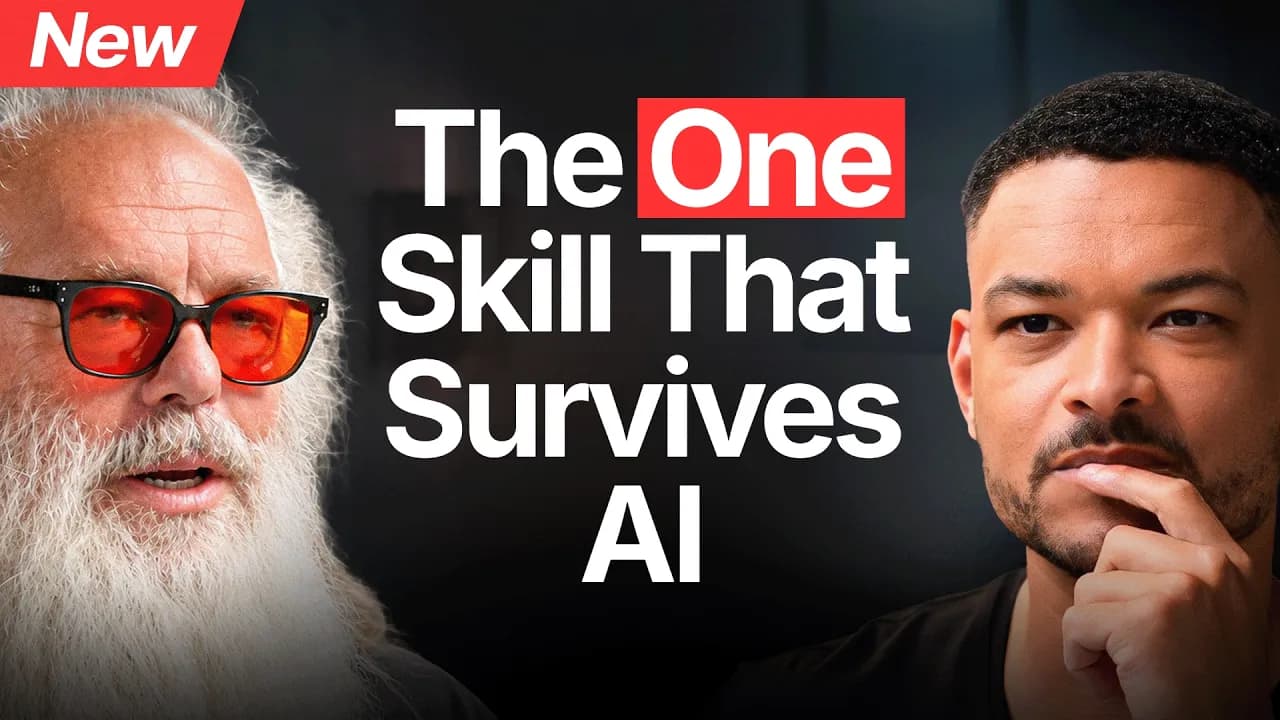
The Quitting Expert: Quit NOW Before AI Makes The Choice For You, This Is a Superpower! | Seth Godin
In a Nutshell
The core message is that most people stay stuck because they simultaneously want two incompatible things (the "but"), and the superpower is quitting the wrong pursuits to focus on serving a small, specific audience with your unique skills—especially now that AI handles everything that can be written down. Key takeaways: name your resistance, treat sunk costs as gifts from your former self rather than obligations, choose consistency over authenticity, and use AI as a tool to connect humans rather than compete with it.
These notes were generated by AI and may contain inaccuracies.
Michael Jordan's quote "If you quit once, it becomes a habit. Never quit" is wrong. People have failed more times than most people listening. The simple secret for the power of quitting is the dip. The dip describes something in the world that no one talks about. The whole career is about how to help people do better, find why they're stuck, realize what's holding them back, go solve the problem. Problems are opportunity. All problems can be solved.
People are afraid. People are lonely. People are disconnected. They're victims of all sorts of media and commercial systems. We've been indoctrinated to not notice it.
There's a philosophy which is the key to figuring out our stuckness. The donkey is trapped halfway between the water and the carrot. The donkey is thirsty and hungry, but he's unwilling to move away from either of the things he wants. So, he starves to death and he dies of thirst. All of us do this and we do it with one simple word: but. "I want to run the marathon, but I don't want to get tired. I want to have a job that fulfills me, but I also like this car and this house." There are tools that can help overcome resistance and the mechanics to become the person your future self thanks you for.
The skill of overcoming shame or embarrassment might be one of the most important skills in the modern world today.
Some guests show up and say, "I did the research. I did the math. Do this because I told you to." The approach is to show up and try to paint a picture for people of what the words mean and what the systems are like and then encourage you to do things because you told. People are afraid. People are lonely. People are disconnected. They're victims of all sorts of media and commercial systems. We've been indoctrinated to not notice it. There are problems all around us. If we can solve problems, we can make things better. The goal is to help people find the words to talk about their problem, realize what's holding them back, go solve the problem. When we solve problems, we make things better for ourselves and for other people. Problems aren't something to be avoided. Problems are opportunity. All problems can be solved. Some things aren't problems. They're situations and you have to live with them. But if it's a problem, it means there's a solution. The goal is to help people find the vision and the words to see where they're stuck, why they're stuck, and whether it's a problem or a situation. If it's a problem and someone's going to benefit from you solving it, the mechanics, the tools, the vocabulary to go move forward toward better can be provided.
If someone's applying for college, it's super easy if you're 17 years old to get all hung up on "I'm about to be judged. How are they going to know the real me? What if I get rejected? Am I a loser? Have I wasted my whole life?" But once you see the college industrial complex, once you understand the agenda of the admissions office, once you realize what people are looking at and why, you say, "Oh, this is a game. This is a game like Settlers of Catan or Monopoly. And if I win this game, it's not because I'm a good person. It's because I played the game better. If I lose the game, same thing." Once you see that, all the drama and entanglement of applying for college moves to the side. You say, "What's in it for the admissions officer to see the person I want to present to them? Because if I can solve their problem, I'm going to go to the school I want to go to."
We engage with a system or a person or a boss or a co-worker or spouse and we think we're right. We've got all this noise in our head. We think everyone can hear the noise in our head. They can't. We think everyone wants what we want. They don't. And so we show up saying, "It's my turn. I need to get this." And now we have a problem. The reason we have a problem is because that other person thinks they're as right as we think we're right. And they have a different problem. So we're colliding. But if we can see that all of this is a dynamic within family systems, corporate systems, commercial systems, we can understand what are the forces at work. Now that we see them, we can use them to get to where we want to go.
Most people we meet would like to be seen, missed if they are gone, understood, and of use. That's something that crosses borders and cultures. And yet we end up being a cog in a system. The Uber driver racing around doing things they wouldn't ordinarily do because the system is pushing them to cut every corner. Or the mom who's struggling because the financial system that she's stuck in is pushing her away from the kind of work or parenting she wants to do. Many of those things are injustices and some of those things cannot be fixed by an individual. We can accept those as situations. You're not going to change Uber. Uber is going to be the way Uber is going to be. And if you choose to be an Uber driver, the rules of Uber come with it. But other things are things where we get to make a choice.
It's not saying anyone deserves an injustice. Anyone deserves where they are right now. But given who you are, given where you are, what are the choices you do have? And how do we get out of the stuckness of wanting two things that we can't have at the same time? Because it's when we want two things at the same time that cannot coexist that we feel stuck. And that feeling of stuckness robs us from the chance to be of use. It robs us from the chance to get to that place that deep down we want to go.
The word purpose is used and what is meant by that is not you're born with a purpose because that's not what is thought. But you can choose with intent the purpose of whatever you're going to do tomorrow. That purpose might be "I need to get paid." That purpose might be "I need to get this date." That purpose might be "I need to put something on the internet that changes the lives of a thousand people." When you say your purpose out loud, the purpose of this work is so and so. Then the very first question which is the key: Who is this for? Is it for everyone or is it for 12 people or a thousand people? What change are you here to make and for who? And if we can't figure out who the who is, then we feel like there's just this amorphous horrible heavy blanket on us trapping us. But if you can find the five people you can solve a problem for or the 25 people who would miss you, it starts to work.
You're a stand-up comic. You've been working really hard. And your agent calls, "I got a great gig." So, you go and there's 100 people there and you bomb. Not one laugh for 10 minutes. And you leave the stage. Then you find out it's a tour group from Italy and no one in the room speaks English. So, who bombed? It's your agent who put you in the wrong room. There was nothing wrong with your jokes. It was a mismatch because the audience didn't speak English. So, you're allowed to say, "It's not for you." When we show up to try to engage with someone it's not for, if we read the comments, if we read the reviews, and someone gives a great book a one-star review, all that one star review says is, "This book wasn't for me." That's all they needed to write. Nothing else in the review is helpful because someone else thought it was five-star book. So the author has learned nothing. So we pick who it's for. What is our intent? This person I'm going to help. I'm going to trade with. I'm going to engage. I'm going to sell to or whatever. Who exactly? What do they believe? What do they want? What are they afraid of? If I can solve their problem, they're going to want to engage. And I can be of use. And then I can do it again. And then I can do it again.
People sometimes call me a marketer and I had the luxury of starting my career right when television was dying. So before that marketing meant big companies buying ads, interrupting people, hustling them etc. And then it shifted. So I got to define marketing as anything I wanted. And I have defined marketing as telling a true story to the right people in a way that helps them get where they want that they will tell their friends about. If you do those steps, you're not doing any of the icky part. You're being of service. And you don't have to have a budget to do this. We are all marketing. When you walk in in tatty jeans to a job interview at an investment bank, you've just marketed yourself by your clothing. There's a signal that you chose to send and that they will receive or not receive. So when we think about the agency, the freedom that each of us have, we have the freedom to decide who we're going to show up for and what's the story that's built in.
Back to this Uber driver, if you want to make a living driving a car and meeting interesting people, one thing you could do is give up all of your freedom to Uber and let them find you, the passengers. But the other thing you could do is realize that there are 75 people who live in this suburb of your town who need to get somewhere reliably and safely and would be delighted to have you be their driver. And when you hand out the right cards to the right people, making it clear what you do and don't do and who you do it for and don't do it for, getting to 15 regular customers is not out of reach as a private chauffeur. That path is a better use of his tomorrow than simply being ground out by some social media company or ride sharing service.
There's a rope here. And it serves as a somewhat interesting analogy for being stuck and pulling on the wrong thing. 2,500 years ago, this guy named Alexander, who didn't have a last name yet, showed up outside of a small village in Turkey and there was a legend from King Midas. There was a wagon there and it was tied with a complicated knot. And the legend was whoever could untie this knot would become the ruler of huge parts of Europe. And Alexander was 21 years old and he did not use a knife. He did not cut anything. But he looked at this knot that was tied to the wagon and he did one thing that no one before him had ever done. He realized that there was a pole in the center of it that it was tied around and he removed the pole and then he could see by looking very carefully how the whole knot was held together and he could untie it with no trouble whatsoever. And then he became Alexander the Great because the secret the simple secret was we are stuck because we can't see what's holding us there. If what's holding us there we cannot change like gravity is holding us to earth. Gravity is not a problem. Gravity is a situation. Going to the moon doesn't deny gravity. It works with the fact that it exists. But we are working with problems, but we're confused because we want two things.
Here's an actual carrot and here is actual water. This is not actually a donkey, but let's pretend this is a donkey. In Buridan's philosophy experiment from a couple hundred years ago, the donkey is hungry and thirsty. He has complete freedom. He can move. And he's halfway between a pile of carrots and a bucket of water. And he's trapped because every time he moves toward the water, he's moving away from the carrot. Can't do that because he's hungry. And every time he moves toward the carrot, he's moving away from the water. Can't do that because he's thirsty. And so in the experiment, because we're trapped, we end up dying of hunger and thirst. And all of us do this. And we do it with one simple word which is but. "I want this but I also want that." "I want to have a creative life but I never want to get rejected. I want to run the marathon but I don't want to get tired." And we hide the but. We don't say the but out loud.
Jackson Pollock was the most famous painter in America in the 1940s about 80 years ago. He was on the cover of Life magazine. He had three years where he could do no wrong. His paintings were snapped up. Everyone saw him as a little bit of a hero. It's very unusual for an artist to be a hero in their own lifetime. And his wife Lee Krasner later said that he felt like he had done everything he could do with this cycle of art. And what most people in that situation would have done is become a Jackson Pollock cover band. Paint more versions of his old paintings. Take the money. You've won. He wanted to be a brilliant creator. He wanted to be on the frontier. So he stopped painting Jackson Pollock paintings. He went to a studio and came up with a whole new style. Different size canvas, different approach. It didn't look like Jackson Pollock had done it. And he brought it to this big show and the world yawned. Not one piece sold. And to this day, if you go to a museum, you will probably not see a second cycle Jackson Pollock. This led him to become even more of a substance abuser, which led to him dying in a tragic car crash that killed somebody else as well. Because Jackson Pollock wanted two things. He wanted to live on the frontier and be the creative artist on the cutting edge, but he also wanted to be the celebrity who could sell everything he made and was seen as a genius. He forgot how many years it took the first Jackson Pollock to accomplish that. And because the second Jackson Pollock didn't hit, the but became really loud in his head. You can't have two of these things if they are diametrically opposed. We need to find where is the but. "I want this but I want that." It's usually hiding as an and but once we see it, once we say, "Oh, that is what is keeping me from giving the people I'm trying to serve what they need. That's why I'm not getting where I need to go." We can remove the pole, see the entanglements, see what we're measuring wrong, forgive them, make a new decision, and the problem goes away.
You can substitute and, you're saying, instead of but. The and is the thing that emphasizes it. "I want to be a creative person and I'm eager to be rejected and not have people get the joke for a while and have to live in the back of my van because that's what creative people do. That's part of it. I get that. I want to be popular on social media. And that means I can't be honest and authentic and consistent because I got to keep chasing X, Y, or Z." And when we look at the people who consistently get big clicks, that's what they're doing. They're not saying, "This is who I am." They're going to chase the next thing. If you're not happy with that, please don't do it. But the and amplifies the work, but undercuts it.
There's people listening right now that maybe got three kids under the age of seven. And they also want to launch a company. And they might feel that there's a tension between those two things because they on one hand want to be the best dad on earth but at the same time they really want to launch that AI startup. Now these two things are tugging at each other. The first thing they did was really important. They named it. Second thing: can't do two things at the same time, but you can do many things over time. And what that means is he made a commitment to three small humans in this moment. He's going to go to work, but he can't go to work for 100 hours a week. So he needs to pick a project where the amount of time he has is enough time to do the project really well. He cannot start an open AI competitor. It is off the table. That is impossible because the thing he's committed to cannot coexist with that. That's hard to admit, but it unlocks the door to what we can do. If he can figure out how to build an entity where he's not hiding, where he's actually showing up on the hook to a group of people and say, "I know more about AI than you, and I'm going to use this tool to do X," and they pay him for it. Now, at the end of a 40-hour week, he appropriately goes and does the work of a dad. That's a business that's creating value for people that will make you more profit than OpenAI made last year. So the point I'm making is media keeps showing up and saying what you're supposed to do is be a Kardashian. What you're supposed to do is be Sam Altman. No, that's not what you're supposed to do. You're supposed to make promises and keep them for the smallest audience. That's enough. You can't maximize two things that use the same space.
Is it possible to know if a motivation or a goal or a dream you have or an ambition you have is real or not? And when I say real, I mean like did I just inherit this from expectations from Instagram or from my family or because my brother-in-law is rich and I want to kind of compete. Is there a way to know if my the goal I say I want is a real one? This gets back to the idea of purpose. What is the change you seek to make with the next cycle of your effort? Not your purpose on earth, but the purpose of the work you're about to do. Are you trying to make Mark Zuckerberg happy? Are you trying to make an anonymous commenter happy? Are you trying to teach troll a lesson? Because when you say that out loud, you realize that's a ridiculous purpose and a trap.
If we can be clear, what's in it for me? If I put this time in, what will I get in return? So my company has 75 people, let's say, and should I grow to have 250 people? Well, what would be in it for me to be a CEO of 250 people instead of 75 people? You're going to have a bigger headache. You're going to have more money theoretically. Theoretically, but what you're really going to earn is a different kind of status. You have to decide if that status boss of more people that status what I get to say at the cocktail party that status of what could happen after that is worth the price you're going to pay to do this or not. And so we keep making these choices about what is the purpose of this work. And that leads to the key from Steven Pressfield which is resistance. And resistance is any feeling we have that keeps us from doing generous generative creative work of any kind. So for example, writer's block is resistance. For example, you're going out on a date and you change your outfit six times. Resistance shows up in so many of the things we do. And the systems around us indoctrinate us because they want us to be cogs in the system. They want us to say, "Well, how do I get an A? How do I get permission to do X, Y, or Z? I'm not going to initiate anything." So, it's easier for your brother to deal with the resistance in his head by saying, "I'm stuck." than it is for him to say, "I changed the lives of 17 people this weekend." Whereas, if we kept drilling into what's your purpose, I think he would say, "Yeah, changing the lives of people is more important to me than making Business Week magazine happy because I built some company."
Is it useful to try and name the resistance in order to overcome it? You can't make resistance go away ever. You can dance with it. You can invite it in for tea. You can name it. You can say the reason I'm hesitating to do this is resistance. You can say, "I don't feel like it. I got to go do this other thing instead. I don't want to host a small party." Resistance. My friend Lisa moved across the country to be with her partner all the way to Los Angeles. Knew three people in the whole city. She says, "I don't want to live a lonely life in Los Angeles. I'm going to have a potluck dinner every Friday. I'm going to start by inviting the three people I know. And every week, you can come back if you bring a new person." 50 weeks later, she has a network of 400 people, all good friends. Anyone could have done that. No one does. Resistance. What if I invite someone and they say no? What if I
People face constant resistance when considering invitations or new actions, including concerns about rejection, disliking others, or being disliked. The key is naming this baggage explicitly so it becomes visible and manageable. Once identified, the resistance can be dropped to move toward desired outcomes.
People begin from vastly different positions regarding their ability to handle resistance. Some can comfortably invite strangers while others live in fear and avoid risks entirely. A significant factor is privilege and cultural injustice that either provides or denies the benefit of the doubt. However, even among people with equivalent privilege, some naturally help strangers navigate while others cannot overcome their fear.
An example involves a family friend who attended an Ivy League school and wanted to be an actor. After placing 11th in improv troop auditions, he was advised to start his own improv troop since it requires no equipment or permits—just four people. He could not do it, revealing that the resistance was not about resources but about the fear of rejection.
Purple.space is an online community with thousands of people coaching each other without scams, hustle, or sales. It operates on mutual accountability where participants talk through challenges together. The fundamental barrier is that everyone wants to be invited but few want to start such a community, because initiating requires risking rejection, which feels like "one step short of dying."
The work involves offering to solve problems while naming the resistance and identifying where value can be created, rather than attempting to sell or hustle others.
Many people approach podcasters with podcast ideas they've been considering for four years. The extended deliberation period indicates resistance at work. A podcasting fellowship workshop revealed that the cost of starting a podcast is less than a dollar, yet people still resist due to various concerns, including fears about securing good guests.
When people express concern about getting good guests, the exercise involves asking who would be the best possible guest (often Michelle Obama), then working backwards through increasingly likely guests until reaching the next-door neighbor. The resistance often prevents even asking the next-door neighbor for a 20-minute interview.
The suggested hack is starting a blog under an assumed name for 100 days. This removes the fear of failure or disrespect because no one knows the author's identity. Most people will eventually want to claim their real name, but the exercise demonstrates that posting publicly carries no fatal consequences.
Two competing desires create paralysis: wanting recognition while simultaneously not wanting to fail, be disrespected, or lose status. The system benefits from this paralysis because it maintains the status quo.
Embarrassment functions as the cost of entry for moving beyond current context and identity. Regardless of the endeavor, some level of embarrassment must be accepted as the fee for attempting anything new.
Imposter syndrome was identified by social scientists approximately 70 years ago as the feeling of being a fake or fraud when doing something important or new. The lifeguard story illustrates how context changes everything: when a child is drowning, the lifeguard doesn't worry about their stroke technique or compare themselves to better swimmers—they simply act because the need is immediate and personal.
This same principle applies to sending email newsletters or creating content that helps others. The embarrassment often exists more in anticipation than in the actual work.
Shame requires reception to be effective—it is sent constantly but only works if accepted. An encounter with a four-year-old taunting a bystander in a playground demonstrates how shame can be rejected: the interaction occurred across a fence with no ongoing relationship, making the shame irrelevant and bouncy.
When doing useful work for a small audience, it's acceptable to tell people the work isn't for them. The shame and embarrassment offered by others doesn't need to be accepted when the work serves the right purpose.
Since embarrassment and shame are ubiquitous online, the ability to overcome them becomes a superpower. Most people will avoid this discomfort, making the skill of handling negative feedback, criticism, and shame increasingly valuable.
Practical empathy recognizes that others have different knowledge, experiences, and desires. This allows forgiveness without taking things personally while still taking feedback seriously—these are distinct responses.
Danny Meyer founded Shake Shack based on his St. Louis upbringing with crinkle-cut French fries. New York Times critic Ed Levine criticized the frozen crinkle-cut fries as inconsistent with handmade, fresh food principles. The team spent millions researching potatoes, reconfiguring restaurants, and implementing fresh-cut fries.
Fresh-cut fries proved problematic: they vary by season, sometimes turn out limp, require different cleaning procedures, and staff disliked making them. After switching, customer complaints increased and the change failed to improve the business. Eventually, they returned to crinkle-cut fries, which aligned with their core purpose rather than serving critics' status preferences.
The key insight was distinguishing between serving non-customers' feelings about eating at a Danny Meyer restaurant versus serving the actual Shake Shack story and experience.
Amazon maintains an empty chair in meetings to represent the customer, ensuring decisions remain anchored to customer needs. This practice can require making choices that disadvantage merchants when customer interests conflict.
However, Amazon has recently lost focus on customer service by prioritizing ad revenue that degrades search quality for users while benefiting shareholders.
Most meetings serve to make bosses feel heard and take attendance rather than accomplish necessary work. If information could be conveyed via memo or video, meetings often indicate organizational entanglement with unspoken rules about acceptable behavior.
Three forces drive decisions: fear, belonging/affiliation, and status.
Fear manifests as freedom from fear—the desire to avoid actions that create nervousness or anxiety.
Affiliation explains why people don't wear tuxedos to funerals or clown suits—they observe what others do and conform to fit in.
Status involves hierarchy questions like who eats lunch first or gets water at the oasis. Status isn't equivalent to money but can relate to it. These three forces influence choices like purchasing Patagonia versus cheaper alternatives based on different affiliation and status associations.
Surface-level desires often mask deeper motivations. Someone might claim they want a fast car, but the real driver could be proving wrong a high school classmate who said they would never amount to anything. Once the actual problem being solved is identified, clearer decisions become possible.
High school experiences create lasting patterns. One English teacher wrote in a yearbook that the recipient was "the bane of my existence and you will never amount to anything." This memory became relevant when becoming a professional writer. The book was eventually dedicated to this teacher, allowing the experience to be released.
Nutritional supplements and biohacking trends often serve agency and affiliation needs rather than purely health optimization, reflecting cultural cycles rather than scientific fashion.
People must choose which voices to serve: parents' expectations (doctor, lawyer, scientist), children's desire for a present parent, or playground trauma seeking revenge. These voices cannot all be served simultaneously without becoming the donkey stuck between water and carrot.
Three entanglement types prevent clear action:
- Time entanglements: Today is neither yesterday nor tomorrow—only right now exists
- Social community entanglements: Concerns about what various people will think
- Self-vision entanglements: Questions about self-perception if actions succeed or fail
After three years of law school and five years of practice, someone might hate being a lawyer but feel unable to quit because they must justify the investment to their former self. Sunk costs create traps, but past investments can be viewed as gifts from former selves that don't have to be accepted. A law degree, like a Vietnamese pot-bellied pig offered as a gift, can be politely declined.
Sunk cost bias affects investment decisions when people refuse to sell losing positions because they originally paid higher prices. This psychological tendency can ruin decision-making across life domains if unrecognized.
Parking apps allow you to find a parking garage and pay in advance. When driving into the city with a $35 ticket to park at a lot starting in five minutes, a free space on the street presents a choice. Taking the free space saves five or ten minutes and allows leaving when desired, but it wastes the money already paid for the garage. The money paid is already gone. The ticket represents a gift from your former self.
The decision framework asks: knowing what you know now, would you take this job? Knowing what you would know now, would you take this parking space? If the answer is yes, then you can forgive what got you here because serving the old you, and the old you is gone.
If someone leaves a relationship every three weeks because they ignore some cost, they will never have a relationship. Repeating the process has costs because it develops patterns. When someone has decided to end a relationship, the healthy approach is to recognize that the relationship was then, and they made all the right decisions based on who they were then and who the other person was then. But they are not those people anymore. Based on who they are now, they should ask whether they want to recommit to this and whether it will pay off in the future. If the answer is no, the question has already been answered.
Daniel Coleman's work on loss aversion explains why people do not like to lose things. A study showed that if someone loses £10 in the street and then finds £10, it does not make up for the loss. They would need to find £20 to feel pleasure sufficient to offset the pain of losing the £10.
Humans do not like to lose things. The evolutionary hypothesis suggests that once upon a time, when people had a meal in front of them, going in pursuit of another meal that would risk the one they currently had was a terrible decision. Humans are designed to be sufficiently satisfied with what they have versus the pursuit of surplus. People want to protect what they currently have because that was a survival advantage.
Wild animals hate change. Change never helped a species move forward because it represents a threat. Humans built a culture where change is happening faster and faster. By the time a conversation ends, some AI company will have launched a new frontier model.
Systems create efficiency. When driving in the United States, people drive on the right side of the road. When driving in the UK, people drive on the left side of the road. This system exists because it is more efficient to drive on the same side of the road as everybody else.
The college industrial complex is a 400-year-old system that starts in first grade and includes SATs, stickers, football teams, and dorms. This system works for most people most of the time and provides an easy way to look at a resume and decide whether to interview someone.
The system people grew up in involved doing well in high school so a college would pick them, then doing well in college so a company would pick them, then doing well at the company so they would get a promotion. This indoctrinated billions of people to wait to get picked. The system was rigged, with some people getting picked unfairly.
Starting in the 1990s, the system changed. People received a microphone, video camera, and typewriter, and were told to pick themselves. This extended to AI, where someone can start a company by tomorrow or build a complicated website by Friday. No one is going to call with permission.
When people put themselves on the hook, it becomes scary because they become responsible. People have the chance to say they pick themselves to solve a problem and are on the hook to help people. They will use whatever tools they can to pick themselves to make something better. This is generative. When someone gets good at it, lots of people will ask them to do it again. When people give away credit and take responsibility, lots of people will ask them to do it again.
Waiting to be picked serves as a nice excuse for resistance. People live in a permission-seeking state because it provides a good shield to avoid freedom from fear.
The New York City book publishing industry is based on the author saying they were picked to write the book and then going to promote it because they promised. Once someone can publish their own book or start their own YouTube channel, they do not get to say that YouTube called and wants them to start putting things on the platform.
Someone is probably delusional if they pick something super fun that involves skipping lots of intermediate steps and ends with a happy ending where they become famous. The chances of winning that lottery are very low.
When someone has a great book and wants help getting a career as a novelist, the advice is to take their novel, make it into a nicely formatted PDF, and email it to 20 people. If they send it to other people and it spreads, someone will call and hire them to write their next novel. If it does not spread, they should write a better novel. They should not start running around saying they are a novelist and deserve to get picked and have a big advance.
The heartbreak of someone who is delusional is that they insist the world owes them because they worked so hard on something or that they have found some secret transcript that if anyone else understood it, everyone would realize. If people do not understand it, that is on them.
People can get past delusion by going for the smallest viable audience. The question becomes: what is the smallest group of people that if I made a difference for them, it would be enough? People hate this advice because it is comfortable to be stuck in the knot of being a genius who is really hardworking but no one understands. This frustration provides safety at some level because people do not have to worry about the responsibility of being in front of the wrong people.
The advice is that this is possible, but it is not easy. This is possible, but it will not give the thing being dreamed of. It will merely find a path to get to where it is possible to go. This is a grown-up thing to commit to.
If someone is not happy with this advice, it illuminates that their motives may be wrong. When starting a podcast, two friends said it was good and asked when the next one would come. Those two people provided energy and motivation to keep publishing. The advice to send something to 20 people causes many people to bounce off because they are attached to the podium. They want to be famous and make a million pounds, but that is not what is being offered.
Someone is going to win the lottery, but it is probably not going to be you. The approach is to show up to buy lottery tickets in a way that lets you buy more lottery tickets. Show up to add value for people so you can keep going, and then when there is a lottery, you have a shot.
Customer traction is the single best indicator of whether a startup is going to succeed more than any other metric. The question is how many customers would miss you if you shut down tomorrow. For a pizza place, 100 is enough. The advice is to make a thing for one person you know and make it for one person you know that really loves it, and it will turn out that there will be lots of people like that person.
The only way to launch something new is to create tension, not to relieve it. Generous tension is the tension of you might be left behind or you will not be in on the first cycle of it. Tension that is offered generously is the only way people create forward motion.
Taylor Swift creates tension for 40,000 people when only 15,000 can fit in the arena because people say to their parents that they have to get tickets before everybody else. If she is not willing to create the tension, she cannot go on tour. It is awkward to create tension and say that an event is happening and hope there is room for someone, but it is the only way to cause other people to decide to move forward.
Live events create a different sort of tension. Videos on the internet that have not been seen are not stressful because they will be there tomorrow, but live events change how people engage with them among the community.
Juggling is fascinating because when seeing someone on the street juggling, people root for them to succeed rather than drop a ball. When people learn to juggle, they throw one ball and catch it, then throw the other ball, but within two or three throws, one ball goes off course. They lunge to catch it because they think juggling is about catching, but now they are out of position and the next ball hits the ground. People give up because they think juggling is about catching.
Juggling is about throwing. If someone gets good at throwing, the catches take care of themselves. The way to teach juggling is with one ball, throwing and catching until really bored, then two balls with throw, throw, catch, catch. After doing throw, throw, catch, catch for 20 minutes, every ball lands exactly where it is supposed to, and juggling becomes easy.
Self-improvement podcasts focus on catching: does this help lose weight, find friends, or build a business? The question should be about the throwing. How to get good at throwing? How to get good at realizing that even if no one reads the next short story, the goal is to get good at putting words on the page?
The process and the practice matter. If someone develops a practice, they are no longer attached to the outcome because the outcome is out of their control. The practice is under their control. Get good at throwing, get good at seeing where problems lie, seeing where audiences are, and seeing where you can be generous. When someone gets good at seeing those things, the catches take care of themselves.
Julian Treasure did two TED talks, one about speaking with 40 million views and one about listening with 2 million views. Spies who get people to do whatever they want and hand over their secrets say it is all about listening. They go in a taxi and listen to people for eight weeks as they offload because no one listens. No one focuses on the throwing, and that becomes the great competitive advantage. The practice matters. The world's greatest spies are unknown because they are not on podcasts.
The Dip describes the power of quitting. The dip is the hard part between starting and getting good at something. The dip is organic chemistry on the way to being a doctor. The dip is the gym in March when trying to get six-pack abs. Most things that create value have a dip in them.
The advice is to see the dip before starting. If driving a car across the Gobi Desert, there is no point whining when gas stations cannot be found. There are no gas stations in the Gobi Desert. There is a dip to get across the desert. Pack what is needed to get through the dip or do not start.
When the dip shows up, say thank you because it means hitting the hard part and this is the beginning of getting to the other side. Do not complain about organic chemistry because it was known to be coming. Organic chemistry is part of the process of becoming a doctor. It is not an obstacle in the way but something along the way and a signpost that you are on the way.
The question of whether to quit depends on whether anyone has ever made it through this dip before. If this is a dip like organic chemistry where every single doctor in the world has made it through, then it is known that this is coming and that making it through gets to the other side.
On the other hand, no one has ever smoked their way through emphysema. When emphysema shows up, it is not a dip and continuing to smoke is not going to make things better. It is what made things worse. It is a cul-de-sac and a trap.
When talking about a journey, delusion, or problem being solved, the question is what it usually costs to get through a dip like this one. Do I have the resources to get through it or am I throwing good time and good money after bad? If a business is losing money with no evidence that putting more money into the thing will get to the other side, that is a cul-de-sac. Forgive the old self who started the wrong business and say thank you for having the right insight but it was not correct for this world today, then quit and do something else.
The key word is evidence, and the evidence could be small.
Restaurant businesses that succeed give 95% of their profit to the landlord, while those that fail give 102% of their profit to the landlord. The only difference between failing and not failing in these businesses is how much the landlord takes. A landlord's job is to take as much profit as possible without driving the tenant out of business. Someone with a four-year lease who is two years in and losing money every day faces a sunk cost of having to pay for the remaining two years whether or not they stay in the storefront. They can quit by forgiving those two years because the decision was made when they signed the lease. The question becomes whether to spend the next two years punishing themselves for a decision made years ago rather than taking a deep breath and building something useful elsewhere.
A gym displays the quote: "If you quit once, it becomes a habit. Never quit." This is attributed to Michael Jordan, but the statement is incorrect. Michael Jordan no longer plays professional baseball, golf, or basketball because humans age and he stopped doing the thing when it was no longer productive. As an athlete, he was fueled by grievance, evident in his Hall of Fame speech which listed chips on his shoulder throughout his career, and by the principle of never quitting. If those two pieces of fuel helped him become the greatest basketball player of his generation, that is one thing, but for most people, this approach creates resistance and becomes a trap of shame and getting stuck.
There is a paradox where society celebrates starting a new company, job, or relationship, yet intuitively knows that starting something new requires quitting the previous thing. Never quitting should theoretically mean celebrating quitting just as much as starting because they are fundamentally interconnected. However, this applies only to quitting the right stuff. Quitting a marathon at mile 25 differs from quitting a job with an abusive boss who will never stop being abusive. In the latter case, every day spent in that trauma reinforces a system one does not believe in, and tomorrow can be reclaimed.
A quitting framework distinguishes between when something is hard versus when something sucks. When something is hard, that alone is not reason enough to quit, such as running a marathon at mile 23 while raising money for a meaningful charity. The appropriate time to quit is when something sucks, such as having a toxic boss, and the effort required to change the situation is not worth the outcome on the other side. People who have a history of quitting because something was tough in the short run, rather than evaluating whether it was worth it, can find a coach or peers to challenge their judgment.
A person was one of the leading makers of DVDs for book publishing companies and worked with Fisher Price on a DVD for parents. When the internet arrived, it became clear that book publishers would do less of this work rather than more. Every day spent defending the DVD production business was wasted because the world had changed. The situation represented a cul-de-sac and dead end. The appropriate response is to forgive oneself for not changing the world, recognize that somebody else changed it, accept that it will not get better, and start something else.
People in their 30s, 40s, and 50s remain in jobs that have not fulfilled them for a decade because they have twenty years invested and have climbed to director level. They have sunk costs from earning their position and entanglements including wanting a fulfilling job while also wanting their car, house, and neighbors thinking they are stable and respectable. The list of "buts" reveals that the person has already chosen to stay in the job. The alternative is moving to a two-bedroom flat, eating rice and beans, resetting everything, and taking a job paying half as much that provides fulfillment, a better relationship with family, hope for the future, and a chance to make an impact in the world.
When someone has a community built around an identity tied to their business card but feels miserable, announcing that all the other things are too important to change the job makes the job suddenly feel better because it becomes a choice rather than something being fought against. In the funeral industry, people who stick with the work are not saying it is horrible to be around dead people. Instead, they recognize that all the benefits they receive in life come with the job. Getting tired in a marathon comes with the marathon. The question becomes how to be the best undertaker possible within that structure rather than wishing for a different opportunity.
People who believe they are in control of their life and have control over their happiness rate their overall life satisfaction at an average of 7.4 out of 10, compared to 5.6 for those who do not feel they have control over their situation. People who report low overall happiness are five times more likely to feel their personal situation is entirely outside their control. A landmark 1976 study in care homes found that elderly residents given plant care and small daily choices they could make were 50% less likely to die over an 18-month period compared to residents whose care was fully handled for them. When hospital patients are given a button to self-administer pain medication, they consume equal or less painkillers, report lower pain levels, and have higher satisfaction. The physical pain does not change, but the stress of helplessness amplifies pain.
The distress of helplessness is always a story because one can look at situations of human bondage or trauma and project what one would feel. The question becomes what narrative one tells about how they are living each day, what they actually have control over, and what situations they are choosing to stick with. Most people have the freedom to shift. The narrative one tells may not change the outside world in the short run, but it creates a feeling of agency that leads to responsibility and amplifies into choice.
Warren Buffett stated that in the world of business, the people who are most successful are those who are doing what they love. This statement is backwards. The people who are most successful love what they do. Doing what you love means there is an amusement park with all the treats and prizes one loves. Loving what one does is a choice. A developmentally challenged 50-year-old man who cleared tables at the Dean and Duca cafe in Midtown was the mayor of that establishment and loved his job. He loved it because he decided to love it. Reverend King stated that if one has to be a street sweeper, at least choose to be the best street sweeper possible under the conditions, because one's day will go better.
Mark Twain stated that the two most important days of your life are the day you are born and the day you find out why. The shift is that it is not the day you find out why, but the day you decide why. This is not something one is born with but something one chooses. One can decide to devote a generation to helping the 400 million people on earth making three or four dollars a day. People have different head starts, but they still get to decide based on who they are, what they know, and what access they have, which problems they will solve and who will benefit.
Steve Jobs stated that the only way to do great work is to love what you do, and if you have not found it yet, keep looking and do not settle. The keep looking part might mean look inside rather than looking elsewhere. The question becomes why one does not love what they do right now. Finding the next thing gets easier once one gets clear about whether they are being disrespected or whether the external narrative undermines who they hope to be. One can go hire a boss, and when they hire the right boss, the job is transformed.
Perfectionism is a trap every time. Perfectionism has nothing to do with quality. Quality means meets spec, not luxury. The quality of a 1998 Toyota Celica was higher than the quality of a 1998 Rolls-Royce because the pieces fit together better and met spec. If one is not happy with the quality, make the spec better. Perfectionism says perfect feels like an honorable thing to pursue, but perfect is unachievable. Announcing oneself as a perfectionist means announcing one will never need to ship because it will never be perfect.
Authenticity is a trap and is for amateurs. Friends and family want authenticity, but nobody else does. Professionals are not authentic. Professionals are consistent. Professionals make a promise and keep it. During knee surgery, one does not want the doctor to authentically be in a bad mood and make a mistake. One wants them to be the best version of themselves. Keanu Reeves is not authentically Neo. He is an actor pretending to be Neo. On social media, unless one is a diva like Amy Winehouse where self-destruction is the entertainment, people want consistency. Consistency means making a choice about the promise one will make and keeping it repeatedly. When writing a blog, one is playing the role of the blogger, which is not authentically how one felt in that moment but the best version of what the blogger would say.
One should not sign up for something where they cannot happily be consistent. A teacher knows everything they are teaching while students know nothing. The empathic solution is not to authentically talk about whatever interests the teacher, but to create conditions for students to get closer to where the teacher is. That is a commitment. People who are happy find consistency that rhymes with their overall authentic self. The authentic self changes over time based on the promises made. Hanging out with people on Wall Street changes one to become loud and short-cycle because that is who they are surrounded by. Choosing not to join Apple or Activision after business school meant being behind on the status ladder of peers, but that was an investment in the long arc of becoming the kind of person one wants to be.
The background includes taking a PhD course with Doug Lenat, one of the fathers of AI, at Stanford in 1983, and working with Isaac Asimov and Arthur C. Clarke in the first real job. AI is the biggest change in the world since electricity. Either one works for AI or AI works for them. Companies and workers in 1890 who said they would wait for electricity to go away and keep being a blacksmith did not fare well. This change is similar but much faster.
Bosses are going to keep pushing the AI to do all the good parts and you to be a gig worker for all the parts that the AI can't do yet. But if you can say, I use AI to connect humans. I use AI to build a network of people. We don't know how to replace networks of people. And AI is never going to be able to replace networks of people. If you are trusted and connecting and leading using whatever AI tools you want, you're never going to have trouble making a living. And so that's what you say, okay, if I have these tools, how do I use them not to be a junior, smaller version of open AI, but use them the same way that the movie theater used electricity, right? That the electric company brought electricity to lots of businesses, but it took a movie theater to figure out how to get you to pay $5 to see the movie.
There are very few jobs where if I can write down what you do all day, I can't find an AI to do it faster and cheaper than you. So, you want a job where I can't write down what you do all day and then you'll be fine. If you think about what does a bookkeeper do? I can write down all the rules of bookkeeping and hire a different bookkeeper tomorrow and my business isn't going to fail. That's something AI is going to get really good at really fast because once we can write down rules, AI knows how to follow them. On the other hand, somebody the way you were talking about your good taste about who the next guest should be. You can't write down the algorithm for how to do that. Your awareness of the world you're in. The fact that you have read so many books, met so many people, talked to so many listeners. I can't write all that down with instructions to get Claude to do that for me.
Most of what they got out of it is each other. And when we let the computer networks take over, it keeps pushing us away from each other. It pretends we're connecting on social media, but people are more lonely than ever before. But when we figure out how to connect human to human, we create value. And ultimately, if you want to make a living, you're going to have to create value. And the bosses that are right now cost reducing as fast as they can have no imagination. They're saying, "Oh, this is cheap, super offshore labor. It's called a computer. I can get rid of 400 customer service reps." They're racing to the bottom. Some people are racing to the top. How can I make this more human? How can I make it so that now that I've augmented doctors with these AI tools, they're going to spend more time per patient, not less time per patient? Because we know that patients that have doctors that spend more time with them are more satisfied. So that's a business advantage because now someone can either stay home, talk to Dr. Google and figure out what's wrong with them and never go to the doctor or they can go to a doctor that's worth paying for because that doctor has an AI working for them.
Dame Cooper was an indigenous person growing up in New Zealand and New Zealand was the last major country to be colonized by the United Kingdom and so huge amounts of native lands were taken and the indigenous people were disenfranchised in a lot of ways. It's really tragic when you think about it. And Dame Cooper at the age of 78 or so decided that she would use her status and affiliation within the tribe she was part of to capture the attention of the entire nation and try to put indigenous people's rights on the agenda. So you look at this and say here's this woman, she doesn't she's not famous. She doesn't have a lot of money. She's almost 80 years old. What could she possibly do? This is a problem or it's a situation. If it's a situation, what are we gonna do? Just live with it. But if it's a problem, let's figure out where are the pieces to make progress happen. She organizes 50 people. Most of us could organize 50 people. And they start marching to the Capitol and they do the work to spread the news in advance. And day after day after day for more than a month, this group of people is walking to the Capitol. She's on the front page of every newspaper in New Zealand by halfway through. Now there's a 100 people, 200 people, 2,000 people. By the time they get to the capital, there are 4,000 people patiently marching side by side. And they presented their demands, requirements, suggestions to the parliament. And too late, not enough. But in a very big way, it shifted the culture of the entire country, changed the laws about how land was allocated and made a really fundamental difference. She didn't do that by herself, but she understood she had enough agency to connect the others, to create a culture, to show up and show up and show up with a practice. So, if one 80-year-old woman can change an entire country, what can we do? Right? We can't drive to London or Washington DC and change everything. But what we can do is find the others, come up with the story we can tell ourselves and the others and establish a new normal. The only way the world has ever changed is when a few people come together, build a culture and repeat it over and over and over again.
When the person you're dreaming of becoming meets the person you become, how's that meeting going to go? How do you become the person your future self thanks you for? Because most of us have regret. I wish I had done something when I was 20 or 30 or 40. Well, that regret's a powerful fuel. When I think about my mistakes and I've had so many mistakes. The mistakes I regret the most are the things I didn't do, not the things I tried that failed. The person I didn't help, the lesson I didn't teach, the door I didn't open. Because it's easy to ignore those things and just move on. But that's our power, our leverage, our agency is to be able to say, "There's a thing I could do. There's someone on that street corner who needs a hand. How do we build a thing that our future self will thank us for doing today?" And so I spent two years organizing the carbon almanac with 1900 co-authors, full-time volunteer work for me. And the 1900 of us got something out of seeing each other, working with each other, realizing we could do something about our understanding of our climate problem. And then it became a bestseller in five or six countries and opened the door for many of the people who participated in it to have more leverage and to do the next thing. But when I think about that day when I said, "Well, I could post something about this and see who shows up." It would have been super easy to say, "Nah, let's just go see what's on Star Trek today." But the habit, the practice of saying, "Okay, this is the next thing." That begins this generative positive cycle. And it's contagious. And that's the magic of this sort of virus. If the generative contagious idea of who can I open a door for spreads, then you're probably going to end up living in a world that's more like the world you want to live in.
When I invented email marketing all those years ago, I needed to do it to make a living, to eat, and it was thrilling to watch an industry grow up out of that. But after that, writing books is a lousy way to make a living, but it's a pretty good way to make a difference. And I said, don't turn your hobby into a business because you'll ruin both of them. But it's interesting to think about turning your business into a hobby, into the thing you love to do. And if someone said, "I can't share ideas anymore." I'm not exactly sure how I would spend my day. For me, when I hear from somebody who says, "I learned something from someone who learned it from someone who learned it from someone who learned it from you." That's thrilling. The only thing I'm trying to do is turn on some lights for people, offer them some dignity, and create the next cycle. And if you sign up for that, I'm not sure how you can stop.
You're not alone. We all are. Every single one of us, especially me, we're all stuck it with something. And you can forgive that and then say, "Okay, who can I contribute to today? Who can I offer help to and maybe ask for help? And it doesn't mean that where you are is fair and it doesn't mean that what you're feeling isn't real. It is real. The only question is what will we do next?"
In such a noisy world, I think maybe some of the most critical advice you've left me with is this central idea of like getting clear on which voice in my life I'm going to listen to. Because we fail. We end up in a knot when we try and serve them all.
The question left for you, if you were given the opportunity to live forever, would you take it? No. That was quick. I think walking through the world as the only immortal person would be heartbreaking and innovating and wear you out much faster than you think. If everyone was immortal, I think we would play by different rules as a planet and that would be fascinating. But that wasn't the question. I think if you read enough science fiction, you realize that selective immortality is a real curse. Why? Because everyone around you is dying and you're not. Every single day, everyone's dying just a little bit more. And we define our humanity by our connections. And we're all on this journey together. And all of a sudden, you opted out of the journey. You're the only person on the boat that's not going where the boat's going. And in the short run, it would be nice that my shoulders didn't hurt and that my voice was fixed and things like that, but that would get old really fast.
Keep The Diary Of A CEO in your library
Save the videos and channels worth coming back to, and find them again in one place.