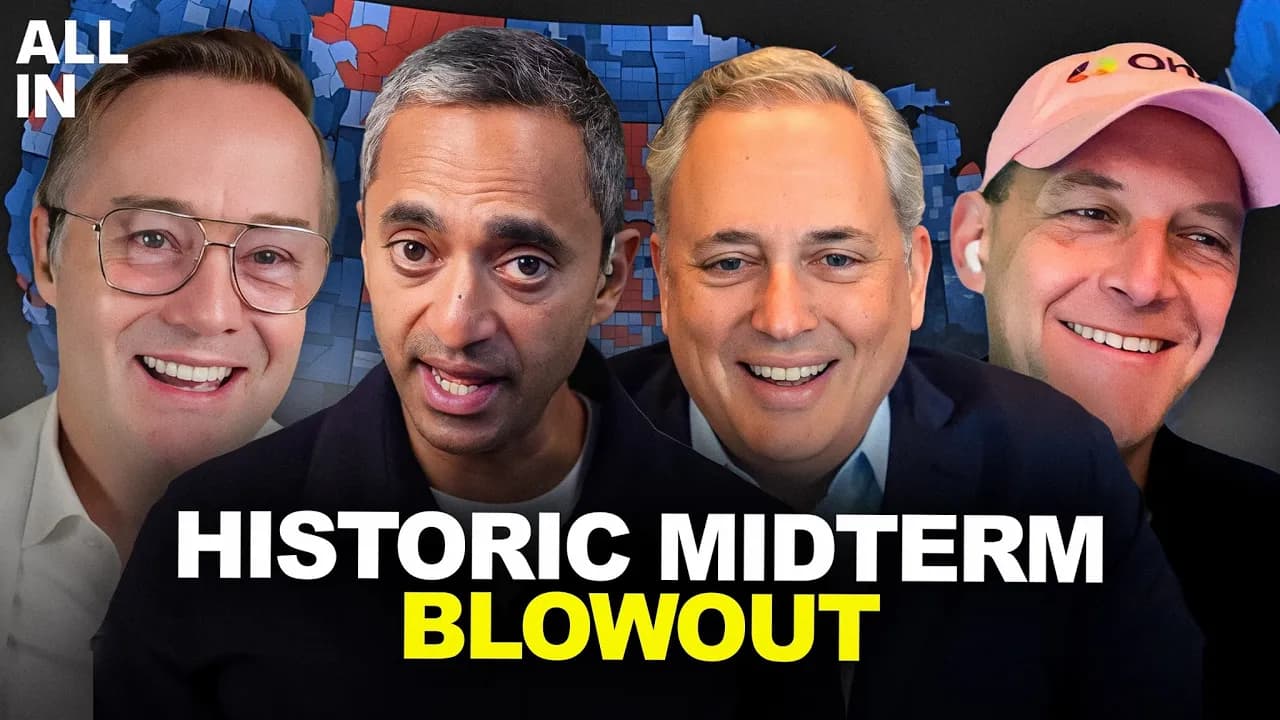
2026 Election Night Livestream with the Besties!
In a Nutshell
The 2026 election delivered a Democratic sweep that Republicans attribute to voter backlash against high living costs, perceived corruption, and policy missteps like tariffs and the Iran conflict. Democrats now face a strategic choice between scorched-earth obstruction or legislating on shared priorities like ethics reform and healthcare cost reduction to consolidate their coalition. The outcome threatens AI infrastructure growth, risks legislative gridlock, and sets up a 2028 race where both parties must address economic populism rather than cultural issues.
These notes were generated by AI and may contain inaccuracies.
The discussion begins with concerns about creating mechanisms that tax assets after income tax has already been paid, or illiquid assets before income tax has been paid. This creates a structural tax system that leads to ruin and socialism, making individual progress difficult in the country. These systems are viewed as the potential ruin of Silicon Valley, California, and potentially the country as a whole.
Steve Hilton was trending poorly with a 2% chance on Polymarket. California continues its pattern of putting unqualified people in positions of power to run the state into the ground. The speaker fled California three years ago. Proposition 40 is hoped to fail, while Propositions 41 and 42 are hoped to pass. The speaker stayed in California for family reasons and to continue building businesses, accepting that they will pay taxes if required, but noting the negative slippery slope for incentives to build in the state.
The election shows an enormous shift in the sentiment of the country, with betting markets, polls, and exit polls being analyzed. At 7:04 p.m. in Texas (5:00 p.m. on the left coast, 8:00 p.m. on the right coast), polls have closed in more than a dozen states including Georgia, Virginia, Florida, Ohio, and North Carolina. The night is not expected to be a "blue spritz" but rather a "blue tsunami."
Polymarket sweep chances for the 2026 midterms jumped from the low 80s to 93% in the last hour. The volume on this market is $68.7 million, representing significant financial commitment. This level of volume indicates substantial confidence in the betting market's prediction.
Senator Ted Cruz from Texas discusses concerns about the election. The early votes showed Democrats with a sizable advantage across the country, including in Texas where Democrats had a big advantage. Using the "four Rs, three Rs, two Rs, and one Rs" framework for analyzing Republican voters and the equivalent for Democrats, early votes in Texas showed about three-quarters of 4Ds and 3Ds had voted early, while only about half of 4Rs and 3Rs had voted early.
Republicans have more outstanding votes available for election day, with more 3Rs and 4Rs who hadn't voted yet compared to Democrats. The key question is election day turnout, which needs to be substantial for Republicans to win. This dynamic is particularly relevant for states further west, including congressional races in California where turnout will matter.
Florida's governor's race and Senate race are neck-and-neck, with Republicans expected to win both but the close margins are not encouraging. Georgia's Senate race was called at 7:02 p.m. Texas time, about an hour after polls closed, which Senator Cruz described as "That ain't good."
A structural dynamic exists where the party out of power typically gains seats in off-year elections because they are angry, unified, and motivated. Left-wing voters hate Donald Trump with "a fury that could ignite a thousand sons," which motivates turnout and donations. Republicans face the danger of complacency among their voters who feel "things are pretty good" and don't need to show up, as well as division among different factions.
In Texas, conservatives are mad that Congress hasn't passed the Save America Act, and moderates are upset that John Cornyn lost the primary. If both conservatives and moderates stay home, Republicans quickly run out of votes. Senator Cruz participated in 17 rallies in 9 states over 14 days, contributing to his voice being weak from campaigning.
If Democrats take one or both houses of Congress, there will be almost total legislative gridlock. Democrats are animated by hatred for the president and won't want to do productive legislating. Most legislation will grind to a halt, with only minor actions like naming post offices expected. Confirmations will halt, leaving cabinet vacancies and sub-cabinet positions open. Judicial confirmations will also stop, potentially leaving Supreme Court vacancies open for two years.
There will be two years of relentless impeachment, with the House potentially impeaching Donald Trump multiple times if they gain control. Subpoenas and investigations will target President Trump, his family, and cabinet members. An impeachment of Pete Hegseth is expected in the lame duck session. This represents "all out partisan war" that encourages the "crazies" in the Democratic party, including open communists and open Islamists.
A Democratic sweep would be very bad for the economy, particularly for AI and data centers. Democrats view AI and data centers as "the devil" and will launch a relentless assault on both if they gain congressional control. This would be a massive in-kind contribution to communist China by slowing America down. Halting all data center construction in America would likely put the American economy into a recession.
The Democratic agenda with congressional majorities would involve subpoenaing everyone, getting as many documents as possible, and either releasing or leaking documents to create FUD around administration figures. They would pass legislation counter to what the president wants, forcing vetoes and pushing uncertainty into capital markets, which would freeze markets and induce recession.
Peter Thiel's interview suggested that a blue tsunami would unshackle Democrats to run their most extreme candidate, viewing it as legitimization of the far-left edges of the platform. Michigan's Abdul El-Sayed and Texas's James Talarico are identified as the two most dangerous Democratic candidates this cycle. If El-Sayed wins in Michigan, it makes AOC much more likely to be the Democratic nominee for president in 2028, as the party would conclude they can "go full-on crazy and win anyway."
Democrats have foreshadowed using subpoenas to go after business executives who worked with the president, including targeting Elon Musk. Bernie Sanders has suggested nationalizing and seizing SpaceX and Starlink. Alyssa Slotkin in Michigan, who styles herself a moderate, has outlined a strategy of targeting business leaders who worked with the administration and young people (including 25-year-olds) who worked in the federal government to disincentivize anyone from working with Republicans.
Rural voters, farmers, and ranchers are really unhappy and have made a big difference, particularly up the middle of the country. Diesel costs $6-7 per gallon, fertilizer has gotten extremely expensive, and tariff impacts have affected farmers. Farmers and ranchers, historically reliable Republican voters, may have stayed home or even voted Democrat.
Suburban voters have been a swing vote, with states like Georgia and Arizona turning from bright red to purple or blue due to suburban voters in Atlanta and Phoenix turning against the president. Hispanic voters in South Texas are a major concern - the Rio Grande Valley, which had been bright blue for a hundred years, was flipped red in 2024, but these new Republican voters may have stayed home or switched back to voting Democrat.
98% or 97% of farms are now losing money and cannot make a profit. The US, the world's largest exporter of agricultural products, lost its biggest customer China. Fertilizer costs doubled as the number one input cost for farming row crops, and fuel prices doubled. Structurally, farmers cannot make a profit and have received multiple government checks and ad hoc payments to stay afloat, creating a crisis in agriculture that's playing out in rural state election results.
Rahm Emanuel joins to discuss the Democratic sweep, noting that Republicans lost through repudiation but Democrats have an opportunity to solidify a coalition of strong Democratic turnout, "non-MAGA Republicans" or "John McCain, Mitt Romney Republicans" who voted Democrat, and independents. This coalition needs to be made "not transactional but transformational."
Emanuel proposes comprehensive ethics legislation affecting all three branches of government, including banning stock trading, banning participation in prediction markets for the executive branch, mandatory blind trusts for those making over a million dollars, mandatory term limits or age-out at 75, the "Jared Kushner rule" preventing government officials from taking foreign money, and a two-year hiatus before former officials can take foreign investment after leaving government.
Emanuel criticizes Congress for being in session for just shy of 100 days while kids on the Abraham Lincoln aircraft carrier were at sea for 322 days straight with non-working bathrooms and "ransom food." He asks why Congress doesn't "show up like the kids on the Abraham Lincoln" and pass meaningful legislation rather than spending political capital on their version of "Donald Trump's Hunger Games."
Rahm Emanuel emphasized that quality of candidates remains very important and underappreciated. When he was chair 20 years ago in 2006 for Democratic efforts to take the House, candidate quality was critical. He pointed to several instances where President Trump's involvement in primaries hurt Republican chances.
In South Carolina, Trump picked Darlene Graham in a race where Democrats had a great candidate in Annie Telerico against Paxton, rather than incumbent Senator Cornyn. In North Carolina, Trump chased Tillis out, giving Governor Cooper a real chance. Georgia was supposed to be a battleground but Collins got clean clocked by Hassaf, a candidate picked by the president in a crowded primary. The message is that Trump's involvement in primaries selected candidates and put the weakest foot forward for Republicans.
Emanuel argued that Democrats with majorities in both houses should legislate and actively have an agenda they can caucus on and agree to, rather than treating the two years as a lame duck where everyone focuses on 2028 and runs to the exits. The strategy is to reward swing voters who came over to Democrats by actually legislating.
Everyone Emanuel picked would unite Democrats and divide Republicans. This is important on the political level for 2028. He also emphasized not wanting to "rent" voters in 2026. In many states, independents and non-MAGA Republicans voted Democrat, and that vote needs to be affirmed rather than used and discarded.
Emanuel supports hearings on "follow the money" - wanting to know where Venezuela money is and what deal was cut regarding Qatar giving that plane. However, he argued that impeachment would solidify Republicans, while ethics reform would get half the Republican caucus to vote with Democrats. This would make a difference and clean up the Supreme Court, federal branch, executive branch, cabinet, House, and Senate.
With a big bipartisan vote on ethics reform, Democrats would affirm they are governing. The same applies to raising the minimum wage and tariff relief, which would get Republican votes while uniting Democrats.
In 1991, George Mitchell sent George Bush 41 a tax and budget bill. The president broke his pledge, which led to Pat Buchanan in the primary and set up Bill Clinton for 1992. In 2007, Democrats sent George Bush 43 a kids healthcare bill and 60 Republicans voted with them. When Bush vetoed it, it became the second bill Barack Obama signed into law as president, with 60 Republicans voting for it.
Emanuel appeared on Ezra Klein's podcast in December 2024 where the headline was "It's the corruption, stupid." He stated corruption would be the major issue because Trump was clear this would be a tenure of "greed, grievance, and grand." He fulfilled exactly that. Emanuel, from Chicago with a high standard for corruption, has never seen corruption like this, and it's blatant. Trump said he never got credit for what he did in the first term, and they've been going to town now.
In the closing three weeks, 70% of Democratic ads were about corruption. If Democrats do nothing about it, they will have wasted the second look the public is giving them. "You cannot spike the ball as a party on the 20 yard line."
Emanuel stated that what Democrats do in 2027 will determine whether they won. Republicans are going to get a shellacking and lose if Democrats handle this correctly.
Corruption and cost of living are heads and tails of the same coin. Example: the president gets a $450 million Qatari gifted Air Force One while the public gets 4 bucks and 50 cents a gallon of gas. He's fixated on his arch while families can't afford a meal at Golden Arches. The American people think the reason they can't afford things is because everybody else is making money. This election, unlike 2006, has a level of anger towards the president because he promised money in their pocket and they watch him putting money in his own pocket every day.
While media focuses on gas and groceries, the number one issue driving Americans on inflation is healthcare costs. 40 million Americans put healthcare costs on their credit card. It's the number one reason for personal bankruptcy. Premiums are going up at double digits while incomes are stagnant. Healthcare costs are what people say is top of mind when you talk to them across the country.
The insurance company's business model is structured around the word "no" and your payments on premiums is based on the premise of "yes." There's a mismatch. 25% of all hospital costs are driven by administration of insurance claims. The system needs restructuring to align people's interests toward better healthcare coverage, better results, and where the economics of the industry make sense.
The insurance claim area is $1.5 trillion. Taking 10% out of that equals $150 billion, which isn't hard to achieve, almost doable on just the pre-approval area. 25 cents out of every dollar for hospitals goes to administrative costs around insurance compliance. There's a mismatch in economics. Consensus could also be reached on reimportation of pharmaceutical drugs and prices for greater competitiveness, and transparency since hospital costs are directly related to insurance.
Trying Medicare for All means nothing else will happen. Instead, Emanuel advocates for doable bipartisan things that get at the cost structure and allow better coverage. He took on insurance companies to get 10 million kids healthcare under President Clinton and passed the ACA for President Obama.
Emanuel would not eliminate the filibuster. However, Democrats have a chance to govern, otherwise things will start getting carved out on the filibuster. As a former House member, he thinks the Senate is a constitutional mistake.
Emanuel's approach is to seek common ground but also hold his ground. When negotiating as mayor, his attitude was: tell me what you want to do, I'll tell you what I want to do. You tell me what you can live with, I'll tell you what I can live with. I'll tell you what I'm not going to live with, and we'll compromise. This means hearing, listening, and where possible accommodating, but there are certain things you won't go towards.
Gingrich's government shutdown in 1995 was an absolute mistake. Three years later, they got to a balanced budget agreement. The lesson is to hold your ground but then seek common ground.
Chimamoth discussed the neverending lawfare between parties. There were cases last time Trump was running for a second term targeting him. Some cases might have had merit, but others were specifically to stop him from running. Trump has done lawfare going after people who went after him. There's expectation this will start all over again in the second half of Trump's term, which Americans don't want to see.
Chimamoth noted that Emanuel's strategy of rewarding swing voters by legislating is smart, but struggles to understand what the actual legislative through line is through all Democratic candidates since they're such a wide spectrum. The presumed approach would be scorched earth - trying to slow the president down and put scarlet letters on people so they're in difficult positions for 2028.
There's a version where the president, focusing on his legacy, could negotiate an understanding with concepts down the middle that most people would agree with, giving Democrats a win and the president a win. This could be how to negotiate an offramp.
It's going to be very dynamic in the next six months. Democrats have to come together and coherently develop a strategy. Is it the scorched earth path or the reward the swing voters path going into 2028? You can't do both because legislative horsepower required for one doesn't leave room for the other.
The socialists and folks on the left have done well saying it's about affordability, stopping foreign wars, increasing the minimum wage, and getting focused on affordability. The last time Democrats tried to put Trump in jail, all they did was make him a superhero and martyr. Being the anti-Trump party without ideas would be a mistake.
Freeberg doesn't think there's a working together thing that's going to happen. The next year is going to be instrumental. 2027 is the year where the Democratic nominee is selected for president. Democrats are going to be very calculating going into 2028, wanting to keep themselves aligned and viewed as the antidote to anger. They'll try to find someone angry and strong who speaks up for everyone who feels unheard. AOC is likely to end up on that ballot.
The cost of living has gotten too high primarily as a function of government being too high a percentage of GDP and spending. It's very hard to get out of the cycle of inflation and stagnant wages. The economy is stalling out for the majority of people, they're seeing their assets decline, and they can't afford healthcare. There isn't a good alternative to socialism for the majority of Americans today.
The advice given is simple: take a look at what Trump did. He created a huge tent and invited everybody to Washington DC - business leaders, celebrities. You have to have a big tent and try to win the middle. Trump did this by inviting Tim Cook, Elon Musk, anybody who wants to support America. Democrats had a purity test, kicked everybody out of the party, were super critical, and kept losing. They should take the note that they don't have to agree with everybody on every issue and start recruiting people to join forces.
Shane Copelan, founder of Polymarket, joined the stream. He addressed concerns about prediction markets being manipulated. In early days, criticism was that someone could put a ton of money on one side. Polymarket markets are shares of candidates where the share becomes worth a dollar if that candidate wins. The price trades like a stock - if trading at 25 cents, it's implied 25% likely to happen.
The biggest misconception is that Polymarket is a seesaw of how much money is on either side. It actually trades like a stock where when you're buying, someone else has to be selling. If someone tries to push the price up by paying above market price, market making firms and political analysts notice and take the other side of the trade, and the market rebalances basically instantly. The more people try to manipulate the market, the more incentive it creates for the market to become more accurate because there's more financial incentive for people who can price it correctly.
Regarding the Brazilian election where Polymarket was on the wrong side of trades, when someone has a higher price than the other person, it doesn't mean it's a lock that that's what's going to happen.
In the Brazilian election, higher prices on prediction markets don't represent a guaranteed outcome. When a candidate shows 70% likelihood, this means the underdog still wins approximately 30% of the time if the scenario were repeated. PolyMarket functions as a real-time barometer of market sentiment rather than a definitive predictor.
The Brazilian election featured an interesting dynamic when the Supreme Court extended the voting period, causing Bolsonaro's odds to tank immediately. Market participants interpreted the extension as signaling something unusual was about to occur, demonstrating how prediction markets rapidly incorporate new information into pricing.
Oil markets demonstrate how different market participants hold varying interpretations of price movements. When oil dropped significantly, five different analysts provided different explanations, each reflecting their own internal probability assessments of various contributing factors. Prediction markets aggregate these implicit probability assessments that already exist in people's minds, providing better price discovery for underlying assets.
Markets like oil have always been implicitly traded through individual assessments, but PolyMarket provides a venue that aggregates demand and supply sides effectively, becoming a marker particularly for geopolitics and other complex topics.
LeBron James serves as a partner for PolyMarket and has appeared in advertisements. While Knicks fans maintain their rivalry stance, there's acknowledgment of his status as one of the greatest players after Michael Jordan.
In the last 30-40 minutes of the stream, Texas Governor Greg Abbott appeared to flip in the election results. However, this was noted as potentially not holding since only blue districts had reported at that point.
The US economy syncs through data centers as the primary mechanism for the AI trade. All power that matters for this sector is concentrated in West Texas, making it a critical focal point for energy infrastructure development.
Steve Bannon appeared on the stream, jokingly threatening that the hosts would face a tribunal for their "crimes" related to running the number one podcast. He characterized the show as a successful long-running scam.
The election results were interpreted as a vote against the cost of living rather than a direct endorsement of Democratic policies. The concept of an "economic war disguised as a culture war" was presented, suggesting people attach cultural meaning to issues when their economic confidence is low.
The vote was also framed as a reaction against perceived systemic corruption that Trump had promised to address but failed to correct. This represented voters rejecting both the current administration's direction and Trump's transformation into representing "the system."
Four-year college graduates with significant student debt living in expensive cities feel they're losing economic ground. These white-collar workers are increasingly supporting DSA candidates because they're mired in debt, don't own property, and don't see a path to ownership.
Trump was expected to address these housing and economic concerns, and if he fails to do so, other candidates will emerge to fill this gap.
The current situation was compared to the Gilded Age, where leading oligarchs allocated responsibility for societal good and ensured economic gains were broadly distributed. Today's handful of winning companies represent concentrated gains among thousands of individual employees without broad-based economic benefits reaching the wider population.
Two years into the Trump administration, Republicans lack a coherent message to sell to voters. The Democrats previously lost by focusing on symbolic issues like "democracy on the ballot" rather than addressing core economic concerns. Republicans are now making the same mistake by selling symbolism while voters focus on filling their cars, buying groceries, and paying rent.
The Overton window may be closing regarding acceptable comedy content. Tony Hinchcliffe and Joe Rogan may face restrictions on certain language. Tim Dillon expressed willingness to adapt to any cultural requirements to maintain his career, including wearing a burka and performing at mosques or with diverse audiences.
When asked about alternatives to socialism that might appeal to voters, the discussion acknowledged that economically populist, culturally moderate Democrats represent a viable message. This approach focuses on healthcare, jobs, and working-class concerns without emphasizing cultural issues or radical positions like abolishing prisons.
Taylor Lorenz discussed how younger generations prioritize economic populism over culture war issues. People want to know if groceries will cost more, if they can afford housing, and whether money will be spent on foreign conflicts rather than domestic needs.
Neither party has effectively addressed working people's material conditions, with Democrats failing to speak to average workers' needs despite the establishment's resistance to more populist messaging.
On the Republican side, Ted Cruz was dismissed as having no chance of winning the presidency. Marco Rubio was mentioned as a likely candidate, while JD Vance was considered unlikely to succeed. John Oaf was identified as having momentum and the ability to appeal to both progressive and centrist voters.
On the Democratic side, AOC was considered but noted as lacking Bernie Sanders' energy and appeal. Ro Khanna was discussed but described as unappealing with messaging that doesn't land effectively with audiences.
Both parties have embraced censorship policies. The only bipartisan tech regulation emerging focuses on saving children by banning misinformation and unwanted words from the internet. The J1 Act, sponsored by Ted Cruz and Widen, would prevent government overstepping by pressuring tech companies to censor content, but no one is supporting it because politicians enjoy wielding government pressure to regulate speech.
Europe's tech policies and censorship in places like the UK are viewed as terrifying examples. There is no political faction fighting censorship—leftists embrace it while the right has also adopted these positions.
Regarding oligarchy and wealth concentration in the United States, the solution involves examining how certain income types are taxed, particularly investments versus work income. The asset-owning class has done very well while wage workers have not benefited from the same incentive structures. The current system provides incentives for investment, which is necessary to some degree, but requires rebalancing to tax investment income similarly to wage income earned by EMTs, firefighters, police officers, and teachers.
If balance isn't restored through changes to capital gains, dividends, and potentially wealth taxes at extreme wealth levels, society risks creating conditions that people don't want. Wealth taxes, while unpopular, become understandable to most people at certain extreme wealth thresholds.
President Trump's enduring legacy, assuming no nuclear war occurs, centers on opening communication channels. He applied pressure on tech companies to facilitate easier expression online, which is viewed as essential for democracy to function. By saying whatever he wanted, Trump opened floodgates for both positive and negative speech, making it significantly harder to express certain views before his influence.
Critics argue that despite some positive developments under Trump, he hasn't ensured Meta censors less. Meta continues becoming more censorious, particularly through settlements with state attorney generals. Age-gating and registration requirements with social networks represent a racket where state attorney generals generate headlines by targeting Meta over claims of social media addiction and child harm.
These regulatory systems usher in national ID requirements and mass surveillance, making anonymous posting increasingly difficult. The ability to post anonymously online has become harder than it was five years ago, contradicting claims of restored free speech.
The Overton window shifted under Trump's second term, making YouTube less censorious than previously. Elon Musk's acquisition of X brought freedom of speech to that platform. However, media consolidation under one family owning approximately 20 media outlets represents a significant problem requiring anti-monopoly legislation.
Content creators who were previously restricted would not have been allowed to produce certain material four years ago and would have faced removal from platforms. However, proposed legislation including the Kids Online Safety Act and Screen Act would make such content creation impossible within two years, regardless of administration changes.
AI stocks experienced a 10% reversal following election results, with overseas markets in Japan and Korea declining 5-10% over two hours. The primary concern involves potential moratoriums on new data centers and permitting difficulties under Democratic governance in Texas. Nvidia declined 2% and CoreWeave dropped 6% in after-hours trading.
The consensus forecast for 2027 projects 43 gigawatts coming online, exceeding the cumulative 38 gigawatts built in the United States through 2026. Previous estimates suggested building only half of projected capacity, with concerns about growing backlash even from Republican governors like Greg Abbott. Under a blue wave scenario, 10-15 gigawatts of expected build may not materialize.
Republicans previously embraced the technology industry by inviting diverse companies to the White House regardless of prior political affiliations. Democrats winning elections will increase their input into AI regulation conversations. The current president's deal-making approach suggests inviting Democrats to negotiate on data center and AI regulation issues, as bipartisanship remains necessary for legislative progress.
The Invest America Act has bipartisan support from senators including Warner and Booker. Split government forces bipartisan cooperation, which may prove beneficial despite concerns about policy direction.
Anthropic generated $100 billion in run-rate revenue using 2 gigawatts of compute, with approximately 500 megawatts dedicated to inference. Slowing compute deployment may not significantly impact AI labs and could benefit them, though it challenges the infrastructure trade. Market sentiment will likely push IPO pricing toward the lower end of ranges, though substantial demand remains.
AI infrastructure contributed approximately 75% of GDP growth this year. A 50% slowdown in AI infrastructure development could create a 50 basis point headwind to GDP growth next year, though 27 gigawatts of new capacity still represents enormous expansion.
Proposition 40 in California, characterized as an asset seizure tax targeting billionaires, is predicted to fail despite the blue wave election results. Failure in California would demonstrate that such tax proposals cannot succeed nationally, even under favorable political conditions for Democrats.
Ben Shapiro joined the conversation and shared his personal interest in musicals and opera. His favorite opera is The Magic Flute, and his favorite musicals are West Side Story and 1776. He opened with the quip that he "picked the wrong week to stop sniffing glue."
Ben characterized the election as a referendum on the president. He pointed out that losses were not isolated to a few bad candidates, noting that South Carolina featured an "empty suit" Republican losing, and Florida's Senate race remained very close despite the state staying red. Angie Nixon, described as a "full-scale nutcase," lost by about two points, while David Jolly, spending only one-seventeenth of Byron Donald's campaign funds, lost by a couple of points.
Ben attributed the decline in Republican performance to a steady drop in presidential approval ratings from the 50s, exacerbated by Liberation Day, the Iran war, and the "reflecting pool" issue. He argued that voters perceived the president as disconnected from everyday concerns, distracted by tariffs, the war, and corruption issues. The Fox News exit polling identified corruption as the top issue for many voters.
Ben outlined three actions for Republicans: end the Iran war successfully (Americans dislike losing as seen with Biden in Afghanistan), refocus on economic growth while moderating away from the unpopular tariff regime, and address apparent corruption within the administration.
Ben warned that if Texas and Ohio become vulnerable, Democrats could target a map with approximately 382 electoral votes, leaving Republicans with around 150 guaranteed votes—a steep challenge heading into 2028.
Ben suggested that eliminating two or all three of the major issues—tariff chaos, ICE enforcement imagery, and the war—would have resulted in moderate Republican losses rather than a complete wipeout. He emphasized that Americans can tolerate chaotic online behavior when other matters seem stable, but the combination proved damaging.
Ben argued that the American people generally reject "worldbreaking change" and prefer normality and predictability. He cited the example of wanting the southern border closed without "memes on studio Jibli of ICE arresting illegal immigrants."
Ben identified three drivers of the results: strong Democratic turnout, independents voting against the president, and some Republican dissatisfaction with presidential performance. He noted that trolling works when Americans feel economically secure, but grouting discussions at the reflecting pool while voters worry about affordability seemed unfocused.
Ben identified JD Vance as the presumptive front-runner but warned that some Republicans might now hesitate to enter the race. He stressed that Vance cannot simply copy-paste Trump's coalition, which itself shrank by 20% in this cycle, particularly among Hispanic voters (dropping from 48% to the 20s) and blue-collar white voters (dropping 15-20%).
Ben dismissed AOC and Gavin Newsom as likely nominees. He highlighted Wes Moore as underrated, noting his strong re-election in Maryland and the advantage black candidates have in early Democratic voting states with large Black populations. He recommended buying low on Moore in prediction markets.
Ben observed that Democratic winners included both moderates like Telerico in Texas and Josh Turk in Iowa, and DSA-aligned candidates like El Saledad in Michigan, who won without moderating his "third worldest and quasi socialistic policies." He found it notable that Democrats attacked Haley Stevens more harshly for refusing to endorse El Saledad than they attacked El Saledad's own positions.
Ben stated that Democratic control of both chambers would raise questions about funding for Israel. He noted that the president and Prime Minister Netanyahu had already announced an early end to the military aid memorandum of understanding, and that Israel is preparing for this shift.
Ben argued there is no "next Trump," just as there was no "next Barack Obama." He predicted future candidates will remain within the elected-official box rather than the celebrity box, and he saw no one with Trump's magnetic effect emerging.
Ben dismissed concerns about January 6-style election interference or Trump attempting a third term, calling such fears "total nonsense." He said Trump is content to finish his second term and would likely become a "veto machine," relying on executive actions as presidents have since Obama.
The hosts noted they reached 400-500,000 concurrent viewers, outpacing Hassan and Nick Fuentes. One host expressed surprise at results in Ohio and Texas, acknowledging his priors needed revision. He emphasized that elections are always about the economy—specifically W2 wage growth, not GDP—and that he had over-explained away economic concerns.
Another host reflected on receiving backlash for criticizing tariffs, ICE imagery, and foreign wars. He concluded the losses were self-inflicted and that economic perception remains the decisive factor in every election.
The hosts concluded the All-In coverage, directing viewers to the Poly Market app for continued results. They mentioned a large party at the DC Navy Yard, noting uncertainty over whether Democrats or Republicans were getting more drunk.
Keep All-In Podcast in your library
Save the videos and channels worth coming back to, and find them again in one place.