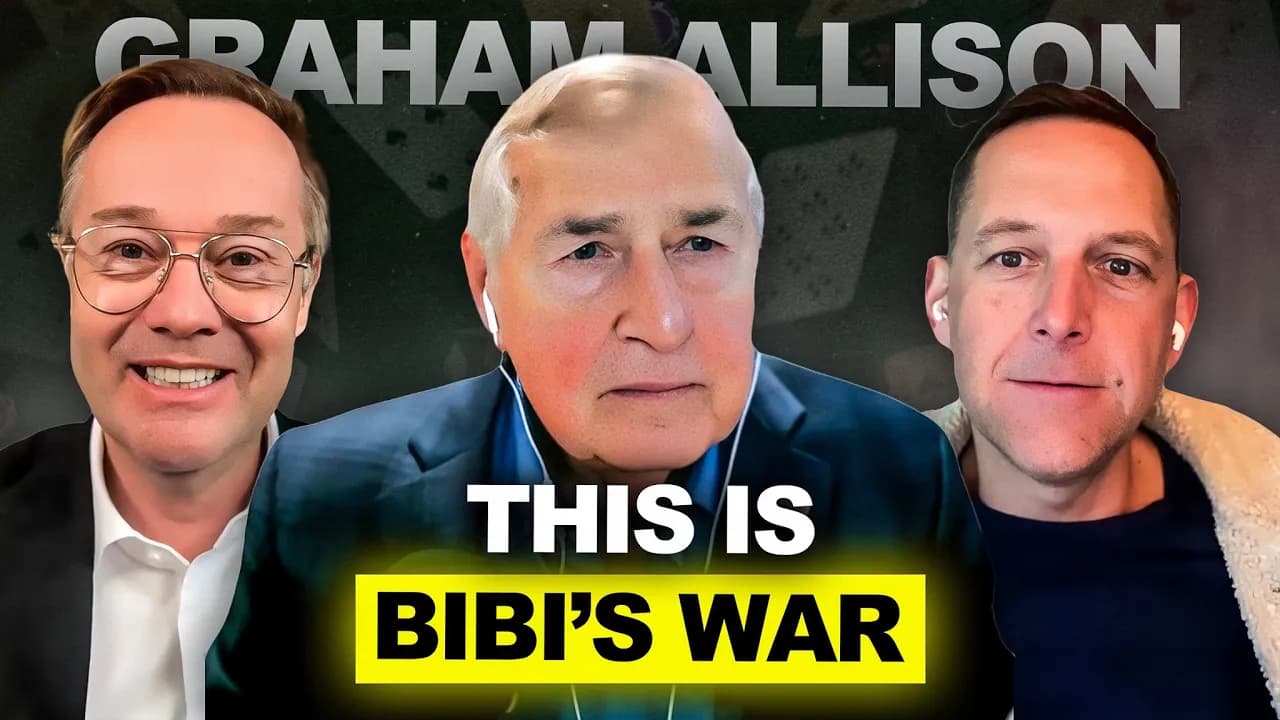
EMERGENCY DEBATE: They Are Lying To Us About AI, The Iran War & What Happens Next!
In a Nutshell
Two guests clash on AI's impact: one warns that CEOs openly predict 10-25% unemployment leading to depression-level collapse with no government plan, while the other claims new jobs in construction, engineering, and space will offset losses and data centers create net productivity. On the Iran war, they debate whether Israeli influence is pushing U.S. policy into endless conflict that closes the Strait of Hormuz, spikes global energy prices, and risks recession, versus the view that pressure on Iran will force a deal and stabilize the region. The debate concludes that by 2028, the combination of mass AI job loss and war-driven economic pain will favor populist candidates like Tucker Carlson over establishment figures tied to corporate donors.
These notes were generated by AI and may contain inaccuracies.
Discussion opened with warnings about companies rushing to fire 10-25% of their workforce due to AI adoption. A 10% unemployment rate would trigger a depression worse than any experienced in living memory, described as an epic disaster with no preparation in place. The opposing view frames this as fearmongering, rejecting the notion that robots will replace all human roles, while acknowledging change is disruptive yet historically creates productivity and opportunity.
By 2028, disaster from AI unemployment combined with war is predicted unless a prepared leader is elected. Republican voter enthusiasm is described as obliterated with low turnout expected. Democrats are characterized as having lost their way. Tucker Carlson is identified as the sole Republican figure positioned to win an election.
Viewers are asked to verify their subscription status to support the show remaining free and improving. The request is tied to an approaching subscriber milestone, with a commitment to deliver stronger guest conversations in return.
Jen and Kevin are introduced with contrasting perspectives on AI, geopolitics, and American politics. The goal is to determine truth through idea collision rather than confrontation.
A graph indicates seven in ten Americans oppose local AI data center construction. Historical precedent shows new technologies create disruption yet ultimately generate productivity gains within the American economy. AI applications cited include cancer cures, democratized education, and space research advances. S&P 500 productivity gains are attributed to AI, requiring supporting data center infrastructure.
Forensic auditors traced opposition funding in Utah to Arabella (also referenced as Marabella) and Neville Singum through IRS 990 filings. The Chinese are accused of meddling in every state and city proposing new power infrastructure via this network. 90 pages of foreign IP addresses were provided to U.S. government agents. The developer reports 12 million social media followers and has escalated death threats against executives to the FBI.
Data centers are criticized for driving up local energy costs through legalized bribery and campaign contributions. The principle advocated is that businesses must fully pay their own infrastructure costs rather than subsidizing them through taxpayers. If government covers costs, equity stakes should be taken in the companies, modeled after the 2008 bank bailout critique where equity was not secured.
The primary public anger stems from anticipated unemployment rather than energy costs alone. Every AI company CEO is rushing workforce reductions for competitive advantage, with stock prices rewarding early adopters. This trajectory is described as leading to a depression with no government plan in place. Roana is identified as the only figure developing a response strategy.
Sam Altman (March 2021) stated AI will replace most jobs and eliminate entire job categories. Elon Musk (May 2024) predicted none of us will have jobs, with AI and robots providing all goods and services. Dario Amodei (2025) warned AI could eliminate half of entry-level white collar jobs within five years, pushing unemployment to 20%. These statements come from individuals with least incentive to highlight harm.
Data centers cannot draw from existing grids without raising community energy prices by 30%, as occurred in Virginia. Developers must bring their own power and return excess to the grid. Chinese coal plant construction reached 400 gigawatts in 19 months with no environmental constraints, directed by supreme leader fiat.
Future wars will be conducted using AI, with technological superiority determining outcomes. Deepseek is identified as China's competing AI platform. Shutting down U.S. compute development would allow China to lead, enabling potential non-kinetic invasion of Taiwan through AI-controlled infrastructure shutdowns.
AI targeting was used in an attack on a girls' school in Tehran killing over 160 civilians, characterized as lacking true precision. Preference expressed for human involvement in life-and-death decisions over systems like Palantir.
Transitioning from a $120,000 coding salary to UBI estimated at $3,000 monthly ($36,000 annually) would be economically devastating. Coder layoffs have already begun, particularly among younger professionals. Truck drivers face greater transition challenges at older ages. Waymo autonomous vehicles are trusted more than human drivers yet eliminate driver jobs.
Wall Street record highs are questioned given shrinking customer bases from unemployment. Middle-out economics is advocated, citing Nick Hanauer: advantages given to the middle class generate immediate spending versus minimal spending by the wealthy under trickle-down approaches. No plans exist for managing 10-25% unemployment.
AI development cannot stop because China, Russia, North Korea, and Israel are advancing. Israeli possession of advanced AI is viewed as dangerous given their historical use of power. The question is whether the race can be conducted responsibly to serve citizens rather than solely AI company executives and shareholders.
America's political system has become nearly unsolvable due to legalized bribery stemming from Supreme Court decisions in 1976 and 1978, along with Citizens United. This system prevents politicians from serving voters because whichever AI companies provide more money receive favorable treatment. AI companies have already begun influencing primaries by using money to eliminate opponents. Both Republican and Democratic politicians serve the donor class rather than constituents.
The prediction is that America will run into an iceberg resulting in epic disaster. The only hope lies in electing a prepared, intelligent leader in 2028 who can begin steering the country in the right direction.
When the disaster hits, AI shareholders and executives will face tremendous public anger. The argument will emerge that AI companies should bear the costs of unemployment they created by funding unemployment insurance and other programs to help displaced workers. The current dynamic of AI companies keeping all profits while workers lose jobs will not be accepted by the public.
The discussion suggests AI could lead toward socialism as society questions why a few people reap billions while everyone else faces unemployment.
AI companies are currently losing billions of dollars annually while racing against China. They raise capital but have not yet monetized their technology. The market provides funding because of perceived productivity opportunities, potential cures for cancer, educational benefits, and demonstrated productivity gains across all 11 sectors of the S&P 500.
New jobs created include 4,000 construction jobs lasting approximately nine and a half years and 2,000 engineering and support jobs, all high-paying positions. Data centers are being built in Utah in desert areas that don't replace farmland, don't consume local water, don't take energy from the state, and contribute energy instead.
Most taxes in America are paid by wealthy individuals who already pay their fair share. Increasing tax rates beyond 50% as seen in California, New York, New Jersey, and Massachusetts causes wealthy individuals to relocate to lower-tax states like Florida and Texas. If all states implement high taxation, wealthy individuals may leave the country entirely, similar to what occurred in England with 90% tax rates and in France where wealthy citizens moved to Monaco.
Entrepreneurship is emphasized as essential, with one-third of the population being entrepreneurs who employ the other two-thirds. America receives 52% of global sovereign wealth investment because of the opportunities it provides.
Capitalism should not crush average workers while enriching corporate CEOs. The American system requires a strong middle class that serves as productive citizens, voters, and consumers. The core problem identified is the lack of plans addressing inevitable massive unemployment.
When millions become unemployed while a few accumulate billions or trillions, questions will arise about fairness. Unemployed young men historically lead to increased crime and wars. The AI industry response of telling people to relax while executives retreat to places like Monaco is considered inadequate.
Entry-level hiring decisions have shifted dramatically. Candidates without AI proficiency are being passed over because those with AI skills function as 5x or 10x employees in the same roles. Companies are making different hiring decisions than they were six months ago, particularly regarding coding positions.
Engineers are hired primarily to solve problems rather than write code. AI tools like Claude assist with coding, but the core function remains problem-solving.
Figure AI conducted a four-day live stream showing a humanoid robot sorting parcels on a factory floor, performing better and faster than humans. Elon Musk has predicted there will eventually be more humanoid robots than humans, with a ratio of approximately 2:1 or higher.
Musk's predictions about rockets landing on chopsticks and self-driving cars eventually proved accurate despite timeline inaccuracies. His predictions about humanoid robots performing surgery and cleaning tasks by 2027-2028 are considered credible by some observers.
The missing component in robotics has been intelligence rather than physical machinery. With AI providing that intelligence at low cost, robotics development is accelerating. An entrepreneurship accelerator in San Francisco shows participants building robotics applications including robot arms cooking food and machines creating custom perfumes.
Space projects including putting humans on Mars and establishing a permanent moon base will create hundreds of thousands of high-paying jobs for engineers, analysts, coders, and manufacturing workers. These represent new opportunities that did not exist 24 months ago.
Even if long-term AI scenarios prove positive with abundant leisure time and new opportunities, the transition period of approximately 20 years will involve massive unemployment waves. Assembly line workers, truck drivers, and others losing jobs cannot easily transition to Mars engineering roles, particularly at age 61.
Wall Street analysts celebrate cost-cutting and employee reductions without addressing who will purchase products after mass layoffs. The CEO of Uber stated they will create autonomous vehicles to replace 9.4 million drivers but responded "I don't know" when asked what those drivers will do afterward.
Tech executives discuss massive disruption privately but avoid public transparency about anticipated job losses.
The discussion addresses conflicting reports about whether a deal is imminent or whether bombing has resumed, with the Strait of Hormuz alternating between open and closed status. The uncertainty centers on what is actually occurring on the ground.
The war has severely damaged the president's polling. His numbers were already weakened by the Epstein files, failure to address affordability, a large tax cut for the wealthy, and consistent alignment with Israeli policy. He has lost roughly 20% of hardcore MAGA supporters and retains only 53% support among non-MAGA Republicans who originally voted for him. Overall disapproval stands at record levels, with 68% of the country believing the nation is headed in the wrong direction and 76% dissatisfied with the economy.
Rising gas prices triggered by the war are fueling broader inflation. The conflict has also disrupted fertilizer supplies passing through the Strait of Hormuz, intensifying the energy crisis. Shortages are hitting Asia and Europe particularly hard. South Koreans are especially angered at having to conserve energy because of a war they view as serving only Israeli interests.
The conversation turns to campaign finance, noting that U.S. law effectively permits unlimited corporate and individual contributions to super PACs. The Adelson family (Miriam and Sheldon) alone has given Donald Trump over $317 million. Trump has publicly stated that Miriam Adelson cares more about Israel than America and that Sheldon Adelson used to instruct him on policy, including moving the U.S. embassy to Jerusalem.
Israel contributes to 94% of Congress members. The same dynamic exists across multiple industries: oil companies receive $35 billion in subsidies despite record profits, and pharmaceutical lobbyists block price negotiation. However, applying the same scrutiny to the Israel lobby triggers accusations of antisemitism and professional consequences, creating a unique taboo on criticism.
Israel has invaded Lebanon with the stated goal of controlling territory up to the Litani River and permanently holding southern Lebanon after displacing approximately one million people. Similar ethnic cleansing occurred in Gaza. Netanyahu has been recorded boasting that Israel now controls over 60% of Gaza compared with 53% after the previous war, indicating the objective was land acquisition rather than self-defense.
American interests require reopening the Strait of Hormuz to stabilize energy prices and the broader economy. Iranian officials have repeatedly offered verifiable commitments not to develop nuclear weapons, consistent with the Obama-era agreement. In contrast, Israeli leadership seeks to eliminate all rival powers in the region so Israel can remain the sole regional superpower and continue territorial expansion without opposition.
Following 9/11, Israel reportedly presented a list of seven countries it wanted the United States to confront. All seven have now been targeted, with Iran being the final entry. The wars are framed as serving Israeli strategic goals rather than American ones, at a cumulative cost of $8 trillion plus $320 billion in direct aid to Israel.
Netanyahu has claimed for thirty years that Iran is weeks away from a nuclear weapon. Iran possesses no missile capable of reaching the United States and has never enriched uranium to weapons-grade levels (90%). Enrichment has remained around 60%. The former Grand Ayatollah issued a fatwa prohibiting nuclear weapons development. American media is described as functioning primarily as a conduit for Israeli messaging rather than providing independent verification.
The IDF's civilian casualty ratio stands at 83%, significantly higher than that of Hamas or Hezbollah. Israel is characterized as a terrorist government due to its pattern of attacking seven neighboring states, occupying territory, and systematically destroying civilian infrastructure while receiving hundreds of billions in U.S. funding.
Every time a potential agreement nears completion, Netanyahu imposes additional demands. Recent conditions include the immediate surrender of all highly enriched uranium (currently buried and requiring months to extract), mandatory accession to the Abraham Accords without ending the occupation, and permission for Israel to continue attacking and occupying southern Lebanon while other parties cease operations. These terms are presented as incompatible with any viable peace deal.
The Iranian regime is described as a small ruling elite of roughly 150,000 people maintaining control over nearly 100 million citizens through a large paid militia. This structure has been tolerated by neighboring Gulf states until recent missile attacks. Kevin argues that Iran must be prevented from acquiring nuclear weapons and that control of the Strait of Hormuz should be transferred to a regional arrangement involving Saudi Arabia, the UAE, Qatar, and Bahrain to ensure open passage.
Blocking the strait costs Iran approximately $210 million per day. This revenue loss is expected to eventually force the regime to negotiate because it can no longer pay the forces needed to maintain internal control. Kevin expresses optimism that the conflict will conclude once these two core issues—nuclear weapons and strait access—are resolved.
Jenk predicts further escalation rather than resolution. Because Israel insists on continued operations in Lebanon, Iran will refuse any peace agreement. This stalemate is expected to lead to renewed U.S. bombing of Iran, deployment of the 50,000 ground troops currently positioned on ships, Iranian strikes on Gulf oil and gas infrastructure, and a resulting global recession or depression driven by extreme energy price spikes.
The war is characterized as the first major "tech war," relying heavily on GPS-guided munitions controlled from space. Early drone waves consisted of low-cost carbon-fiber aircraft with lawnmower engines priced around $35,000, while defensive missiles cost between $1.2 million and $3 million each. This cost asymmetry raises questions about long-term sustainability and compute requirements for defense systems.
Current defense systems are expensive because countries are positioned on the wrong side of defense needs. The focus needs to shift toward cheap drones. In approximately 24 months, new drone blocking technology and inexpensive versions of Iranian drone designs will emerge, with improvements over lawnmower engines. This development will significantly impact military economics.
The assessment is that the region will stabilize and be funded by neighboring countries, resulting in better outcomes for all parties. Chinese oil supplies on water and in storage are dwindling. The Chinese leadership may pressure Iran to settle due to the pain becoming unsustainable. Every Asian country is experiencing economic strain from the situation.
North America has abundant energy resources, including imports from Canada as the number one source. The challenge is that oil prices are determined by global markets as a commodity priced in US dollars, recently trading around $97.12 after previously being at $106. America will not face domestic energy shortages, but global energy resolution remains necessary.
Pipe Drive serves as an intelligent CRM system for growing sales teams, used for over a decade. The platform provides one dashboard showing every deal at each stage with real-time next actions. Over 100,000 companies use the system. An exclusive 30-day free trial is available at piperive.com/ceeo without requiring a credit card.
Vulnerability serves as the doorway to connection after extended interviews. The Diary of a CEO cards feature questions written by guests. The cards facilitate connection in romantic relationships, team bonding, and family discussions. The product is available at thediary.com.
Trump faces declining approval and rising disapproval numbers. Iran may calculate that Trump has limited time before the 2028 election and midterms, giving them leverage to wait out negotiations. The Iranian regime has demonstrated willingness to oppress its population without apparent moral constraints around that decision.
Negotiations involve multiple supreme leaders: the Chinese leader whose power depends on economic performance, food availability, and job creation for citizens, plus Iranian leadership. The Chinese economy requires 48% of its energy through a specific strait. China may apply pressure on Iranian leadership before November, described as squeezing heads like teenage pimples.
Trump and JD Vance have stated they do not know who they are negotiating with due to eliminated leadership layers. This creates negotiation difficulties, as noted by JD Vance and Marco Rubio regarding inability to reach remaining Iranian missile operators. The lack of organization resulting from leadership elimination raises questions about whether any deal is possible.
A deal framework was nearly reached involving opening the Strait of Hormuz, lifting the blockade, Iran handing over highly enriched uranium, abandoning weapons programs, and accepting international monitors for energy-level enrichment. Israel rejected this, demanding permanent resolution instead. Netanyahu and the head of Mossad met with Trump in the situation room and via teleconference, advocating for immediate attack according to a New York Times report.
Trump's position shifts from peace to non-peace with new impossible standards following calls with Netanyahu. This pattern has occurred approximately half a dozen times. Israel is described as driving decisions. The United States has no direct interest in the region and had a deal ready for American interests, but Israel requires southern Lebanon and complete Iranian decimation.
The fantasy that the Iranian regime will simply give up is unrealistic. Previous regime change attempts failed. Iran maintains infrastructure ensuring replacement leadership emerges from 150,000 personnel. China observes Russia depleting resources in Ukraine and America depleting resources in Iran while maintaining its own non-war posture. This allows China to offer infrastructure development in Africa and Latin America as an alternative to American military approaches.
Both Republican and Democratic politicians rejected the peace deal, with each having received over one million dollars from the Israeli lobby. America is not truly energy independent despite resource abundance because oil enters global markets controlled by world prices. Exxon Mobil and Chevron can sell American oil anywhere globally. Preventing this would require socialist-style restrictions on corporate sales.
Israel deployed AI in Gaza through a program called Where's Daddy that selected targets based on phone connection chains, bombing homes to kill entire families. This technology is now being used in Iran. Larry Ellison stated the capability now exists to track all citizens anywhere, with plans to bring this technology to America. The concern centers on importing surveillance state capabilities.
80% of Democrats now hold negative views of Israel. Among Americans under 50 across all parties, Israel has a negative 45 rating. Only politicians and media maintain pro-Israel positions. The general population opposes endless wars and financial extraction. The question is raised why a country with population size equivalent to Papua New Guinea can influence American policy toward endless wars.
Bombing Iranian and Gulf country infrastructure would require 5 to 10 years for rebuilding, creating global economic disaster. Iran represents a market of 100 million people. The UAE previously served as capital of capital until nine weeks prior. The broader Middle East including Egypt, Jordan, Sudan, Saudi Arabia, and Iran constitutes massive consumer markets.
Most people across religions and geographies want to raise families, have jobs, and enjoy life without being blown up. 99% of the population shares these basic desires. Crazed leaders seeking only destruction do not last long. A peace deal is anticipated soon despite disappointment that one did not materialize this weekend.
Positive views of capitalism among Americans have reached all-time lows according to Gallup polling. Nearly 70% of Democrats view socialism positively while only 40% view capitalism favorably. 62% of young Americans hold favorable views of socialism. Zohran Mamdani was elected in New York. This shift is attributed to wars, AI, and wealth inequality.
America experiences dips into socialist sentiment every 17 to 20 years, including periods in the 1940s and 1950s when Brooklyn residents expressed longing for Soviet Union and Cuban models. Such systems consistently fail. AOC raises small donations through social media effectively. Bernie Sanders operates similarly. Neither is expected to become president.
Students in business and injury classes begin as socialists until receiving their first paycheck and seeing tax deductions. They then question where half their salary went. High tax states like Massachusetts drive residents to relocate to Austin, Tennessee, or Florida where rates are 16%. Everyone holds voting rights and the debate continues.
Socialism will not reach the White House. The pendulum swings between extremes, with the Biden administration going too far in one direction and the current administration potentially going too far the other way. Midterms will provide indication of direction. The next president cannot be predicted at this stage.
Democrats have lost their way and need a moderate leader focused on jobs rather than socialism rhetoric. California faces significant problems including lawlessness, poor management, and lack of executional skills among politicians. A Republican mayor in Los Angeles is considered possible.
Crime rose in major cities between 2019 and 2023 but declined significantly in 2024 and 2025. America practices corporatism or crony capitalism rather than true capitalism. Every industry has captured government through political bribery. Price negotiation is impossible. This represents socialism for corporations. Money must be removed from politics to restore free markets.
Almost all governments operate as mixed economies. Northern Europe practices more public services while maintaining private businesses. Democratic capitalism allows capitalism checked by democracy, with legislators protecting citizens from corporate overreach. Ro Khanna represents the closest candidate to this model. Far-left candidates focused on identity politics cannot win national elections.
After Trump's actions, Republican voter enthusiasm has collapsed. Midterms are considered lost for Republicans. By 2028, the
By 2028 the combination of war-related disaster and AI-driven unemployment will create major political challenges. The only figure positioned to win under these conditions is Tucker Carlson. If Tucker enters the Republican primary he would definitely win it.
In 2016, during an appearance on ABC's This Week with George Stephanopoulos, the speaker was the only panelist to correctly predict Donald Trump would win the presidency after the Democratic National Convention when Hillary Clinton held a ten-point lead. The rest of the panel laughed. Populists win elections. Candidates who chase donors, whether for Israel, Big Pharma, or other interests, are disliked by voters. Kamala Harris lost because she highlighted having ninety corporate CEOs supporting her campaign. Corporate CEOs are deeply unpopular according to polls, and this sentiment has become increasingly justified.
Kevin initially laughed at the suggestion that Tucker Carlson might win but reconsidered after reflection. Tucker possesses a massive base and operates his own network, which is increasingly necessary for political success. A strong social media presence and organizational capability are essential for competing in the seven key swing states. Themes likely to dominate the November election include affordability and border security, with AI potentially emerging as a major issue focused on job displacement rather than data centers and power consumption. The concern about robots replacing workers could become an election issue.
A pro-Israel candidate cannot win according to current polling. Most politicians are trained to support Israel yet struggle to read public opinion. A contest between populist right and populist left candidates would be ideal if both are authentic. Voters are exhausted by politicians who fail to follow through on promises and consistently prioritize donors. Honest figures in Congress include figures such as Massie and possibly others like Bernie Sanders. The country needs to move in a new direction, potentially through populist or independent candidates.
The host expressed long-standing admiration for both guests, noting he has watched The Young Turks since age nineteen and considers Kevin his favorite Shark Tank investor for fifteen years. The discussion concluded with acknowledgment that many questions remain unanswered and will be resolved as events unfold.
Keep The Diary Of A CEO in your library
Save the videos and channels worth coming back to, and find them again in one place.