380 ‒ The seed oil debate: are they uniquely harmful relative to other dietary fats?
These notes were generated by AI and may contain inaccuracies.
Peter Attia welcomes Lane Norton to the Drive Podcast in Austin. This episode focuses on the seed oil debate: are they uniquely harmful relative to other dietary fats? Originally planned as the inaugural debate series with two guests holding opposing views, but debates on podcasts are criticized as useless because claims can't be verified in real time. Planned structured format: presubmit all evidence, papers, questions, and data to Peter and analysts; during debate, only reference presubmitted materials, like courtroom discovery. Peter's role: judge, not jury; audience decides.
First topic: seed oils. Spent 9 months to over a year preparing. Lane to argue seed oils are not uniquely harmful; another expert (unidentified) for the opposing view (seed oils pose unique nutritional risk) backed out, possibly due to Peter's stated bias that seed oils are probably not harmful. Peter emphasizes transparency on biases and commits to fairness. Proceed anyway as the topic matters, with Peter steelmanning the opposing case.
Discussion on Bias in Science
Everyone has bias. Everyone has personal beliefs they developed and um that is just a human characteristic.
Lane upfront about his biases; acknowledges when differing from consensus. Personal beliefs as powerful as funding in biasing views (e.g., people argue politics online for free). Social media creates information silos. Goal: present evidence, acknowledge strengths of opposing views, explain why his view aligns with best data.
Lane's background: from low-carb lab (saturated fat not bad, LDL doesn't matter, focus on particle size, oxidation, ratios); changed mind with evidence. Funded by National Dairy Council, National Cattleman's Beef Association, Egg Board. Despite pro-animal protein bias, argues against anti-seed oil stance common in low-carb/carnivore circles.
Scientific method perfect, but done by imperfect people; rely on consensus and converging lines of evidence for confidence.
- Mortality literature from large RCTs (Minnesota Coronary Experiment, Sydney Diet Heart Study): substituted saturated fat with polyunsaturated fats (mostly linoleic acid), lowered cholesterol but not mortality.
- Mechanistic: LDL oxidation (beyond particle size).
- Industrial refining process introducing harmful byproducts.
- Evolutionary/first principles: no seed oils 100 years ago, people healthier.
1960s study (1966-1973, ~7 years), institutionalized mental patients (hard to replicate today due to control over diet). Elegant design: two groups, isocaloric diets; one higher saturated fat, one lower saturated fat substituted with polyunsaturated fat (mostly corn oil and margarine, e.g., canola, safflower, sunflower oils). Total cholesterol significantly reduced in polyunsaturated group (only tool at time; no LDL/ApoB/particle size data), but mortality did not improve (surprised investigators; unpublished for 13 years until 1980s).
Magnitude: TC down substantially (assume LDL fraction down). How explain no mortality benefit, suggesting polyunsaturated fats nefarious vs. saturated (butter, lard, meat)?
Lane's Critique of MCE
Most cited study by anti-polyunsaturated proponents. Well-designed for era.
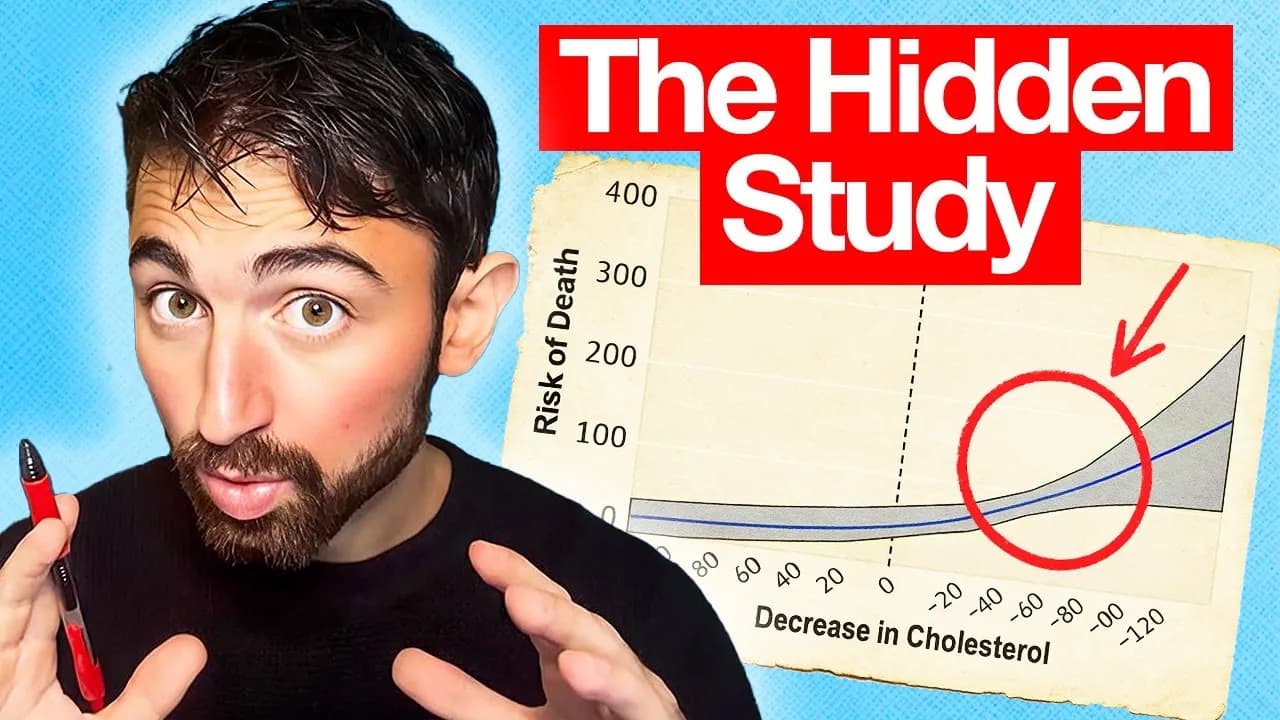
Key finding: for every 30 mg/dL decrease in total cholesterol, ~22% increase in mortality.
Major confounder: trans fats in margarine (25-40% trans fats; source of polyunsaturated fats). Trans fats atherogenic (FDA banned).
Fatty Acid Types Explained
- Saturated fat: no double bonds; every carbon has two hydrogens; solid at room temperature.
- Monounsaturated fat: one double bond.
Fatty acids in micelles or phospholipid bilayers (polar heads out, hydrophobic tails in for blood transport). Cis double bonds (natural in mono/polyunsaturated) create kinks, increasing membrane fluidity (impacts LDL receptor recognition, aggregation, CVD progression). Trans double bonds straight like saturated, rigid membranes; oxidizable double bond = worst of both.
Butter/margarine history: saturated fats demonized; margarine (unsaturated but solid like saturated via trans fats) substitute. Butter not pure saturated (has mono/polyunsaturated, low natural trans fats); fattiest ribeye similar.
Trans fats caused more heart disease than saturated.
Additional MCE Confounders
Unknown exact trans fat amounts (corn oil/margarine).
Laws changed: psychiatric patients could check out; many not continuous (disrupted protocol; unknown intake outside).
Randomization mitigates (affects both groups equally).
Short follow-up (~1-2 years average) for CVD (decades-long process; lifetime LDL exposure risk). Compare to investing: small annual differences compound over 40 years.
No baseline LDL stratification (unknown tools then). Low event numbers in similar trials (e.g., corn oil trial).
Smaller than MCE (~500 vs. 9,000 subjects), but high-risk: men post-MI (survivors).
Baseline saturated fat intake was 16% of total calories, PUFA intake 6%. Intervention group (low saturated fat) instructed to increase PUFA to 15% and reduce saturated fat to 10%. Achieved via safflower oil and safflower margarine.
No difference initially mentioned, but higher mortality in control group (stayed on saturated fat): 32% vs 20% at 3 years. Suggests group that lowered saturated fat and raised PUFA had lower mortality risk short-term, potentially indicating issue with safflower oil. Safflower oil high in linoleic acid.
Strengths of Study
- Longer duration.
- Participants had existing cardiovascular disease, increasing likelihood of hard endpoints.
Criticisms
- Participants had lifetime plaque accumulation; limited impact possible.
- Main confounder: inclusion of trans fats (25-40% in safflower margarine).
- Difficult to distinguish PUFA vs trans fat problem.
- Human RCTs without trans fats better designed and powered.
In sick elderly, low cholesterol indicates poor health/wasting (reverse causality), not upstream cause. Sydney study: low total deaths (~under 100); 37 treatment group, 28 control. Small numbers prone to sampling error.
Confidence interval nearly crossed 1 (original: 1.03-2.8). Wide interval given risk shown. Trans fats inclusion major issue (researchers unaware at time).
Biggest contention: RCTs used trans fats as substitution. Reconciliation depends on belief in trans fat harm. Without trans fats argument, no other major counter.
Other Arguments Against PUFA Harm
- Relatively short durations in some pro-PUFA studies.
- Low overall deaths.
- Ramsden reanalysis including all substitution RCTs: null effect.
Largest Cochrane analyses (two): overall null effect. Ramsden analysis excluding omega-3 confounded trials showed increased risk (still includes trans fats). Net: equal risk.
Logical symmetry: If allowing confounders supporting one side, must allow both; net no harm.
Other confounder: EPA/DHA (omega-3s; literature not strongly supportive of CVD reduction).
2-year study, significant CVD patients:
- 26 control (business as usual): 3 total deaths, 1 cardiac.
- 26 olive oil: 5 total, 3 cardiac.
- 28 corn oil: 8 total, 6 cardiac.
Free-living; oils provided (like early PREDIMED). No trans fats/trans fat confounder.
Criticisms:
- Tiny sample: prone to sampling error.
- Wide confidence intervals (6-37; not significant).
- Olive oil (acknowledged heart-healthy) had 3x CVD deaths vs control.
Hazard ratio: 4.64 (364% risk increase corn oil), but CI 0.58-37.15.
2017 meta-analysis (non-trans fat confounded PUFA substitution RCTs): clear benefit, ~20%+ reduced mortality (Rose had largest hazard ratio).
Trend across 5 studies: 1.13 (13% risk increase), not significant. Only Sydney statistically significant (74% increase, CI 1.04-2.91). Messy due to inclusions.
Veterans homes; controlled food; ~850 participants; ~9-year follow-up. No trans fats.
- 18% risk reduction overall (CI 0.56-1.21; narrow but crossed 1; not significant).
- Included omega-3s (potential help or underpowered?).
Small for hard endpoints despite 800+.
- Oslo Heart Health Study: 400 people; 47% risk reduction; omega-3 confounded.
- Finnish Mental Hospital Study: Strongest; no trans fats, no omega-3s; crossover design (6 years each diet, 12 years total); 1,200 people (~2,400 effective).
Crossover Design Explanation
- Participants do both treatments (order randomized, 50/50).
- Each person own control: eliminates baseline confounds, lifestyle bias.
- Weakness: Not individually randomized (two hospitals alternated diets logistically).
Results: 41% reduction CVD events/mortality treatment group.
- Control: 18% sat fat, 4% PUFA.
- Treatment: 14% PUFA, 9% sat fat (measured linoleic acid in tissue/blood to verify).
Pro-PUFA studies better: longer, better controlled, no trans fats.
2017 meta-analysis (non-trans fat; some omega-3): 29% risk reduction. Ramsden best anti-PUFA case: smaller risk increase, wide CIs.
Nutritional studies require substitution. Excess calories harmful regardless.
Analogy: Pathways like stocks; outcomes like mutual funds (net matters). Smoking reduces Parkinson's (nicotine; not recommend smoking). Aspirin: pro- and anti-coagulant pathways, net anti.
PUFA: mechanisms suggest possible negative, but net more show saturated negative. Impossible to disconnect (substitution-based).
Other substitutions:
- Carbs for sat fat: little change (depends on carb type; fiber likely reduces).
- Monounsaturated fats: reduction in CVD risk, not quite as powerful at
Monounsaturated fats appear to reduce risk of cardiovascular disease, though not as powerfully as polyunsaturated fats (PUFAs) in cohort studies. Substituting PUFAs for saturated fats improves outcomes, even if PUFAs have no net cardioprotective effect alone, due to mechanisms explaining PUFA cardioprotection.
The 2017 Cochrane review excluded studies confounded by trans fats when comparing PUFA vs SFA. Ramsden's analysis included all studies (net null effect); excluding omega-3 confounded studies showed negative PUFA effect, but still included trans fats. Cochrane had no trans fats but included omega-3s, showing ~29-31% benefit for PUFA.
No analysis excludes both trans fats and omega-3s; down to ~2 studies: Finnish study and STARS (STARS looked at plaque progression, not hard CVD endpoints; 1-year study comparing saturated vs polyunsaturated fat diets).
Clarification on Omega-3s
Omega-3s refer to EPA/DHA and alpha-linolenic acid (ALA); ALA converts inefficiently to EPA/DHA. Studies had some omega-3s (not clearly supplemented with marine sources).
STARS measured plaque progression (harder than biomarkers, more granular than mortality/events). Hypothetical: 99% blockage without event counts as risk reduction, but plaque shows true progression.
- All-cause mortality: ultimate but high bar.
- Disease-specific mortality (e.g., coronary death).
- MACE (major adverse cardiac events: heart attack, stroke, cardiac death).
- Disease progression (e.g., plaque).
- Biomarkers (e.g., LDL cholesterol change). Trade-off: harder outcomes vs barrier to detection.
MR provides lifelong RCT via random genetic assignment at birth. ~Dozen variants affect LDL (clearance, production, absorption). Large studies (hundreds of thousands) assess lifelong LDL exposure on CVD/mortality risk, minimizing confounders via randomization.
MR Caveats
- Genetic assignment to variable (true for LDL).
- No pleiotropy (genes don't directly affect other outcome variables); tests for pleiotropy. MR tests LDL causality, not directly saturated vs PUFA nutrition (but ~15% LDL drop from PUFA substitution for SFA is established).
MR Example: LDL and Cancer
MR showed no LDL-cancer link (unlike some observational studies), assuming no pleiotropy on cancer pathways.
MR Strengths and Results
Lifelong low LDL exposure shows linear CVD risk reduction per lipid hypothesis. 2012 MR paper: R >0.9; every 1 mmol/L (~39 mg/dL) LDL reduction = 50-55% CVD risk reduction, consistent across variants (except some CETP variants discordant on ApoB/particle number).
CETP variants/drugs lower LDL mass but not ApoB proportionally (smaller particles, smaller risk reduction explained by ApoB drop).
Statins: ~22% risk reduction per equivalent LDL drop, consistent across mechanisms.
MR: steepest slope (50-55%/~40 mg/dL LDL drop). Statins: 22% benefit (ongoing, non-linear?). Explanation: Statins start later (e.g., age 40); prior decades of exposure cause irreversible atherosclerosis. Lifelong low LDL (MR) prevents buildup (concentration-dependent penetration <70nm particles with ApoB).
Analogy: Late statin = pumping brakes on rolling truck; lifelong low LDL = never started.
Other factors (insulin sensitivity, metabolic health) independent of LDL.
Consistent dose-response across MR variants, statins, other drugs (independent mechanisms), some cohorts reinforces LDL causality over pleiotropy/inflammation alternatives.
Dietary fiber: consistent dose-response benefit on CVD/cancer/mortality (forest plots all protective).
Unprocessed red meat: inconsistent cancer link, vanishes with diet quality controls.
Leucine experiment anecdote: perfect leucine-muscle protein synthesis association; critics lacked alternatives.
High linoleic acid (LA, omega-6 PUFA) in LDL particles → arachidonic acid → prostaglandins (inflammatory); PUFAs more oxidizable than saturated fats; oxidized LDL more atherogenic (elevated in CVD).
Counter: Higher LA intake linked to lower CVD (cohort >1M people, multiple countries). Oxidized LDL/inflammation key in atherosclerosis (plaque rupture > occlusion).
Broad view: PUFA substitution should increase unstable/oxidized LDL if true, but epidemiology shows opposite.
To unpack: Understand disease progression, mechanisms.
One problem with dietary recall studies is their reliance on self-reported data. In cohort studies examining linoleic acid intake, the primary source isn't always specified, but likely from seed oils. Critics argue healthy user bias, as people eating more linoleic acid may be healthier overall.
Healthy user bias typically shows no effect or inconsistency for harmful exposures, but here converging evidence contradicts seed oils being uniquely deleterious. If seed oils drove CVD, higher linoleic acid should show harm despite healthy behaviors, not protection.
Dietary recall is unreliable, but tissue levels reflect intake: adipose or blood samples show higher linoleic acid incorporation with higher consumption. Studies confirm higher tissue linoleic acid links to reduced CVD risk.
Logical consistency: if higher saturated fat intake showed lower CVD, anti-seed oil advocates would reject saturated fat harm claims. Data doesn't support polyunsaturated fats being bad; saturated fats would be worse by the same logic.
Higher linoleic acid doesn't increase arachidonic acid production; conversion is saturated.
Lipid Hypothesis and Atherosclerosis Mechanism
Lipid hypothesis: Non-HDL cholesterol particles <70 nm diameter (VLDLs, LDLs, IDLs) with ApoB penetrate endothelium into intima (concentration-dependent). Penetration alone insufficient; particles can exit.
Enzymatic modification of ApoB to proteoglycan retains particles in intima. Retention leads to oxidation, attracting macrophages. Particles aggregate; macrophages engulf forming foam cells. Smooth muscle thickens, narrowing vessels.
Oxidation role: Polyunsaturated fat-enriched lipoproteins more oxidizable, but oxidation mainly in intima microenvironment (antioxidants scarce), not plasma (<1% LDL oxidized in plasma; cleared in hours). Plasma has vitamin E, C, beta-carotene protecting PUFAs.
Once retained (weeks), oxidation ramps up (30-80%).
PUFA vs Saturated Fat in Atherosclerosis Progression
Aggregation key: PUFA-enriched LDLs more prone to oxidation in intima but:
- PUFAs lower LDL particles entering intima (concentration-dependent).
- Increase membrane fluidity: better LDL receptor clearance (less circulating), stiffer saturated membranes aggregate more.
- ApoB less prone to enzymatic modification on PUFA-enriched LDLs vs saturated.
- Enzyme sphingomyelinase on saturated-enriched LDL produces ceramides, collapsing/clumping particles.
Net: PUFAs decrease entry, retention, aggregation vs saturated fats.
Think of ApoB particles as bonfire (LDL in blood), forest as vessels. CVD is forest fire. Sparks are LDL particles. PUFA sparks more flammable but smaller bonfire, fewer sparks, more bounce back, scatter if enter forest. Saturated: bigger bonfire, more sparks, clump/start fires.
Debate on peripheral oxLDL: Even if 1% oxidized, could disproportionately aggregate/retain? Oxidized LDL more atherogenic per particle (in intima and potentially periphery), but small fraction.
RCT: Soybean oil raised peripheral oxLDL slightly (e.g., 0.5% to 0.78%), negligible vs intima rates (30-80%).
Antioxidant trials fail to reduce CVD (e.g., rabbit studies: injected oxLDL causes atherosclerosis, antioxidants prevent only if oxidation peripheral). Implies intima oxidation dominant.
Higher peripheral oxLDL correlates with CVD (downstream of intima events); some oxidized particles escape back.
Post-MI: oxLDL spikes (rupture releases intima contents).
No metabolic tracer studies confirming peripheral vs intima oxidation origin.
Balance favors PUFAs: lower entry/retention, less aggregation despite per-particle oxidation risk.
Seed Oil Processing Concerns: Hexane, Heat, Impurities
Seed oils undergo industrial processing: heating, refining, hexane extraction.
Processing removes oxidants/impurities; some negatives increase.
Hexane: Non-polar solvent extracts oil (low boiling point 69°C). Seeds washed, crude oil steamed (minutes-90 min, low temp <200°C). Oxidation needs >200°C for hours (e.g., soybean at 240°C/3h: ~1% oxidized).
Residual hexane: <1 ppm (often undetectable; 0.05-0.5 ppm). Toxicity from inhalation, not ingestion. Rodent LD: 5,000 mg/kg for mild liver/neurotoxicity (human equiv. high). To get mild effects: consume 11,340 kg oil at once.
No chronic accumulation risk: doesn't bioaccumulate, body metabolizes/excretes quickly. Lifetime exposure negligible vs constant LDL.
Mechanical extraction possible (costlier, lower yield), may be available at premium.
Historical Increase in Linoleic Acid Intake
~100 years ago: <3% food availability linoleic acid. Today: ~10%. Anti-seed oil book claims 75x increase over 150 years.
That's an enormous increase.
Seed oil consumption represents an enormous increase; humans did not evolve consuming seed oils in significant quantities, yet today people get 10-15% of calories from them. Tissue levels are up more than 100%.
Isn't there a first principles argument that this would be negative?
Be logically symmetrical: modern human diet, even 'natural' foods, differs vastly from ancestral. Vegetables, fruits, plants modified; animals too—fatty ribeye not ancestral, cows different from wild game.
Biology's Purpose: Reproduction Over Longevity
Biology's goal is passing genetic material. Post-breeding age (~40), decline accelerates as evolution is 'done' with you; longevity not essential for species survival. Prevalent short-lived species thrive by reproducing.
Cardiovascular Disease (CVD) as a Disease of Longevity
CVD rates up because people survive viruses, wars, bacteria to reach ages where it manifests. CVD existed pre-19th/20th century; people died suddenly without diagnosis. If lived long enough, everyone gets some CVD—time/exposure issue.
Even in 1860s, past age 10, life expectancy ~55-60 years; few reached CVD age. Treatments primitive (e.g., bleeding). Modern longer lifespans (~longest ever) allow 'unhealthiness' to emerge.
High LDL cholesterol not ancestral: Hadza (best proxy, untouched tribe, low CVD) have LDL 50-70 mg/dL average; one <30, only one >100 mg/dL. Linoleic acid lowers LDL.
Anti-seed oil 'ancestral' diet unsupported. Naturalistic fallacy: nature has toxins; synthetics can be beneficial. Romanticize past falsely (e.g., crime lower now per FBI stats).
Natural not necessarily best for longest healthiest life; humans thrive via adaptability.
Question: net effect of seed oils per best evidence, not evolution.
Sodium hydroxide minimal in end product (turns to soap/water); even if residual, need 2-700 kg oil at once for harm.
- Peroxide value (oxidation measure): decreases 5-10 fold.
- Aldehyde levels: much lower in refined vs. crude oil.
- Polymerized triglycerides increase slightly.
- Trans fats: ~0.5%, far below harmful threshold.
Refined oil lowers LDL; mechanisms clear. Cohort trials, unconfounded studies, Mendelian randomization trials agree.
Replacing saturated fat 1:1 with linoleic acid/PUFAs: neutral/positive on inflammation, liver fat, insulin sensitivity, metabolic health (numerous studies).
If PUFAs bad, saturated fats really bad.
Seed oils in zeitgeist (e.g., menus boast 'no seed oils'). Culturally persona non grata, unwarranted.
No precautionary principle needed; if avoiding seed oils, displace saturated fat with leaner proteins, monounsaturated fats (olive oil, avocado oil)—lower LDL vs. saturated, cardioprotective (less than PUFAs).
Processing under vacuum (no oxygen) prevents oxidation. Frying: thin layer (1-5 cm) or reuse accelerates oxidation/negative products (20-30 min thin layer; vats all day).
Frying Oils: Seed Oils vs. Lard
Both bad (hypercaloric fries aside). No direct human RCTs comparing. Saturated fats less prone to oxidation.
If having fries, just have them; lard fine if preferred, but not health food.
Food companies indifferent (tallow/lard next if demanded). Marketing risks implying healthier = eat more.
Short-form (TikTok) viral vs. long-form nuance. Hot takes cherry-pick truths, omit context (hours here).
'Did you read the study or just social media hot takes?' 99% explainable by design (controls, differences).
PhD adviser: easy to design studies for any effect. Use converging lines, high-quality evidence.
High confidence ApoB-containing lipoproteins atherogenic (Mendelian randomization, statins). Changeable with much data.
LDL not sole CVD driver (BP, fitness, insulin, inflammation matter). High LDL + low others = lower risk possible; stats probabilistic.
Everything equal, lower LDL better.
US average: 3,500 cal/day, <20 min activity. Step over $100 bills for pennies.
Caloric imbalance/activity >> seed oils for 50-year health decline (directionally 'a lot more').
Obesity hazard ratios: 80-200% mortality increase (even 'healthy' class 3/4). VO2 max, grip/strength (proxies), activity: hundreds % longevity impact.
Prioritize: control calories/exercise. Avoid seed oils? Limit saturated too, get ApoB measured, manage.
Majoring in minors, minoring in majors; seed oils don't matter much.
Seed oils tend to show up in low-quality foods. Restricting seed oils likely provides a net benefit because it means eating less Oreos, less potato chips, less junky salad dressings, and crappy sauces. The substitution effect works in your favor, but no need to be maniacal. For example, when making a salad, preferring safflower oil or canola oil over olive oil does not seem harmful based on the data. No need to go to restaurants adamant about excluding seed oils; if it's a good restaurant, it uses good ingredients otherwise regardless of seed oils.
Comparison to Sugar Intake
Yeah. I mean, you make a great point about it's probably more about what comes along for the ride, right?
People cut out sugar and feel better because they cut out junk food. However, some get maniacal and cut out fruit because it has sugar, which biochemically is similar once in the body—that's a bridge too far. Most people experiencing negative effects from seed oils likely have overall low-quality diets. It's not an issue for those cooking with canola oil or using seed oil-based salad dressing occasionally. The problem is eating a lot of potato chips, French fries, etc. Anti-establishment voices point out increased seed oil intake following government advice.
Closing Remarks and Restaurant Advice
So my only wish that come from this podcast in addition to public education is if you are a restaurant owner and you're listening to this, please take the no seed oils used off your menu. It just insults me and insults anybody who's been patient enough to listen to this episode.
Yeah, thanks for having me. This was fun and a really cool educational experience and I loved it. So, thank you for having me and letting me rap about this stuff for a couple hours.
[music]
Keep Peter Attia MD in your library
Save the videos and channels worth coming back to, and find them again in one place.