You Will NEVER Consume Seed Oils Again After Watching This
In a Nutshell
Seed oils high in linoleic acid have replaced stable saturated fats in our bodies since 1960, rising from 6% to 18% of body fat composition and creating fragile, easily oxidized cellular membranes. The Minnesota Coronary Experiment proved that replacing butter with vegetable oil lowered cholesterol but increased mortality risk by 22% for every 30-point cholesterol drop. The core advice is to eliminate seed oils immediately and restore omega-3 balance through fish and cod liver oil, though full clearance from fat tissue takes up to 600 days.
These notes were generated by AI and may contain inaccuracies.
There was a study about seed oils that was hidden for over 40 years on nearly 10,000 people. It is one of the most careful experiments ever run, and the results sat in a basement unpublished until the scientist who ran it died.
The fat in your body today is not the same fat that was in your parents or your grandparents in 1960. No one's been telling you this, and no one's been asking for your permission for this to happen. Your body fat is not just a fuel tank. It is a living tissue built out of the fats that you've been eating.
The main fat in seed oils is called linoleic acid, and it comes from corn oil, canola oil, and soy oil. In 1960, our bodies were made of about 6% of linoleic acid. Now, our bodies are made of 18% of linoleic acid. That's a jump of 200%. The physical material that your body is built from has been reformulated over this time frame. At the core cellular level, our bodies are very different than someone born in 1960.
Linoleic acid in mother's breast milk roughly doubled across the 20th century. Soybean oil has not just increased 10% or 20%, it has increased 1,000% over this time period.
The big problem with seed oils is when they become oxidized. The worst thing you could do to these seed oils is heat them and heat them and reheat them. Every time you heat the oil, you create toxic byproducts. These byproducts go throughout the body, they accumulate, and they're like superglue. They start attaching to all sorts of proteins, and then they make that protein unavailable to you.
Today's argument is not necessarily about the seed oils themselves. It is what happens when they accumulate in your body. It is also what happens when you keep reheating them. Oxidation is not just about frying them. It is also what happens when you burn this oil that's in your fat cell. When you're using up your fat, you're burning the seed oils that are embedded in your fat cells, and you're creating oxidation and byproducts just from using this fat.
Normally, our fat cells are supposed to be made from saturated fats, which are tough, and they have more durability. But what we've done is we've slowly been replacing the saturated fat with the unstable, very fragile linoleic acid in our fat cells. There is research and animal studies that show it's a major problem. It goes in the brain. It goes in the arteries. It goes into the nervous system, and actually irritates the nerves. We've never done any long-term safety studies on linoleic acid.
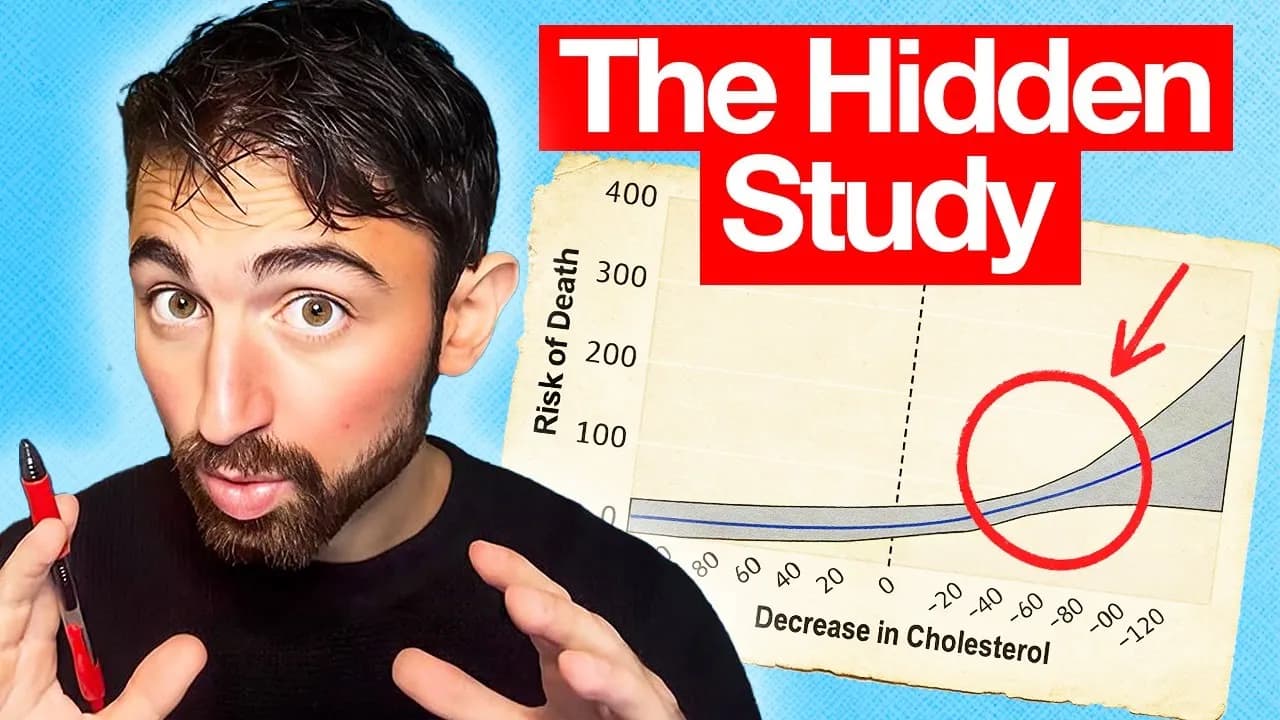
A massive piece of scientific research was sitting in a basement for quite some time and was released in 2016. It actually had to take the death of a researcher and then his son who then found it in some cardboard boxes to then bring it out of the basement. The government launched a massive experiment to prove that animal fats caused heart attacks. They took 9,500 people and forced half of them to swap out butter for vegetable oil. This is one of the largest, most rigorous diet trials in human history and it was sitting in a basement.
It was called the Minnesota Coronary Experiment. When independent researchers finally analyzed that data in 2016, they found the missing piece. The vegetable oil that people consumed did end up lowering the cholesterol, exactly as promised. But it did not save their lives. In fact, for every 30-point drop in cholesterol, the risk of death actually went up by 22%. The Minnesota Coronary Experiment meant to justify 50 years of dietary advice completely backfired.
We use cholesterol as a biomarker to indicate if our heart is healthy or not or if we're going to have a heart attack. Our body makes cholesterol. Somewhere along the line someone came up with an idea that we'll use cholesterol as a great biomarker to determine if you're going to have a heart attack or not.
The 2016 systematic review analyzed 19 different studies, tracked over 68,000 elderly individuals without statin therapy, and noted a distinct U curve where the lowest risk of death occurred when the total cholesterol was maintained between 208 and 278 mg per deciliter. A lot of doctors will consider that high, and they would put you on a statin. Yet, the data shows that was the lowest risk of death when your cholesterol was in those levels.
There is also data to show that when your cholesterol is too low, your immune system's compromised, you're more at risk for cancer, you're more at risk of getting clots, you're more at risk of getting a stroke. This is all because cholesterol is a fundamental structural component of all of your cellular membranes. So, when it's too low, it creates problems.
A little bit of seed oil now and then is probably not going to create a major problem. It is the cumulative effect over the years of building this up into our fat cells and our cellular membrane. There is a lot of data showing that reheating and deep fried foods of this oil creates byproducts that are really toxic on just about every tissue on our body.
These omega-6 fats are supposed to be balanced with the omega-3 fatty acids, which are anti-inflammatory and protective. They come from seafood, shellfish, and cod liver oil. Ideally, a one-to-one ratio, but the average American is so lopsided that they're like 10 to 20 times heavier on this linoleic acid than they are the omega-3 fatty acid.
If your environment is off, everything else struggles. It's like a fish tank. Pollute the water and the fish gets sick. You could feed them the best food, you can treat every single symptom, but if the water stays toxic, nothing recovers. The body runs on 10 signals like insulin, cortisol, inflammation, sleep quality, and gut function. Every one of them affects how you feel, but there is always one signal that is more broken than the rest. And until you fix that one, everything else stays stuck.
Stop consuming seed oils. It's going to take up to 600 days to remove this oil out of the body. At the same time, you need to replace the omega-3 fatty acids. That comes from fish oils, cod liver oil, fish, and shellfish.
Keep Dr. Eric Berg DC in your library
Save the videos and channels worth coming back to, and find them again in one place.