How to build proactive agents & self-improving company (Fully explained)
In a Nutshell
Agents are now running closed-loop systems that capture performance data, extract learnings, and autonomously update their own strategies and skills without human oversight. Companies achieve this by combining memory layers (temporal logs + procedural skills), cron-scheduled review cycles, and agent-native CRIs that let agents access and act on data efficiently. Early results show 3-5× gains in revenue per employee and ad performance when these feedback loops are in place.
These notes were generated by AI and may contain inaccuracies.
Y Combinator ran a session on self-improving companies where companies in the current batch are hitting 5x more revenue per employee compared with 18 months ago. Their agents have been handling all the internal ops and write 45 of its own tools all autonomously. A company called Porsche already sold $30 to just build and run the whole company from scratch. All of this points to a new AI-native way of running your business.
The team has been experimenting with this AI-native way of running a company for the past few weeks and encapsulated their learnings and best practices into an open-source agent skill for long horizon work and self-iterating tasks alongside many other useful tools.
Before AI, humans have been the glue to use multiple steps to get a certain outcome. A human is the one that prioritizes and decides what kind of things to do. With the recent AI boom, most have translated to AI-enhanced workflows where you talk to an agent or AI workflow that is completing a task end-to-end. However, there's no feedback loop back to a system to inform improvement they should do. A human still remains the main driver about prioritization, plan, and trigger tasks.
What's really powerful is the real AI-native loop where agents can take an input or trigger about a certain goal, do certain tasks, but most importantly actually capture the feedback to learn what's working, what's not working, plan next steps to make sure next time it is doing things better.
Diana from YC explains this in a control system setup comparing closed-loop versus open-loop where there's no feedback back to the system versus a closed-loop where status, decisions, and outcomes are continuously captured and fed back into the intelligence layer.
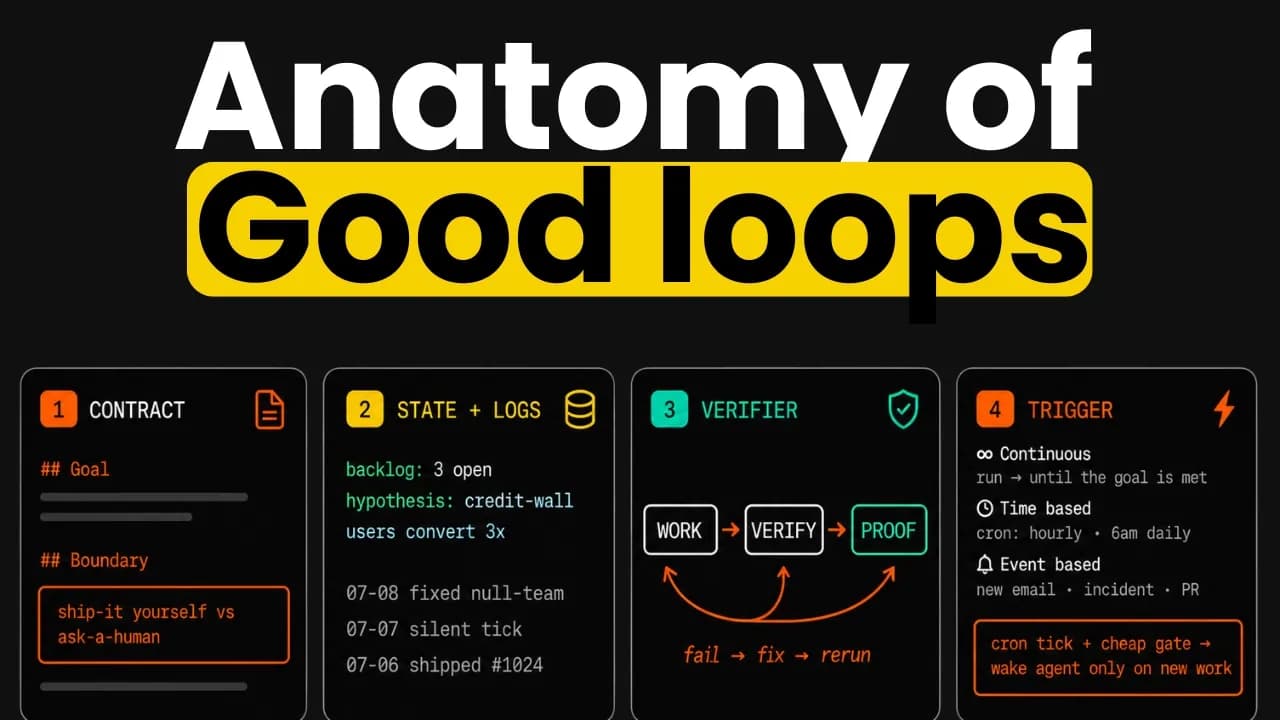
There are five core elements for each AI loop: how the data actually ingests into a system, the policy layer which is like a contract about the workflow and SOP, two layers that allow agents to access different systems, write quality gates in the workflow where either human or AI evaluator can go through the output quality, and lastly some sort of mechanism that can bring those learnings back to the system so that it can improve its operations.
For each AI loop, start by setting up a memory layer or environment so the agent can keep a system or record of the tasks and outcomes, as well as different skills and current jobs for the agent to continuously execute and monitor the results. Depending on the type of task, there might be different cadences and skills.
SEO is a good use case to start with because it's a solved problem that can be engineered. At high level, humans are basically doing this loop of doing research across Google Console, internet, Ahref to form a keyword strategy. Based on that strategy, they start pumping out different social content, web pages, and continuously monitoring the performance, updating the strategy if needed.
To get agents self-sustaining this loop, set up a proper memory layer. The memory layer breaks down into two parts: one is the temporal log to log what the agent did every day or every week, and from that continuously forming a latest strategy and pumping all the learnings into it. The second part involves setting up skills with CRI so the agent can continue the whole loop end-to-end by itself, including things like SEO audits, draft the content, publish, and reading data from Google Analytics or Ahref.
HubSpot free AEO creator is relevant for answer engine optimization to increase the chance your product and service show up in ChatGPT, Perplexity, and Gemini's answers. AEO complements SEO because it covers channels like AI answer engines that traditional SEO doesn't fully measure, including what kind of pages are cited when people ask random questions and what kinds of things were mentioned.
Normally, tools on the market charge a good amount of money for this type of information. HubSpot free AEO creator gives your company name and analyzes how ChatGPT, Perplexity, and Gemini characterize your brand across multiple different dimensions, as well as gross areas that you or the agent can fix. The audit report can be taken back to the agent to form the right keyword and content strategy or even execute autonomously.
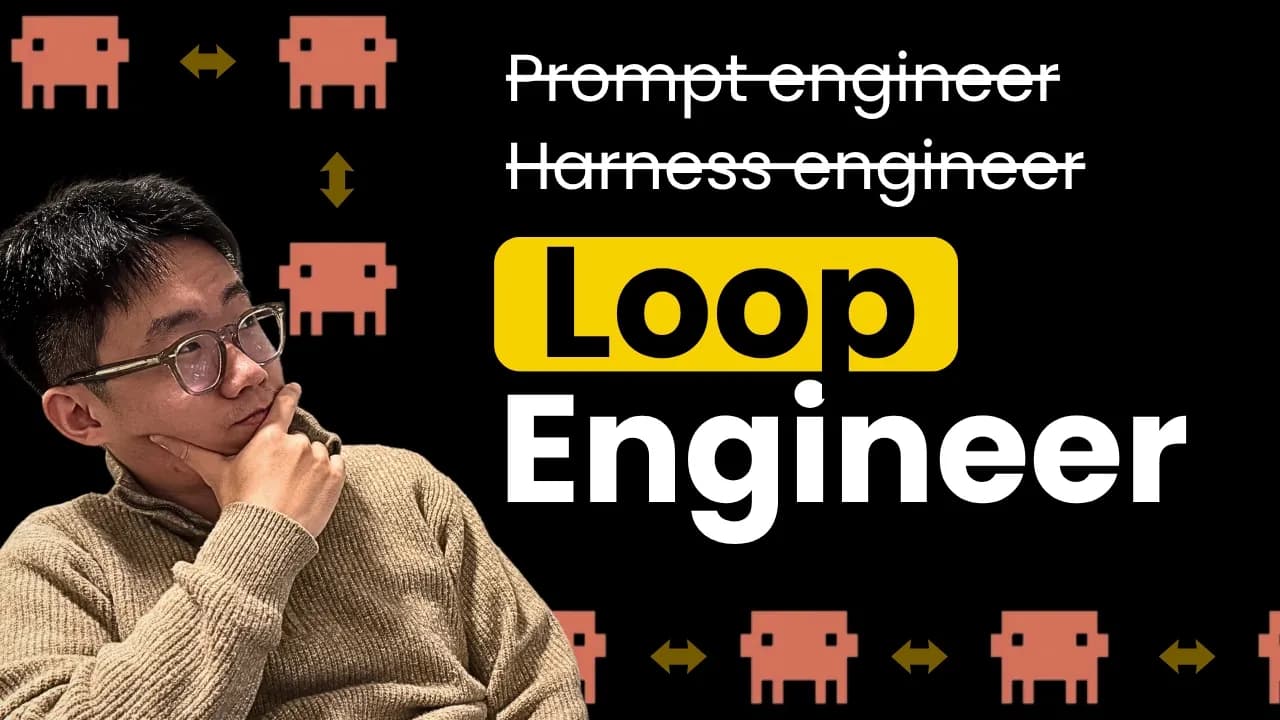
The last part of building these AI loops involves performance memory and SQL through cron jobs. Cron jobs can be set up to get agents recursively execute on actions and also do cloud auto-dreaming type of setups by having a weekly planning cron job. These three things together allow formation of a closed loop so the agent will continuously monitor results, publish content, and update its hypothesis continuously.
Enkit from Air B&B Co set up similar AI loops for SEO IGO and increased traffic by three times in just one to two months. He shared setups for analysis, designing website information architecture, assignment to write high quality SEO content and blogs.
Giorgio tried an experiment to get agent autonomy around ads for a month by applying autonomous loops with proper cron and skill setup. The skills included analyzing performance, copywriting, image generation, and research. He kept a state folder to log all change logs and learnings, as well as JSON file of campaign history and live ads.
In this process, the first week the agent tested 10 different ads formats from whiteboard sketch, notebook pages, cardboard signs to tweet screenshots. From this process, the agent learned that ugly ad assets that look like this actually win better. The second week immediately decided based on all the learnings, including specific asset format to be a whiteboard, plus what kind of copy showing on the whiteboard, as well as the content itself should be around a free skill pack, and generate 243 leads within months for a $1.5 thousand budget.
There are two types of information that need to be saved in memory setup. One is factual memory which is normally logs of things that agents ever did so you can remember what have been done before and review performance. Another is procedural learnings which can normally be turned into a skill. While you can just prompt the agent to save everything as a log, when there is messy information or complex structure, it can make it very difficult to retrieve later.
Jerry Tan's Jbrain is an open-source memory layer that can be reused as a plugin for open claw prompts or claw code. It has skills instructions to handle data extraction from meeting scripts, YouTube videos transcripts, and other difficult-to-extract sources. Data gets saved in a specific format in brief folders with predefined entities.
Gibbering setup is designed for logging different entities for personal assistant usage like meetings, people, program and projects. Each folder has a readme file to detail explain what goes into this type of entity, and each entity or folder is markdown structure to log the facts as well as the timeline log. It comes with a retrieval pipeline where all knowledge saved will be automatically turned into a vector DB alongside some CRM and MCP tool for searching. This works well from personal assistant point of view for managing hundreds of thousands of different entities.
Stone X on the team experimented with Loop Me which is a company in the loop memory setup optimized for long cycle tasks and self-learning behavior, so the agent has relevant cron jobs to output learnings and skill proposals. This can be used by copying instructions to any agent like Hermes Open Graph, then it will start setting up the memory layer on computer.
There are predefined artifacts that can be used. Beta will ask questions step by step about what kind of AI loops to create or what type of missions agents should drive. Based on conversation, the agent can be prompted to set up relevant artifact types and cron jobs.
The post draft artifact allows agents to log what has been dropped before as well as feedback. Relevant cron jobs have instructions to scan previously relevant nodes and information and generate new ones. Most importantly, during the daily cron, it also has instructions to extract learnings as well as propose updates to skills so procedural learnings can be logged.
Lupini plugin has special data access skills for data ingestion because agents can't really access certain special types of data, and structured data needs special CRI to access. Having skills for data access and detailing strategy for accessing specific types of data is really helpful.
There are many different open-source repos handling this problem. For builder club, data access skills are included in agent skill 101 for copy-paste use.
Printing press is an open-source tool that solves the problem that most APIs or MCPs or even official CRIs are not actually designed for agents, so they're not token efficient. It also addresses problems like getting into interactive mode which agents aren't great at, error messages that might not contain enough information for agents to self-heal, and sometimes CRIs returning big amounts of data.
Trevor has an article about the 10 principles for design agent native CRIs. The printing press tool encapsulates all those principles into a CRI skill so agents can be asked to build any sort of CRI like accessing internal databases or third-party software that don't have MCP or CRI officially, with agents autonomously researching and building the CRI with those principles in mind.
This enables building quite sophisticated and efficient data ingestion.
Keep AI Jason in your library
Save the videos and channels worth coming back to, and find them again in one place.