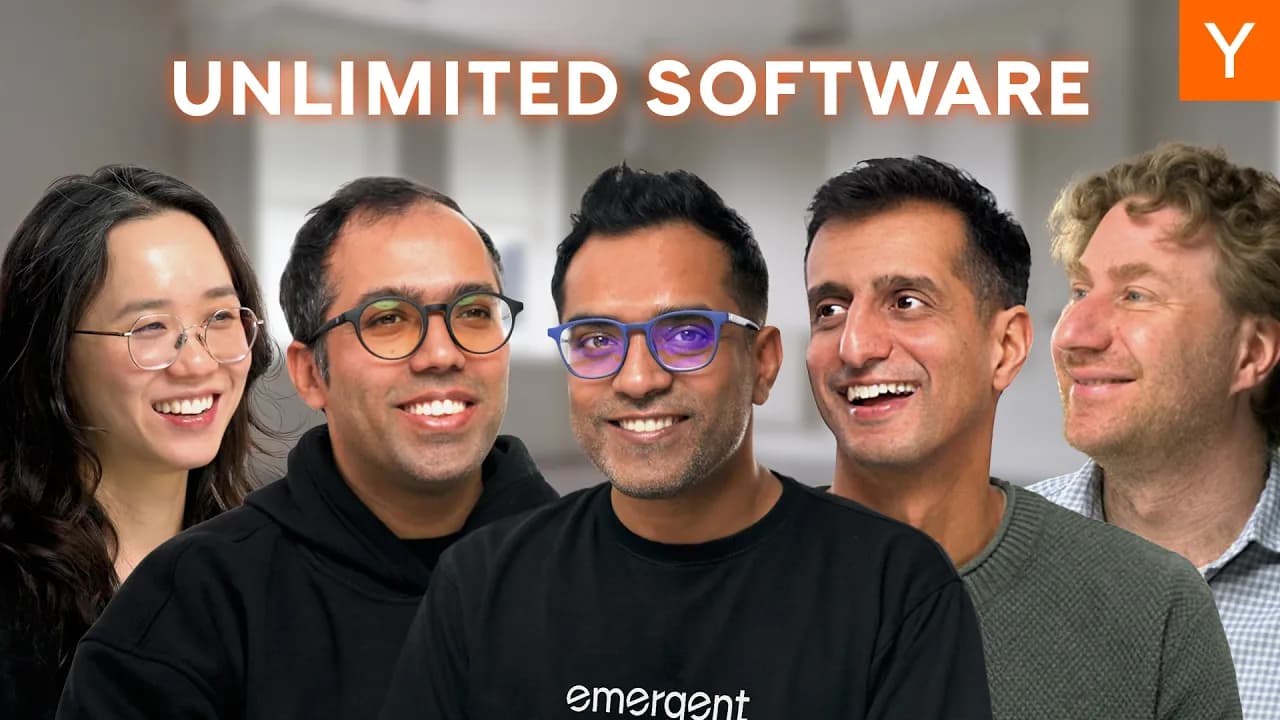
Emergent: How Six Months of Tinkering Led To A $100M ARR Company
In a Nutshell
Emergent built a $100M ARR AI platform in nine months that lets non-programmers create and ship real software through autonomous coding agents. The founders achieved this by spending six months tinkering at the technological edge, then committing fully to automating all of software engineering rather than building copilots or front-end demos. Key lessons include solving personal pain points, maintaining extreme focus on hard benchmarks, and scaling ambition 10-100x from day one while building globally from India.
These notes were generated by AI and may contain inaccuracies.
Over the last 30 years, most economic gains in the world have come from software companies. Removing all software companies from NASDAQ and S&P leaves a flat line. The mission is to bring this power to almost everybody in the world.
Emergent is one of the fastest growing AI companies in the world and one of the first truly AI native companies in India to achieve real scale. Emergent is a platform that allows anybody without programming knowledge to build software that can be shipped, used by customers, and monetized. The platform rides the wave of AI making coding easier.
The founders started as a research lab building coding agents and became world number one on SWE-bench, the benchmark for coding agents, with a four-person team. The mission emerged from recognizing that billions of people have ideas that die due to lack of access to bring them to life. Both founders have been programming since age 12 and are passionate about programming.
Emergent has more than 8.5 million users on the platform and more than 10 million apps have been built. The company recently crossed $100 million in annualized run rate and is one of the fastest growing startups in the world. Users can ship what they dream by chatting with an agent, with Emergent handling hosting, deployment, and maintenance.
The current version of the product launched 9 months ago, making Emergent a 9-month-old company operating at significant scale with 8.5 million users and over $100 million in annualized revenue run rate.
The latent demand in the market is very high. Many users are entrepreneurs without tech teams who were previously handicapped by access to technology. The platform now enables them to build software independently.
Emergent has users across 190 countries. Most revenue comes from the US and Europe, with India accounting for about 10% of revenue. The audience is fully global.
The founder previously worked at Google in the US and wondered why there was no Google or Facebook from India despite abundant engineering talent. Indian talent leads major global companies like Microsoft and Google, yet no technology-first global company had emerged from India. The goal is to build a global company from India similar to Facebook and Google.
Dunzo was a massive quick commerce company that raised half a billion dollars. At peak, Dunzo had one of the most loved consumer brands in India and almost became a verb. The company did 10 million monthly orders, had almost a million riders on the ground, and nearly 5,000 stores. Dunzo was one of the first to start the 10-minute delivery trend.
There were 87 companies doing the same thing when Dunzo started. The hard part was last mile logistics and ensuring the end consumer received products in the right state. The founder personally delivered orders on a bike and in a car during early days, following the YC mantra of doing things that don't scale to get close to customers and understand real pain points.
The founder grew up in a middle-class, upper-middle-class family with an engineer father. He got into engineering college and was inspired early by Steve Jobs videos, particularly the 2007 iPhone launch. In 2008, he bought an iPhone in Spain as a souvenir and tried to hack it. In 2009, he went to the US for a PhD program.
During a Google internship, the founder realized Google had already done the research he planned to pursue, so he dropped out of the PhD program and joined Google full-time on the search ranking team. He was the youngest person on a 50-person team that controlled all of Google search ranking. At the time, Google was anti-machine learning in search, but the founder pushed for ML adoption and contributed to major changes in search ranking.
The founder left Google to start a company building a group education platform, raised money, then pivoted to a P2P software company. He realized his passion was building consumer-first products and wanted to solve education problems. He returned the money and shut down that startup.
The founder started another company focused on habit creation. After getting married, his wife did not want to move to the US, so he moved back to India and attempted to run the startup remotely with an engineering team in New York, but coordination proved too difficult.
Trusting intuition has been a consistent principle. Dunzo started from a personal pain point after moving to Bangalore when coordinating car servicing, electricity setup, and gas felt unnecessarily difficult. The founder started a WhatsApp group for friends needing help with tasks.
Solving personal pain points creates stronger feedback loops and deeper customer understanding. This same pattern led to Emergent when both founders, as idea generators with thousands of ideas, wanted to automate and bring more ideas to life by automating programming.
Key lessons include solving hard problems and deeply caring about customers. Without AI at the time, all chatting was manual. Every evening during traffic spikes, engineers would stop their work to handle customer chats. The company once put a rider on a plane to deliver a package to another city. The culture emphasized going the extra mile for every customer.
One failure was lack of focus. Dark stores were working well, but the company pursued 10 other models simultaneously including marketplace and pickup/drop-off. Doubling down on what was working would have helped. The founder views the entire journey as a stepping stone to build something bigger.
Dunzo had a team called Watchtower that monitored every order in a war room setting because operational things break frequently. Emergent borrowed this operational rigor by monitoring all tasks being built and flagging breaking software.
In 2023, Dunzo raised $100 million and appeared too big to fail, but the story ended differently. The founder left in September 2023 and was depressed for the first 6 months, reflecting on what could have been done better.
AI was accelerating during this period with ChatGPT taking off and GPT-4 just released. The founder spent 10-12 hours daily tinkering with new models including voice models and open source releases. He built an assistant on his Mac similar to early versions of what became Claude. There was no objective, just pure joy of tinkering.
Tinkering revealed that coding would be disrupted quickly. The founder spent time in the US with friends at labs. The pure joy of building without pressure led to insights applied when building Emergent. Curiosity and building for the joy of solving problems enables deeper exploration and insights otherwise hard to obtain.
The founder was tinkering with whether ChatGPT could write code when models were not yet capable. At WCOM, this approach is called living at the edge. The best startup ideas come from things not quite possible yet but showing sparks of potential.
Most VCs rejected Emergent because the vision of automating software engineering seemed premature. The founders took a contrarian view that AI progress would be exponential and always built in the direction of AI advancement. They chose to automate all of software engineering rather than piece by piece.
Emergent built autonomous agents rather than copilots when agents were not yet a common term. The system uses a multi-agent orchestrated architecture where different agents perform different actions at different times. There is an automated testing agent, a design agent, and others coordinated through a large memory system that self-learns from every new app built.
Every new app built on Emergent allows agents to extract learnable aspects stored in memory, making the platform better. The company does significant RL on collected data and some finetuning. All infrastructure was built in-house including the coding agent.
When starting, no one was building deep container technology, so Emergent invented container technology including disk snapshotting and memory snapshotting to preserve state across multiple parallel agents running on the same snapshot.
Living at the edge means discovering problems early before the broader ecosystem encounters them. When new model classes emerge, such as Opus, the team must delete previous learnings and reimagine the system from the new model's perspective. In nine months, the system has been rewritten three times.
When starting, models struggled with JSON output, and 20-30 YC companies were solving JSON parsing. Emergent took the view that the next model would solve this, skipped the problem entirely, and started building the agent instead.
Living at the edge and imagining what is possible in the next six months is critical during startup journeys.
When applying to YC, the founders were initially building testing agents. Coming from India, they drew a whiteboard diagram showing how AI would soon enable building web apps and mobile apps. On day one, they told their YC partner they wanted to build a consumer app building company.
During the initial three-month program, the team generated a new idea each week, including concepts like AI Zapier, leading to constant pivoting that frustrated team members. To maintain focus while determining the core direction, the team was directed to tackle the hardest benchmark available at the time. This approach consumed three months but resulted in achieving world number one ranking on that benchmark.
This benchmark work established the foundation for Emergent, enabling development of the world's best coding agent. Key innovations discovered during this period include paralyzed test time compute, memory systems, and agent-to-agent communication. Attaching efforts to measurable benchmarks provides clear progress tracking and directional focus when building toward a company goal.
Emergent was not the first AI website builder when it launched, as multiple established and smaller players already existed in the space. The team identified that existing platforms primarily focused on front-end development and demo creation, achieving product-market fit in those areas. However, users ultimately want real, functional software rather than prototypes.
The market gap was that competitors were effective at generating initial outputs but struggled to complete projects, failing to produce working software with real backends and attached databases. Emergent approached the problem from a different angle by asking how one would automate all of software engineering, building the solution from the ground up rather than iterating on existing approaches.
When testing prompts across platforms, Emergent significantly outperformed competitors, validating the approach. The core consumer insight was that users want real, working software rather than demos, and no existing solution could reliably reach completion.
After product development, the team analyzed fast-growing companies to inform their growth strategy. They converted growth targets into a mathematical framework, calculating required social views, impressions, clicks, and user acquisition numbers. Influencer marketing was selected as the primary channel due to strong conversion rates, with the focus placed on maximizing reach to potential users.
The team is 95% based in Bangalore, with the company built primarily from India. A small team operates in San Francisco following the recent opening of an office there. The company is actively hiring and welcomes applications for those interested in working at an AI-native company.
Hiring prioritizes candidates with strong learning curves who demonstrate passion for solving problems and excitement about AI challenges. The differentiating factor is that team members genuinely enjoy working with AI daily, beyond the benefits of company growth and solving user problems. The complexity and possibilities within AI create engaging day-to-day problem-solving opportunities.
Building Dunzo, a local Indian company during the first wave of major Indian startups, and building Emergent, a global AI-native company in the post-GPT second wave, required equivalent effort. The advice given is to think globally from day one, as building either type of company presents the same level of difficulty.
Starting with harder, more ambitious ideas can be advantageous because they inspire greater commitment from both founders and teams. Global reach is now accessible from day zero due to universal internet access and technology availability, enabling companies based in India to serve global customers immediately.
Founders should prioritize following their intuition over external advice, as they possess better understanding of customer needs. Additionally, thinking should be scaled dramatically—whatever initial vision exists should be multiplied by 10x or 100x. With AI transforming possibilities, the recommendation is to aim for the ceiling rather than the floor, as bigger thinking correlates with higher success probability.
Keep Y Combinator in your library
Save the videos and channels worth coming back to, and find them again in one place.