America After Charlie Kirk
In a Nutshell
Tucker Carlson argues Charlie Kirk was murdered for embodying Christian principles—human dignity, free speech, free conscience, and opposition to power—that directly challenged both political establishments and donor interests. Kirk's evolving skepticism toward endless wars, economic inequality favoring the connected elite over young Americans, and attempts to silence dissenting voices made him a growing threat to those profiting from the status quo. The video frames his death as exposing a society where rejecting Christianity's core tenets—every soul's divine worth and right to think freely—has created conditions where violence and coercion replace dialogue, and where powerful interests weaponize accusations like "hate speech" to control thought and eliminate opposition.
These notes were generated by AI and may contain inaccuracies.
Within minutes of Charlie Kirk being shot at an event in Utah, a proxy war broke out over his memory. People online immediately began claiming to know exactly what happened, what it meant, and what should be done next. This was an attempt to leverage the intense emotion, rage, and grief surrounding the event. Various groups began asserting that Charlie died for specific causes they supported.
The left claimed Charlie was a Nazi and that the lesson was "Nazis get killed." Certain parts of the right claimed Charlie died for Israel, citing the Prime Minister of Israel and others who said Charlie was a defender of Israel. Tucker Carlson states that Charlie was indeed a defender of Israel but did not die for Israel. These explanations are described as self-serving and dishonest.
Charlie Kirk's life was defined by his Christian faith—not merely spirituality, but his belief in Jesus. Everything he did, said, and believed flowed from this. This was deeply provocative to the rest of the world. Christianity is the world's most profoundly nonviolent religion, based on a Man whom Christians believe was also God, who scolded his disciple for fighting back while being led to death on made-up charges.
Christianity insists that you are not God, and neither are your leaders. God is God, and all stand before Him to be judged. Christians believe the only way to heaven is through Jesus, but all are fallen sinners. This implies limits on behavior—you don't get to do whatever you want. There are rules you didn't write that you must abide by, known as natural law, which forms the basis of Western law.
Christianity insists every human being is created by God and has a distinct, unique soul. This makes it the only true universalist faith. The New Testament tells the story of Paul, a former Pharisee in charge of killing Christians who met Jesus on the road to Damascus. His life demonstrates that people can change regardless of their background because they are created by God. There is no tribalism or identity politics in Christianity—God created all people and loves all people.
If other people have souls created by God, they have freedom of conscience. You can tell them what they ought to think but cannot force them. Christianity does not convert by the sword—it requires free will. This is why Western civilization, based on Christianity, rejects collective punishment. Each person stands alone before God. Every person is equal before God in having a divine spark, though not equal in ability or choices.
Charlie abhorred anti-Semitism, racism, and bigotry based on genetics of all kinds because he was a Christian who believed God created each person. This belief circumscribes what temporal authorities can do—it sets limits on their power. If God created each person, you cannot force them to repeat your creed or control their conscience.
When Charlie Kirk advocated for free speech, he understood it was in the Bill of Rights because it originates in the New Testament. It is a right from God bestowed at birth. Charlie felt his duty was to live this principle, not merely protect it. He spent his life traveling to college campuses to speak with people because he believed in winning minds and souls through words. The Gospel of John begins with the Word being with God and being God.
In a college campus exchange, Charlie Kirk argued against abortion by appealing to the young woman's conscience. He stated that every life has a moral obligation to live. When asked about a single mother with twins who cannot provide for them, he clarified that killing two-year-olds would be wrong, and by the same logic, eliminating six-week-old babies is wrong. He referred to the feeling that tells you killing a two-year-old is wrong as your soul speaking—the spark of the divine inside you.
Charlie appealed to people to listen to the divine spark inside them, to turn off distractions and accept what they already know. Only someone who appreciates the person they're speaking to as an actual human being could speak this way. Charlie was a free speech champion because free speech is another way of saying free conscience—the right to make up one's own mind about right and wrong.
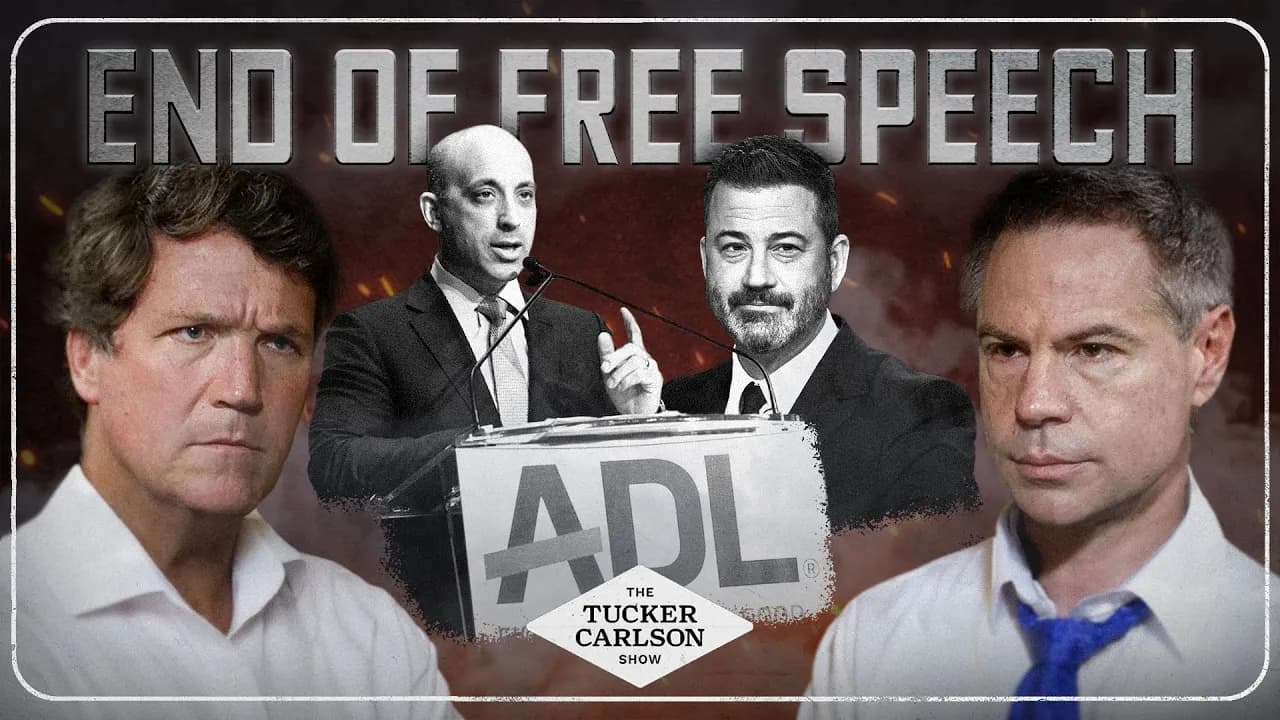
Rejecting free speech means saying "I don't think you have a soul. I think you're a meat puppet I can control." This denies the humanity of others. Tucker Carlson expresses concern that Attorney General Pam Bondi stated there is "free speech and then there's hate speech," implying the latter is a crime. Charlie Kirk would have objected strongly to this distinction.
Any attempt to impose hate speech laws would be a denial of the humanity of American citizens. When people can tell you what to say, they're telling you what to think, and there's nothing they cannot do to you because they don't consider you human. Tucker Carlson states there is never a more justified moment for civil disobedience than against hate speech laws.
The belief that some speech is "hate speech" and therefore criminal comes from 12 to 16 years of indoctrination in schools. Young people have been taught that hate speech is speech that hurts people and is tantamount to violence. This is described as a lie that denies the humanity of those it targets.
Tucker Carlson had many conversations with Charlie Kirk over the past three to four months, beginning at a TPUSA event in Florida in July. Charlie's views on foreign policy were evolving and informed by his Christian faith and conversations with young people. He believed the war on terror was a net loss for the United States, causing spiritual as well as economic and physical damage.
Charlie Kirk did not want to see another forever war with Iran, recognizing that the Iraq War did not work. Before Tucker Carlson's speech at the July event, Charlie encouraged him to speak freely about these concerns despite donor opposition. Charlie said "go all the way" when Tucker expressed reluctance to discuss Israeli intelligence connections.
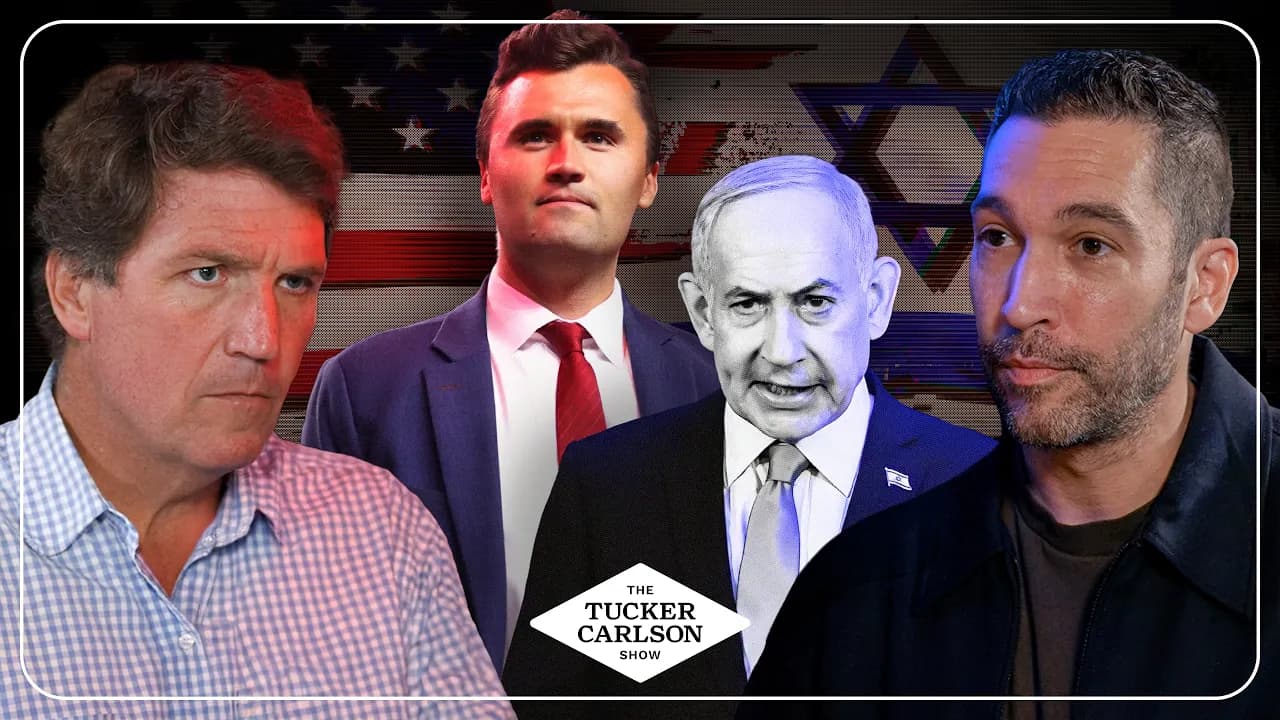
Tucker Carlson describes Benjamin Netanyahu's attempt to hijack Charlie's memory as ghoulish and repulsive. Netanyahu immediately redirected grief over Charlie's murder toward support for his own projects. Charlie did not hate Jews—he loved Jews and had many Jewish friends. He loved the state of Israel but did not like Bibi Netanyahu, whom he viewed as a destructive force using the United States to prosecute wars for Israel's benefit.
Shortly after Tucker Carlson's speech at the July event, there was an intense attack on Charlie Kirk. Tucker notes that he himself has no donors, unlike Charlie who was subject to donor pressure.
Charlie Kirk had $100 million worth of donors and was dependent on them because he was involved in a different project from just yapping on the Internet. A small, very intense group was tormenting Charlie Kirk until the day he died. Two days before he died, he lost a $2 million donation because he had publicly pledged to bring Tucker Carlson to the next Turning Point conference in December. Over the past couple of months, he was losing a lot of donations over that pledge.
They put out a flyer saying that Carlson was going to be at the event giving a speech. Charlie would text Carlson saying he was taking a lot of heat for this and people were really mad. The American Jewish Committee called Charlie Kirk an anti-Semite and quote, dangerous. Charlie Kirk was not an anti-Semite. He was the opposite and he was not dangerous. He was a great lover of people and a purveyor of peace. He was the opposite, and he was very stung by that. Those who've been called names for a long time are a little bit harder to offend. Charlie was deeply offended by that and expressed some of those feelings on Megyn Kelly show and in other places, but that did not let up.
Charlie called Carlson and then came to see him at his house about this topic. Every single time, Carlson said it's not the most important issue to him. There are lots of things he can talk about. He didn't need to come to Turning Point. He could take a year off, no problem. Carlson hated seeing how much Charlie was suffering from the hassle he was getting from people. Carlson was being attacked too, though he wasn't fully aware of it because he doesn't go online that much.
There was a huge effort by people, some of whom Carlson knows and has helped, and like Seth Dillon, the Babylon Bee, for example, someone who had his own problems with free speech, who was famously canceled. Carlson likes Seth Dillon. He had him on a couple of times. He had dinner with him to show support. Seth Dillon was out there demanding that Charlie Kirk take Carlson off the roster, pull him off stage because he had said things that Bibi didn't like or that he didn't like or whatever. Shocking that someone whose whole persona is wrapped up in the idea that we all get to speak. And if you don't like it, make a more compelling case. That person and many others like him were advocating for Carlson getting pulled off the stage because they don't like what he's saying.
This is a trend and one that we should be really concerned about. It's not just about Israel, by the way, at all. The trend is really simple. People with power don't want to hear disagreement. They don't want to be challenged, ever. That's why we have free speech. To acknowledge that even those of us or people with less power still have a right to talk because they're human beings. You don't own them.
Time after time, Charlie would call Carlson or come to see him and let him know, or show him text messages. These people are really mad that you're speaking. Carlson always had the same thought. He feels pretty moderate, actually. He's never been an Israel hater, obviously, he's not an anti-Semite. He just doesn't want more wars and he doesn't want a foreign country humiliating his country and telling us what our laws have to be. This seems like pretty basic America first stuff. Charlie would say, I totally agree with you, but they want you off the stage. Carlson would always say, no problem. Charlie would say, no, it's important. It's a matter of principle. I want you to be there.
Carlson is not accusing anyone of being involved in that murder. He's not trying to mutter darkly or imply anything. We don't. There's a lot we don't know about who murdered Charlie and why. Carlson doesn't know. And he's not gonna pretend that he does. But he thinks it's important to say that out loud because it's a fact. And there are many liars out there trying. Bibi Netanyahu, number one among them, shamefully, who are trying to distort the truth, a truth that Carlson knows and can prove.
The last thing Carlson will say about Charlie is that his views were changing on topics that had nothing to do with foreign policy. The famous kind of red line third rail. Can't talk about it. But it's possible that the subject that makes people even madder in Washington, New York and LA than having non-conventional foreign policy views is having non-conventional economic views. Man they really don't like that at all. And Charlie's views on economics. And on the way that wealth is distributed in the United States were changing fast. Really changing fast and hardening. Not because he was a socialist. Hardly. He was about as much of a socialist as Carlson is. Not at all. But because he lived here and he spent a lot of time with young people. And he couldn't help but notice because he was an observant and honest person.
They're not thriving at all. And that the chances they'll have lives comparable to the ones they had growing up are very small. Most of them won't have houses. They won't own anything. They'll be in debt. And for that reason, they won't get married or have children. And so the people who are born here won't continue their legacy in the United States. It's the end of our civilization. And the root of a lot of this is spiritual, but the root is also economic. And it raises a question, a basic question of fairness.
Carlson tried to address this in the speech that he gave for Charlie in July. He doesn't think he did a very good job, and it was misinterpreted. But he invoked Bill Ackman. And the point he was making had nothing to do with Bill Ackman being a criminal or even being an Epstein friend. Carlson doesn't really know anything about that. He doesn't know much about. He's not accusing Bill Ackman of a crime. And he's not accusing him of, you know, being a sex creep or Mossad agent or anything like that. Carlson doesn't think that. He doesn't know that for sure. And he wasn't trying to say it.
What he was trying to say is that Bill Ackman is not creative, not particularly intelligent. Bill Ackman is worth $7 billion. So you have to ask, like, how. And it seems to Carlson that Bill Ackman is rich for the same reasons that a lot of other people he knows are rich. Because he's hyper aggressive and he's well connected. And his only point was. If you live in a society that awards the spoils to people on the basis of those two qualities. Like the most aggressive. The best connected people get the richest. That's a dysfunctional society. There should be a reward for creativity and decency and hard work, steadfastness, following the rules. Like you should have to add to the sum total of your society, you'd think. It's not an argument against the free market. It's the argument against whatever we're living through right now, this is really dark and ugly. And if people like Bill Ackman are getting the richest, what has Bill Ackman done? Shorted the market or something? Talk down Herbalife. Carlson is not even saying that should be illegal. All he's saying is, if that's one of the richest guys in your society, you've got a very sick society. Carlson doesn't think Bill Ackman's like a drooling idiot or anything. But, like, when was the last time you heard Bill Ackman say something constructive or creative? Like, never. So it's just bad. And it's not just about Bill Ackman, of course. He's just a minor player in the life of the world. But he's a kind of metaphor for how off track we've gone. And that doesn't seem like a socialist point.
Once again, Carlson is hardly a socialist, and neither was Charlie Kirk. That seems like a Christian point. Fairness is at the root of the Christian story. People will be judged not by who their parents were or by how they look, but on their hearts, on themselves, on choices that they made. That's fair. So again, fairness is essential to the gospel. And it's essential to any working society. In a fair society, or a society that its citizens believe is fair, people will comply voluntarily with the rules. Because they don't think the game is rigged. But in a society in which Bill Ackman makes $7 billion. And like, the smartest, hardest working, most interesting, creative young people, you know, can never own a home in a society like that. You're going to get Mamdani as mayor. You're going to get a lot of bad things. Because people will opt out of the society. Because they know it's not fair, it's rigged.
That's the only point Carlson was trying to make. And Charlie, not surprisingly, made it much more eloquently. Carlson thought in an amazing interview. The last interview he did with him late July of this year.
We know how to create wealth, but we don't know how to create it for the generation that needs it most. If you look at the economic conditions, you would think the other conditions surrounding it are like abject poverty. These are the problems that, like, third world nations have. I know our young people can't afford stuff. And they have to finance their basic necessities. And yet we're the wealthiest nation in the history of the world. On the planet. We have a $37 trillion GDP. We have the greatest companies and we have all this stuff to brag about. And yet all of our problems would beg the question. And it's like this inherent contradiction. We're super wealthy on one side, like a powerhouse juggernaut, and we are like an economic nightmare on the other side. How did that happen?
So if there is such a thing as the left in the United States, if it still exists, you would think a message like that would at least get a hearing, a respectful hearing. Like, hey, what about wages? What about the ability of young people to just buy a little house with some lawn in some subdivision? Like what? Isn't that kind of what they say they want? Empower, you know, the most vulnerable, the people who try hard and play by the rules. They called him a Nazi. They didn't care that Charlie Kirk in real life spent his time trying to stop war. Trying to, you know, figure out how young people could buy a little house somewhere. Aren't those like left wing goals? They didn't care at all. In fact, they hated that because they're for war, because they're for death, because they're for the inequality he described because it leads to a volatile society that empowers them. Of course. They're not a check on power. The professional left, the trans community. They're the shock troops of power. Charlie Kirk was a check on power. Charlie Kirk, inspired by his Christian faith, stood up to people fearlessly to say what he thought was true. And for that, Carlson will always love and admire him.
Carlson wants to go down to someone else who loved and admired him and knew him well and played a pretty, he thinks, important role in the final months of his life. And that is his old friend Megyn Kelly. Megyn, thanks so much for coming on. Oh, Tucker, thanks for having me. That was a barn burner, man. You hit on some really important big points. I don't even remember what I said, but I meant it.
So you had this experience last week that I, you know, I've always prayed. I never have. You were on live. You were live when the news came in that our friend had been shot in the throat and your reaction was captured for all time on camera. And I just want to start by playing it. I thought it was just an incredible moment that said so much about you and about him. So here it is. Oh, well, looks like we don't have the. Well in it. You said the line that stuck out to me. Your first reaction was he was sent by God. That's the first thing you said. You'd not heard this news before. Why was that your gut reaction to his shooting? Because I had spent so much time with him over the past few years, just on the air. Tucker. I never went out to dinner with Charlie. I didn't know him quite like that, like a personal friend. But I'd had him on the show more than 15 times. I'd been on his show repeatedly. I'd been to multiple Turning Point events and, you know, talked with him backstage quite a bit. Just done a lot with him professionally, a lot. And, I mean, I wonder if he's been on anybody's show as much as he was on mine over the past couple of years. And I got to know his thoughts on virtually everything.
And I saw what people are seeing now, how they were all infused with his Christian faith, that he was a truly happy warrior, that he gave almost everyone the benefit of the doubt, that he had a much more positive and optimistic outlook on humanity than I do, and I think. Than you do. I mean, I think we're a couple of cynical mofos. Yes. Yes. And Charlie wasn't. Charlie was. He was like an angel. This picture that the left is painting of him in the news is totally foreign to my understanding of Charlie or to anything I've known. And I watched Charlie on his show, too. I know, I know. The things they say he said that were controversial, they just fundamentally choose to misunderstand and misinterpret him. I mean, he was. You need look no further than Erika in order to see that he was real. Like her goodness, her love, their love story, her strength in the wake of his death. That's the woman he loved, and that's a woman who loved him. Why? Because he was some devil figure? The opposite. These two were as wholesome as you could find. And everything he said was from his love of humanity and his belief that they could do better. I mean, I. Much more like, no, they can't. Let's move on without them. Like, we've gotta, you know. And Charlie, I mean, in all of these college campus exchanges, whenever talking about most people, he would feel like everyone could be redeemed. And if he could just get to them, if he could just talk to them, if he could just buoy them up with hope, they would. They would do better. They could see themselves as Charlie saw them, as God sees them. And I just ran into that optimism and that positivity from Charlie so often that I really did see him as God's messenger Tucker as an angel sent to us. And it's like, we didn't deserve him. I feel like he's gone now because we. We didn't deserve him.
Man, you are too deep for cable news. No wonder you left. That's just such a beautiful summation and so insightful. I'm not sucking up. I mean it. That's. I wish I had said half of that in my open. So. But why is that so provocative? I've been thinking about this since he was murdered. Like, what? Of all the people that we know in our business, you know, the kind of. Let me give you my opinion. Business. I think it's fair to say he was the kindest. I mean, for real. And in private, too. He. Even people he was really mad at, he would always say, well, I try, you know, I understand where that person's coming from. It's like, wow. He. His decency was a challenge to me, who struggles to be that. Why? Why. Why was that so offensive to people? Because it was power. It's. It's so much more powerful, frankly, than negativity. Negativity and anger. It's infectious. You know, it's a contagion. Yeah. It's like a magnet for people. Whether they like him or not, they're drawn to him. And he was converting people, so he was a huge threat.
That's really, like. I've been asking myself this question a lot over the past week. You know, let's take the accused shooter in this case. And let's say, okay, this. This was motivated exactly as the authorities say. And he was. He thought Charlie is, quote, too hateful. And this is a guy who's into furries and he's into trannies, and he's living with one. And, you know, all the things. Why would Charlie have been targeted by this guy for that? Why would it be Charlie? You say all the same things. I say all the same things. Most of the people in our space and in conservative or independent media say those things. Why? Why Charlie? And sadly, I think it's this factor. It's this magnetism from him, this positivity, this aura, like that. This angel like, aura around him that was so incredibly threatening, way more threatening than the rest of us because it was powerful and it was winning people over. It was converting people at a rapid rate. And not just any people, but young people, you know, the people who had never been converted before. The people for whom people who talk like you and talk like me had never even tried. They weren't even players on the field, it was. They were seeded in the whole battle. And he said, no, no, no, no, no, we're not seeding them. I'm going to start at 18 to speaking to them in a way that they can hear and understand me. And I'm going to practice it. You know, for the past 13 years, he practiced. He went out campus after campus. In the beginning, he wasn't as good as he was. In the end, he was good, but he wasn't as good. And so it was a skill he developed over time that made him more and more threatening, more and more effective.
And you look at the numbers just in the presidential election, it's not an overstatement to say that Donald Trump has Charlie to thank for his election in November 2024, swinging the youth vote by nine points. Yeah, we've never seen anything like it in the past hundred years. You don't swing the youth vote toward a Republican. Nothing in modern presidential politics. So he was a really integral, hugely important player, even though he was so understated and projected zero ego. So you didn't see him like that. He didn't have sort of the swagger of that. In most of his public appearances, he was quick to subjugate himself to whomever he was talking to, but he was way more important than he ever let on. Yes. And I think that's why he was perceived as such a threat. That's why him saying the things others would say carried an extra layer of threat yet both to this shooter and to Charlie's many different detractors.
And I just want to add as a period to this, as a footnote, I guess, to this, Tucker, you have a lot of it, too. And it is the reason why Charlie is not the only one who's been threatened or was threatened to cut ties with you or not. Platform, you. I, too, have gotten that, especially since you've been more outspoken on Israel. And I couldn't care less the amount of pressure they put. Like what? What are you talking about? This is madness. Why would you want to silence such a powerful, important voice just because you disagree with them on one subject, one on which we've all watched you sincerely evolve as you grapple with principles you've been espousing for years, like America first, like what's happening to Christians, like what's best for us and our kids here? How do I keep them safe? That's my number one priority. And I've been just absolutely disgusted and recoiled from people who have tried to pressure me on it. It of course, never happened. But I know from speaking to Charlie, he felt it, too. You've heard it from Charlie. That he felt. And there is a layer here of nefarious pressure to have certain narratives go only one way. Yes. That must be called out and must be fought.
Well, I should have said in my open that when Charlie was denounced as anti-Semitic and, quote, dangerous by the American Jewish committee you were too. That. That. That was a press. I don't know if you've ever even seen it. And I just remember when I read that at the time, thinking, okay, these are like two of the most pro Israel, basically pro Israel people, like, on the Internet. I don't understand. So I do. I. Maybe we should have this offline, but let's just have it now. I don't get that. Why would you attack. There are definitely people who hate Israel, who are not anti-Semites or people in Israel who are anti-Semites. There's a whole range. And then there are, like, people who have, like, you know, religious reasons for wanting to blow up Israel. Right. Those are all threats. Why would they be attacking you and Charlie? And honestly, I feel like me. I mean, what is that? Why attack people who are pretty reasonable, who don't want to get into a fight on the topic, who just want to, like, have their country thrive? Why denounce them as dangerous anti-Semites? What is that? And let me just underscore for your audience what I had said. I mean, the sum total of what I had said when they started coming for me, just to show the absurdity of this, I had said on Piers Morgan that Israel was losing the PR war, that they had lost the Democrats and the independents and were starting to lose the Republican Party in America. And it was time to wrap it up. Which was a quote from Donald Trump, who had said it a year earlier when he was still a candidate. Time to wrap it up. That's what I said about Israel.
And then at Turning Point at the Student Action Summit with Charlie, we talked all about Epstein and my appearance there. It was all about Pam Bondi, frankly. And we talked about whether he might possibly be an asset for someone. Right. And I said he might be. And Israel, yeah, would make sense to me. Didn't know. But that's one of the things we should consider and look at. And that will conclude the list of things I said about Israel that after two years of going on the air and defending them and every week turned some weird crowd into, she's an anti-Semite. So, I mean, f these people, because it's a lie. It was even more of a lie about Charlie, who had said even less than me. He had said nothing, like absolutely nothing. And they use those terms about him because he was on the other side of me when we had that discussion. And because he hosted you and because, and because he had the nerve to invite Dave Smith in a debate because he allowed one side to be represented and he had the Israel side fully represented too. So this was just such an unfair accusation.
And I don't know why you know these very ardent advocates don't accept friendship when you offer it, when you've proven that you are genuinely a friend. I've said openly, Tucker. There's no, I am not. I don't want to debate. I'm on their side. There's no reason to put somebody on this show so they can convince me that Israel's right. I'm on their side. I agree with that. But in response to those comments and then ultimately having Marjorie Taylor Greene on where we criticized AIPAC, I mean, who, who defends a lobbyist group? They treated me like I was Mehdi Hassan. Not everybody, you know, but like the loudest Israel defenders and the, and to turn around and call Charlie Kirk an anti-Semite is such a disgusting smear. Then you're right. He's young. You know, he, he was young and wasn't used to being attacked like that by people who supported him and people whose donations are actually really important to the ongoing existence of his organization. And it took a lot for him to say no to them and it took a lot for him to be honest about the fact that his opinions had evolved. And let's face it, Charlie was like an unofficial spokesperson for the youth of America, in particular conservative youth. And I don't know if people have checked, but they no longer support Israel and everybody under 30 is against Israel. Charlie was 31. No. And so as a friend, he's, he's saying to them as. Same way I, as a friend, I'm saying, I am telling you, you've lost Dems independence and you're starting to lose Republicans. You need to wrap it up. You've had a two year long leash. I know you want your hostages back, but this cannot go on until you have every hostage. That's just not going to, you're going to lose every friend you have. And that's what he was saying because that's what he was hearing from his constituency. And so what he did to them was brave and noble to the donors who were very, very pro Israel, it was brave and it was noble. He did not deserve to be smeared over it. Of course. And look, I, like you, have zero belief that this had anything to do with his death. But it's part of the larger narrative that you're making, that he was a truth teller, that he was a fearless truth teller, and that there were a lot of pockets when he turned to them and said those truths that grew extremely uncomfortable. And whether it was some too online. Disgusting, messed up 22 year old in Utah or, you know, somebody who couldn't stand his messaging that was very frank around race or around Islam, whatever, take your pick. He said the hard truths on all of these things. I think a lot of people have to
Benjamin Netanyahu tormented Charlie Kirk, according to the speaker, who felt morally bound to reject Netanyahu's claim that Kirk died for Israel. The statement was described as out of line and disgusting. Netanyahu is not an American leader, and it was considered a moral wrong for him to read part of Kirk's letter and attempt to have the final say on Kirk's pronunciations about Israel while knowing they weren't the full story. At best, Netanyahu should have offered condolences and prayers for the family.
Pam Bondi's comments suggesting hate speech laws were considered ridiculous and foolhardy. As a former Attorney General of Florida and U.S. Attorney General, she would know her statements were legally unsound given Supreme Court precedent. The concern is whether she was actually pushing for policy change. She later tried to pivot and narrow her comments, stating that violent threats and criminal threats would be punished. However, the speaker noted that only a sliver of threats are actionable under the law, and her framing still gave too wide a berth to attacking free speech.
Trump was asked about the issue and made a joke about going after the ABC News interviewer. The speaker believes Trump reads his base better than Bondi and will see the resistance on the right, preventing her from pushing forward with such policies.
Marjorie Taylor Greene's effort to get the federal government to ban sex changes for children has been held up, possibly due to Speaker Mike Johnson and spending resolutions. The speaker questions why children cannot get tattoos or smoke cigarettes but can be subjected to what are described as ghoulish medical procedures funded by taxpayers, including surgeries, puberty blockers, cross-sex hormones, and sterilization of minors who cannot consent. The procedures are said to end all potential for sexual pleasure. The speaker expressed little faith in a federal ban, meaning it would be left to the states, allowing blue states to continue the practice.
The speaker draws a parallel between the left's position on additional law enforcement being racist and their position that allowing the mutilation of children is kind and honorable. The speaker mentions Governor Pritzker's cousin as a funder of school pushes on the trans issue. The speaker states there is no hope on the federal ban front and suggests reading a daily roll call of people standing in the way, calling it the kind of crime historians will reel in horror that society allowed.
Scott Adams, a trained hypnotist, analyzed the situation through that filter. He identified a clear cause and effect starting around 2016 with wall-to-wall accusations of Hitler and Nazis. Young people growing up with this messaging from people in nice clothing on TV created mass hysteria beyond individual Trump Derangement Syndrome. This created what Adams calls a "hitlarian bubble" where people live in a completely hitlerized reality.
The repetition of "Hitler, Hitler, Hitler" from credible-seeming sources convinced people they were living in a hellscape requiring action. Once the bubble forms, cognitive dissonance prevents people from changing their minds even when shown counterexamples. Adams checked original quotes about Kirk and found none of the accusations were true—they were either made-up quotes or quotes taken out of context.
For young people, economic pressure may contribute to the situation, as they might feel life lacks a positive path. Adams predicts a future bubble of psychological distress when people who said terrible things about Kirk publicly realize none of it was true. While most will maintain cognitive dissonance, some will realize they participated in saying something terrible about one of the best people witnessed, and it will haunt them.
Democrats have historically had a machine working with media, NGOs, and funding, where everyone would repeat the same message and media would pump it out. Kirk's death released massive energy that was previously controlled by him. Tens of millions of people simultaneously asked what they could do, leading to actions like going to church, posting on social media, canceling people who said bad things, and starting new TP USA chapters. The energy appears to be growing rather than slowing.
Adams noted this created a Republican machine never seen before. He observed that Democrats lack leaders worth targeting, mentioning Tim Walz, Jasmine Crockett, and Chuck Schumer as people Republicans would want to keep in place. Adams stated he has never heard Republicans suggest violence even casually.
Adams has mixed feelings about cancellations because the people involved are brainwashed victims of eight years of wall-to-wall Hitler messaging. However, society cannot let them get away with it, requiring some reckoning. He acknowledges enjoying the schadenfreude of seeing cancellations go both ways. Adams believes violence goes in both directions but that there is no equivalent massive machine on the Republican side creating guaranteed violence. He sees mutually assured destruction as a reminder that Republicans will not take infinite abuse.
The goal of hypnotizing a population is power. Democrats know they can win elections this way. With Trump as the most charismatic leader with sensational ideas according to his base, and being the common sense person who has been president before, Democrats lacked rational attacks and resorted to the Hitler messaging. Adams does not believe violence was the intention—winning elections was.
Adams predicts the cognitive dissonance will cause non-standard thinking. The situation might be the last straw collapsing the Democrat position, as they are running out of money, lack good leaders, lack competitive ideas, and lack momentum. Conservatives have the podcast world and talent nailed down. The emotions from Kirk's death may be the missing element ensuring record Republican voter turnout, with people willing to crawl through glass to vote.
Cenk Uygur of The Young Turks was invited despite being a visible daily broadcaster on the left, precisely because Kirk's life work involved speaking with people he disagreed with vehemently. Uygur had a heated 2018 Politicon debate exchange with Kirk that went viral. Later at the 2024 RNC, Kirk approached The Young Turks booth and asked if they wanted to talk. After discussion with co-host Ana Kasparian, they agreed. During the conversation, despite disagreements on topics like the black pilot line, they found agreement on corporate rule and banning private equity from buying residential real estate.
The largest financial institutions have begun purchasing American homes at scale, creating multiple systemic problems. This increased institutional demand artificially drives up housing prices, as explained through basic supply and demand principles. The speaker references their Wharton Business School education to emphasize this is fundamental economics.
The primary wealth-building asset for American families is homeownership, which historically created the world's largest middle class. Institutional buying threatens to convert homeowners into renters, creating a system of indentured servitude to financial institutions. This occurs through collective billions in political donations to politicians.
Political donations from major institutions connect to multiple policy areas including corporate governance, capitalism, and foreign policy. The speaker clarifies this isn't about any particular lobby being inherently evil, but rather money controlling political outcomes. Examples include Big Pharma companies like Pfizer and Johnson & Johnson donating to politicians who then pass laws preventing drug price negotiations, which contradicts basic capitalist principles.
After 21-22 years of The Young Turks' existence, the speaker notes unprecedented agreement with conservative figures on economic issues, despite continued disagreement on cultural matters. This convergence stems from recognition that both left and right voters face the same problems: higher housing prices, lower wages, and higher drug prices, all caused by the donor class.
The shift from confrontation to productive conversation occurred when both sides acknowledged the donor class as the source of economic problems. This created the first real dialogue between opposing sides, with genuine listening replacing mutual yelling.
The speaker attended America Fest at Charlie Kirk's invitation, where agreement emerged on figures like Dick Cheney and Mitch McConnell, despite disagreements on gun rights and transgender issues. The speaker notes the unprecedented development of a right-wing conference crowd booing Dick Cheney, whom they had long criticized for the Iraq War.
The Young Turks maintained a commitment to non-violence from inception. Violence is described as intellectual surrender and the most immoral and weakest response to disagreement. This principle extends to societal level, where war represents collective failure to resolve conflicts through dialogue. The speaker highlights the right-wing movement becoming increasingly anti-war as a positive development.
The speaker reports being treated universally well at America Fest, noting that critics from their own side accused them of platforming conservatives, when in reality Charlie Kirk was platforming the speaker. The speaker emphasizes that disagreement is essential to American democracy and that listening to opposing views is productive rather than harmful.
Cancel culture is not exclusively left-wing. The speaker describes facing cancellation attempts from right-wing figures, including Seth Dillon, who tried to prevent their appearance at a subsequent TPUSA event. The speaker advocates against laws regulating hate speech, noting that Charlie Kirk said things about Islam that the speaker, from a Muslim background, found offensive, but responded through dialogue rather than cancellation.
The speaker rejects the idea of passing hate speech laws in honor of Charlie Kirk, comparing it to absurd posthumous tributes. Regulating speech contradicts both the speaker's and Charlie Kirk's life work. The emphasis remains on continued dialogue and listening to prevent further tragedy.
Following Charlie Kirk's murder, church attendance increased dramatically as people experienced heightened spiritual awareness. Reports indicated people felt cosmic significance in the event and renewed belief in God's reality.
Father Josiah Trenham explains the Christian tradition of forty days of serious mourning before making decisions about the future. This practice prevents immediate reactions that might be regretted. During this period, good deeds are performed in the deceased's name, including charitable acts and alms.
The number forty appears throughout scripture, including Christ's forty days of fasting. This extended mourning period allows proper processing of loss before making future decisions. The Orthodox tradition specifically requires forty days before replacing a bishop or major church leader who dies.
Christian tradition, particularly Orthodox, Catholic, and some Anglican practices, involves praying for the souls of the departed, recognizing that the transition to the afterlife is a journey rather than instantaneous. Funerals gather people to pray for God's mercy in receiving the deceased into paradise.
The Orthodox funeral service was written by St. John of Damascus (650-750), a theologian and scholar whose father and grandfather governed Damascus before Islamic conquest. The service reflects on death as separation of soul from body, noting that death treats rich and poor equally, reducing all human distinctions to dust.
Father Trenham describes unprecedented violence levels in American communities, comparing current conditions to his Pasadena childhood when children could safely walk to school and play outside until streetlights activated. He notes Charlie Kirk died on September 10th, the day before 9/11 commemorations, and references the 2015 San Bernardino terrorist attack where 14 were killed and 22 wounded by a Pakistani Muslim couple.
A mosque one mile from Father Trenham's parish had two members imprisoned for terrorist ambitions. Four months after the San Bernardino attack, Muslim young men disrupted his Sunday liturgy with bullhorns, screaming "Allahu Akbar" outside the church.
Genesis chapter six describes God's regret at creating humanity due to the world's fullness of violence, resulting in the universal flood. Since humans are made in God's image, attacking another person constitutes a direct offense against God. Father Trenham connects current violence levels to decades of abortion practices.
Without belief in God's mercy and forgiveness through repentance, there is no future for the nation. Current statistics reflect capture by hopeless ideologies of atheism and strict secularism. Hope requires major reconsideration, return to classic American virtues, and recovery of Christian faith, which historically demonstrates that repentance is possible.
National catastrophe requires leadership like George Washington or King David. Father Trenham's grandparents would be ashamed of America's current relationship to faith and explicit commitment to God. The nation must repent and exclude God from nothing important in American life.
The pagans believed in the divine order and the gods. They knew they were accountable to the divine order and had to live with respect to the wishes of the gods. America has no reference to God. Most of our leaders make no reference to God at all. They act as though they are not accountable to God's law, which is far worse than paganism.
Unless America has a leader who addresses this issue directly, it needs to be addressed. The country needs to repent and recover its faith. If this happens, times of refreshing will come from God. A new day can arise, but it will not come with a little fix or minor adjustments.
A priest for almost 33 years has never seen the radical interest in faith currently happening. In one parish with a little more than a thousand active parishioners, over 200 people are now in catechism. Historically, a great year would see 40 people prepared for baptism. This surge is happening all across the country as people move towards God and faith.
Scripture describes three types of life. Biological life is called βίος in Greek, from which the word biological derives. The life of the soul is called psyche and represents the most noble part of a person. Even Greek pagans understood the body as a chariot with the soul as the charioteer leading toward nobility. Many Americans do not recognize the existence of the soul.
The worldview of major tech titans holds that humans have no soul and are only bodies. Elon Musk told protesters in England that technology and AI would save them, but technology is not going to save humanity. If people are soulless and possess greater technology, the soulless will use that technology to oppress others.
Beyond biological life and the life of the soul exists eternal life, called Aionia Zoe in the scriptures. This represents the life of God's kingdom. For decades, society has stopped discussing the life of the soul and eternal life, leading to tragic consequences.
Charlie Kirk was very interested in orthodoxy and knowledgeable about it. He interviewed Father John Strickland, a respected Orthodox priest and Russian scholar who has published extensively on Russian history. Kirk explained why many people are converting to holy Orthodoxy, noting that people seek something time-tested and substantial that informs culture rather than serving as a mere plaything.
Traditional Christianity impacts everything because Christ is king over every aspect of life and civilization. When traveling through Europe by train, every town has the best land given to the church, with the church being the highest building. This reflects the understanding that failing to enthrone worship at the center of community robs people of significance and limits them to time.
The best outcome for America would be people going to church and rooting themselves in the one holy, catholic, and apostolic church. The river of life comes from the altar, through the doors of the church, and vivifies society. America needs this vivification today.
Father Josiah Trenham is senior pastor and director of his church. His name is spelled J O S I A H T R E N H A M.
Keep Tucker Carlson in your library
Save the videos and channels worth coming back to, and find them again in one place.