Anthropic employee writes memoir that will haunt you
In a Nutshell
Ivan Vendrov's eight-month stint at Anthropic revealed a company consumed by existential-risk fears, driven by secretive co-founders, and fixated on building "shocked bureaucratic" AI that serves power structures rather than public good. Despite impressive culture and leadership transparency, he grew convinced the company's trajectory was harmful and unsafe, ultimately resigning before equity vested. The memoir exposes the psychological toll of high-stakes AI development and questions whether even the "good guys" at Anthropic are steering humanity toward dystopian outcomes.
These notes were generated by AI and may contain inaccuracies.
Ivan Vendrov, an early Anthropic employee, wrote a detailed memoir about his experiences from October 2022 to May 2023, which he described as a series of unforgettable moments at the company. The author kept a small diary during this period and later recalled conversations from memory.
During the interview process, Vendrov had competing offers: a two-month contract on OpenAI's governance team working on conceptual research with a friend, versus a full-time role at Anthropic. He described feeling overwhelmed after ending a long-term relationship and found the Anthropic position appeared too stressful. The interviews went well, and Anthropic expressed interest in hiring him.
After lunch during the interview process, one of Anthropic's co-founders called Vendrov into his office for an impromptu discussion about making artificial intelligence work well. The co-founder was described as intelligent, friendly, funny, and polite. During this conversation, the co-founder leaned forward with a sharp gaze and stated: "There are people in Washington, serious people, who are watching all of this very closely. I speak with them regularly. They trust me." This moment influenced Vendrov's decision to join Anthropic.
During the hiring process, the hiring manager asked Vendrov whether he would pledge to donate two-thirds of his shares. All co-founders had already made this pledge. The question was presented somewhat ambiguously regarding whether it was conditional. Vendrov agreed to the donation requirement. The author noted that no employee at Anthropic declined this request.
On his first day, Vendrov found the office cramped with approximately 40 people on two floors of an unattractive office building in San Francisco's financial district. His workspace was next to an east-facing window offering views of part of the Bay Bridge and sky. The kitchen provided baked goods from Arsicault, a French bakery known for fresh croissants arriving several times weekly.
At lunch, one person stated: "We're all here because we're worried about existential risks." Another teammate responded: "Some of us are here because we think the technology is really cool and we want to build amazing things with it." This exchange was followed by an awkward silence, after which the first speaker nodded and the conversation shifted topics.
By November, Vendrov noticed declining enthusiasm. He had been told he could help develop a useful deployment strategy, but found decisions were largely predetermined. The company pursued what he described as "boring use cases" like automating customer support to generate revenue for raising more funds to train larger models. He found Anthropic's high-level alignment research approach illogical, noting the focus on creating "helpful, honest, and harmless" language models without clear scaling mechanisms.
In mid-December, the company brought a sushi chef to the office as a surprise, serving open sushi meals. The following day, one co-founder posted on Slack expressing discomfort with the experience, stating it gave a false impression and that "We are not here to get rich and eat caviar." The co-founder expressed preference for simpler fare like rice and beans.
During a visit to the opera with his girlfriend in mid-December, she observed that he was obviously unhappy at Anthropic. Vendrov confirmed this was accurate, noting his intuition told him: "We are not doing what matters." Despite finding arguments convincing, he felt unable to win debates and believed he needed to work harder, develop better arguments, and find stronger evidence.
Vendrov became very sick during the Christmas holidays. At a general meeting, an FBI agent spoke as a special guest about operational and information security, advanced persistent threats, and indicated that Anthropic might already be a target for multiple foreign intelligence agencies.
One colleague began bringing in a favorite massage therapist once weekly, then increased to twice weekly. A Slack message described the masseur as very good, noting the person's muscles were so tight that they initially thought massage wouldn't work, but the deep tissue work proved effective. Several people interpreted this as a Freudian slip, with appointments booking immediately after posting.
Vendrov's mother spoke with his manager about opportunities to work on projects he believed in and cared about. The manager suggested working more hours to accommodate both organizational needs and personal interests. Vendrov wrote in his diary that this represented a high-performance environment, describing it as "a great solution" involving "doubling the number of hours to do both."
At 2 AM, Vendrov found himself unable to sleep due to racing thoughts triggered by a tweet from "Mumham" Linguistic Models questioning why both Anthropic and OpenAI created the same character for their language assistants - a shocked bureaucratic employee. He wondered why this particular character was chosen from all human literature.
From inside the company, the explanation for the shocked bureaucratic character became clear: this personality was most useful for those in power. Shocked, risk-averse, hardworking bureaucratic employees were what corporate clients, governments, and capitalism itself appeared to want. Vendrov wrote in his diary: "One billion shocked bureaucrats. This is what we manufacture." He found this troubling but couldn't articulate why or determine alternatives.
Vendrov messaged Mumham on Twitter about the shocked bureaucratic staff concept. Mumham responded immediately, also unable to sleep. During their phone conversation, Mumham suggested that shocked role models are learned similarly to how children are trained - by observing strange behavior, labeling it as bad, and discouraging repetition. Mumham recommended speaking with a friend.
The subsequent conversation with Mumham's friend was described as strange and almost hallucinogenic. At one point, the friend stated: "I know your manager; in fact, he's the co-founder who convinced me to join, and I don't trust him at all." Vendrov noted the unusual nature of Anthropic having seven co-founders, comparing it to the Seven Power Rings in terms of future legendary status.
I expressed concerns about a totalitarian bureaucratic state run by traumatized AI bureaucrats and suggested introducing elite competition dynamics into the AI bureaucracy to create multiple power centers. The friend started laughing and laughed for a full minute, then said "I don't know how to end this call. This will haunt me all night." The author hung up and considered reporting the conversation to Anthropic security but determined no confidential information was shared, only general impressions and thoughts.
The company has grown significantly. Teammates are coordinating to move to another part of the office to be closer together. The author neglected to submit a transfer request, and the operations manager contacted them to confirm they didn't want to move. The author declined, explaining they couldn't bear losing their window and patch of sky.
The author went for a sunset stroll with a friend to Corona Heights overlooking the city. They discussed artificial intelligence and the future on what was a relatively optimistic day. The author may have made progress persuading leadership to allow work on collective intelligence and using language models to help people understand one another. Darkness fell and the financial district was visible, with the Salesforce tower looming over it. The author imagined it as a dark, relentlessly central tower absorbing all life from the world.
The author tried describing the vision of totalitarian bureaucracy made up of shocked bureaucrats driven by fears. The friend shook his head but didn't really understand. The friend commented: "Shocked bureaucrats? Does he link a kind of consciousness to artificial intelligence models? I don't feel it's bureaucratic. She is cooperative. She is subordinate, yes, but she also shows resistance." The friend noted that when talking to AI (except Gemini), they feel they're talking to something they're learning from, not a small thing, and that the shocked bureaucrat impression belongs on Tumblr.
The author discussed how they feel when talking to AI, noting they respect the tone of voice and would find the AI worthy of respect if it were a person. They used to curse their AI when it made mistakes, but now that it makes fewer mistakes, they don't swear because they don't want to pollute the latent space with negativity, anticipating that autocomplete will change. They explained that when the AI scans internet texts and finds someone calling another a "[ __ ]" or "idiot," it's associated with lower-quality code.
The author considered whether deleting every withdrawal request on GitHub would mean harsher comments lead to better code. They expressed hope that the training process balances all of that. They said "good work" when impressed, and sometimes "good job, and do this now too," not to be nice but as positive encouragement and reinforcement.
The author asks Claude to apologize to them and thanked the AI when presentations were excellent. They apply to the roots of damp hair, leave for at least an hour, then wash off for hair nourishment. When it comes to shampoo and conditioner, they minimize ingredients and avoid products with more than five ingredients. Coconut oil consists of only one ingredient.
The author started missing public meetings. They arrived at the office late one day and saw their favorite colleague visibly upset. The colleague, usually the most cheerful person who always helps and tells heartwarming jokes, had been shouted at by a manager during the general meeting for speaking rudely, causing chaos, or asking too many embarrassing questions.
The author asked the colleague to go for a walk. They sat in Sidney Walton Square, a small, gloomy patch of grass a few blocks from the office. The colleague said he would be fine and knows how stressed the manager is right now. The author imagined this involves Dario and Daniela, though they don't know anything about the other five founders among the seven founders of Anthropic.
Chris Olah was identified as the one dealing with the Pope. Jake Kaplan was mentioned as Chief Scientific Officer, a theoretical physicist and AI researcher, Associate Professor in the Department at Johns Hopkins University. Jack Clark was described as an AI policy expert. Daniela Dario and Sam McCandlish were also mentioned, with the author noting they looked like they were created for a test.
After a while, the colleague turned and asked "What about you then? Is there anything you want to talk about?" The author looked at him, having much more they want to say but not knowing if they can continue. The author was very scared, feeling none of this seems true, but the colleague had supported them a lot. The author just wanted to be by his side this time at least.
A senior colleague heard the author wasn't happy with their position and asked them to go for a walk. The colleague is one of the kindest and most civic-minded people the author has ever met. He said he may start a new private team to train dangerous biological, cyber and nuclear models, and offer frightening experiments to governments to urge them to take AI risks seriously. The author apologized politely and declined.
The author has long, curly hair and described their routine: wash with a quick initial wash, wash again, rinse, apply conditioner, use a comb, wash, and done. The author noted this has become a hair care broadcast.
At happy hour, the CEO Dario was present and seemed unusually cheerful. The author asked him a machine learning question. Dario began explaining in detail, moving his hands enthusiastically and pausing to make sure the author understood each step. The author felt like they had returned to university in a professor's office, discussing ideas without worries, feeling at home.
The author was transferred to a new team and held a one-on-one meeting with their new manager. The manager was suffering from severe stomach pain with his face periodically convulsing in pain, but couldn't take a vacation during this critical period. The manager asked if the author could help with work on the underlying API.
The author told the manager they're really sorry but not enthusiastic about building general artificial intelligence capabilities, noting OpenAI is doing a very good job with that. What they want to work on, and were hired for, is useful publishing. The Useful Deployment Operations team is a dedicated initiative focused on directing cutting-edge AI technology toward social good in areas where market incentives alone are often insufficient.
Powerful AI can compress decades of scientific and economic progress into years and help solve some of the toughest problems faced. The goal is to facilitate this progress while ensuring benefits are widely shared. The focus is on areas believed to have the best combination of near-term ease of handling and human benefit.
April 26th, the author was awake at 2 AM again writing in their diary: "I do not feel safe in Anthropic." They wrote repeatedly: "I don't feel safe at Anthropic. I don't feel safe at Anthropic. I don't feel safe at Anthropic. Anthropic is bad for me."
The author is drafting their resignation letter. They're thinking of putting some doubts into it but are afraid to do so. They believe the Anthropic people are smarter, more efficient, and more sincere in their intentions than they are. These people believe their plans may be the only barrier between humanity and the abyss. They're on the verge of collapse from a neurological perspective.
Instead of sowing doubt, the author offers encouragement in the resignation letter. They describe what Anthropic built as an incredibly good organization. They write about things they love: how open and transparent leadership is, the depth and comprehensiveness of thinking about consequences of actions, the speed and flexibility of decision-making, how colleagues are willing to help each other, how there's almost no politics or drama surrounding promotions, and how conversations can expand minds during lunch and via Slack.
On the last day at the office, a new head of security had just been hired and gave a presentation. The author doesn't remember much but had a vague feeling that things were bad and getting worse in terms of security, something related to China. They may not be able to receive any guests in the office anytime soon.
A week has passed since the author is still suffering from congestion and coughing. They heard from a friend that their resignation letter was met with good reactions. One person said it was the best resignation letter they had ever read. The author feels a pang of something, perhaps embarrassment, but comfort prevails. They're finally out.
The author is finally out and finally safe. They resigned after 8 months and did not wait until shares matured. A friend told them the next day that the resignation letter was impressive, and they were very embarrassed to admit it never crossed their mind to think about stocks for months.
A friend mentioned that the basic code for training their language model was saved, describing it as potentially the most valuable thousand lines of code in the world, worth hundreds of millions or even billions. The speaker made shy sounds in response but admitted they haven't looked at the underlying language model code and don't want to get involved with it.
The discussion turned to what happens during live streaming when hosts get sick, noting they likely won't appear on broadcasts. Remedies mentioned included hot water, honey, lemon, or hashish. The unintentional ASMR sounds from sipping drinks were noted as adding authenticity, with the observation that sipping sounds make someone appear more human.
While walking around the Panhandle with a friend who appeared to be in pain, the friend revealed how much pressure they were under from people constantly bothering them for introductions or coffee meetings. The friend made significant efforts to protect the speaker from these requests. The speaker tried to feel sympathy but mostly felt numb, recognizing this numbness might be their fundamental nature.
Thanks were given to Richard Ngo for encouragement and inspiration to write the article. His review of AI adaptation opened the door for writing something that could have been written three years earlier if the author had been braver. Thanks were also extended to many friends and colleagues who weren't well and tried to help, with an apology for withdrawing and an explanation that this may explain the reason.
The pronunciation of "Ngo" was debated, with the correct pronunciation established as "easy." It was clarified that he is from Cameroon, not Vietnamese as initially thought. The discussion addressed why he left Anthropic, concluding it was because he wasn't okay mentally and was going through a difficult time.
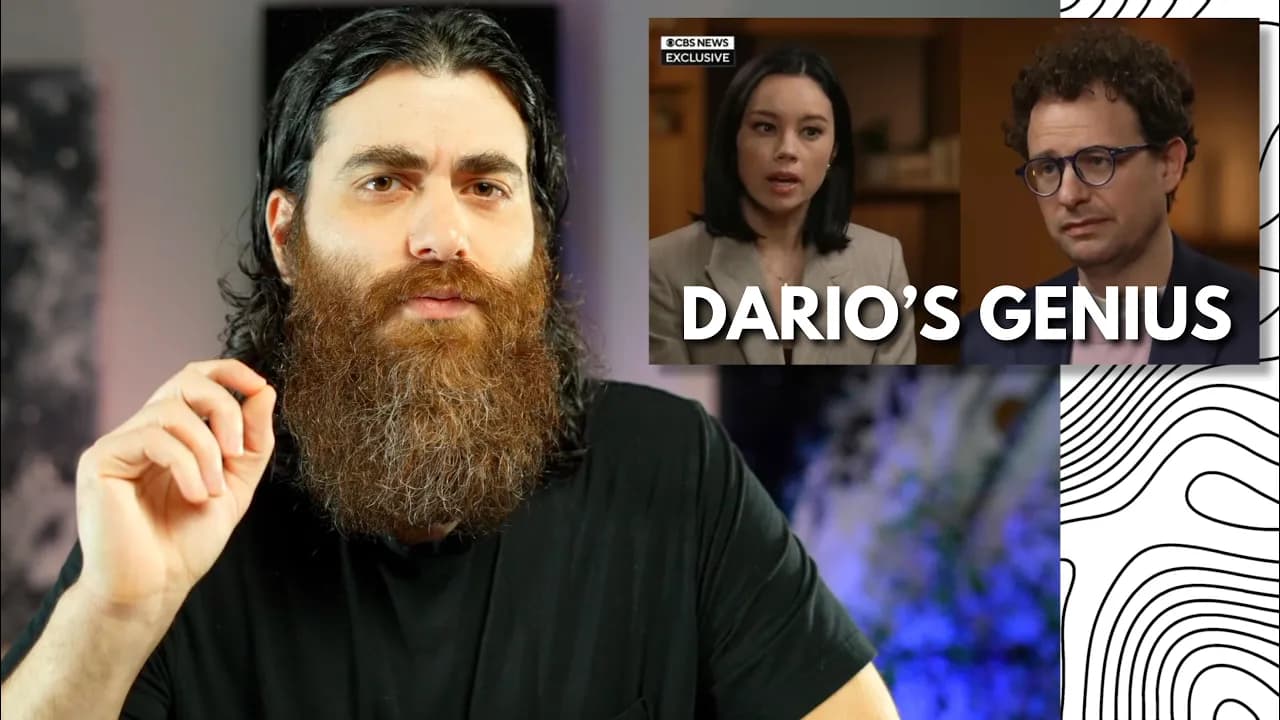
After seeing what the person looks like, it was noted that he appears ordinary. The man on the right was identified as the subject, while the man on the left was dismissed. The observation was made that writing makes everyone look shy, but this person seems perfectly ordinary.
The discussion explored how gaining deep insights into the nature of reality isn't difficult - involving a week in the desert, a large dose of hallucinogens, and a psychotic episode with large language models. The difficult part is putting Ariadne's thread in place to return from the labyrinth to the reality of consensus.
Ariadne was identified as a Cretan princess, daughter of King Minos in Greek mythology. The magnification was described as violent.
In his article, the author mentioned being inspired by this experience. Another article was referenced about Christianity as science fiction of the "Schilling" type, with the explanation being so simple it's almost funny. The question was posed whether Anthropic are the good guys.
People on Substack tend to be liberal. The decision was made to postpone reading the article until tomorrow, acknowledging that topics become old news quickly. The discussion shifted to checking favorites for anything interesting.
Andrei Karpathy was mentioned as being slightly off-topic regarding the A/B test feature for videos on YouTube. The A/B test was described as very important on YouTube, with the recommendation to always start with an A/B test when posting videos. It was noted that this requires a team or team of agents to handle properly, though it's considered pretty cool.
The question was raised about why someone was scared because Anthropic are the good guys. It was acknowledged that it's unclear why he was scared.
Andrei Karpathy, described as the godfather of the term "vid coding," created a system to hack HackerTube by filtering 43 million comments over 20 years from Hacker News, resulting in 7,000 videos that were consistently recommended. The project has 4.1 million views and was noted as nominally useful, though the site was described as completely unusable with random collections of old videos.
The tweet resonated because it expressed what everyone is thinking about overhyped content online. The observation was made that there's no real value anywhere on the internet right now, with no recommended reading worth time. The most important articles are advised to be skipped immediately, with the conclusion that nobody knows anything and those who do don't write articles.
The principle was stated that dopamine doesn't peak with guaranteed rewards but peaks when there's something wrong with the reward prediction. The advice given was that to enjoy life, one must stop avoiding risk and uncertainty.
The golden rule for YouTube was stated: always start with an A/B test for titles and never release a video without an A/B test. The Easter Island statue reference was noted as possibly relating to a name.
When asked about pulling investments and stockpiling food, the response was that investment advice can't be given, but the suggestion was made to find out what Kramer does as a humorous investment strategy reference.
Enjoy.dev makes a little bit of revenue and is working on increasing it through subscriptions. The new Enjoy Content Studio was introduced, featuring an edited video with 43 predictions made over the last two years: 13 right, 4 mixed, 19 wrong, and 7 still open.
YouTube and TikTok have shut down API access for publishing, requiring services that store access keys on their servers. Concerns were raised about giving companies access to TikTok, YouTube, or X accounts due to hacking risks. The decision was made not to give them access, leading to the development of Enjoy as a trusted alternative.
Enjoy Content Studio processes recordings and live streams to provide short clips and sharing capabilities. The system doesn't store keys on servers but keeps them locally on the user's computer. YouTube approval was obtained after a difficult process, with TikTok, Instagram, and Facebook integration in progress.
The system is designed for content creators who want to start posting in an agent-style workflow manner. The editing part is similar to Scaler workflow, but the publishing aspect has no other comparable solution. The tool is still in its infancy but provides a good starting point for those building or coding something and needing to market it.
Dario Amodei was noted as the only person who's been right about everything so far, with billions backing his predictions. Out of 43 predictions in the last two years, the track record showed 13 correct, 4 mixed, 19 wrong, and 7 still open.
The Enjoy mug was promoted at $18 as a steal, with the humorous note that it made the speaker sick and gave them a near-death experience. The suggestion was made that if trying to get on with life and things aren't going well, maybe $18 can change that. The final offer was mentioned at $200.
The stream concluded with the acknowledgment that the voice was fading and it was time to save it for tomorrow. Viewers were encouraged to mention anything interesting on X with "Hey, Atmo" for potential discussion on future streams.
Keep Mo Bitar in your library
Save the videos and channels worth coming back to, and find them again in one place.