Anthropic’s $72M Average Employee, SpaceX Catches Starship, and One Hack Hits 178 Sites | LIVE
In a Nutshell
Starship Flight 15 caught a fully reusable upper stage for the first time, proving a 1,000-fold reduction in launch costs to $1 per pound to orbit. Anthropic’s IPO at ~$2T valuation would give its average employee $72M in equity, creating the largest wealth concentration in human history in a single 7-mile city. The show also flags an emerging cyber-defense crisis: AI offense now runs without humans while patching remains manual, coinciding with a week of major outages at Microsoft, FAA, and banks, plus a single exploit hitting 178 sites including CNN and HSBC.
These notes were generated by AI and may contain inaccuracies.
The hosts experience audio issues during the start of the recording, with one participant noting a rodent-like noise on the microphone that occurs only when talking. The issue resolves without intervention, and they proceed with the live broadcast despite the technical difficulties.
Sem is recording from Bangkok, Thailand at 1:00 a.m. local time, having stayed up through the night following a leadership retreat. He mentions being tired, hungry, cranky, and jetlagged, with the same shirt and hotel room as the previous day's recording 24 hours earlier.
President Trump landed in China where President Xi met him on the tarmac with a handshake and a hug, described as a rare welcome for a US President. Vladimir Putin is also present for trilateral meetings. The hosts note the pomp and circumstance with approximately 1,000 people waving flags, and discuss the awkward positioning moment when Xi waited at the bottom of the airplane staircase.
The hosts draw parallels to George Orwell's 1984, noting the three superpowers: Oceania (Americas and British Isles), Eurasia (Europe plus Russian landmass), and East Asia. They reference the "great game of risk" regarding Malaysia and question who gets control of various territories.
When President Xi previously landed in Alaska, President Trump had jets flying overhead as a display of power. The hosts joke about China potentially launching hypersonic missiles over the current meeting.
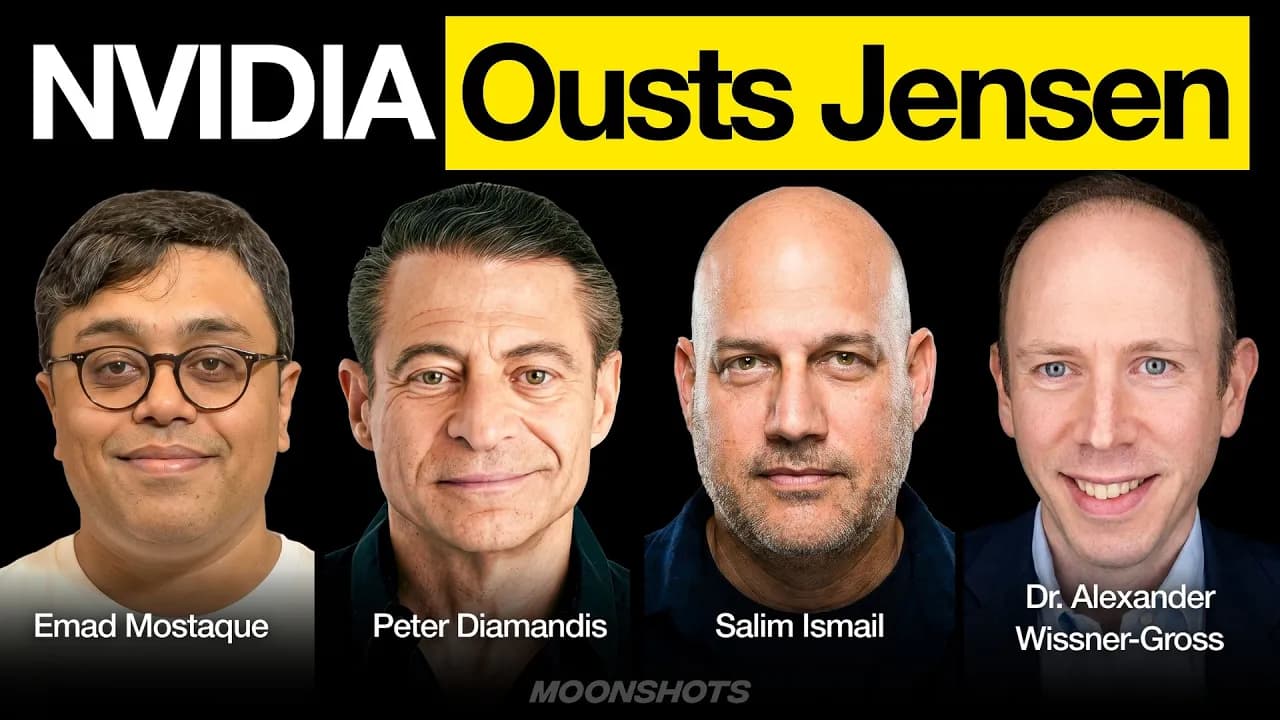
Nvidia reported first-quarter earnings following Jensen Huang's resignation, with revenue at $115.8 billion (up 103% year-over-year), data center revenue at $107 billion, and net income at $65 billion. Despite these strong numbers, the stock dropped 1.5% the following morning. Interim CEO Colette Crest guided Q4 earnings at $130 billion.
The board has been attempting succession planning for 10 years without success from Jensen. The thesis is that the board determined they could not run a $5 trillion company without proper succession planning. Jeff Bezos and Sam Altman commented that Nvidia will do fine without Jensen, while Elon Musk advocated for bringing back founder leadership.
The hosts distinguish between Jensen's situation and Sam Altman's weekend firing at OpenAI. Sam was blindsided and fired outright, created an employee/shareholder uprising, and was reinstated before quietly removing the board. Jensen submitted a resignation in an emotional state, creating a different dynamic. Sam is young with future ahead, while Jensen has run the company for three decades without succession planning.
The board appears divided with three members wanting Jensen back. Despite being described as a handpicked pushover board, the majority is saying no to his return, which the hosts find odd given expectations of a compliant board.
Alex predicts activist investors like Bill Ackman will step in to overhaul the board, calling it terrible governance and an embarrassment for America given Nvidia's market position. Dave counters that espionage issues and chip leakage to China may prevent Jensen's return.
The hosts note that time kills comeback attempts. The longer the delay, the less relevant Jensen's return becomes, making it nearly impossible to restore his previous empowerment after six weeks. They suggest the board needs to act quickly.
Steve Jobs returned to Apple after years through a reverse acquisition, though Apple was borderline bankrupt at the time. The hosts suggest Jensen could wait for the company to deteriorate before returning as a white knight. Polymarket gives low odds of his return this year but 30% chance by end of next year.
The hosts draw parallels between 1970s oil politics and current GPU politics. In the 1970s, great powers played games in the Middle East for oil access. Now, GPUs are the critical commodity coming from the US and Taiwan, potentially motivating similar geopolitical maneuvering including leadership decapitation strategies.
If Jensen were to negotiate, he could demand a cash-out of his 3.5% stake worth billions, then step aside for 1-1.5 years while CUDA gets obliterated by AI competitors like Positron and Xcale. He could then return like Steve Jobs to turn around the company after the competitive landscape settles.
Hyperscalers and frontier labs now have their own Nvidia/CUDA competitors through partnerships with Broadcom, internal development, or using frontier models to design chip architectures. They may no longer need Nvidia's chip design prowess, though they still require TSMC transistor supply.
The hosts discuss alleged circular financing schemes where Nvidia props up neoclouds and startups to purchase Nvidia architecture. Without Jensen, this scheme would allegedly collapse under a new interim CEO mindful of regulatory pressure, leading to artificially propped-up demand disappearing.
The hosts push back against characterizing Nvidia's ecosystem building as a Ponzi scheme. With $130 billion in projected revenue at 75-80% gross margins, Nvidia has unprecedented cash accumulation. Building an ecosystem around this cash is a natural business strategy, though without Jensen's aggressive approach, the board and CFO would likely be less aggressive.
Nvidia needs to follow Elon's model of building adjacent companies up and down the stack. They've started with open source models, but the hosts question what Jensen's departure means for the open source world.
Elon immediately supported Jensen's return, possibly because he needs Vera Rubin chips. The hosts note Elon started OpenAI to counterbalance Google, lost control to Sam Altman, and is now using xAI for the same purpose. Google has more data than any government and TPUs are gaining traction toward a vertical monopoly.
Google is expected to pounce soon and take the lead. The hosts note Google's quiet approach - staying out of the limelight while building TPU compute exponentially over the past year. This strategy allows them to avoid drama while preparing to fill the void left by Nvidia.
If Google wanted to sneak up and take over AI, they would keep models one notch behind competitors while staying out of the spotlight, building TPUs quietly. The hosts argue the balance of power shifts significantly without Nvidia counterbalancing Google.
The steelman case for Google pulling ahead involves an xAI-style Cursor acquisition or strategic partnership that surprises the market. Organic advancement to number one or two among frontier labs is considered difficult but not impossible.
The hosts introduce Moonshots as the number one podcast covering AI and exponential technologies, with a mission to help understand recent developments and maintain abundance mindset during rapid technological change.
Sem confirms he's in Bangkok at 1:25 a.m. following a leadership retreat, flying back in 10 hours. He acknowledges his poor carbon footprint from the travel schedule.
The episode is being live streamed on X, with a clip channel available for hottest takes, particularly featuring Alex's contributions.
Ship 42 stayed airborne for 22.5 hours before Mechazilla arms caught it back at Starbase, representing a significant milestone in SpaceX's reusable rocket technology.
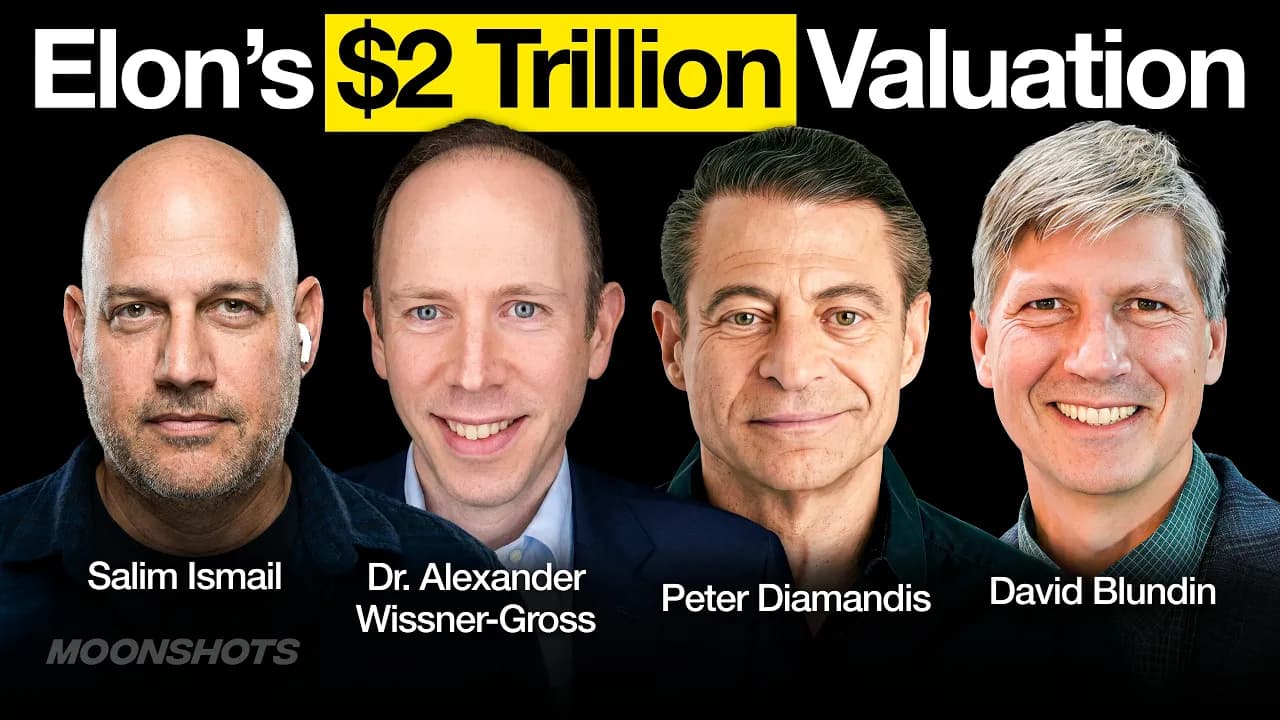
Anthropic begins trading under ticker ENT, with an $825 million share offering priced between $70-78. The deal shows 5x demand for shares. At the top range, the offering would raise $64 billion, valuing Anthropic at $1.4 trillion. Wall Street expects shares to reach $80. Third quarter revenues reached $17 billion (up from $1.4 billion year-over-year) with an annualized run rate of $81 billion as of October 31st.
Seven companies including Google, Nvidia, AMD, and Microsoft agreed to purchase $26 billion in non-voting shares. The seven co-founders pledged to donate 80% of their personal equity to philanthropy, creating significant capital flow to the philanthropic sector.
In San Francisco's 7-mile-wide city of 800,000 people, the AI boom has created thousands of fortunes over $10 million. At Anthropic's IPO midpoint, the average employee would own shares worth $72 million. OpenAI insider stakes average $126 million based on current valuations. Despite representing 0.1% of world population, San Francisco absorbs over a third of global venture capital.
The wealth concentration in San Francisco from AI companies dwarfs any previous wealth event in human history. SpaceX shareholders from early days also largely come from San Francisco despite the company's Texas relocation. Combined OpenAI and Anthropic wealth creates massive concentration that mathematically shifts the world's financial capital to SF.
The hosts dismiss concerns about paper wealth, noting the lock-up period is very short and this represents real trading wealth that will be fully liquid shortly after IPO. Unlike real estate, this liquid cash can be invested in new companies.
The discussion focuses on Anthropic's IPO at nearly $2 trillion valuation and the implications for retail investors. Alex expressed disappointment that it took until this valuation for retail investors to gain direct exposure, noting that individual investors previously only had indirect access through index funds via Google or financial institutions. He described the current IPO difficulty as a "travesty" that prevents frontier labs from going public earlier.
The company was formed in 2021, making it barely 5 years old at the time of IPO. While some participants acknowledged the need for maturity and stability before an IPO, others highlighted the unprecedented wealth creation, with intelligence becoming an asset class. The growth trajectory is described as "hypersonic" rather than merely exponential.
A question was raised about the standard 6-month holding period for employee shares post-IPO. Anthropic has an unusual schedule for employees taking vested shares and liquidating them compared to conventional IPOs. At the six-month mark, there is expected to be significant rotation, with many employees likely taking half off the table. However, demand remains high, and trading will likely occur at levels far from the IPO price.
The capital from these liquidity events will be reinvested back into AI startups and Series A rounds. This represents approximately 1.4 trillion in personal liquidity - equivalent to a decade of the entire venture capital industry's annual deployment.
A graphic was presented showing the decreasing time from founding to unicorn status: 21 years in 2000, 11 years in 2010, 4.5 years in 2020, and now just 1 year. This represents the fastest founder time ever seen. The venture capital industry has grown from $20-40 billion to over $150 billion, with AI creating unprecedented scale of reinvested capital.
Some companies are achieving unicorn valuations out of the gate based on founder reputation rather than business plans or projections. This is described as "spiky antic-causal or acausal unicorns" where SAFEs are being written to teams at unicorn valuations before companies even exist.
The team matters more than anything else when investing. A clear moonshot vision is the most important factor. Entrepreneurs are advised to go to San Francisco for idea generation and capital raising, but not for recruiting. The schools and ecosystems that are untapped include Carnegie Mellon, Georgia Tech, Villanova, and Northwestern.
Recruiting should happen away from major universities in San Francisco due to noticeable talent voids caused by vesting schedules at companies like Anthropic and OpenAI, where employees are locked into positions with 2+ years of remaining vesting. The average employee at Anthropic has $72 million in trapped value.
The question was posed about how many trillions of dollars of IPOs it will take before San Francisco looks like a city befitting the newly created wealth. Currently, Union Square has visible fentanyl fold issues, creating a "Blade Runner" juxtaposition between super intelligence development and visible street-level problems. The prediction is that it will take approximately 3 years for the city to modernize, with AI management tools eventually penetrating like Waymo did.
A series of system failures occurred over six days. Last Thursday, Microsoft Outlook and Exchange went down, with Decoder logging nearly 130,000 reports across 74 countries. On Friday afternoon, the FAA issued a nationwide ground stop for more than 4 hours - the longest in 25 years - affecting 12,462 flights and 3,500 planes. Transportation Secretary Shawn Duffy used this as a plea for his $50 billion air traffic control revitalization.
On Monday, three major US banks (Chase, Bank of America, Wells Fargo) experienced service disruptions due to software bugs, not cyber attacks. Also on Monday, a confirmed cyber attack occurred when attackers exploited a flaw in Optimizely's experimentation signup flow, injecting hostile JavaScript into 178 organizations including CNN, Zoom, HSBC, Equifax, Salesforce, and IKEA. The attack attempted to hijack crypto payments, skim cards, steal cookies and screenshots, and load iPhone exploits. Optimizely closed the vulnerability the same day.
The outages are attributed to aging hardware, aging software infrastructure, and the fact that AI has made vulnerabilities and exploits too cheap to meter. Linux kernel maintainer Linus Torvalds believes the peak of AI-discovered patches has passed. The asymmetry between cyber offense (now human out of the loop with agents attacking multiple vulnerabilities in parallel) and cyber defense (still human in the loop, patching one port at a time) creates a dangerous situation.
The concern extends beyond cyber attacks to vaporware, where AI-generated frontends can appear functional without underlying competence. Government agencies like the FAA might be sold "vibecoded" solutions that look impressive but lack substance.
Major cyber attacks are expected as part of a transition period until legacy C and C++ code is patched. The government will not move without voter pressure, making visible inconveniences like the FAA outage potentially beneficial for driving necessary change. However, there is concern about false flag operations where outages could be weaponized against AI progress rather than encouraging vulnerability patching.
The current period is described as a "great patching moment" or "great refactoring" where super intelligence will be used to fix vulnerabilities, analogous to curing the top 5,000 diseases. However, implementation across all embedded systems will take considerable time, with legacy code potentially persisting even in interstellar travel scenarios.
SpaceX achieved a major milestone on Saturday with Starship Flight 15. Ship 42 lifted off Friday evening from Pad 2 at Starbase, reached orbit, and deployed 26 Starlink V3 satellites. SpaceX confirmed contact with all satellites and reported they are functioning. After a 22.5-hour coast phase, the ship deorbited, re-entered the atmosphere, lit three Raptors on the landing flip, and was caught by the tower's Mechazilla arms.
The Super Heavy booster attempted the tower catch but diverted to an offshore landing in the Gulf. This marks the first successful catch of the Starship upper stage on the initial attempt, following the previous successful Super Heavy booster capture.
Elon Musk shared plans for Starship V4 on Sunday, describing a vehicle approximately 70 meters long—a 40% increase in length and 60% increase in propellant capacity. Engine count will increase to nine with three additional high-thrust Raptor vacuum engines.
The economics of fully reusable Starship operations represent a 1,000-fold reduction in launch costs. At mature reusable operations, propellant cost is estimated at $1-2 million per launch, implying total operating costs of $4-8 million per flight. This translates to $27-53 per kilogram to orbit.
The Space Shuttle operated at approximately $54,000 per kilogram. With propellant costs dropping to $500,000 per flight and payload capacity increasing to 200 tons, per-person ticket prices to orbit could drop below $1,000.
A historical chart posted by Steve Gerbbertson shows cost per kilogram declining from $51,000 with expendable systems to approximately $100 with Starship. The chart illustrates that ICBM-derived expendable launchers showed flat cost curves, while Falcon 1, Falcon 9, Falcon Heavy, and Starship demonstrate the dramatic cost reduction trajectory.
The Starship catch represents a fundamental shift analogous to the transition from circuit-switching to packet-switching in computer networks. Rather than monolithic named missions characteristic of the NASA era, future space operations will consist of hundreds or thousands of interchangeable, packetized flights that self-assemble in orbit, refuel on demand, and operate as a continuous transportation network.
The standardized shipping container analogy applies: just as containers enabled global trade through standardization and interchangeability, Starship flights will enable a "packet-switched solar system" where standardized payloads can be shipped throughout the solar system.
At mature operations, Starship achieves approximately $1 per pound to orbit. This represents the same cost as a first-class airline ticket for a 150-pound person, estimated at $2,000-$4,000 per person to reach orbit.
The Mechazilla tower catch strategy enables rapid turnaround: catching the vehicle, refueling it, remounting it on a booster, and launching again within hours. The precision required for this operation—landing a massive vehicle in a tiny target zone—demonstrates unprecedented feedback and control capabilities that will enable applications across multiple domains.
On November 15th at the PAC Silica founders retreat, the US and nine partner nations signed the San Francisco Declaration on the Secure Foundations of Enduring Prosperity. Signatories include the US, Australia, India, Israel, Japan, Republic of Korea, Qatar, Singapore, UAE, and UK. The declaration treats economic security as national security.
Five working groups were established covering policy, adoption, supply chain, safe harbor, and security.
The Commerce Bureau of Industry and Standards issued an interim final rule requiring licenses before selling or shipping advanced AI chips to Indonesia, Malaysia, Singapore, Thailand, and Brazil. These gateway countries previously enabled Chinese access to advanced chips. The policy targets companies including ByteDance and Alibaba.
The Trump administration is considering rules requiring US companies to disclose when they use Chinese AI models. Treasury Department and White House Office of Science and Technology Policy discussions include requiring website disclosures. Examples include Airbnb's use of Alibaba's Qwen model for customer service AI.
Chinese open-weight models including Kimi, Deepseek, and Qwen ranked among the three most-used models on OpenRouter in October. The concern is that US companies may become dependent on Chinese AI infrastructure.
The policy approach of restricting software access is considered ineffective because AI models can be rapidly retrained and cloned. A foundation model without weights can bootstrap new models at 1/10th the cost; with weights available, the cost drops to 1/100th. Hardware and data centers remain the only containable elements.
Photonic computing and other new computing substrates will shift the landscape within three years, making GPU-focused restrictions obsolete. The critical question becomes where regulation should focus on hardware rather than software.
The effectiveness of technical protectionism depends on the timeline to superintelligence. If a "max Q moment" of the singularity occurs within months or a year, short-term restrictions may provide strategic advantage. If the timeline extends years or decades, such policies function as counterproductive measures that spur alternative technology development in targeted nations.
SpaceX completed the Minihard portion of the Colossus 2 campus in Memphis in approximately five months. A new site called Gun Range south of the Tennessee-Mississippi line targets a four-month construction timeline. Comparable projects typically require 8-12 months.
Macrohard represents the largest existing hall on Colossus 2 with 700 megawatts of requested power. Minihard is the adjacent building with approximately 450 megawatts. Macrohard is planned as the next expansion phase.
Semi analysis reports that Colossus 1 retrofit put 150 megawatts online in 122 days while Colossus 2 retrofit put 210 megawatts online in 91 days. The rapid construction speed stems from Tesla's dense hardware culture and modular electrical and cooling gear that avoids vendor dependencies. Construction steps run in parallel, creating extraordinary build times. The 2.4 gigawatt figure represents Semi-analysis estimates, with the Salem 4-month green field data center representing a new tempo if achieved.
The speed creates an exponential learning advantage, with each cycle exposing teams to experiences others haven't reached. This represents the organizational singularity made tangible, where competitive advantage derives from organizational velocity rather than superior technologies. This capability extends to any hardware domain, fundamentally changing cycle times across industries.
One data center site is named Spam, located in the former Hormel warehouse where Spam products were manufactured. The conversation notes the irony of moving from a spam factory to a spam factory in the modern economy. Rob Fischer identified a potential site at an abandoned yogurt factory offering half a megawatt of power, which could accommodate approximately 500 GPUs.
AI represents the greatest management tool in the history of management. A team challenge involves having interns buy land, build a house, and sell it for profit with 50/50 gain splitting. AI provides straight answers about construction sequencing and concurrency that contractors typically reject. Video capture AI translates physical world actions into events and actions, enabling precise monitoring of worker activities.
Robots on building sites paint pillar locations from drawings with millimeter precision for cuts. When robots enter learning loops, AI tasks robots and receives feedback for optimization. Systemic compounding suggests 10x improvement is minimum rather than maximum potential.
OpenAI shut down their dedicated robotics model team because Astra GPT.x functions as a generalist model that passes driving benchmarks. The humanoid robot effort was also discontinued. Competition now focuses on which generalist models perform best at robotic manipulation tasks.
OpenAI released GPT 6.2 Soul and GPT 6.2 Astra, with Astra being the first release model to meet the high threshold for AI self-improvement. Altman stated these models can do amazing things and are very token efficient. A frontier lab is formally rating its own product as a meaningful accelerant for AI research.
Opus 5.5 and Fable 5.2 remain preferred models despite GPT 6.2 release. The 6.2 series displaced Gemini for Carbon as the top math model on applicable leaderboards. Progress appears in math capabilities, benchmarks OpenAI prioritizes, and Life Val performance on ARC AGI 3 challenge. However, some users report the model gets caught in doom loops during certain activities.
Opus 5.5 has held the top position for approximately a month and a half. Opus 5.5 costs about a quarter the price of Fable 5.2 and provides better balance for fast reactions and tight feedback loops. Fable 5.2 offers fast mode for twice the price but reaches insane price points.
AI deployment will soon require routing tasks across hundreds or thousands of concurrent agents. The question becomes whether half-price models with one notch lower performance represent good value. Current complexity resembles a zoo of options.
Palmer Luckey posted renders of a massive concrete block in open water with smoke stacks, towers, and gardens. The seasteading company called Slab has a thousand-year design life. The goal is to be cheaper than land and operate absent state and local laws for critical American industries including metal processing, medical research, desalination, oil refining, and chemical engineering.
The project received backing from Joe Lonsdale and reached a billion dollar valuation in 2017. No location, size, budget, builder, or date has been named. The project sits outside state and local rules but not automatically outside federal and maritime law.
The Seasteading Institute was founded in 2008 by Patrick Friedman and Wayne Gramlich with early backing from Peter Thiel. South Pacific plateaus with hundreds of feet of water depth allow pilings and platform stabilization. Construction could occur in large ports in South and Central America or the US, then float out to location.
Potential applications include launch ports and regulatory environments for longevity research facilities offering experimental treatments not yet allowed in the US.
Starlink provides high bandwidth connectivity to almost anywhere on Earth, solving the supply-side connection problem. Data centers facing terrestrial resistance could drive demand for ocean-born data centers as nuclei for ocean cities. These two factors address why ocean colonization becomes viable now compared to earlier attempts.
Palmer Luckey's post predates data center considerations, focusing on regulatory liberation rather than data centers as the driver.
The project trades an operating environment for industrial innovation as the product. The ocean's corrosive nature and navigation difficulties present challenges, though oil rigs have operated for decades. The UAE's World Islands faced erosion issues, but infinite ocean space offers abundance opportunities.
When agents work for weeks, customer service and customer operations shift first from supervising tasks to supervising outcomes due to measurable outcomes and bounded scope. Resolution rates, customer satisfaction, and retention measurements become primary metrics. The organizational redesign extends beyond customer service to coordination activities now handled by AI agents.
A pilot running for 3-4 months shows a process reduced from 20 days to 38 minutes. The organizational singularity enables coordination for extended periods through AI agents.
Education should focus on shaping mindset for how individuals see the world and process opportunities and threats. The second focus involves helping individuals find purpose in life, addressing Mark Twain's quote about the two important days: birth and discovering why. Education should teach top AI tool usage and entrepreneurship rather than job preparation.
Entrepreneurial schools using latest AI models enable students to find problems, build solutions, and become entrepreneurs. This gives kids agency to control their own future rather than depending on others for livelihood.
One AI can directly adjust another AI's weights while teaching robots new skills. A new MIT paper called weight space programming demonstrates adjusting parameters directly with neural nets, putting thoughts into another neural net's brain. Stepping stones include modular changes to attention sides or adding new expert modules.
Historically, AI required retraining from scratch each time, but training costs reaching $100 million make knowledge recycling valuable. Progress on this breakthrough will be incredible.
Moderna and OpenAI have maintained a partnership for three years, recently announcing its existence. Major frontier labs train on genomic, multiomic, and proteomic data. Evidence includes frontier models from Anthropic and OpenAI prompted with genome sequences, with perplexity measurements of extrapolations demonstrating training on real biological sequences.
The same mechanism used in copyright lawsuits against frontier labs for training on books applies to biological sequences. The broader progress extends beyond specific antiviral studies to fundamental biological sequence prediction capabilities.
The broader question of how AI is making real progress against viruses. While specific studies in the literature show point solutions for particular antivirals, the better answer lies in increasing civilizational capacity rather than narrow capability increases. This is likely to be the case for AI progress against viruses. Point solutions for particular viruses are possible, but the solve everything mentality of increasing civilizational capacity by training on all biology and all biological sequences, building those into generalist frontier models to the point where models speak biology and think biology, is where most of the net long-term progress against viruses will come from. In the short term, it's probably Moderna using ChatGPT tools to speedline all of their regulatory approvals and other paperwork.
There is an AI-discovered broad spectrum antiviral called MDL001 that looks strong in animal models. Moderna is very much focused on this area.
When local infrastructure lags Silicon Valley, the obvious answer is not to compete with Silicon Valley because you don't have the capital to build large foundational models and there is huge expertise with dedicated researchers to do this. Instead, focus on applications and local problems where India has a massive advantage. Help a small business operate using a voice-only agent in multiple Indian languages. India has 20 different major languages with different scripts for each language, creating a complete patchwork of different cultures more like Europe than the US. The opportunities to manage that complexity with AI are absolutely huge. Build a voice-first agent that would help businesses interface with different customers in different languages, creating unbelievable economic value. There are already huge opportunities in taking very specialized workflows, training with hands, and mapping. The money is usually made in the application layer, not the infrastructure layer or the model layer over time.
The question asks what happens to democracy if longevity breakthroughs led dictators to stay in power for centuries. This speaks to the Charlie Chaplin line from The Great Dictator where he states "And so long as men die, liberty will never perish." However, this concern will not stand the test of time. People as late as the early 1990s used to talk about software as immortal, but software itself is very much not immortal. Software has vulnerabilities and bugs and operates in a complex ecosystem. For software to survive, it has to be patched and continue to evolve. Similarly with humans, living for centuries is probably going to necessitate transforming oneself and reinventing oneself at every level of the stack. In the same way that if you wanted a piece of software to operate for decades successfully without falling over, that software is going to need to be patched beyond recognition. Dictators only stay in power so long as they're able to oppress their people, and AI is empowering the public such that people are becoming more powerful than ever before.
Startups could trade control of their businesses for access to a lab's most capable internal models. OpenAI already has a program for that. Sam Altman is great as an entrepreneur who's turned into a foundation lab CEO and gets it. This program is relatively new, but inevitably this has to be done by all the labs. Rather than saying everyone's going to lose their job, provide a roadmap of the future where everyone can contribute and here are the rules. This is exactly what this question is calling for. Anthropic should get its act together and do a program like this where they're not going to give their best models to someone who could use it for an evil nefarious purpose. An application program where you're vetted and let under the hood, and you don't have to give control of your company to them, you just have to share the equity upside. This is an inevitably great outcome from the foundation models and labs, but OpenAI is already there, Google is not as far as known, and Anthropic is not, but they should be.
Robotics can finally make recycling work at the scale our waste problem demands. It's not just robotics, it's exponential technologies. Robots should be cleaning up the beaches in Santa Monica, going along the 10 and the 405 freeway and picking up all the garbage. There was an X-Prize for this years ago that never made it. A waste management site filled with everybody's crap is resource refined elements and capabilities. A machine that goes into a dump, grinds everything up into a slurry, spits it out, then electron beam charges the particles as they come out and sorts it into organic matter, copper, silver, gold, plastics, and basically takes a waste dump and makes it a resource refinement facility. This is very capable in the future and some way for us to recycle the world that we are consuming and tossing out in our trash.
In California, everything is always three bins - compost, recycling, and trash - but when you look into the bins, everything is in every bin. The compost has plastic in it. It would be so easy to build an AI capability that sorts after the fact anyway. MIT has this capability where walk around the MIT campus, the three stream recycling bins have little cameras with AI attached to them that will offer you the option of looking with computer vision at whatever you have and recommending a stream. Or catching you if you put organic matter into the recycle bin. If you make it social stigma, that's no fun. Just sort it after the fact. The microplastics issue is a major crisis, with seven grams of plastic in your brain, a credit card worth in the average human brain.
Mr. Duckets 5818 says "Need AI to tell me why I'm so addicted to this show." B Greer 4752 says "I always feel fired up after an episode." Chris says "I want Peter to live longer. He can steer human agency in space." There is an upcoming episode with David Sinclair on the future of longevity.
Please send outro videos to [email protected].
"What mission gets defined? The universe conspires when your purpose is aligned. When you're moonshot minded, your purpose is alive. You can't change what you don't see. Can't become what you won't believe. Which is why we're here to say the future starts today. Keep your mind on the moment and your moonshot in your mind. When you figure out your gift, let go and let it shine. So why not take the shot? Put yourself on the spot. Want to be a moon? Then you got to be moonshot minded. In due time it all comes to pass. Nothing here on earth will forever come to last. So what legacy will you craft? What impossibility will you make your unique ability? This is bigger than disruption, bigger than the next. This is human evolution. This is how far we can go. When we aim beyond the ceiling, beyond what's been done before, every moonshot that we're taking opens up another door. For the kid who's watching somewhere, thinking dreams are just pretend, with a proof that crazy ideas are just where breakthroughs begin. Keep your mind on the moment and your moonshot burning bright. When you harness your gift, you become the speed of light. So go and take that shot. Put in everything you got. Cause if you want to change the world, maybe you got to be mooned. We are mooned. We are moonshot minded. From this moment forward, you're not the moon. What are you waiting for? The impossible is possible when."
Looking forward to getting out of the hotel room bubble. When you have internet on a flight with AI, you can start doing all sorts of stuff over time. Planning to watch episodes of For All Mankind and Rings of Power season 3 dropped. The next episode is going to be with Steve Jurvetson, which will be a fun one. Planning to bring up the parallel universe question and talk about whether intellectual property is still a thing and whether you should file patents. He said no last time about 10 years ago. Let's see what he believes today.
Keep Peter H. Diamandis in your library
Save the videos and channels worth coming back to, and find them again in one place.