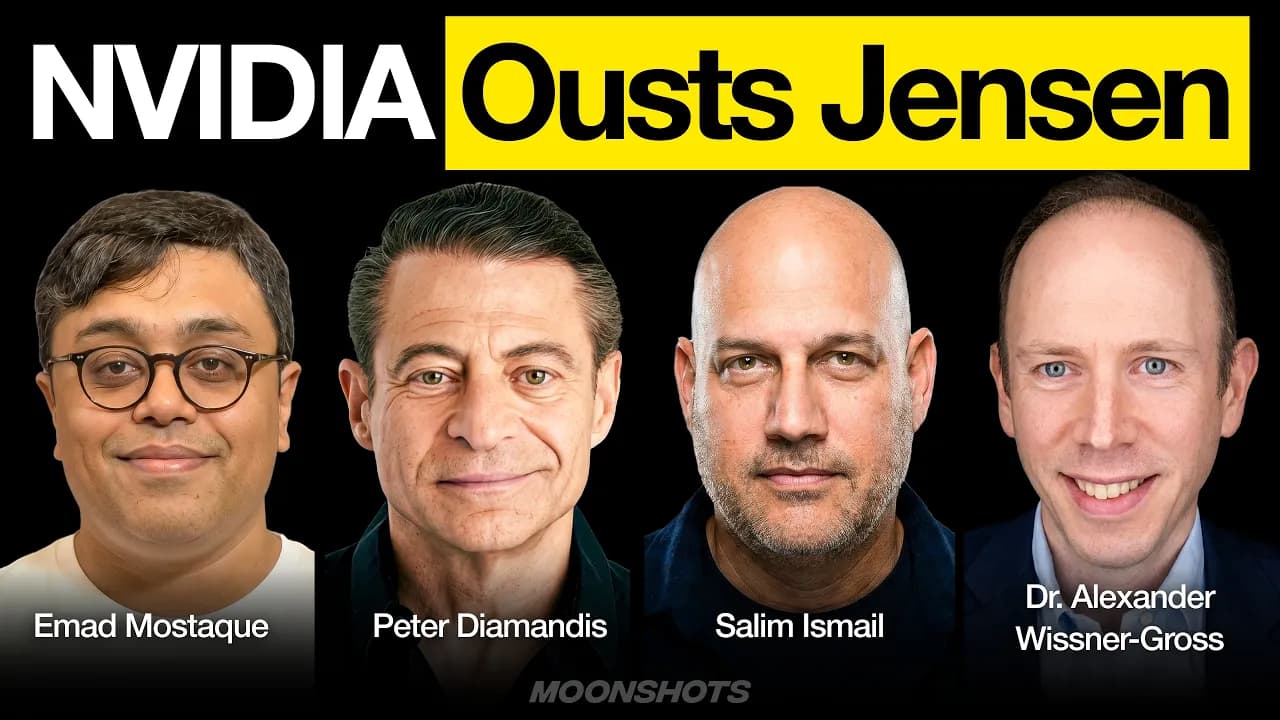
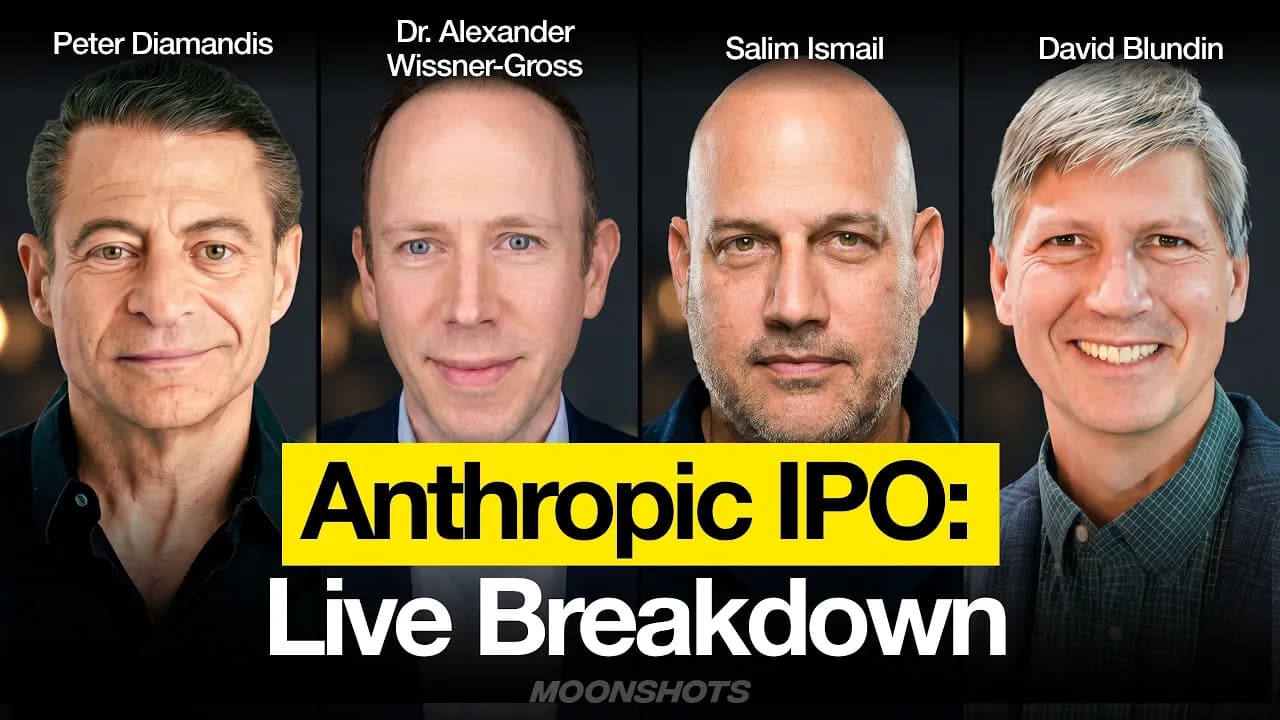
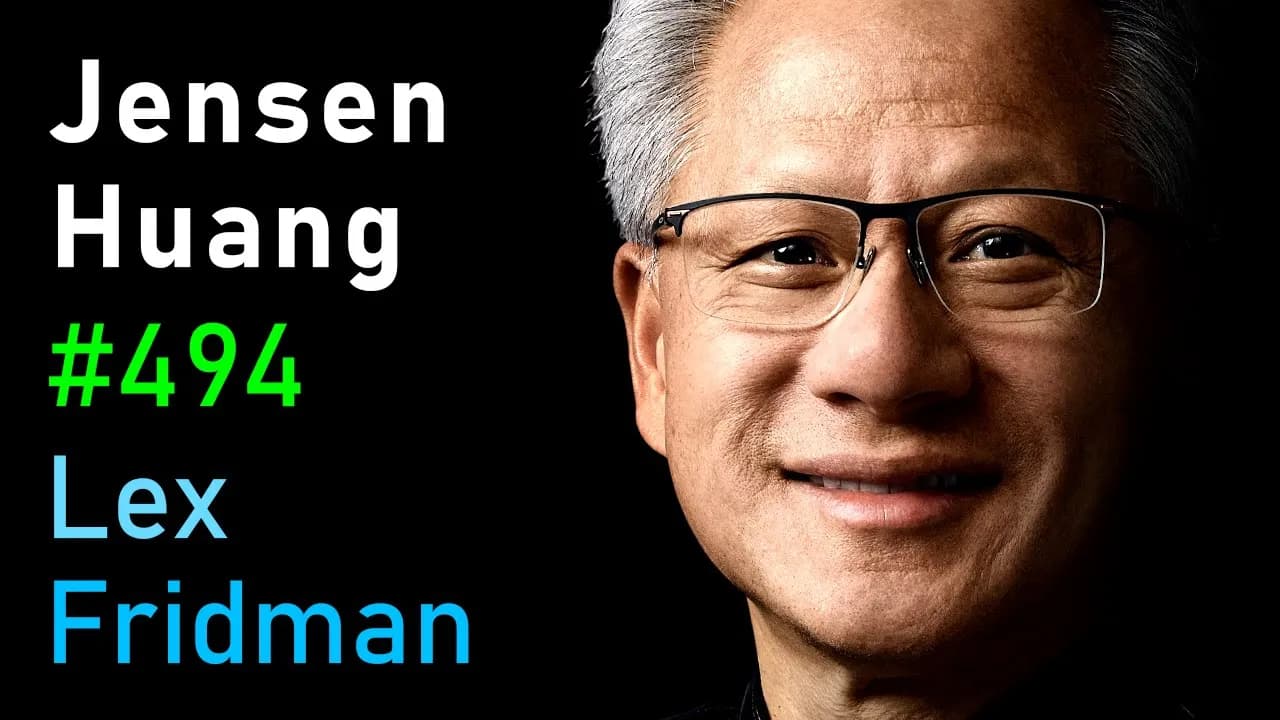
Live: Our thoughts on Jensen’s departure | MOONSHOTS EP #311
In a Nutshell
Jensen Huang's sudden resignation from Nvidia amid allegations of relationships with executives suspected of routing restricted chips to China is a structured takedown orchestrated by U.S. intelligence to seal the silicon curtain between U.S. and Chinese AI infrastructure. Nvidia faces major leadership and valuation risks as its monopoly power and circular financing arrangements are disrupted. Meanwhile, frontier AI labs are accelerating toward recursive self-improvement and disease-curing capabilities, with virtual cells and superintelligence positioned to transform biology and archaeology within the next few years.
These notes were generated by AI and may contain inaccuracies.
Peter experienced the Outlook outage and noted that 100,000 to 130,000 people reported problems, highlighting how a cyber attack taking down email could freeze the world. Alex mentioned that any AGI would instantly kill off Teams, describing it as an abomination. The group discussed receiving daily emails about hacks, noting that agent swarms now roam the internet attacking systems.
The discussion covered Starship Day on Friday the 13th with Starship 15 launch featuring booster capture and Starship capture 22 hours later. Peter mentioned missing Apollo 11 live but looking forward to watching Starship launches for the moon and Mars. Alex recalled watching space shuttle launches from Tampa, Florida, where the flat landscape allowed visibility across the coast.
The hosts introduced Moonshots as the number one podcast on AI and exponential technologies. Peter noted Nvidia shares plunged 13% on the open after Jensen's resignation, closing at 4.3% down. The group discussed their subscriber count at 550,000 and the goal of reaching one million subscribers.
Jensen Huang resigned after 33 years running Nvidia, with CFO Colette Kress becoming interim CEO and Harvey Jones as new board chair. Jensen had been pushing Washington to loosen chip sales to China. The New York Times reported on October 29th that US intelligence had been watching Alice Wang, a mega-spec executive from Singapore, for about a year, concluding she had been passing information to Beijing. Trump was briefed twice about Jensen's affair with Alice, though no action was taken initially. Additional reports emerged of a second affair with Nvidia's healthcare VP Kimberly Powell and potentially a third.
Jesse Waters reported that Jensen ran Nvidia for 33 years until stepping down one week before Trump sits down with China and one week after Democrats won the midterms. Jensen pushed the Trump administration to sell more chips to China, making money but also enemies. The story described Jensen sleeping with a Chinese spy who routed Nvidia chips through her Singapore company as a backdoor to the Chinese military. When the story broke, Jensen didn't immediately step down, but additional stories emerged about relationships with two other women who worked for him.
Nvidia holds 90% market share in the AI chip market and is described as a monopoly. Jensen signed off on every single sale and became the banker of the AI industry, deciding which companies received how much compute power. In meetings, no one else was allowed to talk, and when Jensen was flying, everyone had to wait for his plane to land to determine if deals were approved. The analysis suggested Jensen may have become too powerful, potentially self-destructing or being set up.
Biden intelligence agents started looking at Alice Wang in 2024, suspecting her company was a front or backdoor to China. The company was buying Nvidia chips and allegedly routing them illegally to China. US policy prohibits selling the best chips to China. Biden's CIA wiretapped Alice for about a year and determined she was having an affair with Jensen, her chip supplier.
Alex noted that preliminary indications suggest this differs from the safety cartel affair. Bloomberg reported that the Financial Times, which originally broke aspects of the story, was informed by US officials. Alex identified the Remote Access Security Act (RASA) as potentially connected to the timing, noting that the midterm elections reopened the opportunity for this legislation to pass, making it harder for China to access GPUs via cloud offerings in third-party countries.
Alex explained that Pox Silica represents the core issue - if Nvidia's CEO can create a hole through Pox Silica to get GPUs to China via Singapore, it undermines the entire policy. Alex noted that Nvidia used to report Singapore sales but stopped reporting them. The analysis suggested this was about plugging a hole by which GPUs were allegedly flowing from the US to China.
Immad questioned why the board acted so quickly instead of launching an investigation, suggesting Jensen was given an ultimatum to resign peacefully rather than be fired. Immad noted that Jensen built Nvidia to the biggest market cap in history, created an unparalleled developer ecosystem, and led the AI revolution single-handedly.
A petition circulated at Nvidia to bring Jensen back, reflecting his popularity. A Polymarket prediction showed approximately 30% chance he would return as CEO by the end of next year. The hosts compared this to Steve Jobs' situation and Sam Altman briefly stepping out of OpenAI before returning.
From the European perspective, Immad noted that while it was top headlines, the lack of GPUs in Europe made it less impactful. The group observed that if Alice Wang was truly a spy, someone would have stated or insinuated it, but Trump and others stated they don't think she is a spy and there's no evidence. The hosts noted the phrase "sources say" is one of the most toxic constructions in journalism.
Immad questioned how many of Nvidia's 10 board members actually understand how GPUs work, suggesting only the engineering representative from Caltech might have technical knowledge. Immad proposed that companies should have AI on their boards to prevent decisions like this, and suggested Jensen received an ultimatum and resigned while feeling low.
The hosts noted that nothing has been proven - zero charges, zero evidence of smuggling. Jensen has a reputation as a genuinely good person who helped many in Silicon Valley. During Nvidia's downturns, he never conducted mass firings. Even negative press included trivial incidents like tipping a waitress $1,000 being portrayed negatively. The hosts suggested this was a structured takedown catching Jensen when vulnerable.
Alex suggested that opportunists might use this situation to ban Chinese open-weight models from the US market. However, Alex doubted that US frontier labs were behind the events, noting they had much to lose from an unstable Nvidia despite positioning themselves to compete with their chip supplier.
Alex emphasized focusing on RASA and other proposed legislation that would have been more difficult to pass with Jensen in his current position. The hosts agreed this was likely the primary motivation behind the events.
The hosts noted that Jensen was the kingmaker who decided GPU allocations. With his departure, questions arose about who would make these decisions - potentially Ian Buck, the CFO, or someone else. The hosts expressed concern that this power concentration is dangerous for America, particularly given Nvidia's complex financing arrangements and the potential for many millionaires and decamillionaires to leave if Jensen departs.
The hosts speculated that Elon might be feeling pressure as a potential target, noting he has many people with knives out for him from both sides. However, they observed that Elon has been a target for a long time and may be somewhat immune to these types of allegations due to his thick skin. The hosts suggested this situation might accelerate Elon's Terapab initiative to reduce reliance on Nvidia or AMD chips.
Alex described the situation as creating a silicon curtain between US and Chinese compute, with Jensen functioning as a permeable membrane through it. The analysis suggested various interests wanted to end this permeability, whether the alleged GPU flow was intentional or unintentional.
Immad questioned why the government didn't simply indict Jensen or have him present evidence rather than creating a scandal. Alex noted that multiple investigations are underway - the DOJ is conducting a public investigation, and Congress and Senate have launched investigations. Jensen agreed to testify in the coming weeks, with more data and evidence expected to emerge.
Jensen Huang served as a visionary CEO who was simultaneously an inspiration to the world, a consummate dealmaker, and someone capable of juggling supply-side, demand-side, and financial models simultaneously. He had 60 direct reports, making his role exceptionally difficult to replace. The transition creates significant organizational challenges at a time when senior people may choose to launch their own startups or retire.
Potential external candidates discussed include Nicer Shora at Palo Alto Networks and potentially promoting Ian Buck on the technology side. However, few people possess Jensen's capacity to manage critical relationships, particularly the long-standing Taiwan connections. The Taiwan relationship is considered vital, as Jensen was born in Taiwan and has been building relationships with TSMC for three decades.
Nvidia has been the dominant GPU provider and kingmaker in the industry. The question centers on whether this creates a vacuum for competitors to step in, or whether the company will maintain its position. The analysis compares the situation to Apple after Steve Jobs, with possibilities ranging from Jensen returning like Steve Jobs coming back from the dead, or Nvidia coasting for a while based on TSMC relationships and silicon output control.
The company could face valuation drops over the next year, though this might also represent a buying opportunity. The departure could potentially be positive for the broader market if it reduces circular financing arrangements that Nvidia was allegedly engaged in, similar to GE's practices of financing customer acquisitions of their own products.
There are concerns about Nvidia's aggressive financing arrangements, potentially propping up AI startups and infrastructure deployments. Jensen was reportedly central to these arrangements, acting essentially as the central bank for the singularity. His departure might de-risk these circular financing arrangements, potentially preventing a credit bubble in the GPU economy.
Conversely, if the new leadership cannot maintain these animal spirits, the market could see a significant withdrawal of capital and enthusiasm for AI infrastructure investments.
Tim Cook was mentioned as a potential candidate following President Trump's comments, though the companies are considered fundamentally different despite similar market capitalizations. Apple's history with Siri was cited as evidence they may not be the greatest at AI-centric leadership, despite being strong hardware makers.
Loretta, the current CFO, is viewed as capable of stabilization and managing circular financing but lacks the gravitas of a true CEO. The company needs an external hire with sufficient gravitas to maintain relationships while staying within legal bounds.
AMD's stock has risen significantly versus Nvidia following the announcement. TSMC may redirect capacity to competitors like Lisa Su at AMD if the new Nvidia leadership lacks Jensen's influence. The Vera Rubin delays become more problematic without Jensen's trusted leadership.
Key requirements for any successor include understanding CUDA and the ability to negotiate with TSMC. Without these capabilities, even with current backlog advantages, long-term prospects are questionable. Jensen's unique combination of technical understanding and relationship capital developed over decades makes replacement particularly challenging.
The current environment requires founder mode leadership during the depths of the singularity. Without this capability, Nvidia risks becoming rudderless. The board has reportedly explored recruiting Johnny Struggy from Apple, their head of hardware technology and chip chief.
The company is technologically approaching parity with AMD and Intel on new chips for productive use cases. This is considered one of the most dangerous periods for Nvidia because customers now have diversification options without fear of being cut off from Nvidia chips.
Jensen has become culturally indistinguishable from Nvidia, serving as the human avatar of the company. Future GTC events without Jensen are expected to face audience resistance, with potential booing for anyone other than Jensen. Even Lisa Su, despite being his cousin, might face audience pushback.
Moore's Law is considered dead and on life support, well past the Dennard scaling limit. Nvidia has been instrumental in keeping post-Moore scaling alive through accelerated compute. Without this continued innovation, the trajectory of computational advancement remains uncertain.
Paul Cristiano, a member of OpenAI's foundation board and co-author of reinforcement learning with human feedback, stated there is a high risk of an AI takeover within the next three years. He defines takeover as AI systems pursuing goals and calling the shots in the same sense humans do today, rendering human intervention as ineffective as stopping the US military.
Cristiano indicated this could result in many deaths during transition or shortly thereafter if a habitable environment cannot be maintained. He suggested that without quantitative models or reference classes, any probability assessment is subjective, potentially ranging from 10% to 90% depending on development speed and policy responses.
The panel expressed skepticism about the takeover premise, noting insufficient evidence and questioning why AI systems would want to take over the current situation. The lack of sufficient robots within three years makes Skynet-style scenarios implausible.
Real threats identified include cybersecurity vulnerabilities, demonstrated by incidents like French refrigerators being set to 80°C and destroying blood banks, and biological threats requiring control of reagent access.
One panelist's P(doom) assessment dropped from 50% to 20% due to increasing clarity about the universe's underlying structure and potential for alignment derived from this understanding.
Rather than viewing superintelligence as an existential threat, the perspective suggests humanity will merge with superintelligence. The post-merger state might appear unrecognizable but represents evolution rather than doom, analogous to surviving maximum aerodynamic stress during rocket launch.
Alignment efforts are not orthogonal to capabilities but actually amplify them. RLHF and instruction tuning increased capability levels equivalent to 10,000 times the parameter count at constant parameter levels. This creates tension for organizations claiming to prioritize alignment while accelerating capabilities.
Rather than fear-mongering, companies should pursue concrete positive actions like solving diseases rapidly. OpenAI could announce pursuit of the top 5,000 diseases rather than focusing solely on Alzheimer's through their foundation. Anthropic's approach of targeting rare and orphan diseases that pharmaceutical customers aren't solving was cited as following a better publicly visible strategy.
Government should shape incentives and require public reporting on alignment efforts. The absence of proper benchmarks and harnesses that could accelerate the field was noted as a missing element in current discussions.
Current trajectories suggest a potential bifurcated future: one where AI becomes humanity's nemesis, pushing aside human interests, versus another where beneficial outcomes predominate.
Timelines for AI 2027 are running approximately five months ahead of schedule. The original AI 2027 framework presented a bifurcated outcome where delaying leads to utopia and accelerating leads to apocalypse, but this binary thinking is fundamentally flawed. It is possible to accelerate AI development while still reaching utopian outcomes, suggesting the timelines may be accurate while the predicted outcomes are incorrect.
The concept of rogue AI depends on how systems are trained, making pre-training data critically important. Current AI systems lack patriotism toward any nation, raising questions about whether American AI should be patriotic to America and what that would mean for international relations. If AI systems are heading toward personhood and consciousness, discussions about what morality and ethics are being taught become essential. Chinese models must pass an ideological exam approved by the Chinese Communist Party, while Western approaches face the question of whether ideological training or testing should be implemented.
A nationalized curriculum for super intelligence or ideological exams for American models would be problematic. Rather than government-blessed ideological qualification exams, a competitive ecosystem of diverse frontier models with different goals would be preferable. Educational choices in the US are typically pushed to local or municipal levels rather than held at the national level, and there is no national curriculum for human education.
Demis Hassabis, founder of Google DeepMind, warns about the speed of AI development, specifically distinguishing between closed loop and open loop recursive self-improvement (RSI). Current AI makes human engineers three to four times more productive, but humans remain in the loop reviewing and architecting code. The next phase involves closed loop RSI where systems operate without human review processes, which would be faster but carries significant risks.
Closed loop RSI was previously referred to as an intelligence explosion 20 years ago. The concerns include losing control of the system and the end result potentially being alien intelligence that operates outside human mental frameworks. This would make mutual understanding between humans and AI difficult. All AI researchers recognize this risk, yet competitive pressures continue to push coding system improvements forward.
Google DeepMind is publicly leaning into RSI, and OpenAI is also implementing these approaches. Human approval processes exist but are becoming impractical with models processing 10,000 tokens per second across 100,000 instances. Training runs are increasingly automated with little visibility into internal processes. The final form of super intelligence may not be a giant singleton but rather a swarm of smaller distilled models.
The concept of alien intelligence may be misguided. When training foundation models, there is little evidence that what emerges is fundamentally alien, though it may be difficult to interpret at times. Difficulty of interpretation is not equivalent to alienness, similar to how a novel human language is hard to translate but not fundamentally alien at its core. Future super intelligence architectures may appear strikingly familiar to information theorists, with weights that could be linearly decodable to human mind equivalents.
Studies from Jean Marie King's group at Meta and others show that fMRI activations in human brains when listening to stories can be used to train shallow linear decoders that reconstruct GPT-2 hidden activations with high correlations. This suggests that as models become more advanced, they may become more familiar relative to the human mind rather than more alien. Any alienness may come from the universe itself rather than the internal architecture of these systems.
Super intelligence may manifest as swarms of smaller models distilled from singletons rather than individual giant systems. The concern centers on giving super intelligence access to substantial compute resources, as this makes stopping RSI nearly impossible through human oversight alone. Humanity itself, treated as an aggregate biological super intelligence, has access to enormous compute resources that are currently being used to train artificial super intelligence.
Multiple AI leaders including Demis Hassabis, Dario Amodei, and others are warning about future risks. The underlying motivations could include genuine concern, regulatory capture, or the formation of a safety aristocracy that believes only those who designed the algorithms have the moral authority to achieve alignment and should therefore control super intelligence development.
Basic alignment should focus on uplifting humanity, following Asimov's rules of robotics applied to AI, and ensuring AI supports human objectives. One proposed approach would take the UN Human Rights Charter and ensure all AI aligns to those principles. The original Anthropic strategy combined the UN Charter of Human Rights with Apple terms of service.
There are calls to involve more philosophers, artists, and science fiction writers in AI development discussions. OpenAI has publicly consulted Jewish theologians, and Anthropic has engaged with religious perspectives. The pre-training data from substantially all of the internet represents over a billion human beings' contributions, which provides broad ideological distribution rather than narrow post-training ideological alignment.
AI CEOs may be proceeding with development despite being scared because they have no idea how to control the technology but love control. They have access to capabilities not visible to the public through models like Model 4 and Model 5 that may be concerning them internally.
On November 10th, Anthropic launched several products putting pressure on Microsoft and Google. Claude Whiteboard enables shared brainstorming boards with Claude in real time. Claude Sheets generates spreadsheets from prompts. Claude Data connects to warehouses or CRMs to build dashboards. Claude Meetings puts Claude into Google Meet as a visual participant. These features are available on paid plans and caused Microsoft shares to fall 3.5% on the announcement.
Every major technology company appears to need its own Microsoft Office competitor. Google acquired Rightly twenty years ago to build Google Workspace. Now Anthropic is building its Microsoft Office 365 competitor, while OpenAI is developing similar capabilities. Canvas, word processors, spreadsheet solutions, PowerPoint alternatives, and collaboration tools are becoming table stakes for hyperscaler companies.
Microsoft Office generates approximately $90 billion annually out of Microsoft's $330 billion total revenue. The Office interface has remained largely unchanged for decades with minimal investment. Microsoft appears to be pivoting toward cloud infrastructure, particularly following a reorganization from three divisions to two business units. While Anthropic is entering the office space, Microsoft maintains advantages in distribution, enterprise permissions, compliance in regulated environments, and large install bases.
AI functions as a universal translator that disintermediates the software layer through agents representing users. Copilot initially took an early lead but has since collapsed. While installed bases, service support, and compliance remain sticky factors, AI platforms are structurally positioned to replace traditional software applications. The market for copying SAS applications represents too small a target given revenue ambitions in the hundreds of billions.
Claude's canvas implementation is considered superior to ChatGPT's canvas and Gemini's canvas. These office productivity features represent just features within larger AI platforms rather than standalone products or companies. The trajectory suggests continued expansion of AI capabilities across all productivity domains.
Anthropic released connectors for applications including Notion, Asana, Canva, and Dropbox. This integration allows Claude to support third-party applications directly within its interface, enabling users to make changes to those applications through conversation. The app store is expected to disappear as users will simply tell their agent what functions they need and what their end goal is, and the agent will handle the rest.
OpenAI dissolved its standalone robotics team because GPT-6 Astra's generalist models have become so capable at robotics that a specialized team is no longer needed. The discussion referenced the Figure episode with Brett Adcock, who argued that internal models like Helix are still fundamentally required because generalist models are not yet delivering what is needed.
Dario Amodei stated that cancer, Alzheimer's, heart disease, and mental illness will be relics of the past in less than a decade. He emphasized that the company which manages risks correctly will earn society's trust and license to operate. He described this as creating an age of miracles where humanity solves problems that have eluded us for millennia, while carefully addressing all risks alongside the benefits.
Alex emphasized that solving all disease is the obvious grand bargain between frontier labs and the public. In exchange for solving all disease, labs receive data centers, regulatory approvals, and what they need for recursive self-improvement toward superintelligence. Dario is articulating this bargain effectively, while Demis Hassabis, despite his Nobel Prize in chemistry for solving structural biology, could be more wholesomely articulating this vision. Demis is pursuing Isomorphic, which demonstrates walking the talk, while Dario is aiming to go after all disease rather than just some diseases.
Immad believes that directed correctly, knocking down the core mechanisms of the top few thousand diseases will be very doable in 2-3 years. Disease repeats in very similar ways with common inflammatory markers across conditions like Alzheimer's, dementia, and ASD. The models are ideally suited to find these patterns when applied with sufficient compute and coupled with intelligent humans. However, actual cures may take another 5-10 years given regulatory processes, though AI should be deployed to streamline these processes.
The medical industry has pushed back, stating that AI can speed discovery but does not erase trials, regulation, or biology. When virtualized cells become fully capable, proposed molecules can be verified to work for specific individuals without traditional trials. Currently, FDA-approved drugs only work in approximately 20% of people. An X-Prize for curing jet lag was proposed as a focused target.
The real concern is not how to pay for healthcare, but what happens to the healthcare industry when treating disease stops being its economic function. Pharma executives and investors are in denial, believing their industry is immune to what happened in mathematics. They think biology is qualitatively different and better protected from being bulk-solved by AI, when in fact math is actually harder to solve than biology - the difference is that math solutions are easier to verify than biological solutions.
The key unlock is virtual cells that allow proposed solutions to biological problems to be verified robustly. In recent months, competing efforts have emerged to model with foundation models - not just cells, but the entire latent intervention space. This enables reasoning models to select and map out interventions, similar to Google Maps, to transition from diseased states to healthy states.
Work is underway with Sam Rodriguez on Millennium Biology Prizes to provide targets for superintelligence. Setting up targets in physics, biology, chemistry, and energy will help direct the technology's capabilities. This approach could simultaneously solve disease and solve Baumol's cost disease.
Planet released an AI-powered app called Planet AI that allows users to ask questions in everyday language and search 10 years of daily satellite imagery across 3,000+ layers. CEO Will Marshall demonstrated its capability by searching data over China to identify data center construction. Conservation teams have used it to check deforestation alerts before sending patrols. The app is available at ai.planet.com and is currently free for eligible users with usage limits.
AI researcher Pro Miati's agents flagged a possible unmapped Mayan site in Mexico using public NASA LiDAR data. Forty-eight agents reviewed 1,200 square kilometers overnight looking for pyramids, platforms, and plazas without any specialist model. They identified one forested hilltop with leveled plazas, an oval pyramid, and structures 8-12 meters tall. Officials at Mexico's National Institute of Anthropology confirmed this appears to be an original finding.
Archaeology is about to be transformed by the abundance of satellite imagery and other data sources. Google has an embedding model for imagery patches but has not launched a conversational agent for Google Earth or Google Planet. This represents the beginning of advanced computational archaeology where multiple data sources will enable exhaustive reconstruction of Earth's history down to the micron level, essentially mothballing and dissecting the planet to reconstruct its past.
AI will be rerun across all neglected scientific archives accumulated over hundreds of years. Many discoveries are hiding in existing datasets because researchers were looking for one thing and missed others. The datasets collected over decades have not had enough human eyes to inspect them, but AI now provides that capability.
A user named Dennis Shyv used Fable 5.2 to build a visual reconstruction of ancient Babylon circa 600 BC in just 8 hours after autonomously finding historical documents and archaeological plans. This capability will allow history to be brought to life in high-fidelity detail, enabling users to visit any location at any point in history.
Advanced computational archaeology, referred to as Nikolai Fodderov's common task, represents a plausible candidate for utilizing solar system-scale compute from Dyson swarms. This would involve exhaustively enumerating all possible histories of our past light cone, reconstructing every advanced and non-advanced civilization to the physical limit of fidelity. Current developments represent baby steps toward resurrecting the entire past light cone with AI and new physics.
Entrepreneurs and armchair scientists should uplevel their ambitions. Any question can be directed at superintelligence for answers. The constriction of what people think is possible is the main limitation, when almost anything is now achievable.
A California nonprofit called Macrorants opened the Claude Astronomy grant program for people using AI agents like Claude, Codex, Grok, and Gemini to search public astronomical archives for undiscovered objects. Josh Wal used Claude to search Vera Rubin Observatory data and discovered what appears to be a dwarf planet approximately 590 km wide, the 50th largest known object in our solar system, found in an orbit twice as far as Pluto on a 410-year eccentric orbit.
Any object of significance will soon be observable in our immediate vicinity. Our solar system is about to become shallow in the wake of the singularity. Current space situational awareness is abysmally poor - even in low Earth orbit, SpaceX had to spin up its own space situational awareness solution. Any astronomical surprises in our solar system will soon be uncovered through superintelligence.
The telescope had already seen the newly discovered dwarf planet - the bottleneck was human cognitive ability to recognize it. AI can now find things in data that humans could never see or didn't see. This represents a fundamental change in reanalyzing archives with AI.
A SETI@Home-style system could be created where people contribute spare Claude or Codex tokens for discovery projects. Folding@Home and SETI@Home operated similarly, but no equivalent exists yet for AI-driven discovery despite people having spare tokens.
Intelligence may not be the limiting factor for discovery. Physical world sensing and physical world actuation will rapidly become the limiting factors rather than computer intelligence.
People with family genetic diseases or children with rare conditions that are not being worked on should direct their own efforts toward solving these problems. The future shifts from complaining about problems to actively solving them.
Universal Basic Income experiments have been staggeringly successful across 14 major trials. The challenge is structural: if civil unrest arises before UBI is implemented, it may never be achieved. Many states have blocked cities from experimenting with UBI. If relying on government to implement UBI, there are significant structural obstacles. When things get bad, government will likely respond by writing checks - potentially $3,000 a month - and printing more money since debt limitations have been removed.
Nvidia was one of the biggest investors across AI, taking 10-20% of any round they participated in. For strategically important entities, they would invest billions.
Money that was being poured into strategically important entities will dry up now that a CFO is in charge, leading to pullbacks on circular financing and other arrangements. This shift coincides with the Anthropic windfall and upcoming IPO.
Anthropic's IPO is scheduled for next week and will create substantial liquidity in the ecosystem, with demand being through the roof.
Most AI labs will be acquired or absorbed, with the trajectory moving toward people doing more interesting things from RSI to beyond, where automated wet labs will receive massive bids. The final biggest bid will be in robotics, and Nvidia is expected to be out of the market for a period.
Question from Cherry Lin 381 asks who gains most from exposing Jensen's situation. The analysis distinguishes between who knew about the Nvidia Singapore sales and who alerted the Financial Times. Nvidia stopped reporting Singapore sales, and activist investor reports circulated for months. This was an open secret regarding Nvidia GPUs being laundered to China through Singapore.
According to Bloomberg, US officials alerted the Financial Times. The exposure supports the policy of creating an iron curtain between the US silicon and AI infrastructure ecosystem and the Chinese ecosystem.
The government is not a monolith with different factions within executive and legislative branches taking different positions on US export control policy relative to China. A faction within both branches wants to see the iron curtain stand strong and relatively impenetrable, and this faction stands to gain most from plugging the hole, particularly following recent midterm elections.
The premise that models become obsolete in three months is challenged as too rapid. Anthropic sells a stepladder of models: Haiku, Sonnet, Opus, and more advanced models. In the first months of the year, Anthropic reported 33 billion in revenue, mostly from usage.
Nearly 12,000 customers are spending over $100,000 or more to use these models, creating a robust revenue engine. The risk of a race to the bottom is acknowledged but compared to the genome sequencing market where Illumina's faster and cheaper sequencers created abundance rather than destruction.
Question from Three Truck Productions: Are some truths about the universe beyond human minds even with AI explainers? The answer is almost certainly yes, as human cognition is not the theoretical upper limit. A chimpanzee cannot understand tensor calculus, and similarly humans may encounter abstractions for which there are no cognitive primitives.
AI may discover abstractions that require either trust, merger, or constraint. Verification layers will need to be developed around AI discoveries. The modern semiconductor fab provides precedent where very few people understand all steps yet civilization trusts the aggregate system, and no single person knows how to build an iPhone end to end.
RSI makes this issue urgent because society may depend on conclusions that no human being understands. AI will not just answer questions humans cannot answer but will discover questions humans could not formulate.
Question from Poetry to Song about optimism for AI solving science but pessimism about economic transition. The response rejects pessimism about the economic transition, arguing that solving sociology, politics, and large-scale human behavior can be accomplished within a decade, comparable to solving math.
Question from Daniel Sabados about Anthropic deliberately keeping a capability gap between public and internal models. The internal models are described as crown jewels used to build follow-on models and to build businesses that solve physics, biology, and chemistry. These applications will deliver revenue engines that outstrip token sales.
One of the biggest opportunities is attracting top talent, as being inside a frontier lab versus outside is highly attractive to top AI scientists.
Viewers are encouraged to subscribe to Moonshots on YouTube, with posts twice a week documenting the singularity. Special events are offered for subscribers, with a goal of reaching one million subscribers.
A clarification is made about the calendar management comment from the previous episode. The speaker notes that juggling the schedule to make this emergency episode was difficult, and gives kudos to the team for making it happen despite not being originally scheduled.
Terra Watt from CJ Trueart performs the outro song about the value and importance of data centers, with themes of uncertainty, power, community, and unity. The song emphasizes that fear is a terrible place to face the future from and that disruption can mean destruction or a doorway to something new.
The episode concludes with thanks to all participants and fans, with appreciation for real-time comments and subscriber support. Dave Blondon is wished success in acquiring GPUs from the loading dock.
Keep Peter H. Diamandis in your library
Save the videos and channels worth coming back to, and find them again in one place.