Prime Days: Best Smartwatch and Health Tracker Deals in 2026!
In a Nutshell
Rob recommends the Fitbit Air ($99) and Amazfit Helio Strap ($9) as the top budget devices, delivering excellent heart rate tracking (especially on the biceps) and strong sleep stage accuracy with fully free apps. The Pixel Watch 3 leads budget wrist-based HR monitors, while the Fitbit Charge 6 tops sleep tracking at ~$80-100. These older-generation devices offer the best value when discounted during Prime Day sales.
These notes were generated by AI and may contain inaccuracies.
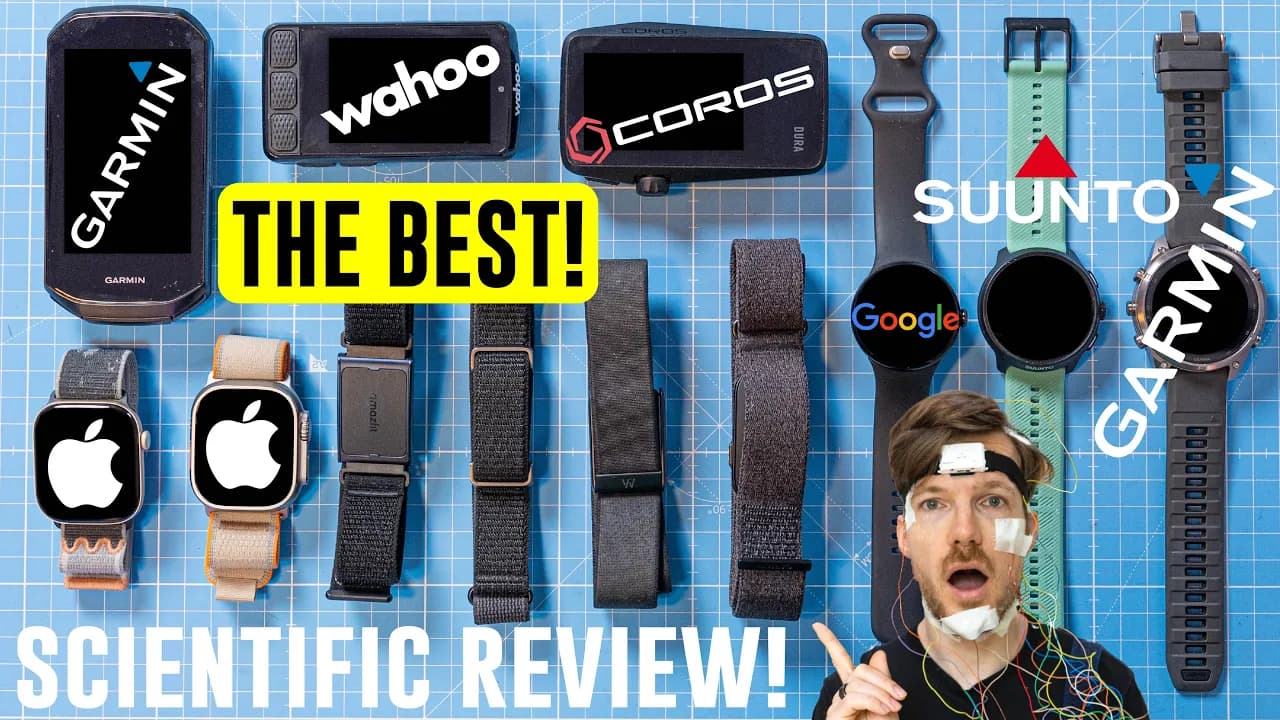
The video focuses on affordable smartwatches and sports watches for health and sports tracking, with emphasis on devices likely on sale during events like Amazon's Prime Days. These older-generation devices tend to be discounted regularly, providing good value regardless of purchase timing. The presenter is Rob, a post-doctoral scientist specializing in biological data analysis, who prioritizes data-backed recommendations.
The video is structured into three main sections: best sports watches focusing on wrist-based heart rate tracking, best sleep and recovery health trackers, and best overall devices that combine both capabilities with good app experience. For each category, the top three devices are presented along with honorable mentions. Premium expensive devices are excluded to focus on budget options that enable health tracking without high costs.
Two strong heart rate trackers are reserved for later discussion in the overall best devices section. The third-ranked budget option is the Huawei Watch Fit 4 and 4 Pro. These devices resemble Apple Watches in appearance but cost significantly less while delivering solid heart rate tracking performance.
Testing data for the Huawei Watch Fit 4 Pro shows near-perfect correlation of 1.00 against an ECG chest strap reference during indoor cycling, with all data points closely aligned to the reference line. Example sessions demonstrate excellent agreement across intervals. Running tests show most points on or near the reference line with only minor deviations. Outdoor cycling also performs well with most points aligned and only small moments of deviation. Weightlifting shows good overall performance but misses some heart rate peaks in higher ranges.
Comparative analysis places the Huawei Watch Fit 4 Pro in the 70th to 80th percentile range across exercises, ranking among the top quarter of tested devices. For indoor cycling, biking, running, and weightlifting, it outperforms approximately 72% to 80% of competing devices. Pricing in Europe is approximately €100 for the standard model and €165 for the Pro version.
The Apple Watch Series 10 ranks second among budget heart rate trackers. Refurbished units are available for approximately €200 to €210, with potentially lower prices on secondhand markets like eBay. While this represents the higher end of the budget category, the performance justifies consideration.
Performance data shows the Apple Watch Series 10 among top devices for most exercises, achieving correlations between the 80th and 100th percentiles. Indoor cycling, outdoor cycling, and weightlifting show excellent results, while running achieves a correlation of 0.97. The device performs among the best or near-best available options for heart rate tracking accuracy.
The Pixel Watch 3 is ranked first for budget heart rate tracking. New units are available for under $150 in Europe, with similar or lower pricing expected in the American market. The device demonstrates exceptional heart rate tracking with correlations of 0.99 for indoor cycling, 0.99 for outdoor cycling, 0.99 for running, and slightly lower but still strong performance for weightlifting.
The Pixel Watch 3 edges out the Apple Watch due to superior app experience with Google Health compared to Apple Health. The circular design differs from the square Apple Watch format. Platform compatibility is a consideration: the Pixel Watch 3 works with Android, while the Apple Watch requires iOS. The Pixel Watch may potentially expand to iOS support in the future.
The Oura Ring 4 ranks third among budget sleep trackers despite originally costing over $300 new. With the release of the Oura Ring 5, secondhand units may become more affordable. The device requires a subscription of $5.99 monthly for full metrics including sleep stages, though basic readiness, sleep, and activity scores remain available without subscription.
Sleep stage testing against the Zmax EEG reference device shows the Oura Ring 4 among the top five performers, with strong agreement across deep sleep, light sleep, and REM sleep categories. Heart rate and heart rate variability measurements during sleep are among the best tested, with near-perfect agreement to reference devices. The subscription-free scores derived from high-quality underlying data may still provide value for training and recovery monitoring.
The Amazfit Bip 6 (corrected from initial misspoken "Bip U") ranks second for budget sleep tracking at approximately $75, with the Bip Max available around $100. These devices deliver similar sleep stage tracking performance. The Amazfit Cheetah 2 Pro, sharing the same sensor configuration, demonstrates 77% agreement for deep sleep, 66% for light sleep, and 68% for REM sleep.
The Zepp app accompanying Amazfit devices provides substantial free data despite occasional crashes and a cluttered interface. Users can access sleep tracking details, recovery metrics, and activity data. The app displays exertion levels, sleep stage progression, and training context such as hot weather conditions during runs.
The Fitbit Charge 6 is the top recommended budget sleep stage tracker at approximately €85 in Europe, or $80 to $100 in dollars. Retested in 2026 with an alternative soft band for improved fit, it achieves 90% agreement for deep sleep, 78% for light sleep, and 70% for REM sleep. These results rank among the strongest budget performers.
Comparative analysis positions the Fitbit Charge 6 among top sleep stage trackers alongside Apple Watch Series 10/11 and Oura Ring 4. The Amazfit devices cluster near the Cheetah 2 Pro performance level. The Fitbit Charge 6 also demonstrates strong nighttime heart rate tracking with most points aligned to reference measurements, and reasonably good heart rate variability tracking.
Apple Watch and Pixel Watch devices, while offering good heart rate and sleep stage tracking, are excluded from top overall recommendations primarily due to battery life limitations requiring daily charging. For sleep-focused tracking, devices lasting approximately five days without charging are preferable.
The ranking shifts to top two devices rather than three for overall performance combining heart rate tracking during exercise, sleep stage tracking with nighttime automatic measurements, and useful free apps.
The Amazfit Helio Strap ranks second at approximately $9. This screenless device provides exceptional heart rate tracking when worn on the biceps, achieving correlations of 1.00 for indoor cycling, 0.99 for outdoor cycling, 1.00 for running, and 0.96 for weightlifting. Percentile rankings include 98th for spinning, 90th for biking, 95th for running, and 81st for weightlifting.
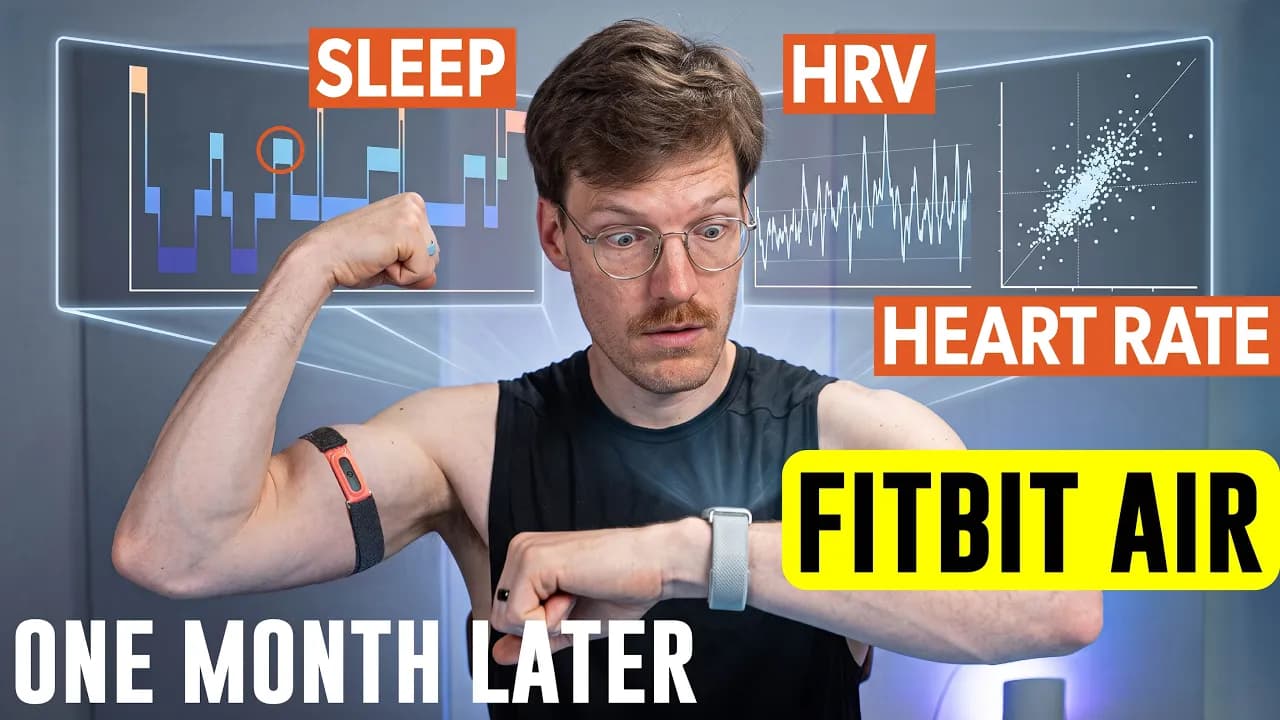
The Fitbit Air ranks first among overall budget health and sports trackers at $99. Testing on both biceps and wrist positions shows strong performance, with biceps placement yielding superior results. Wrist-based heart rate tracking achieves 0.99 correlation for spinning and 0.99 for running, with some challenges during outdoor biking.
The same goes for weightlifting where it's pretty good actually though not quite as good as we see for running and spinning. If we then move it over to the biceps, which is not officially available yet, but you can hack a biceps band together, you get super good performance. So, 1.00 correlation for spinning, 0.98 for biking, 1.00 for running as well, and 0.97 for weightlifting. So, some of the best performance ever. It's better than 95% of devices for indoor cycling, 83% for biking, 94% for running, and 82 for weightlifting.
Both the Amazfit Helio strap and the Fitbit Air are doing really well, especially when worn on the biceps. During the night, the Fitbit Air is doing really well in measuring heart rate with a really good correlation, and heart rate variability even on the wrist is doing really well.
Both the Fitbit Air and the Amazfit Helio strap are doing quite a good job with sleep stage tracking. The Fitbit Air is definitely outperforming the Amazfit Helio strap, which is why it is ranked number one. The Fitbit Air worn on the biceps and on the wrist, and the Amazfit Helio strap on the biceps were tested.
Based on this, the Fitbit Air whether worn on the biceps or wrist is amongst the best five brands out there for sleep stage tracking. The Amazfit Helio strap appears to be in the second tier of devices, probably mostly shared with Galaxy watches. So still pretty good, but not amongst the absolute best devices out there.
The best devices for sleep stage tracking overall in all testing are the Eight Sleep Pod, Pixel, and Fitbit devices, the Oura Ring, the Whoop strap, and the Apple Watch.
Amazfit is definitely seeming to improve and getting better. A full review going into more detail of the sleep stage tracking and heart rate tracking during the night of the Helio strap compared to the Fitbit Air on the bicep is in the works. As more data gets added, the devices might shift a little bit, but this is already a really good first indication that both the Fitbit Air and Helio strap are good devices on a budget.
You don't have to pay anything for their apps, and you're basically done for €9 or dollars if they're not on sale. If they're on sale, you might pay even less. Out of the two apps, the Amazfit app and the Google Health app, the Google Health app is slightly better in opinion. It has all the data needed with a quick overview in the beginning. If you want to dig deeper into your health status or your vitals and other key metrics, you can do that, and it's even more customizable now.
Both devices are good value for the price. You just have to choose which app you like better and which ecosystem you like better. Both work on both iOS and Android. They have good heart rate tracking, good sleep stage tracking, and good metrics during the night, so you can't really go wrong with either of them. For sleep stages, the Fitbit Air is a little bit better.
If you end up getting a Fitbit Charge 6, the Fitbit Air, the Amazfit Helio strap, a Whoop strap, the Eight Sleep Pod, or anything at all on Amazon, even something as small as toilet paper or coffee beans, whether it be during the Prime Day sales, Black Friday, or in general, each time you make an Amazon purchase, if you first click the general link, it doesn't cost any extra and it supports the channel. Given that you watched this video, you will like the video on the Fitbit Air or the video on the Helio strap.
Keep The Quantified Scientist in your library
Save the videos and channels worth coming back to, and find them again in one place.