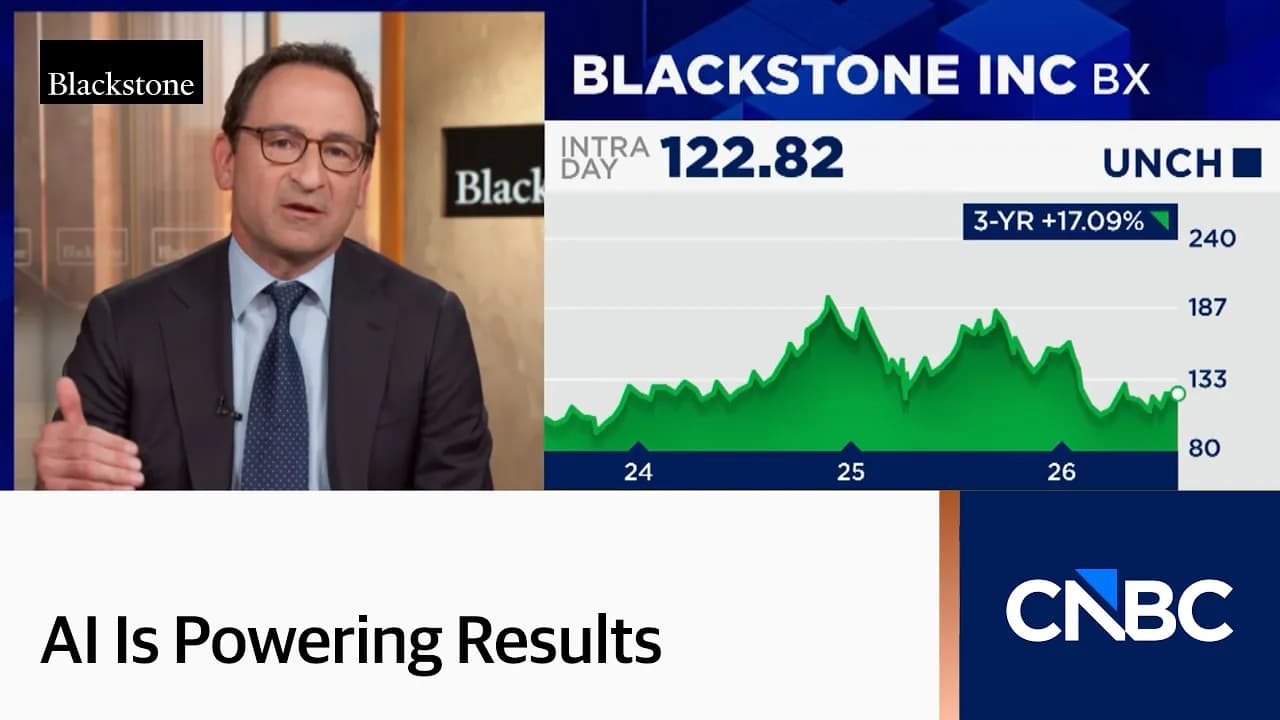
Blackstone's Jon Gray on Why Compute Demand is Outpacing Supply
In a Nutshell
Blackstone delivered strong inflows and earnings despite market headwinds, with private equity portfolio companies showing 10% revenue growth. Jon Gray highlights explosive compute demand—portfolio companies saw 20x model spend growth—outpacing supply due to constraints in capital, data centers, power, and chips. NVIDIA maintains a dominant position in AI infrastructure while Blackstone positions itself in digital infrastructure and energy with long-term contracted income from large enterprises.
These notes were generated by AI and may contain inaccuracies.
Blackstone reported third quarter results amid challenging market conditions. Energy prices rose 30% and the 10-year treasury increased 80 basis points during the quarter. Despite these headwinds, the firm delivered for clients across flagship strategies, beating comparable public market indices. Blackstone secured $63 billion in inflows during the quarter, representing more than $270 billion over the last 12 months - the highest level in four years. Fee-related earnings increased 6% year to date, while total earnings rose 12%. The firm anticipates a strong Q4 and 2024 performance.
The investment landscape features significant cross currents. Cost of capital has risen due to war and inflation pressures, concerns about deficits, and some crowding out of capital from AI infrastructure spending. Despite these challenges, Blackstone observes real economic strength on the ground. Private equity portfolio companies achieved 10% revenue growth globally in Q3, with margins continuing to expand. This earnings strength mirrors patterns seen in public markets and represents a positive signal for investors.
Blackstone continues finding realizations even in choppy markets, including announced sales to strategics in events and gaming in Europe, plus liquidity in energy and electrical equipment companies. Japan and India markets show substantial liquidity. The broader exit picture remains challenging due to market volatility, but underlying earnings strength provides a foundation for future activity. The IPO market, currently closed, is expected to reopen when markets and geopolitical tensions calm. Blackstone maintains a long-term approach and confidence in positioning capital for investors based on company and asset growth.
Blackstone has invested heavily in data center infrastructure. Market analysis reveals a conflation between deliverability of compute and demand for compute. Portfolio companies have seen a 20-fold increase in model spend over the last 12 months. The Ode joint venture with Anthropic to deploy models cannot keep pace with incoming business demand. Compute demand continues growing while supply delivery faces constraints around capital, data centers, power, and chips.
Neo clouds face the challenge of securing sufficient capital, debt, and equity to deliver on demand. Compute pricing has increased 50%, legacy chips retain more value than anticipated, and data centers are leased below market. Companies like CoreWeave demonstrate strong CEO talent and are positioned to navigate these challenges. The underlying business fundamentals remain strong despite capital access difficulties.
NVIDIA maintains an extraordinary market position through its chips, CUDA software, and system integration capabilities. While more competition is expected in this large and growing market, including Google's TPUs and Amazon's Trainiums, NVIDIA's leadership position remains remarkable. Blackstone's strategy focuses on digital infrastructure including data centers and energy with long-term contracted income from large companies, viewed as a safe and strategic positioning.
Inflation presents a mixed picture with crude, diesel, and fertilizer prices rising due to geopolitical conflicts, while broader inflation data remains subdued. Wage growth sits around 3% with limited movement, and rental housing (a major CPI component) runs well below the government's 3% target at approximately half that rate. Inflation expectations have not risen significantly, with pressure concentrated in commodity areas tied to ongoing conflicts. The Fed has room to wait and assess developments, particularly if geopolitical tensions recede.
Keep Blackstone in your library
Save the videos and channels worth coming back to, and find them again in one place.