Inside The Startup Building Reusable Rockets
These notes were generated by AI and may contain inaccuracies.
The team at Stoke Space is building fully and rapidly reusable rockets with aircraft-like reusability. Currently, only the first stage of rockets can be reused. Stoke focuses on the entire rocket, including a stage 2 capsule that survives re-entry to Earth. This opens new opportunities in space.
I think if you have something that can go up and come back to the place where you want it to go when you want it to go, I think it is like the iPhone app store moment. People are going to come up with absolutely crazy ideas for how to take advantage of that.
Andy and Tom invited a visit to headquarters in Kent, Washington, outside Seattle, a hub for space tech startups.
What are you building at Stoke Space? Building fully rapidly reusable rockets designed to go to space, through space, and back from space. Really to lower cost, improve availability, and improve reliability of access to space.
There are around 150 commercial space launches every year, a record but limited. Most are taken by Starlink, leaving little availability. Customers pay more for availability, but cost is a barrier to a ubiquitous, diverse space economy.
Nova is a two-stage to orbit rocket. First stage punches out of atmosphere, restarts engines to land downrange or at launch site. It has one of the highest performing rocket engines in fuel efficiency ever produced, key for long life and rapid reusability.
Second stage (Andromeda) goes to orbit. Typically, rockets discard second stage. Reusing first stage scaled launches from 10-20 to 150 per year, but second stage is thrown away due to 17,000 mph speed and 2700° F re-entry heat. These are multi-million dollar machines that get built, tested, and discarded.
After payload release, Andromeda closes and re-enters. Custom heat shield uses cold liquid hydrogen through a heat exchanger to absorb heat. Then 24 small thrusters slow it and land at right angle.
What rapid reusability allows you to do is to scale the flight frequency without having to scale your factories and your test facilities and all the infrastructure that comes with it.
Andy Lapsa and Tom Feldman started Stoke in 2019 after working as jet propulsion engineers at Blue Origin.
From as far back as I can remember, doing Estes rockets in the backyard with my cousins and it really just took off from there. From pretty early on in high school, it was clear that I wanted to do propulsion. What's the most badass thing you can do with engineering? Rocket propulsion.
They decided to start a company, brainstorming ideas at the intersection of skills and problems. Realized no one was aggressively solving full rocket reusability, and they had an idea.
There were over 150 rocket companies. Many were PowerPoint ideas without bright futures. As hardware people, they knew what it takes to realize them. Key insight: focus on reusability from day one to decrease cost and increase availability/reliability.
It felt wildly irresponsible. Easily the hardest decision I've ever made. I had a 3-month-old at home and a really good paying job that I was quitting.
Set a 6-month timeline: re-evaluate if no traction. Started September 2019, hit pandemic. Got first check around then.
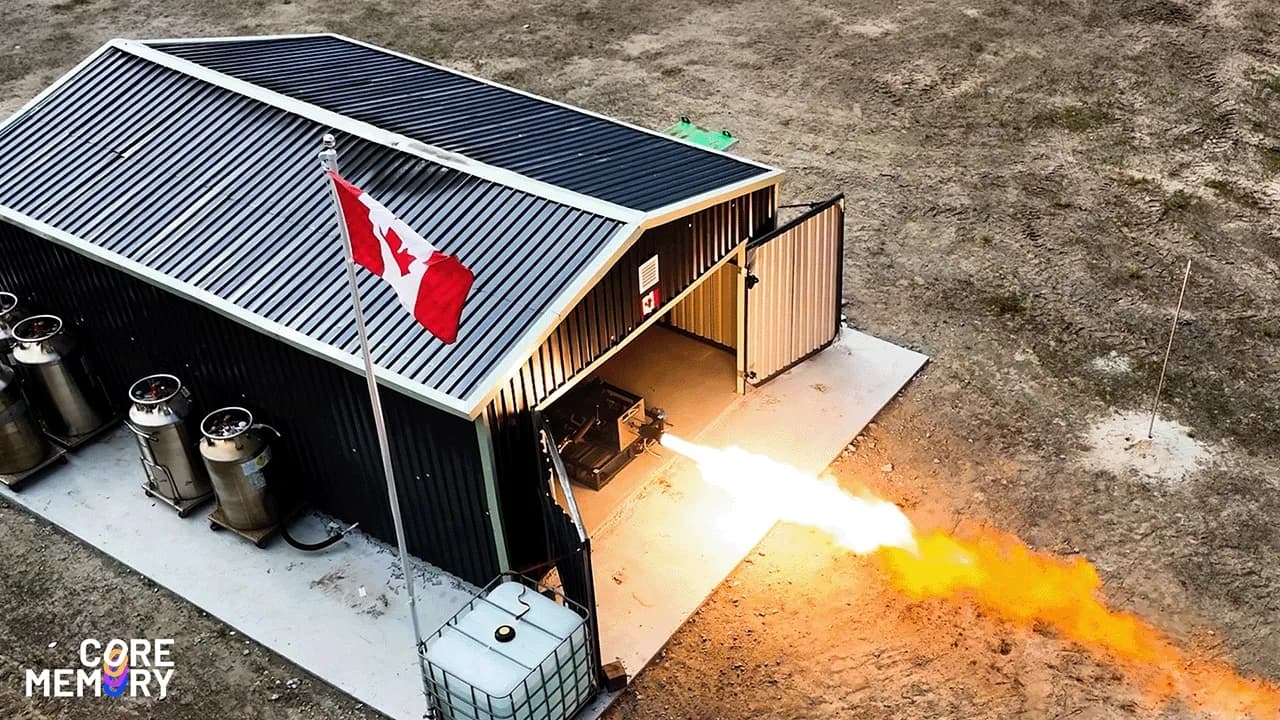
With first check, built prototype engine, tested in shipping container in Tom's backyard.
Andy's in the basement PowerPointing to hone the story and I was welding this steel structure in the garage and taking it out to the shipping container and bolting it in. That was how we spent our days for 2 months.
Demonstrated a pressure-fed gaseous hydrogen liquid oxygen thruster to show fire for early investors.
Shipping containers: one for storage, one for test cell with test stand (oxidizer one side, fuel other). Built entire facility in 2 months. Original workbench and run tank (cylinder) still there.
In January, felt convinced to proceed.
Underestimated fundraising challenge: no network, pandemic hit. Y Combinator (YC) provided network, fundraising language, momentum.
A lot of the venture world was geared towards SaaS. We have a very different story and financial model.
Goal: introductions to hardware-friendly angels.
Key advice: get good at hearing no. Tough to keep conviction when hearing no after no.
Raised $990 million to date, operating efficiently.
2022: first full engine test.
2024: moved into 168,000 sq ft factory.
First orbital launch planned later this year.
Factory has engineering, manufacturing for avionics, electronics, engine assembly, additive manufacturing, structures. Designed for 7 vehicles per year.
Balance speed and patience for deep tech: know it's hard, can't analyze perfectly, must test. Iteration speed is key.
Plan for failure: if engine fails, next one ready on factory floor.
Vertical integration: make every part in-house to speed iteration (1-month cycle to 1-2 days).
Software key for product and operations. Scale from garage to FAA-overseen flights for government payloads or humans.
Rockets typically launch once and lost, but theirs returns for rapid turnaround. Software tracks: did it work? Part service life? Maintenance?
We're in a moment where software can automate a lot of that. Excited about AI to make it seamless for factory workers and abstract data to functions.
Built own tool Bolt Line early on, bases operations around it. Big part of success.
Building launch site at Complex 14, Cape Canaveral, Florida (John Glenn's 1962 first American orbit site).
Progress: massive construction in Cape Canaveral; first/second stage engines in development/qualification; structures builds; structural qualification articles tested in Moses Lake at cryogenic conditions; hardware-in-loop testing for avionics, GNC software simulating missions.
If we are successful we are flying this thing every day.
Conviction moment: idea worth pursuing, owe it to the world to try, whether it succeeds or not.
Keep Y Combinator in your library
Save the videos and channels worth coming back to, and find them again in one place.