BREAKING: The Fed Just Froze Rates — Here’s What Happens After EVERY Midterm Since 1950!
In a Nutshell
The Fed's rate freeze has driven Treasury yields to multi-decade highs, triggering a K-shaped market where only the top 7 stocks are propping up the S&P 500 while 40% of its constituents sit in bear markets. Despite midterm years historically being the weakest of the presidential cycle (averaging just 7.2% returns), the S&P 500 has rallied in the 12 months following every midterm election since 1950, with an average gain of 15%. With inflation reaccelerating and the CAPE ratio at 41, the strategy is to hold a cash/Treasury buffer for buying dips while maintaining diversification across international stocks, bonds, crypto, and gold.
These notes were generated by AI and may contain inaccuracies.
The Federal Reserve recently announced it would freeze interest rates. Nearly 40% of the S&P 500 is already in a bear market, with cracks forming throughout the United States economy. Inflation is rising, and most investors remain unaware of what happens after every midterm election since 1950.
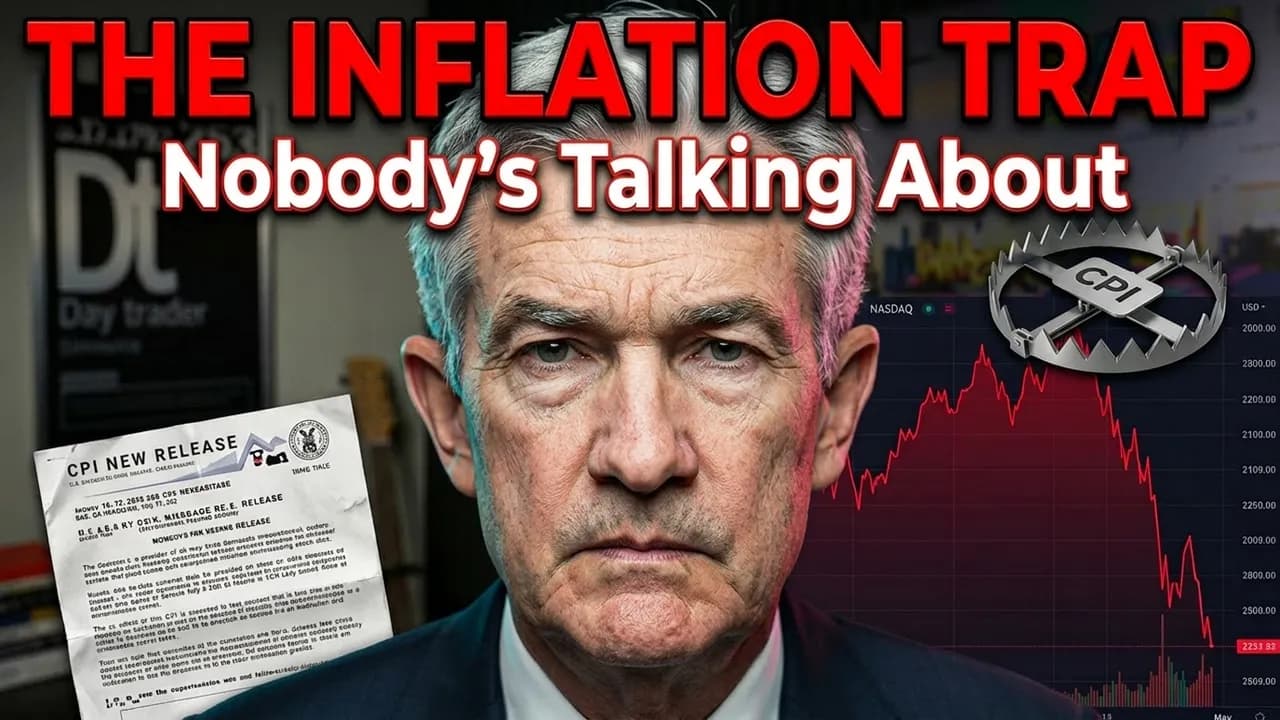
Treasury bonds form the foundation of the entire financial system, with interest rates determining borrowing costs for mortgages, personal loans, and credit lines. The 20-year Treasury has reached its highest level in decades due to persistent inflation. The September inflation rate reached 3.7%, the highest level since 2023. The Producer Price Index showed wholesale prices surging 1.3% in September alone—more than double economist expectations—with annual prices up 6.3%, marking the highest annual increase in nearly four years.
Investors face a critical question: if 5.5% risk-free returns are available for 30 years backed by the US government through Treasury bonds, why hold stocks, buy real estate, or take investment risks? This dynamic has triggered a dramatic stock market sell-off, as investors park cash in government-backed Treasury bonds.
The S&P 500 year-to-date returns appear strong at first glance, but excluding the top seven stocks reveals a different picture. According to Auter's analysis, more than four out of ten stocks in the S&P 500 are down for the year. The S&P 500 is weighted by size rather than equal slices, meaning the top seven companies—Apple, Microsoft, Nvidia, Amazon, Alphabet, Meta, and Tesla—comprise more than 35% of the entire index, representing more concentration than any sector in history except the 1800s railroad bubble.
When investing $1,000 into an S&P 500 index fund, $400 goes into just 10 companies while the remaining $600 spreads across 490 companies. The top 10 stocks have generated 59% of all gains this year, creating a K-shaped economy within the stock market. This bifurcation extends beyond stocks: AI investment alone accounts for a third of all US economic growth this year, while employers added only 29,000 jobs in September, July was revised down to a job loss, and new home construction fell 5.2% with economists warning of a housing market deep freeze.
SoFi, a nationally chartered bank, allows users to buy, sell, and hold cryptocurrency through a single app alongside checking, savings, and investments. The platform offers federally regulated safeguards and in-app guidance. New customers can earn up to $1,000 in Bitcoin, Solana, or Ethereum through December 2nd.
Midterm election years have historically been the weakest for markets during any presidential cycle. Since 1970, the stock market has averaged just 7.2% during midterm years compared to 12.4% in all other years. Since 1950, the average peak-to-bottom drop during midterm years has been 17.5%, the deepest of any year in the cycle. Markets hate uncertainty, causing investors to keep capital on the sidelines.
The positive development is that after midterm election results, markets have rallied. Since 1950, the S&P 500 has been higher 12 months after every single midterm election—19 out of 19 times—with an average gain of 15%. The best performance was 33% in 1954, while the worst was still up 1.1% after 1986, even following the 1987 Black Monday crash.
Since 1874, the stock market has risen following 32 out of 38 midterm elections, representing 84% of the time. Market gains show no correlation with election outcomes—who wins or loses seats has no bearing on performance. The critical factor is simply that results are finalized, allowing investors to plan forward.
The Federal Reserve paused interest rate hikes until the December meeting. Fed Chair Kevin Walsh stated that inflation remains high, rates have already been raised, and more work remains, suggesting higher rates ahead. Walsh refuses to prejudge meetings or provide market guidance, stating the Fed is no longer in the business of signaling intentions. This contrasts with previous Fed Chair Jerome Powell's approach of providing play-by-play indications and hints to journalists.
Markets are pricing in a high likelihood of another rate hike in December, with 50 basis points of hikes expected over the next six months. Best-case scenario involves oil cooling and a temporary Iran agreement leading to just one rate hike. Worst-case involves oil continuing higher, worsening inflation, and rate hikes during a period of historically low job growth.
The S&P 500's CAPE ratio (comparing prices to 10-year earnings) sits at 41, exceeding all historical levels except the dot-com bubble peak of 44. However, the S&P 500 trades at roughly 20 times expected earnings, close to its 5-year average, with companies generating substantial profits.
The recommended approach involves maintaining a cash or Treasury buffer for purchasing during market declines without attempting to time the market. Diversification across international stocks, bonds, Treasuries, cash, cryptocurrency, and gold provides protection if individual asset classes decline. Maintaining steady employment income becomes increasingly important during periods of slowing hiring, enabling continued investment regardless of market conditions.
The strategy emphasizes expecting the best while preparing for the worst, maintaining consistent buying regardless of market direction.
Keep Graham Stephan in your library
Save the videos and channels worth coming back to, and find them again in one place.