Dario Amodei is DELUSIONAL
In a Nutshell
Anthropic's "public benefit fund" is a self-owned LLC that keeps control of the shares, letting the company decide who gets what and when, rather than distributing ownership to the public. Dario Amodei's revenue projections assume Anthropic grows to hundreds of trillions in annual revenue, which is unrealistic and reflects an overconfident belief that the company can capture a massive slice of global GDP. The announcement is a PR move that avoids real public ownership or redistribution, unlike the proposed alternative of giving permanent, non-redeemable stakes to independent public wealth funds.
These notes were generated by AI and may contain inaccuracies.
On October 18, Anthropic announced that it would dedicate 5% of the company to the public good. Based on the company's latest private valuation of $965 billion, this equates to approximately $48 billion. If the company were to offer its shares to the public at a value of $1.5 trillion, as some investors are now discussing, the amount would be close to $75 billion.
The shares will not go to the public. Instead, it will go into a fund owned by Anthropic itself.
The new entity is called the "Anthropic Public Benefit Fund." The fund is subject to shareholder approval, and 5% of Anthropic's shares now go to it. At the sole discretion of the board, the fund can receive an additional 2% of the investment for every 50% in which the company's value grows above a baseline level. As they put it: "The more Anthropic grows, the more of the company's share can be explicitly allocated to the public good."
This is not a public utility company. It's a Limited Liability Company (LLC). Anthropic placed this within a larger number. The co-founders pledged 80% of their shares when the company was founded, and about half of the employees donate their shares, which the company matches. Some of these shares are stakes that would otherwise have gone to the executives as wages. Taking all of that together, Anthropic says that about 20% of its total shares will be allocated to the public good.
The fund is not a charity, nor is it a tax-exempt non-profit organization. It is a Limited Liability Company (LLC), which is wholly owned by the company. In other words, Anthropic owns the fund that holds Anthropic shares. Anthropic says this type of company gives it flexibility in the forms of giving, which could mean large donations to traditional non-profits or direct distributions to specific groups. They have left it somewhat vague for the time being. The only issue they mentioned was the impact of artificial intelligence on jobs. They promised that none of the fund's shares would be used for political lobbying or political donations. As for who runs the fund and how it makes its decisions, they say they will clarify that in the coming months.
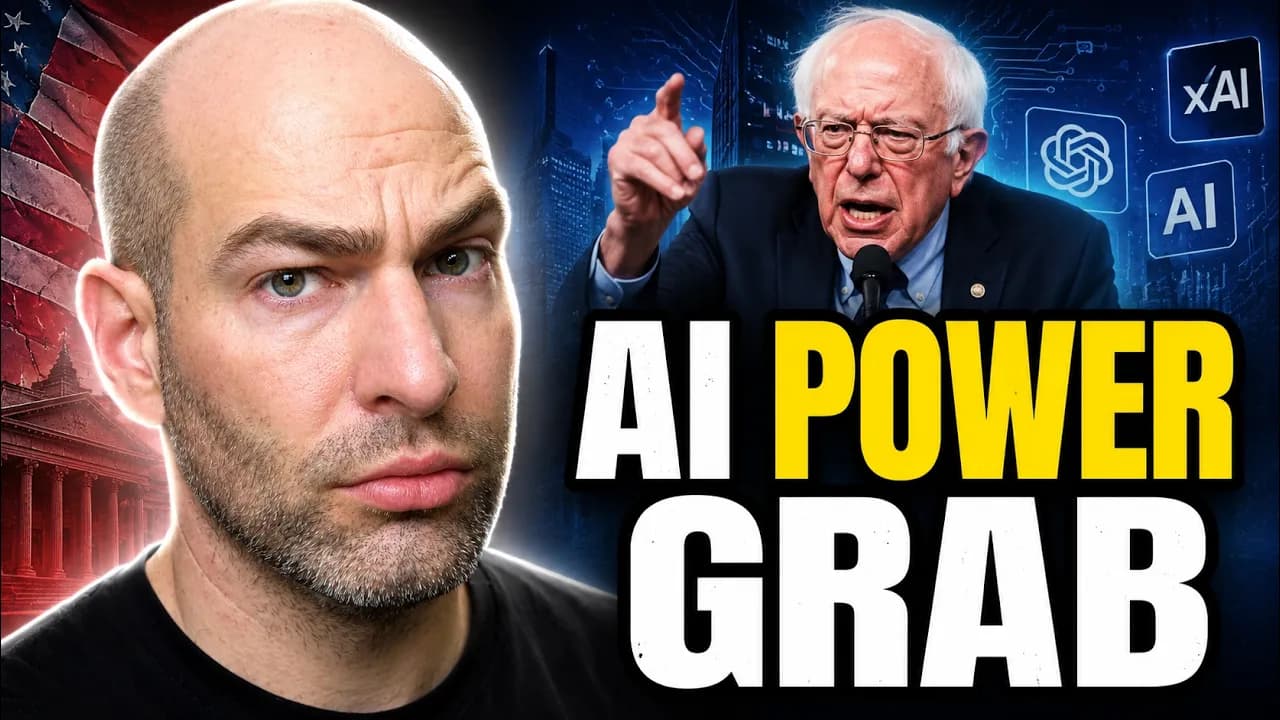
Timing is also important. Anthropic is expected to launch its initial public offering (IPO) before the end of the year in what could be the largest IPO in history. Public confidence in the artificial intelligence industry is at an all-time low, and CEO Dario Amodei has described it as a crisis of confidence at its core. There is political pressure from both sides. Bernie Sanders proposed a one-time 50% tax on major artificial intelligence companies, to be paid in the form of shares in a sovereign wealth fund that would distribute profits to every American. On the right, Steve Bannon argued that AI companies should be forced to give up half of their shares, and President Trump floated the idea of the government owning stakes in leading AI labs. OpenAI even reportedly offered to donate about 5% of its shares to a public wealth fund.
The "Anthropic" fund is owned by "Anthropic" itself. Reactions were divided, and the division was not based on party affiliation. Technology journalist Kevin Rose described it as perhaps the largest commitment of philanthropic capital ever made. According to his calculations, if Anthropic and OpenAI were to go public with a valuation of $1 trillion each, that would mean about $460 billion earmarked for philanthropy, roughly equivalent to one-fifth of the Gates Foundation. A law professor who supports taxing AI stocks said: "Well done." But she added that charity work does not replace the voice of the public. One AI researcher described the structure as ingenious because the fund can finance the kinds of research that Anthropic already does in abundance.
David Sachs, the venture capitalist and former White House AI chief, responded to one of Anthropic's founders by saying, "You put 20% of your stock into a limited liability company." "It remains to be seen whether this serves the public interest." Gary Marcus said: "Anthropic is playing its cards here." One technology executive described it as a reverse version of "OpenAI," a company that builds a fund "that is controlled by you and your friends." Palmer-Lackie said it smells like "USAID 2.0." Travis Kalanick has described it as a loophole for "active altruism" to obtain infinite money. "Active altruism" is a philanthropic movement that Anthropic has long been associated with. A third group simply said: Give it to the people. Elon Musk wrote: "I recommend giving shares directly to the public." Investor Brad Gerstner described it as an exceptional gift. But he added: "I hope that a large part of the wealth generated by artificial intelligence will be a direct distribution of profits."
This is mostly just a moralizing display. The fund is a company owned by Anthropic. Therefore, it is "Anthropic" that decides what is considered to be in the public interest. Anthropic decides who gets the money, and Anthropic decides when. This is not a donation of anything, but rather keeping a "war chest" and giving it a nicer name. They say it may involve direct distributions to specific population groups. But which groups? And who chooses it? Of course, they are the ones who choose it. The expectation is that most of the money will end up as research, i.e., grants to non-profit organizations that already share their vision of the world. Even one Anthropic fan said the fund is useful for the types of research that Anthropic already does a lot of. These are not profits for people who are losing their jobs. This is a grant program, and Anthropic is the one holding the checkbook.
Years ago, Sam Altman said that artificial intelligence could generate $100 trillion, and then said that OpenAI might capture most of that value. At an event in 2019, he went even further and said that if OpenAI succeeded in achieving this, the company could acquire the "light cone" of all future values in the universe. Then this summer, people started posting graphs of Anthropic's revenue, and the line was trending vertically upwards. At the end of 2024, Anthropic was generating revenues of approximately $1 billion annually. By the end of 2025, the figure had reached approximately $9 billion. By the end of July this year, it had reached $65 billion. Around that time, Dario Amodei began saying the same thing that Sam Altman had said, that Anthropic might become the most valuable company on Earth.
Anthropic's revenues grew approximately ninefold last year. So, let's assume that growth slowed down a little, and became only five times per year. This means that within five years, Anthropic will generate approximately $200 trillion annually, if this trend continues. For comparison, the entire global economy is only about $125 trillion. Once the market is saturated, the world will no longer generate more money for you. Every client has a budget, competitors are catching up, prices are falling, and every growth curve eventually curves into an S-shape. This is called a kind of AI psychosis. If you truly believe you are about to own a significant portion of the world's economy, then a fund you control is not charity. It's a way to become a benefactor to the world on your own terms.
Anthropic can now say that it has given 5% to the public. But it did not give 5% to the public. It gave 5% to a fund that it itself owns. This seems very deceptive, and frankly, it is perfectly in line with the familiar "Anthropic" identity. There is a lot of talk about the common good, but control remains within the company.
In June, the company released a policy framework on the impact of artificial intelligence on jobs, and in worst-case scenarios, it outlined ways to share AI revenues widely, including basic income, sovereign wealth models, and equity-sharing mechanisms. Dario Amodei wrote that the main challenge will not be stimulating growth, but finding a way for everyone to share in the benefits. So, they know what the general share looks like in principle. But when it came to their own shares, they decided to keep the keys. What Anthropic describes is something directly inspired by cyberpunk novels. A private company that aims for profit and has a savior complex will give you an allowance at its own discretion. This is worse than relying on remittances, i.e., living on government checks. With government checks, you can at least elect politicians. You cannot oust Dario, nor can you oust the board of directors or the shareholders. Are they supposed to remain generous forever? This is a completely ridiculous illusion.
What is wanted is not a fund owned by "Anthropic", but a fund that is owned by the public. Tax relief should be given for every company, not just AI companies, that allocates shares to a public wealth fund or public endowment. This could be at the municipal, state, or federal level. First, the company relinquishes a non-controlling stake to a public entity. The whole thing is transparent. The public receives the profits and gains, but no politician gets a seat on the board of directors, and no one in the government has the right to manage the company. This is the difference between owning a part of a company and nationalizing it.
Secondly, each of these funds must follow the "Principles of Santiago." These are the 24 principles for sovereign wealth funds, written in 2008, and adhered to by the funds that sign them. Simply put, a fund like this should invest to generate returns, not to achieve political goals. Therefore, it must disclose its financial data and how it is managed. It must be managed completely independently of whoever is in power at the time, with clear rules about when to withdraw funds, so that no one can loot it.
Thirdly, the company receives tax relief in exchange for giving up a permanent stake to the people. Permanent means permanent. The public fund retains the stake, and the company cannot redeem it. The company receives a real reward for giving up part of its future, and everyone gets a real stake in that same future.
Fourth, call it whatever you like, whether it's universal basic shares, universal basic capital, or universal basic ownership. Silicon Valley techies like to throw around these terms without realizing that this is literally socialist politics. But it doesn't matter, if it works, it works.
Put that 5% somewhere you can't reach it, and it will be the first to applaud. Until then, this is not a public benefit fund. It is a private fund with a public name.
Keep David Shapiro in your library
Save the videos and channels worth coming back to, and find them again in one place.