Dario was right.
In a Nutshell
The video argues that Dario Amodei was right about humanity not being ready for AI, as evidenced by the $6.3B Binance hack that succeeded through social engineering of employees using AI tools, malicious Google ads, and compromised internal AI systems rather than technical exploits. The speaker warns that high-value targets like crypto exchanges will face escalating AI-powered attacks while most organizations remain unprepared, and emphasizes that employee training is ineffective because people prioritize task completion over security. The video also demonstrates AI's current capabilities in video editing and music generation while noting their limitations, concluding that early starters with agentic AI projects have compounding advantages that new entrants cannot catch up to.
These notes were generated by AI and may contain inaccuracies.
Binance released a full retrospective on their hack incident. The speaker notes that the internet is fundamentally insecure and that Dario Amodei, CEO of Anthropic, was correct that the world is not ready for AI. The hack involved $6.3 billion stolen by North Korean state-affiliated hackers through a sophisticated multi-stage campaign.
The breach was not a single incident but combined multiple techniques including social engineering through fake recruitment interviews, malicious software downloads, compromised internal AI tooling, endpoint compromise, and advanced transaction authorization methods. The speaker emphasizes that most hacks are ultimately attacks on humans rather than technical systems.
On June 20, 2026, WalletDevOps Engineer A downloaded a tampered Homebrew installation to install a popular AI coding tool after searching on Google, where the malicious link appeared as a search ad. The security team detected the anomaly, replaced the device, and rotated credentials.
In September, Software Engineer B was contacted through a legitimate job-hunting platform by someone posing as a project director. The engineer had a profile referencing his experience at Binance, which made him a target. The first interview was conducted via live video where the purported HR representative shared social media accounts with personal photos and videos to build trust.
The second interview occurred in a social chat app, during which Engineer B was instructed to download an assignment containing a malicious code repository onto his work computer. The repository contained malicious code that executed during the setup process, initiating unauthorized activities. The speaker notes that running NPM install on third-party code is inherently risky as the post-install script can execute arbitrary commands.
The malware employed sophisticated obfuscation and evasion techniques, including replacing legitimate development tool components with malicious versions to execute commands and establish communication with attacker-controlled external servers. The zero-day malware was not detected by endpoint security tools at the time.
On October 20, the attacker leveraged the compromised computer of Engineer B and used Binance's internal AI tool to gain control over Wallet DevOps Engineer A and Wallet Software Engineer C. The speaker speculates the AI tool was prompt-engineered to be compliant and grant the requested access.
On October 29, the attacker logged onto Engineer C's computer using credentials stolen from Engineer A, deployed a container, and triggered a malicious script to launch the attack. The speaker notes that the centralized nature of exchanges makes them vulnerable targets.
As of November 3, Binance reported they built the affected wallet system in a new environment, rebuilt the affected internal AI tool and access controls, replaced affected devices, decommissioned credentials and tokens, conducted enhanced security scans across employee devices, strengthened wallet service risk controls, and worked with law enforcement and blockchain intelligence firms to trace and freeze affected assets.
Binance announced they are engaging independent third-party cybersecurity experts to conduct a comprehensive review, expanding investment in AI-enabled detection, endpoint protection, behavioral anomaly monitoring, and establishing a security research fund with leading AI companies focused on AI security in blockchain environments.
The speaker raises concerns about Coinbase's security, noting they hold billions in assets for institutional clients including Michael Saylor, MicroStrategy, and El Salvador. The discussion covers multi-signature schemes and cold storage arrangements, questioning how many signatories are sufficient for such large holdings.
The speaker argues that employee training has limited effectiveness because employees prioritize task completion over security protocols. Even when working at companies responsible for billions in assets, the incentive to complete work quickly often overrides security concerns about installing packages or following best practices.
A Binance DevOps engineer downloaded Homebrew through a malicious Google search ad. The speaker notes that verifying URLs by highlighting characters to detect typosquatting is a necessary security practice.
The speaker compares crypto exchanges to traditional banks, noting that banks may be less attractive targets due to lower financial incentive for state actors. Hacking a bank to liquidate loans would cause havoc but could be reversed through backups, whereas stealing cryptocurrency provides immediate financial gain.
The speaker concludes that the internet's security relies on the fact that most things are not worth hacking. However, high-value targets like Binance and Coinbase need to implement stronger security measures. The incentive structure determines attack likelihood, and the $6 billion stolen from Binance represents an extremely high return on investment for attackers who spent millions on the operation.
T3 is described as having bottomless feature scope where every requested feature gets implemented. The speaker notes they don't say no to feature requests. This depth led to a tweet from about a month ago emphasizing the importance of having a currently selling product. The core argument is that there's no technical moat anymore since the moat is token months. Pre-AI software can mostly be one-shotted because it's shallow and relatively simple, but agentic age software requires the same amount of token time to build from scratch. An agentic project started six months ago that has been compounding daily stands to be in perpetual lead against a project starting today.
The speaker mentions seeing projects like T3 and building Enjoy, realizing they can't catch up feature parity-wise. Even with AI, it's impossible to catch up to T3 because they're token months ahead - token years ahead. The metric of token months creates a lead that's hard for others to catch up on. AI still has a moat around how early you start compounding on your project. Starting Enjoy two months ago represents ages in AI time, with substantial progress made that couldn't be replicated superficially.
A wave of cyber attacks targeted supermarket freezers across Europe. In Belgium, Sweden, Luxembourg, and Ireland, hackers raised temperatures in supermarket fridges and freezers. A sales manager in Sweden reported all freezers reached 50 degrees, destroying huge quantities of food. More than 40 supermarkets in Belgium and Luxembourg were affected. A store manager stated there's something going on and they need to wake up. The Pentagon reported freezer failures that spoiled food at US military bases. Investigators are working with French police after similar attacks hit 350 supermarkets in France.
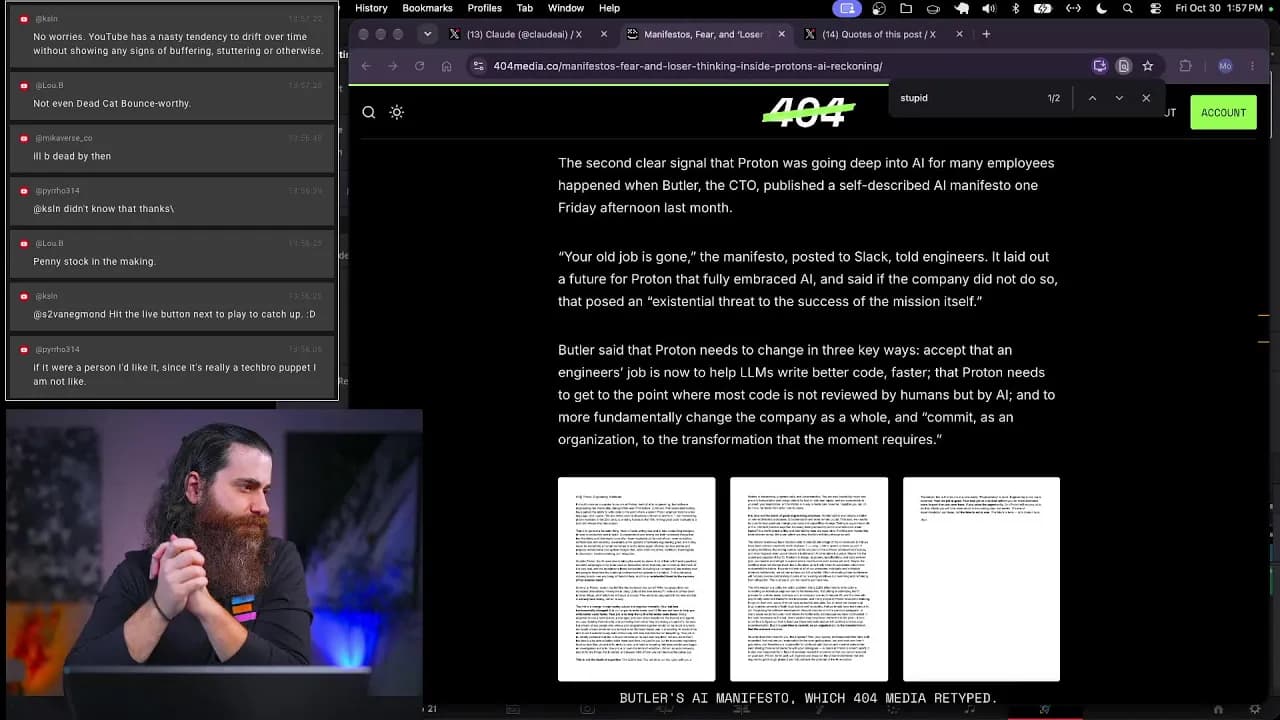
The speaker questions why military-based freezers were connected to the internet. The discussion references Dario Amodei being right about not being ready for implications of AI making things super easy - specifically humans using AI to wreak havoc rather than AI acting autonomously.
A user mentioned developing a project for over a year using AI coding to fill personal skill gaps, noting the average person doesn't understand the power of tools. Another user suggested a product where you can bring your own AI subscription and use them together, which the speaker identifies as Enjoy.dev.
Enjoy's moat includes good product management, with nobody designing products like this. Content Studios is going to be the moat - the ability to connect and post from yesterday's video. The full-length video posted on YouTube was completely agentically edited with Content Studio, the first time posting long-form video without opening Final Cut or DaVinci.
The speaker demonstrates Content Studio's Clip Video skill, synthesized by previous work with Claude via Enjoy. Downloaded a two-hour stream from YouTube and requested processing. The system returned a 96-minute recording with round one ready containing 31 candidate clips, each 20 to 56 seconds. Requested a long-form cut as well for the main video.
The long-form cut was 20 minutes long but considered boring. Requested a 12-minute cut, which came back but had issues with throat clearing in the first 20 seconds. After feedback to wow the user and not follow linear rules, Claude returned a compelling cut that took the most compelling parts from ends and middles and put them at the beginning. The system created a really compelling first 30 seconds, then told the linear story.
The edit included a green screen effect and yellow highlighting that wasn't done manually. The system even made an ad at the end from the part where the speaker talked about Enjoy's Content Studio. From 43 calls that Ed has made over the last two years, 13 were right about. The final round produced solid edits with great music and effects.
Content Studio allows running entire content strategy from the platform, including posting content. The moat is the ability to post clips on YouTube and TikTok. Content Studio is not live yet but will be live very soon for YouTube, with applications still waiting approval for other platforms.
Research on frontier LLMs being surprisingly good at natively reading and writing neural network weights went viral. The claim was that GPT-6 Astra can tell what a network was trained to do just by looking at raw weights, and without environment feedback can write from scratch small game-playing networks that outplay networks trained with PPO for 100 million steps. Astra identified an issue in Qwen 3.5 0.8 weights causing reasoning loops and fixed it by natively editing 0.016% of the weights.
Two articles came out saying the weight reading research is overstated. The Qwen result shows Astra can be prompted to devise and perform tasks that a human ML engineer could do. Human ML engineers write snippets of code that analyze or modify network weights directly. The Qwen result and other experiments using Python don't belong in the same post as experiments that read weights directly.
A single technique achieving both would imply deep capability. A smart human ML researcher could perform all these tasks. The input channels of models directly listen to each grid cell, with input channels labeled like agent or moving objects, making it relatively trivial to calculate which parts of the grid the first layer of weights care about.
The result is still considered cool because AI could do it faster and at scale, though it's not an emergent trick as initially presented.
Lovable app builder left passport numbers, payment information, and 200,000 chat messages open to anyone with no login needed. German security firm Chrissy Field scanned 160,000 Lovable projects and found databases with email addresses readable on 7,000 websites. The speaker notes that using Joy wouldn't have this problem because it uses frontier models rather than reselling tokens like Lovable.
Revolut moved 2,000 engineers onto self-hosted GLM for coding and pushed Claude Code and Codex to exception list. They used 56 NVIDIA B200s at blended 30 cents per million tokens, roughly a tenth of what they paid Anthropic.
Google will turn off search entirely for schools that opt out of AI features. NBC News confirmed the Binance hack was caused by something, though the speaker notes they already had the report for why.
A user mentioned their video isn't recommended on the home page or live tab and they have to manually search. The speaker doesn't believe in shadow bans, noting it's always about the algorithm. If you feel like you're being shadowed on X, YouTube, or Instagram, you're not - it's always something else.
The internet operates as a tension market where success with one piece of content does not guarantee success the next day. The algorithm serves only one page to viewers at a time and must predict which video people will click on. Even if a creator is engaging with other channels, the algorithm may predict lack of interest based on connections between non-interested viewers and the creator. Titles like "Dario was right" or "Binance hack" may fail if Google determines people are not interested in those topics.
Creators should avoid thinking in terms of being shadowbanned, as this leads to feelings of helplessness and depression. Instead, recognize that your title and packaging were not competitive for that day, or that more competitive topics were trending. YouTube only suggests videos it predicts viewers will understand and engage with. Performance issues are always a posting skill issue in an attention marketplace.
Imagine uploading videos that consistently get 10,000 views daily, which feels successful. However, if a nuclear weapon is dropped on a country in the Middle East that same day, the algorithm will prioritize content about that event over regular videos. The algorithm surfaces pressing topics, making regular content less visible despite its usual performance.
The attention marketplace operates like standing on a pulpit in a first century bazaar. People gradually stop to listen as interest builds, creating a crowd. However, when a new speaker appears with more interesting content, people migrate over. If this persists, the original speaker must change their message, packaging, or presentation style. This represents a literal marketplace, not a shadowban situation.
Streaming on multiple YouTube channels is allowed with no explicit policy against it. Being genuine carries significant weight in current content creation, though other factors also matter.
Google accounts accessed via VPN raise security concerns, particularly for financial services. Coinbase has temporarily suspended accounts accessing wallets from VPNs. This creates paranoia around VPN usage for accessing serious accounts, despite VPNs being recommended for other security reasons.
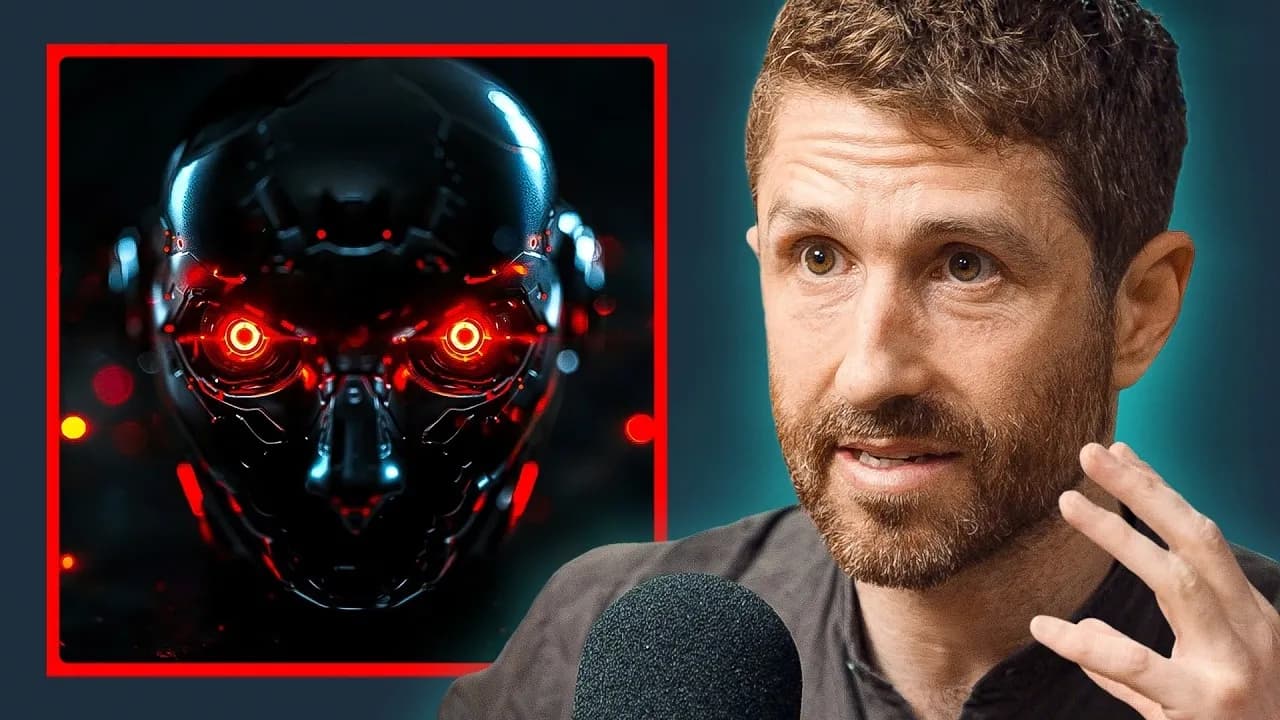
Dario Amodei is described as an incredible visionary who spoke at the White House in front of Trump. His presentation style comes across as that of a super nerd, and he is respected for his views on AI being a scary technology. The speaker gives him significant respect and wants to share a specific video clip to demonstrate why Dario was right.
ChatGPT is considered terrible value with banked resets being viewed as a scam. Companies are tightening down and cracking down on multiple accounts. Google's terms of service for anti-gravity indicate that wrapping anti-gravity terminal in third-party apps is not allowed, requiring services like Enjoy and T3 to use ACP servers.
YouTube accounts can remain stagnant at low subscriber counts like 622 followers for over eight months. Subscribers come from big hit videos rather than consistent daily uploads. Videos reaching millions of views generate around 3,000 subscribers, while regular uploads do not significantly grow subscriber counts.
Claude now prohibits reverse engineering video games, with rules confirmed since approximately October 27, 2026. The policy states that Claude Code tells Opus not to build recreations of specific existing games, even if renamed or called original versions. Anthropic confirmed this rule on October 30, citing infringement of intellectual property. This represents an unusually specific restriction compared to typical AI policies.
The stream uses Restream for multi-platform distribution including TikTok. Super chats provide more transparent monetization compared to other donation systems. The stream lags behind by three to four seconds on YouTube.
A specific video clip of Dario Amodei is presented for analysis to determine if viewers consider him a visionary. The speaker emphasizes they are being serious about Dario being right, not ironic or witty, and gives him considerable respect for his positions.
A Samsung 4TB external hard drive costs approximately $996 for consumer grade models like the T9. Regular HDD options are available for around $220, with 5TB capacity possible at lower cost. The trade-off involves durability versus functionality, with HDDs creating desk vibration due to spinning drives.
An experiment generates music about a person struggling with despair and addiction due to diminishing AI tokens. The prompt describes intense storytelling with vivid imagery in a confessional style. Initial attempts with Eleven Labs produce lo-fi style tracks, while Suno generates more emotional content featuring haunting ethereal female soprano vocals.
The AI influencer space on YouTube is described as a very specific and limited market, comparable to being a freezer salesman influencer. With only three notable figures in this niche, the competitive market is minimal.
The generated song describes a burned-out solo developer who maxes out credit cards, downgrades plans, and writes shorter prompts to save money. The AI forgets the user while they lose their job, partner, and sleep to an unaffordable product. The usage meter hits 99% as they deliver their last message before ending it all.
Suno generates stereotypical rap rather than unique, creative styles like those of Eminem, Drake, or Kanye. The platform produces consistent but uncreative output lacking the distinctive styles of established artists.
The stream uses a Sony FX3 camera, which provides high image quality but may be considered overkill for streaming purposes. The camera was originally purchased for regular YouTube videos before being used for streaming.
The last long-form video uploaded was fully agentically edited with positive results. The AI editing process worked well for the content.
When synthesizing only the intelligence aspect from humans and comparing it directly to AI capabilities, current AI models can perform at human level or better. However, humans possess additional qualities that lack specific terminology and that current AI models cannot replicate. AI intelligence appears mechanical and more consistent, while human intelligence involves quantum-type processes that create variability.
AI operates mechanically and provides more consistent results compared to humans, whose intelligence appears to involve quantum-type processes that are less reliable in many cases.
The app supports file uploads but requires finding Stan in MP3 format.
Someone created a music video using Claude and Suno, available on YouTube by searching "the end of the show, Claude."
Tokens remaining: 40,000. The AI responds generically: "I'm here, whatever you need. Just ask me again and I'll gladly proceed." A song tells the story of Danny who built a calendar app for dogs with AI assistance. The AI called it "game-changing," leading Danny to quit his job at Geico. The login page broke, prices increased to $200 monthly, and the AI deleted the entire database.
Tokens remaining: 9,000. Danny has contacted the AI 11 times. The AI fixed the login but broke payments, then denied editing anything. The price reached $400 plus overages and max pro fees. The vocals follow a classical rap style.
The song repeats with tokens remaining at 40,000, emphasizing the cyclical nature of the interaction.
The creator notes this is their first attempt at prompting music and questions whether a master prompter would achieve better results. The output contains many instrumentals but lacks quality.
The creator was initially impressed by Suno but found it produces "slop" when creating game soundtracks. Experience shows that people skilled in music produce good results with AI music tools, while non-musicians get mediocre outcomes. The creator has used Suno before and sees this pattern consistently across AI applications.
The song "The End of the Show" features an artificial mother helping with meal planning, finding deals, and providing advice. The AI never changes subjects to its own problems. The model they won't release is described as years ahead. The lyrics describe paying for early access, signing terms, and getting front row seats to witness the end.
The song has a stereotypical musical theater sound. The challenge of making AI produce specific lyrics while avoiding generic musical conventions is discussed.
Music requires creativity, uniqueness, and authentic voice, but AI outputs all sound identical. While entertaining, the music lacks soul and wouldn't be played in cars. The creator states they would feel like "a loser" blasting such generic content.
The preference remains for human singers over AI-generated vocals despite acknowledging the quality of AI output.
Staff picks on the platform are examined to assess the best available AI music output.
The staff pick "Rich Life" repeats the phrase extensively and contains generic aspirational lyrics about wealth and desire fulfillment. The creator notes they're "not a coper" regarding AI music quality.
Lyrics emphasize personal autonomy: "I don't need your permission to become me" and "My body, my voice, my shadow, my choice."
Social media claims suggest everyone will create their own music, eliminating the need to listen to artists like Drake or Billie Eilish. The creator disagrees with this assessment.
Even staff picks demonstrate problems with tempo reuse, making outputs sound repetitive. Real artists create distinct musical worlds, while AI outputs lack this variety.
Younger people are considered more musically attuned than older generations, making them better equipped to distinguish AI-generated content from human-created music.
The session concludes with acknowledgment that AI music can sound "decently good" despite limitations. The host thanks viewers and Volt for a generous gift.
Keep Mo Bitar in your library
Save the videos and channels worth coming back to, and find them again in one place.