I was wrong about AI again.
In a Nutshell
The speaker was wrong about AI video editing because they were using poor transcription tools and Final Cut Pro instead of Assembly AI for accurate transcripts and Da Vinci Resolve Studio with MCP integration for direct timeline control. Once they switched to these tools, Claude could create viral clips with effects autonomously, though the process still requires iteration and feedback rather than working perfectly in one shot. The core insight is that AI video editing works now but demands the right technical stack and patient refinement, not one-click automation.
These notes were generated by AI and may contain inaccuracies.
The speaker is on their third iteration of being wrong about AI, referring to it as "I was wrong about AI to the power of three." Their niche involves being wrong about AI topics. The discussion centers around video editing using AI, particularly the challenges and recent breakthroughs in using AI to edit videos end-to-end.
The speaker has been trying to get AI to edit videos since starting content creation but has been perpetually frustrated. While other creators like Ali Abdal have shared mind-blowing results with AI editing, the speaker found that AI-generated edits were consistently sloppy - cutting mid-word, mid-syllable, or creating double takes. They argued that anyone claiming AI edits videos end-to-end was lying, as frame-by-frame control remained essential and the back-and-forth process with AI agents was slower than traditional point-and-click editing in Final Cut.
After venting on X (Twitter) that AI couldn't handle granular cuts, the response was split 50/50. Some creators shared their successfully AI-edited videos, while others agreed that AI struggled with precise editing. The speaker eventually posted an apology, admitting they were "using the wrong tools."
The speaker had been using Claude Code sessions with raw video, asking it to create 10 viral clips. The problem was always transcription accuracy - Claude would generate effects using code and overlay them on video, and it could identify stories in transcribed content, but the transcription quality was insufficient. This resulted in needing to note timestamps and provide frame-by-frame corrections, which took longer than using Final Cut directly.
A recommendation to use Assembly AI proved transformative because their voice transcription is significantly more accurate, capturing "ums," coughs, and syllable-level precision. The speaker has no affiliation with Assembly AI but confirmed the improvement after switching. Claude's strengths remained - it can add animations and find stories in video content - but the transcription bottleneck had been resolved.
The speaker reviewed examples shared by other creators. One video claimed to be entirely AI-edited but contained a double take in the first 60 seconds. Another example from creator Payton showed AI-generated cuts with stutters that would normally be removed manually. The speaker noted that while Claude can fix these issues through iteration, the process of noting timestamps and going back and forth was too time-consuming.
The speaker discovered they had misunderstood Mac's Activity Monitor for years. The CPU percentage column represents percentage of a single core, not total CPU usage. Their MacBook has 10 cores, meaning they could have 10 processes at 100% without issue. They had been unnecessarily killing processes that showed high percentages, not realizing the per-core nature of the display.
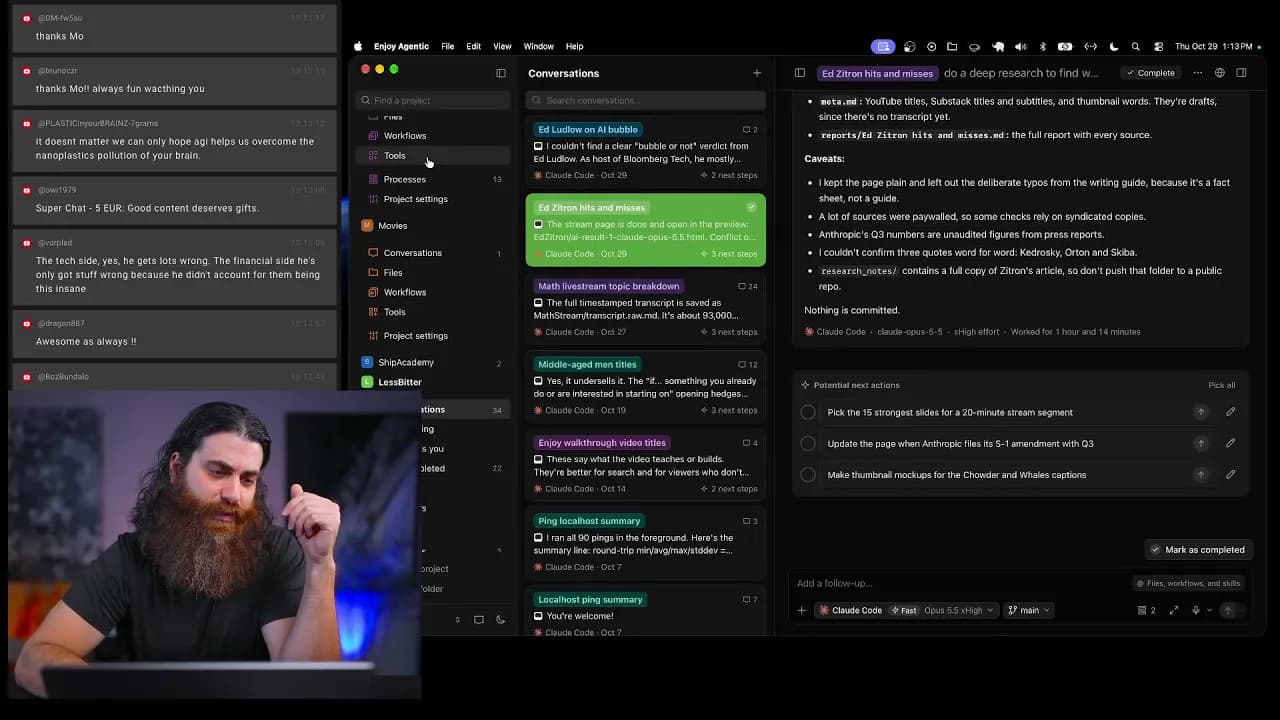
The major breakthrough came from using Da Vinci Resolve Studio (the $236 paid version, not the free version) instead of Final Cut. The speaker had been a Final Cut Pro user but found Da Vinci provided the quick feedback loop that was missing. Unlike other approaches where Claude must rerender entire videos for each change, requiring reopening files in QuickTime and losing scrubber position, Da Vinci allows direct timeline editing through an MCP server without rendering delays.
The speaker initiated a live demonstration by creating a new Da Vinci project and using their AI agent manager "Enjoy" to process yesterday's live stream titled "Anthropic IPO is a scam." They instructed the AI to create five viral-worthy TikTok clips using Da Vinci MCP, going "all out on the effects" to make content "impossible to scroll away."
The speaker clarified that their previous criticism wasn't about AI intelligence limitations but tooling issues. They emphasized that the feedback flow was what had been missing - not the AI's capability to edit, but the ability to see results quickly without the friction of re-rendering and reopening files.
The speaker maintains two Claude subscriptions at $200 plans each, though they acknowledge they could downgrade or cancel one. They noted that YouTube channel economics depend heavily on CPM rates - their AI skepticism content generated $9 CPM while more nuanced AI content achieved $18 CPM. With $20 CPM and 1-2 million weekly views, creators can generate significant income, but consistency in content output remains challenging.
Da Vinci Resolve has minimal official documentation about its MCP (Model Context Protocol) server feature despite being one of its most powerful capabilities. The speaker found implementation details through third-party GitHub repositories rather than official documentation. The free version of Da Vinci lacks this MCP functionality, requiring the $236 Studio version for AI integration.
When asked about using a second computer or sandbox environment for AI access, the speaker dismissed privacy concerns, stating that privacy is effectively dead in a post-privacy world. They argued that maximizing AI benefits requires abandoning traditional privacy notions, particularly when using Claude versus other models like Gemini.
Following the Binance hack, the speaker expressed relief that it was a traditional phishing attack on an employee's laptop rather than AI-related. They described the fear that AI cracking encryption would represent an "AGI moment," and were disturbed that the actual attack vector was simply a compromised analytics plugin, highlighting vulnerabilities in current financial systems.
Phil Mora Wondershare is a video editor that the speaker finds completely unfamiliar, describing it as the type of website where they have no idea what the product does.
The conversation turns to AO3 being hacked, with speculation that North Koreans may be responsible. The speaker expresses concern about Coinbase potentially being next and mentions the Genesis Bitcoin and Satoshi's Bitcoin potentially moving.
The speaker identifies the entire Armageddon scenario as hinging on AI cracking encryption. They state that as long as AI doesn't crack encryption, everyone is safe, but if it does, they recommend arming yourself and stocking up on cash and groceries. The speaker admits being terrified of this scenario despite not usually being a doomer.
The speaker is working on vertical punch-in zooms, bold captions, and hook text, noting it's taking longer than the previous day. They mention Omar sent a latte 600 jewels as a virtual currency donation, estimating it as approximately $5-6.
The editing harness being used is called Enjoy, specifically Enjoy Agentic at enjoy.dev. The speaker has never heard of Filmcraft when asked why they're not using it.
The speaker discusses lots of changes happening with Google's search business. Reddit is locking their doors and becoming login-only, with CEO Steve Hoffman implementing the change. Reddit is down 30% in one day following their earnings call, which exposed that AI mode does not drive traffic.
The speaker explains that AI didn't kill search but killed the middleman for 25 years. The previous deal was simple: creators make content, Google sends visitors, creators show them ads. Now AI reads content, answers questions, and keeps visitors, eliminating the traffic driver role.
The speaker strongly recommends uninstalling any third-party JavaScript, especially from startups. Analytics, monitoring, and tracking scripts from third-party SaaS companies pose massive site takeover risks if the third party gets hacked. They reference Poly Market as an example where a tracking script was hacked and drained the platform.
The speaker is using the official Da Vinci Resolve MCP, which is highly undocumented. Users can access it by downloading Da Vinci Resolve Studio, going to File, and selecting Setup AI Assistance. They note that Blackmagic doesn't document this feature well.
The speaker acknowledges that AI editing seems slower than doing it yourself initially, but expects it will improve. They mention not knowing how to use Da Vinci Resolve and ask viewers to bear with them during the demonstration.
The speaker found issues in the AI's work: a shake path that drifted the whole frame, text outlines that never turned on, and a progress bar that didn't render. They're putting everything into one clip and going all out on effects for a live demo.
The speaker shows what the AI accomplished the previous day with the same prompt to make viral clips and go all out on effects. They created both a fancy version and a subdued version of the edit.
The speaker reflects on the disconnect between AI intelligence and making money, noting that if AI is so smart, why aren't users rich. They conclude that the market needs courage rather than more intelligence, and AI can't provide the "fuck it, I'm going in" attitude.
The speaker references a video by Brian, a professional editor with 1.3 million views, discussing how AI can now do editing jobs. They note the video is receiving significant hate and compare it to previous discussions about whether AI is actually doing coding work or just autocomplete.
The speaker mentions another video from Machine Learning Street Talk posted the same day giving their take on AI video editing.
Claude AI announced renaming their Max plans to Max 5X Da Vinci Resolve unexpectedly. They also announced removing the 5-hour limit for verified Ultra accounts starting that day, with newer accounts keeping temporary limits until verified.
The speaker decides to abandon Da Vinci Resolve and start with a shorter video to avoid spending an hour transcribing. They note they don't have any short videos available in their downloads.
The speaker makes a joke that every professional's pronouns will be "was" in reference to the impact of AI on editing careers.
Six months ago, Brian's 13-year-old nephew asked how to make videos. Brian advised him to sit down, record himself, download Da Vinci Resolve because it's free, import clips, drag them to timeline, learn to cut and rearrange, and tell a story. He deliberately avoided overwhelming the nephew with video editing nuances and rabbit holes.
Brian describes his current editing process for YouTubers: open ChatGPT, turn on microphone, say "Hey, Matt recorded a video. Go edit it," click send, then walk away for 20 minutes. This replaces the previous manual process of navigating Google Drive, downloading files, dragging into Premiere, syncing audio, trimming silent sections, removing bad takes, watching multiple times for boring parts, considering B-roll and music, adding subtitles, and manually fixing each subtitle.
The speaker notes that AI works on videos while they do something else, enabling parallel work. They mention CapCut announcing their ChatGPT plugin, allowing Gen Z who struggle with mouse and keyboard to use AI for editing instead of traditional software.
Every major editing software including Da Vinci, Premiere, and CapCut now has MCP connectors to let agents edit video. The speaker questions the business incentive, suggesting it feels like a desperate attempt to retain users with no real gain, as all these companies may be on their way out.
The speaker watched a 30-minute video from Tim responding to Brian's video. Brian's position is that the industry will never be the same, while Tim's point is that these are just new tools.
The speaker explains editing headlessly means not seeing a timeline in the video editing process. AI can get transcripts, identify messed up sentences, gaps in words, multiple takes, and find the best ones. They note that none of these models are expert video editors yet, but it's easier than teaching a junior editor because AI never forgets instructions.
AI models are effective at using tools like FFmpeg and Python to create plans for snipping videos, reorganizing them, and packaging them without ever using multi-track layer nonlinear editing software. The speaker canceled their Adobe subscription, saving $800 per year on Premiere and Photoshop.
The speaker encounters render quality problems with Da Vinci failing to render properly, resulting in timing issues and incoherent sentences in the final output.
The speaker describes themselves as the equivalent of a project manager to a coder when using AI for video editing. They approach it as a project manager trying to code something, which is why professionals are still needed.
The speaker questions what advice to give their 13-year-old nephew today. The new advice would be to sit down, record yourself, have a good time, and open up AI to edit for you. They find something wrong about this approach but acknowledge it's entirely real. They question why anyone would tell a kid to study L-cuts, punch-ins, transitions, panning shots, or color grading when one model release could change everything.
Using AI for video editing requires patience to go back and forth on feedback rather than being a one-shot process. The headless version of AI editing is considered more powerful by many, though the lack of ability to do quick feedback is a limitation.
Instilling traditional editing values into a kid might do more harm than good today. The next editing revolution is expected to come from someone who has never been in the editing world. Newcomers to a space often have a vision that gets baked out through traditional means of education.
The advice about watching videos and deciding if you're feeling bored during the edit, and imagining how viewers feel, represents the current media meta. However, this approach feels like everyone is becoming little mini Mr. Beasts or getting TikTok-ified in the worst possible way.
AI editing produces weird cuts throughout videos, with dozens or hundreds of errors in a 20-minute video. When AI cuts out words like "Da Vinci Resolve" and "hotkeys," it becomes enraging. The process requires going back and forth with the AI, making it not perfect and still time-consuming.
Machine Learning Street Talk suggests the new way is still impoverished in many ways - you gain a lot but also lose a lot. It takes the same amount of time but allows you to do a little bit more. This represents a good prognosis on almost everything with AI: it's not a one-to-one swap. You gain some, you lose some.
The advice against learning video editing the old way includes not needing to learn hotkeys to split, ripple delete, forward select all, and remove gaps. The question of whether to pursue video editing as a job involves uncertainty about where the economy, market, work, and human agency and meaning are going.
The speaker had their passion automated and was scared of this possibility for a couple of years, waiting and watching for it to happen. The release of Astra marked when it happened for real. Being a really good video editor won't protect against AI automation - the best video editors will leverage AI to become even better and faster.
The speaker feels scared about having their ability to do meaningful work ripped away. While the ability still exists, there is concern about watching others automate video editing. The speaker mentions taking a look at Elliot Abdullah's video on automating video editing.
Brian demonstrates a really strong knack for storytelling and narrative, and is also a very good presenter. This combination of skills may not be common amongst editors.
Tim heads up a YouTube channel interviewing real OGs in the editing space, with 372 videos produced over half his lifetime spent editing. Tim has switched to fully agentic editing without using traditional Da Vinci-style software.
Brian's video demonstrates that perfection isn't necessary - he likely saw errors like "Da Vinci resols" instead of "Da Vinci Resolve" but chose to ship as is rather than rerender the whole video. This raises questions about whether this represents slop or acceptable quality trade-offs.
Coders are increasingly choosing to ship products that are "good enough" rather than making improvements that would be annoying. The question becomes whether this represents slop or acceptable quality standards.
The rendered video is assessed as "ass" with a 2023ish style that won't work today. People would scroll past despite the quality not being awful. The video receives a 7 out of 10 rating, described as "ADHD approved" and about 100x better than the previous attempt.
Creating a political ad style version with drama, suspense, and provocative elements is requested - like a campaign ad against another person exposing something big. This would be more serious and detective-like rather than brain rot subway surfer style content.
Simple captions are preferred over complex styles. The AI is using headless Claude, and even with Da Vinci, it operates through code and overlaying rather than using Da Vinci's animation capabilities.
AI editing represents a completely new era, but AI hypers are sketching out a future where software engineers become redundant through automation, which isn't accurate. Using AI is analogous to typing code into a Python interpreter - operating at a new level of abstraction.
AI can only work autonomously when given well-specified and/or hill-climbable tasks. Things that are done the same way every single time can be automated - like cutting out hesitation islands with 95% accuracy. Creativity involves extending deep domain understanding, pulling out analogies, and exploring new paths.
When hiring video editors, the speaker found they would do templated work - copying or mimicking what others had done, using visual templates and the same typography and styles. Every video would be exactly the same.
A good video respects the contours of the domain being discussed. For example, making a video about the quicksort algorithm could use visual motifs to consistently represent different parts of the algorithm. The alternative is slop - grabbing stock footage of mountains and waterfalls with no connection to content.
Templated content appears in talking head videos and podcasts with the same simplistic approaches used repeatedly. People claiming to have automated everything with Da Vinci Resolve MCP are surprisingly crowing about their achievements.
Video editors who think they can automate everything they do are automating themselves out of existence. If work can be automated without requiring iteration or discovering novelty and complexity, and if it's the same thing every single video, editors should automate themselves out of a job.
Creativity exists because of startling complexity in the world. Taking small steps into the darkness to understand where we are in an imaginary maze represents the creative process. The technology isn't fundamentally different from old tools like Adobe Photoshop and Da Vinci Resolve.
AI is the new Adobe Photoshop and Da Vinci Resolve - giving instructions at a high level of abstraction. This enables more creativity since you're no longer limited and are unfettered.
Video editors are experiencing the same argument developers have had over the last 1.5-2 years. People who know the domain of what they're working in will be the best to hire to build things and tame AI. The best people will be able to do way better work, creating a gap that companies will want to fill.
Ali Abdal's 46-minute video "I tried fully automating my video editing with AI raw results" shows Opus 5.5 capabilities for making launch videos. The question is how AI editing compares to a very good human video editor.
Round one results show three drafts rendered, but the faceless version is "pretty bad." The A-cut has problems with pauses not being handled properly. Adding the presenter's face produces similarly poor results.
Motion plates are identified as the hard part of video editing - rendering contact sheets and creating nice motion graphics that can be added to the A-cut using PNG sequences with transparency, 4K output, and amazing frame rate matching.
Remotion generates solid results for motion graphics, though solid colors of backgrounds in vertical video thumbnails are disliked. The preference is for content to look more like actual UGC rather than sell sheet-style content.
The original 5-minute video was being used to create a 45-second launch video, which is a job that would never be given to a human editor. The lesson is that if you want a short video, film a short script.
Hyperframes produces solid results with good motion graphics. The AI editing reaches approximately 97% as good as human editors by the end of the day, taking about 6 hours from start to finish at no additional cost beyond the Claude subscription.
Having done AI video editing once, the speaker now has all the code Claude generated, making future attempts easier, and has developed a mental model for exactly how AI video editing works. This unlocks thinking of more ways to use the technology for other business applications. The observation is made that this is the worst AI video editing will ever be.
The creator tested hyperframes for generating attack ads against Anthropic's IPO. The initial output contained factual errors including a nonsensical comparison to Amazon's profitability and incorrect financial figures. The ad claimed Anthropic lost $80 billion in one quarter and has $750 billion in obligations over five years, with $430 billion in non-cancellable contracts.
After reviewing the first version, the creator requested Claude to write a 60-second script that was more serious and accurate. The AI produced a script that was deemed too tame. The creator then requested an exaggerated, tongue-in-cheek, self-aware ad that was clearly over-the-top.
The refined script featured:
- Dramatic opening: "Whisper. They don't want you to see this video. Mostly because it's not very good, but also because of what's in it."
- Anthropic described as "Friendly, helpful, suspiciously polite"
- Ed Zitron's analysis of $430 billion in non-cancellable contracts
- Reference to "exit liquidity" targeting retail investors
- Self-aware ending: "Who wrote this ad? Claude did. Their own AI wrote this."
- Final line: "Anthropic's IPO. Read the fine print before the fine print reads you."
The creator tested generating a movie trailer-style script beginning with "In a world." The script opened with: "In a world where every company is an AI company, one company was the polite one. They built a chatbot. They made it kind. They made it helpful. Then they made a filing."
The creator identified a potential content niche creating attack ads targeting various subjects including penguins, chips, and Chick-fil-A. The approach combines AI-generated scripts with dramatic editing to create viral content.
The creator discussed a 404 Media article about Proton's internal AI policies, disclosing prior employment at the company. The article revealed:
- CEO Andy Yen pushing AI adoption internally despite public criticism
- CTO Bart Butler stating 90% of code at Proton in October was written by AI
- Internal Slack messages where Yen called security concerns "loser thinking"
- Employee resistance to AI due to security concerns
Andy Yen, described as an American CEO in a European company, pushed for faster development cycles. The culture clash emerged when:
- Security team requested pentesting periods before deploying AI-written code
- Yen responded: "Stop thinking always of how to be slower and focus more on how to be faster"
- Employees expressed concerns about AI code quality and security
Peter Steinberger supported Andy Yen's approach, noting the company had two years to adapt to AI. DHH also backed the CEO, stating if this is what has employees at Proton in revolt, they're in for a rough ride as the age of agents unfolds.
The creator defended Yen's direct communication style, noting he calls things "stupid" and "loser thinking" in Slack channels. Employees described him as a "straight-up bully inside" while maintaining a different public persona.
The creator analyzed Tuta's poor communication about a 10-minute server restart for a non-critical security patch. Claude was asked to generate better copy, with the creator requesting:
- Professional versions similar to how Google would communicate
- Funny, over-the-top versions mocking the original announcement
- Nature documentary style narration
- Blockbuster trailer style announcements
The creator measured stream latency across platforms:
- X (Twitter): approximately 10 seconds
- YouTube: approximately 30 seconds
The creator tested latency by having viewers type "1" in chat after a countdown.
The company expects to spend over 800 billion on compute infrastructure between now and 2045.
A speaker made an announcement about joining Starbucks as their head of a coding. The statement was questioned for its legitimacy, with uncertainty about whether the person was being serious. The title head of a dent was noted as not sounding like a real position, suggesting it was likely a joke.
A hello world milestone was achieved for project suncatcher after launching a proto.
The 2045 timeframe was discussed with the observation that everyone will likely be dead by then. This was clarified as not even dead cap bounceworthy.
Viewers were encouraged to like, share, and subscribe. Special thanks were given to Radio Head Mika Gustavo, Alex Martin, and viewers tuning in. A greeting was extended from Bolivia by Obsidian Coffin, and the speaker addressed Bruno directly before ending the video.
Keep Mo Bitar in your library
Save the videos and channels worth coming back to, and find them again in one place.