Don't Buy AI Stocks Until You Watch This!
In a Nutshell
Speculative AI infrastructure stocks like CoreWeave, IREN, and NBIS have crashed 36-48% as fundamentals catch up with overvaluation, with CoreWeave showing $51B debt against $5.5B cash. The core message is that these are not fundamentally sound companies but can deliver high returns during momentum-driven rallies—buy dips only in small increments with strict risk management and no leverage. Position sizing should reflect extreme volatility: a $1,000 stake in CoreWeave carries more risk than $10,000 in Apple.
These notes were generated by AI and may contain inaccuracies.
Some of the most speculative names on Wall Street are currently collapsing in the most dramatic fashion, and many of them relate to artificial intelligence infrastructure. These are the new cloud companies, such as CoreWeave, IREN, and NBIS. It has always been speculation, but now the fundamentals are finally catching up with reality. Both can be true - you can make money from companies that are overvalued, but the question is when it makes the most sense to enter into these investments. The risk versus the reward needs to be at least worth it.
IREN stock is down 48%, CoreWeave is down 38%, NBIS is down 36%, and INTC is down 31%. None of these companies were fundamentally good companies, but they were linked to the new AI infrastructure and cloud computing. There are expectations that it will eventually improve because of its rapid growth, the partnerships it has established, and how it has been integrated into building this artificial intelligence system.
From $55 per share to $187, representing a 142% increase in 59 days. The markets may have been too quick to predict. When you look at these companies from a fundamental perspective, the rating shows an "F". The market value is currently around $34 billion, but it has total debts of $51 billion and $5.5 billion in cash, with funding concerns regarding CoreWeave.
The ability to tolerate risks may differ from others. The video was made not to say "Didn't I tell you?" but to remind that it is important to be aware of peak buying and peak selling levels, especially when you are trying to invest. Trading is different - you can make money from anything when it comes to trading, all you need is good price momentum and maybe a good story to be the catalyst. CoreWeave had that, NBIS had that, IREN had that, but what they all have in common is that they are not good companies. They were all overrated, and Wall Street rushed into its decisions.
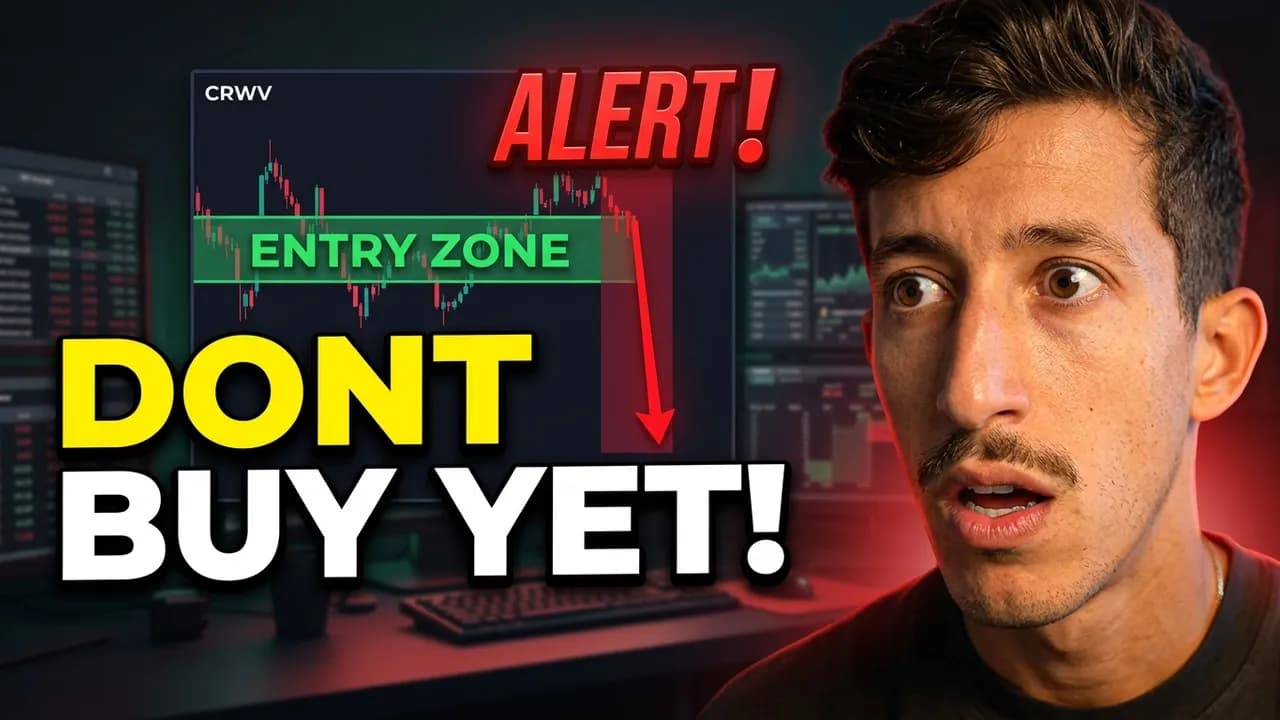
Buying the dip in CoreWeave makes sense because of the potential for recovery. If it returns to the $100 level, that's 80% return. If it returns to its previous high levels of $135, that's 141%. If it returns to its previous historical highs of $187, that's 200%. However, buying the dip does not necessarily mean a change in the overall direction of the stock. It has been forming lower highs and lower lows since its previous all-time high of $187. The trend is going against you.
It is not a safe investment, not a safe trading process, and not a fundamentally good company. However, it is a stock that can take off strongly when it gains good momentum, which has happened many times. The stock had an initial rise, then a sell-off that led to another reversal of 46%. GameStop and MSTR are all worthless and incredibly overvalued companies, all built on speculation, with ratings that have no logic. But with a good story and good price momentum, during irrational times, irrational valuations are supported - 60% and then recently from lows of $73 to total highs of 86%.
You can make money from buying the dip in these most speculative stocks. Buying now makes more sense than when it was trading at higher levels. Understanding oversaturation levels in buying and selling is simple, but it is important to put yourself in a position where mistakes are possible. This means being able to withstand fluctuations. It has dropped by 10% today - just because you bought the stock doesn't mean it will start to recover. It may continue to decline. Do not use margin, and do not use leverage. There is no reason to use any form of leverage with assets that are inherently highly volatile.
With so much fear, it makes sense for people to start taking positions to buy the dip in small increments, with very little exposure and no leverage, because it is oversold. If the markets as a whole start to recover, companies like CoreWeave, NBIS, and IREN can start to recover. These stocks are not safe options or safe investments for beginners. The situation could get worse overall.
Oklo was a stock that never recovered. It was an incredibly good performing stock, among the best performing stocks in 2025, rising by 700-800%. Oklo has always been criticized because it was a company that wasn't expected to generate any revenue until 2030. When you look at the charts and the price, you don't think about that. This is the separation between current traders, retail traders, and those who dedicate some time to doing fundamental analysis. They did not understand the company and how overvalued it was, and that it was not expecting to generate any revenue.
CoreWeave is a startup with impressive total revenue growth. However, the momentum is not in its favor - there have been consecutive sales. The stock has lower peaks and lower troughs, even if it was only during the past year. It is in the "peak selling" zone, but it is still low for the year. The trend is against you.
Respecting and managing risks through the size of your financial position is essential. If you invested $10,000 in Apple, you don't see how you can justify investing more than $1,000 in CoreWeave. It is at least ten times more dangerous, and maybe 20 or 30 times more so compared to Apple. Apple will neither make you rich nor bankrupt you. You also won't become a millionaire by investing $10,000 in CoreWeave. It is all about making well-thought-out and deliberate deals and understanding what you're investing in.
Technically speaking, it started off logically, and it's understandable why you'd want some market exposure. However, the company fundamentals need to be understood. The price momentum is currently working against you, and current market sentiment is currently working against you. Many people do not have access to fundamental analysis programs like Seeking Alpha.
Seeking Alpha is available for a free 7-day trial. You can learn how to conduct fundamental analysis, not just technical analysis. If you like it, you can then join and subscribe to Seeking Alpha. The goal is to acknowledge the opportunity while respecting the risks at the same time. Two things can be true at the same time - you can make money from a stock that is inherently risky and volatile while it is still speculative and uncertain.
CoreWeave could become a very successful company if it achieves what it aspires to and what it expects for itself, but it is still in a very early stage. During these early stages, many things can go wrong, such as excessive borrowing, which is a current concern. It is not wrong to want to take advantage of high-risk opportunities that offer a high risk-reward ratio, but you need to make sure the ratios are in your favor.
The potential for profit from recovery has become so great that the risk is worthwhile. At peak buying levels, it never makes sense. The speaker has considered the possibility of getting some exposure for their children - a one-year-old son and a four-and-a-half-year-old daughter - perhaps by buying a few thousand dollars into their investment accounts, representing less than one or two percent, just to get some exposure, but not too much.
There are many opportunities now with the markets down. Do not use leverage, do not use margin, and be able to withstand fluctuations. Live trading sessions stream every morning when the market opens for a period ranging from 30 minutes to an hour. Members who have been subscribed since 2018 only paid once and still have access to this day. October discounts are currently underway and almost finished.
Keep Ricky Gutierrez in your library
Save the videos and channels worth coming back to, and find them again in one place.