Dr Sean Omara Interview
These notes were generated by AI and may contain inaccuracies.
Stay Off My Operating Table podcast with Dr. Philip Ovadia. Special guest Dr. Sean O'Mara, an emergency medicine physician who retooled himself into a health and performance optimizing physician after personal health challenges and a patient interaction that prompted dietary changes.
Phil explains why he invited Sean: they've had great conversations; Sean offers unique outside-the-box thinking on metabolic health after 50+ episodes.
Trained as emergency medicine physician. Retooled after medical conditions and patient challenge led to diet change with profound personal impact, spilling into professional life. Became researcher on how simple dietary change profoundly affects life. Followed Phil's work via social media as one of the first physicians speaking truths about diet and lifestyle changes for health conditions. Notes unpopularity of this viewpoint, though more colleagues are coming on board. Took him 15 years to realize this as a physician, terrifying for average person. Excited to join forces via social media, internet, podcasting to reach people quickly with life-changing message.
Worked in hospital wellness center, saw doctors working out, including general surgeon doing bypass surgeries. Noticed fit patient who worked out 5-10 minutes. Patient was paleo. Sean had multiple conditions: Barrett's esophagus (pre-cancerous lesions, EGD every 3 months without sedation), high blood pressure, pre-diabetic, overweight, restless leg syndrome (kicking legs all night), obstructive sleep apnea (snoring, keeping wife awake), enlarged prostate (dribbling urination, no stream). Patient explained paleo diet. Sean researched online, started it without expecting impact on conditions. Noticed urination stream like Niagara Falls as in teenage years, no longer waking at night. Epiphany led to fury: medical school never taught dietary lifestyle change reversed these conditions. Conditions were treated symptomatically with medications, getting worse. Realized in emergency medicine they give medicines, unlike definitive surgical arts. Decided to research how diet caused these changes, as training didn't prepare him.
Story Universality
This story could happen to anyone with chronic disease.
Researched reversal of chronic disease. Joined research practice in Minneapolis with Dr. Zhang (MD PhD), introduced to visceral fat biomarker. Believes visceral fat is most effective at eradicating chronic disease. Promotes awareness to physicians for patient use.
4 years college, 4 years medical school, 4 years emergency medicine residency (total 12 years post-college). Trained on disease and trauma care, but not effective lifestyle management or getting healthy.
Physicians from family medicine, cardiology, emergency, psychiatry consistently report 5-10-15 years training focuses on fixing sick people, not keeping healthy. Many fix own health first, realize physicians struggle, what hope for non-physicians. Sean changed practice, then researched why.
Mindset Switch
Realized most learned was wrong or useless, needed different way.
Active duty military, selected as physician to President, Vice President, Secretary of State, key officials. Traveled with VP, former presidents. Could handle trauma, heart attack, stroke, but preventive care terrible, same as rest of country. Senior executives clueless on health.
Cared for Dick Cheney, Bill Clinton, George Bush, Colin Powell, Condoleezza Rice. Set up company with White House doctors providing care to 52 billionaires and royal families worldwide. Wealthiest people eat crap, live crappy, no clue on health despite nice cars/boats. Few have it figured out, possibly bottom better than top.
Not a fluke (n=1). Right changes lead to reversal of chronic disease.
Studied 5,000 people: scanned, measured chronic disease, watched lifestyle changes' impact on visceral fat. Chronic disease improved or resolved. Surprise: all performed better—stronger, faster, smarter, better at every measured task. Improved quality of life.
Hope for future: knowledge packaged for companies to embrace, reducing second-highest cost (healthcare employee expenses) and increasing productivity.
All three (Sean, Phil, Jack) attest personally and via patients. Changing eating and habits improves diseases and day-to-day life. Sean's work provides measurement via visceral fat.
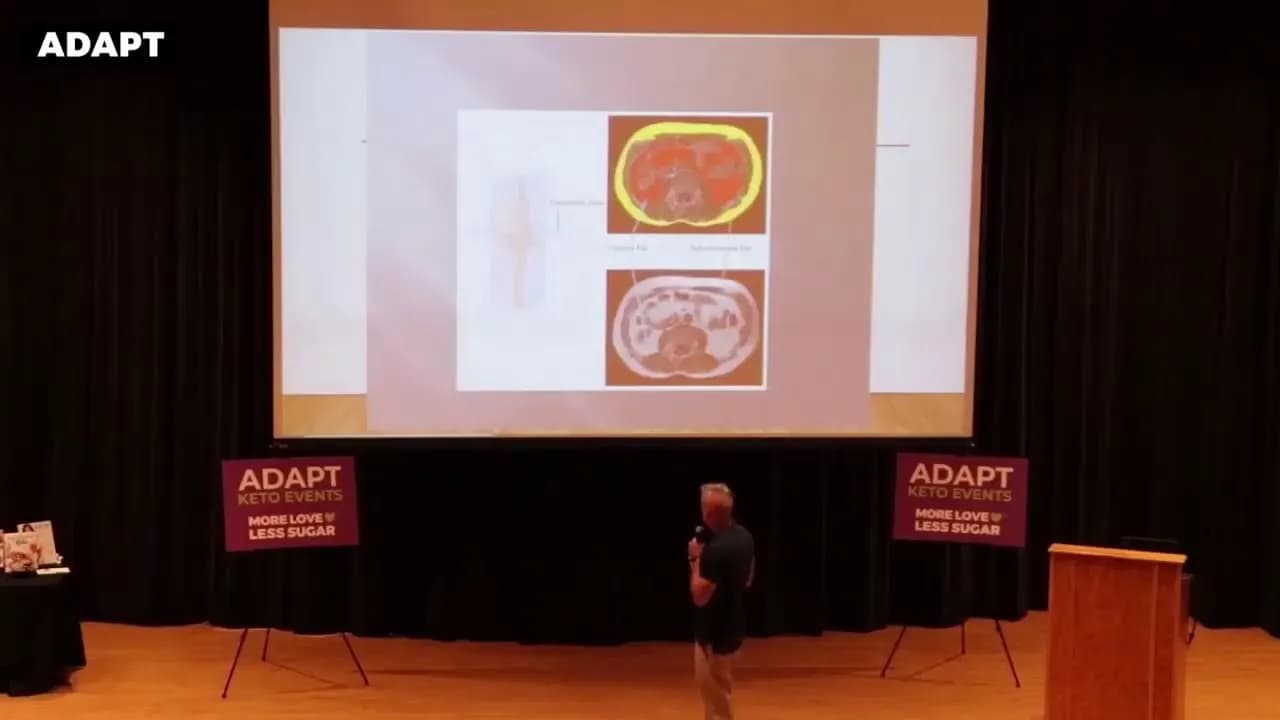
Visceral fat: collection of highly inflammatory tissue stored deep in abdominal cavity surrounding viscera (inner organs). Releases inflammatory molecules distributed body-wide, causing havoc and disease.
Recent June study: releases fracktalkine protein attracting NK killer T cells (first line cancer fighters) back into visceral fat, trapping them, rendering ineffective. Cancer always occurring, normally fought off by immunity. Explains obesity-cancer association mechanism.
Inflammatory cytokines cause havoc in all tissues.
Exposure Matters
Quantity bad, but time exposed critical. Small amount long-term causes disease; large amount short-term less so. Dynamic nature important to track.
Best measurement: MRI or CT (DEXA insufficient, no visualization). Patients process images better than lab numbers, evokes primal response to change lifestyle. More effective than anything else. Example: patient syncopized upon seeing own visceral fat on scan, thought he was healthy.
Recent study: doctors reviewing CT/radiology images with patients get better results.
Walk patients through images, track over time, guarantee elimination improves conditions and body.
Visual Assessment
Can assess visceral fat by face inflammation. Does so at Mall of America in Minneapolis. Future: external changes indicate visceral fat, like ancestors' medicine people spotting issues.
Body of knowledge from four million years of Homo sapiens living has been lost due to convergence and transference of modern technology. Since tracking labs and numbers, humans have developed more disease, more chronic disease than at any point in humanity's existence, including obesity and diabetes.
Laboratory studies are viewed quantitatively and numerically, missing the quality of the number. For instance, one TSH or LDL number does not apply to everyone; the quality of that LDL or the cell receptor quality is not addressed. Lab reports are a Fool's errand for optimization—they identify disease with some utility but only tell half the story. Must consider quality of what's measured and quality of the environment in which that substance exists.
Fasting insulin level, say 3, at a particular time—insulin receptors on one person's cells differ from another's. Lab ranges apply the same "normal" to everyone without discussing tissue response or biological interaction. Every lab value has another half: what it means within the tissue, where everyone's tissue is different.
Friend diagnosed with Hashimoto's found a physician who measured free T3, free T4, TSH, etc., for accurate thyroid function reading, and established that person's baseline to contextualize lab numbers as normal or healthy for them.
Baseline is quantity of substance, not health of tissues thyroid hormone or TSH acts on. Complex endocrine system ignored; no measurement of receptor changes over time or quality of physical/chemical environment the hormone exists in. Phil's TSH works differently on his tissues than on others; labs are one-dimensional.
Use research metrics of signal (what matters) vs noise (distraction). Cholesterol has much noise, not black-and-white. Visceral fat has highest signal-to-noise ratio. Anecdotally and in studies, nothing eradicates disease, changes/improves people as effectively as addressing visceral fat.
Study showed visceral fat had highest causality for mortality compared to subcutaneous fat and liver fat.
Radiologists untrained to track visceral fat despite seeing it daily. Question: What else is more important for patient health?
Jack admits pre-interview blind spot to visceral/pericardial fat on coronary artery calcium scans. Radiologists dismiss: "Everyone has it, why comment?"
In general surgery training, moved visceral fat out of way in bellies for five years without questioning why it's there or what it means.
79-year-old physician reading his own CTs for 38 years diagnosed pancreatic cancer but missed visceral fat cause. Sean pointed out "black stuff" (visceral fat); physician had epiphany, asked: "Does this mean we should follow visceral fat instead of cholesterol?"
Fatty infiltrates (fatty streaks) in skeletal muscle associated with sarcopenia (muscle atrophy) and dynapenia (muscle weakness). Linked to visceral fat; eliminating visceral fat removes these, improving muscle appearance/performance/strength.
Orthopedic surgeon friend: Study shows shoulder rotator cuff muscles' fatty infiltrates predict bad surgical outcomes, but not tracked elsewhere (e.g., knee). Present in older people with visceral fat, absent in young athletes like pro football players.
Fatty infiltrates related to visceral fat process, also in smooth muscle (second body of muscle, lining arteries, veins, capillaries, GI tract, glands—autonomic, non-volitional).
Skeletal muscle voluntary; smooth muscle automatic, largest tissue in vascular system, vulnerable to disease. Likely atherosclerosis process: fat deposition in smooth muscle = hardening of arteries.
Correcting lifestyle causing visceral fat improves smooth muscle, vascular performance. Visible pulses emerge; aorta bulges with blood flow (mistaken for abdominal aortic aneurysm). Improved perfusion to joints, back, brain enhances life quality, memory. Sean feels 30 years younger in health enjoyment.
Business pros use KPIs (key performance indicators) on dashboards to assess company health. Apply to body: KBIs like visceral fat, fatty infiltrates, smooth muscle health, facial inflammation, skin changes (e.g., telangiectasia). Track via photos, apply strategies.
Turn people into CEOs of their body-corporation. Question: Why tolerate crappy health KPIs (cholesterol, labs) driving revenue vs true optimization when you demand valid KPIs for business?
Healthcare prioritizes CPT coding, authorizations, Big Pharma/Insurance over patient health. Longer patient in practice = worse off; intolerable in Corporate America, tolerated in healthcare (largest economy).
Virta Health (Dr. Sarah Hallberg, RIP) manages diabetes for large self-insured companies, sharing cost savings (model like Sammy Urkine's Trulia/Zillow).
Performance-based incentives align: e.g., marketing consultant charges percentage of revenue generated.
Misaligned incentives; no system incentive for health. Individuals/physicians/patients must track useful metrics (KBIs), correlate internal/external signs. Medicine men assessed health visually; now normalized to unhealthy baselines.
Patient example: Not losing weight but everyone says they look great—external sign of improvement.
Native Americans hunted healthiest animal (highest nutrient/microbiome value in hide/fur for recipient hunter's health), unlike other species hunting weakest. Human cerebral cortex enabled selecting best.
Instagram/Twitter: @drseanomara YouTube: Dr Sean O'Mara (with apostrophe) Website: www.drseanomara.com
Works with highly motivated alphas wanting health optimization; studies them for book. No time for uncommitted.
Dr. Sean O'Meara invites motivated individuals serious about reversing chronic disease to contact him for a consultation to become the healthiest version of themselves. The host notes three phrases from the podcast that would make fantastic book titles and praises Jack's performance-based marketing model, which is rare in an industry full of bad marketing. Jack's confidence in his expertise allows him to guarantee results. Dr. O'Meara shares he wasted hundreds of thousands of dollars on marketing firms that wouldn't guarantee performance. He envisions using Jack's services to help healthcare providers get compensated based on performance for reversing disease, predicting this as the future of healthcare. Many healthcare professionals are sick of the current system and would trade golden handcuffs for a performance-based model.
The hosts plan to have Dr. O'Meara back for part two to cover additional topics. Podcast promotions: Follow Dr. Ovadia on Twitter at @iFixHearts, website avaniahearthealth.com, metabolic health quiz at ifixhearts.co. Outro slogan: "America is fat and sick and tired. 88 percent of Americans are metabolically unhealthy and at risk of a sudden heart attack."
Dr. Philip Ovadia introduces Dr. Sean O'Meara as an outside-the-box physician thinker whose insights add a unique angle to metabolic health. Dr. O'Meara, an emergency medicine physician, retooled himself after personal medical conditions and a patient's challenge led him to change his diet. This dietary change had profound personal impact, spilling into his professional life. He became a researcher to understand how simple dietary changes could have such effects. He connects with Dr. Ovadia on the importance of lifestyle changes for health conditions, noting it's still an unpopular viewpoint despite more colleagues coming on board. It took him 15 years to realize this, raising concerns about the average person's ability to make informed decisions.
Working in a hospital wellness center, Dr. O'Meara noticed a fit man who worked out briefly. This man followed a paleo diet. Dr. O'Meara had multiple conditions: Barrett's esophagus (pre-cancerous lesions, EGD every three months without sedation), high blood pressure, pre-diabetes, overweight, restless leg syndrome, obstructive sleep apnea, enlarged prostate. After adopting paleo, his prostate symptoms dramatically improved—strong urine stream like Niagara Falls, no nighttime waking. This sparked fury that medical school never taught dietary lifestyle changes could reverse these chronic conditions, which were treated symptomatically with medications that worsened him. He decided to research how diet reverses chronic disease.
Joined a research practice in Minneapolis with Dr. Zhang (MD PhD), who introduced visceral fat as a key biomarker. Dr. O'Meara believes nothing is more effective at eradicating chronic disease than eliminating visceral fat. He promotes awareness to other physicians.
Four years college, four years medical school, four years emergency medicine residency (total 12 years post-college). Despite extensive training in disease and trauma, no preparation for effective lifestyle management or optimizing health.
Across specialties (family medicine, cardiology, emergency medicine, psychiatry), physicians consistently report 5-15 years of training focused on treating sick people, not preventing illness or keeping people healthy. Many physicians fix their own health first, then research why it works, realizing much of medical training is wrong or useless.
Served as military physician to U.S. President, Vice President, Secretary of State, traveling with them. Preventive care was poor, same as general population. Later provided care to 52 billionaires and royal families via a company with White House doctors—wealthy people eat poorly, live unhealthily, no better clue about health than average people.
"If you make the right changes you start living healthy you start eating healthy you will you can expect to have reversal chronic disease."
Studied 5,000 people: Scanned them, measured chronic disease, tracked lifestyle changes' impact on visceral fat. Chronic disease improved or resolved. Surprisingly, participants performed better—stronger, faster, smarter, improved quality of life across all measured tasks. Potential for corporate adoption: Reduces second-highest operating cost (employee healthcare) and increases productivity.
Visceral fat is highly inflammatory tissue stored deep in the abdominal cavity surrounding inner organs (viscera). Releases inflammatory molecules distributed body-wide, causing havoc and disease. Recent June study: Releases fracktalkine protein attracting NK killer T cells (key cancer fighters), trapping them in fat, rendering ineffective—explains obesity-cancer link mechanism. Inflammatory cytokines cause issues across tissues. Quantity and exposure time matter: Small amount long-term or large amount short-term both cause disease. Dynamic tracking essential. Best measured by MRI or CT (DEXA insufficient). Google visceral fat for deeper understanding due to its elimination's powerful health, performance, and quality-of-life benefits. Factors increasing visceral fat: processed foods, sedentary lifestyle, poor sleep, alcohol, stress.
DEXA scans are not ideal because they only provide a number without visualizing visceral fat. MRI or CT scans allow direct visualization, enabling patients to act on the information to change their lifestyle. Patients process visual images better than lab reports, which require physician interpretation. Seeing visceral fat evokes a primal response, motivating lifestyle changes more effectively than any other method.
Dr. Sean O'Mara recounts a patient who syncopized upon seeing his visceral fat on a scan, despite believing he was healthy—he turned green, gray, then white, and fell, hitting the ground.
A recent study shows doctors reviewing CT scans and radiology images with patients achieve better results than just reading reports. Walk patients through their visceral fat, track it over time, and guarantee improvements in conditions and body if eliminated.
Dr. O'Mara assesses visceral fat by facial inflammation—he's skilled at it from experience. At the Mall of America in Minneapolis, he mentally evaluates passersby. Future diagnostics may use external body changes to indicate visceral fat, avoiding expensive scans, akin to ancient medicine men/women assessing health at the watering hole over 4 million years of Homo sapiens evolution.
Modern lab tracking has led to more chronic disease, like obesity and diabetes, than ever. Labs provide quantities but ignore quality of the number (e.g., TSH, LDL)—cell receptor quality and environment matter. Labs identify disease but fail for optimization.
Fasting insulin example: A level of 3 doesn't account for individual insulin receptor differences. Lab ranges apply uniformly, ignoring tissue responses and biological interactions.
Thyroid example (Hashimoto's patient): Free T3, free T4, TSH need individual baselines for context, but even then, ignore tissue health, receptor changes, and hormonal environment quality.
Phil's TSH acts differently on his tissues vs. Dr. O'Mara's. Labs are one-dimensional; use signal-to-noise ratio—visceral fat has the highest signal, minimal noise, unlike cholesterol.
Visceral fat shows highest causality for mortality vs. subcutaneous or liver fat. Radiologists ignore it despite seeing it daily—no training on its importance. Proponent of coronary artery calcium scans, but upper abdomen cuts reveal visceral fat and pericardial fat, rarely commented on. Radiologists say "everyone has it, why bother?"
In surgery training, fat was moved aside without questioning its presence or meaning.
Anecdote: 79-year-old physician reading his own CT for abdominal pain; colleague diagnosed pancreatic cancer. Dr. O'Mara noted visceral fat as the cause. The veteran radiologist (38 years experience) initially missed it, calling the black areas "black stuff," then had an epiphany: "Does this mean we should follow visceral fat instead of cholesterol?"
Fatty infiltrates (fatty streaks) in skeletal muscle associate with sarcopenia (atrophy) and dynapenia (weakness). Seen with visceral fat; eliminating visceral fat removes them, improving muscle performance.
Orthopedic surgeon friend: Study links shoulder muscle fatty infiltrates to poor rotator cuff repair outcomes, but not tracked body-wide (e.g., knees).
In NSF study scanning pro football players' legs (no infiltrates) vs. older people with visceral fat (infiltrates present). Links to Dr. Ovadya's work on avoiding sarcopenia.
Smooth muscle lines arteries, veins, capillaries (largest tissue mass), GI tract, glands—autonomic, non-volitional (vs. skeletal). Fatty infiltrates likely cause "hardening of the arteries."
Correcting visceral fat-causing lifestyle improves skeletal/smooth muscle, vascular performance. Dr. O'Mara has visible pulses, bulging aorta on lying down—shows patients to motivate (conventional docs might misdiagnose as AAA).
Improved perfusion enhances joints, back, brain (better memory), adding "30 years" quality of life. People disbelieve due to systemic narratives.
Podcasts/social media spread this authentically.
Business leaders use KPIs (key performance indicators) on dashboards to assess company health. Apply to body: KBIs like visceral fat, fatty infiltrates, facial inflammation, telangiectasias—track via photos, apply strategies.
Turn patients into CEOs of their body-corporation. Question: Why tolerate crappy medical KPIs (cholesterol, labs) driving revenue over health, unlike corporate intolerance?
Healthcare prioritizes CPT coding, authorizations, Big Pharma/Insurance—keeps patients sick longer for revenue.
Potential transformation like Virta Health (Dr. Sarah Hallberg, recently deceased): Manages diabetes for self-insured companies (e.g., via Sami Inkinen, Trulia/Zillow founder), paid portion of cost savings—aligns incentives.
Marketing consultant host uses performance-based model (percentage of revenue generated), rare. Apply to medicine: Treat diabetics for % of healthcare savings.
Misaligned incentives; individuals/physicians must take control, track KBIs, correlate internal/external signs. Ancient medicine men assessed health visually; modern loss due to widespread unhealthiness.
Patients often report not losing as much weight as desired, yet others compliment their appearance. This indicates visible improvements despite scale numbers. Need better quantification methods.
Native Americans hunted the best animals in the herd—those with highest nutrient value and best microbes on their hide for microbiome health. Unlike other species that target the sick or weak (e.g., heifer dragging its leg), humans used cerebral cortex to identify superior specimens. Best fur conferred microbes and lifestyle benefits, perceived as 'secret powers.' This selective hunting shaped human evolution.
Discussion teases entirely new chapter on this topic. Plans for part 2 podcast episodes to explore fascinating nuggets from end of conversations. Dr. Sean O'Mara invites return to dive deeper; material is fantastically interesting but needs gradual introduction.
Find Dr. Sean O'Mara on Instagram and Twitter at @drseanomara; YouTube at Dr Sean O'Mara (with apostrophe); website www.drseanomara.com. Seeks highly motivated 'Alphas' for coaching—only super-motivated individuals wanting to optimize health. Studies clients for book; no time for uncommitted people unwilling to sprint or work hard. Focus: reversing chronic disease.
Host impressed by performance-based marketing offers—rare confidence indicator. Dr. O'Mara threw hundreds of thousands at marketing firms with no guarantees, now sees potential. Praises host Jack for turning investment into tens of millions. Future vision: performance-based pay for healthcare providers reversing disease. Many professionals stuck in broken system, ready to trade 'golden handcuffs' for performance model.
Definite part 2 planned. Hosts: Dr. Phil Ovadia (@ifixhearts, avadiahearthealth.com, metabolic health quiz at ifixhearts.co). Podcast: Stay Off My Operating Table. Outro: America is fat, sick, tired—88% metabolically unhealthy, at risk of sudden heart attack. Dr. Ovadia was morbidly obese surgeon, now rebel MD fighting for health.
Dr. Sean O'Mara, emergency medicine physician, retooled into health/performance optimizer after personal health turnaround via diet change. Profound impact led to research career. Met Dr. Ovadia early via social media; aligned on diet/lifestyle for health. Took 15 years for realization; concerns for average person if physicians are misinformed.
Worked out 1-1.5 hours daily in hospital wellness center. Noticed fit patient doing 5-10 minute sessions. Patient was Paleo dieter. Dr. O'Mara had: Barrett's esophagus (EGD every 3 months, no sedation), high blood pressure, pre-diabetes, overweight, restless leg syndrome, obstructive sleep apnea, enlarged prostate (weak urine stream). Switched to Paleo; urine stream became strong like Niagara Falls, no nighttime waking. Fury at medical school omission—diet/lifestyle reversed all conditions, not meds.
Researched chronic disease reversal. Joined Minneapolis research practice with Dr. Zhang (MD PhD); introduced to visceral fat biomarker. Most effective at eradicating chronic disease. Promotes awareness to physicians.
4 years college, 4 years medical school, 4 years emergency medicine residency (total 12 years post-college). Trained in disease/trauma care, not lifestyle/health optimization.
Across specialties (family medicine, cardiology, ER, psychiatry), training focuses on treating sick, not preventing/optimizing health. Many physicians fix own health first, realize systemic flaws.
Served as physician to US President, VP, Secretary of State (active duty military). Traveled with Dick Cheney, Bill Clinton, George Bush, Colin Powell, Condoleezza Rice—preventive care poor. Later company served 52 billionaires/royal families: wealthy eat/live poorly, no health edge.
Studied 5,000 people: lifestyle changes targeting visceral fat reversed chronic disease. Not just disease absence—performance improved: stronger, faster, smarter, better at all tasks. Corporate potential: reduce #2 cost (healthcare), boost productivity.
Visceral fat: highly inflammatory tissue deep in abdominal cavity surrounding organs (viscera). Releases inflammatory molecules causing body-wide havoc and disease. Google for fascination—elimination powerfully boosts health, performance, life quality.
A recent study from June showed that visceral fat releases a problematic protein called Franklinton (likely fractalkine), which attracts NK killer T cells—the first line of cancer-fighting immune cells—back into the visceral fat, trapping and rendering them ineffective. This sequesters them like a spleen sequesters erythrocytes, preventing them from fighting cancer in the periphery. Cancer constantly occurs in the body, but effective immune systems, particularly NK cells, suppress it. Visceral fat impairs this, explaining the strong association between obesity and cancer observed for a decade. Visceral fat also releases inflammatory cytokines and molecules causing havoc in all tissues.
Reducing visceral fat quantity matters, but exposure duration is critical. A small amount over a long time causes disease; a large amount briefly may not. Rapid accumulation from processed foods, sedentary lifestyle, poor sleep, alcohol, and stress doesn't immediately cause much disease, but prolonged exposure does. Track the dynamic nature of visceral fat over time.
Visceral fat serves as a key biomarker to monitor. Patients may not afford MRI or CT for accurate analysis—DEXA scans are inadequate as they only give numbers without visualization. MRI/CT lets patients see visceral fat, evoking a primal response to change lifestyles. Lab reports don't motivate change as patients can't process numbers easily, but seeing visceral fat does.
One patient, thinking he had a healthy diet, saw his visceral fat on scan, turned green, gray, then white, and syncopized, falling and hitting the ground.
A recent study showed doctors reviewing CT scans and radiology images with patients achieve better results. Walk patients through their visceral fat images, track over time, and guarantee improvements by eliminating it. Faces reflect visceral fat; inflammation is visible, allowing assessment by facial appearance. Dr. Omara assesses visceral fat in people at the Mall of America by face alone.
Ancestors used visual cues at watering holes to assess health changes. Modern lab numbers have led to epidemics of diabetes and chronic disease, ignoring quality of numbers (e.g., TSH, LDL quality, cell receptor health) and environment.
Fasting insulin of 3 doesn't account for individual receptor differences. Lab values are one-dimensional, ignoring tissue response and biological interaction.
Hashimoto's patient needed free T3, free T4, TSH measured against personal baseline for context. But even baselines ignore tissue health, receptor changes, and hormone quality/environment.
Use research metrics: signal (what matters) vs. noise (distraction). Cholesterol has much noise; visceral fat has the highest signal-to-noise ratio, most effective for eradicating disease.
A study showed visceral fat has the highest causality for mortality among visceral, subcutaneous, and liver fat.
Radiologists aren't trained to comment on visceral fat—it's overlooked despite being visible on every scan. Even coronary artery calcium scans show upper abdomen/pericardial fat, rarely noted. Radiologists say "everyone has it, why comment?"
In general surgery training, visceral fat was moved aside without considering its significance.
79-year-old physician reading his own CTs diagnosed pancreatic cancer in acute belly pain patient. Dr. Omara pointed out massive visceral fat as the cause; the doctor initially couldn't see it ("all that black stuff"), then had an epiphany: "Does this mean we should follow visceral fat instead of cholesterol?"
Fatty infiltrates (fatty streaks) in skeletal muscle associate with sarcopenia (muscle atrophy) and dynapenia (muscle weakness). They correspond to visceral fat; eliminating visceral fat removes them, improving muscle. Orthopedic study links shoulder fatty infiltrates to poor rotator cuff surgery outcomes—it's body-wide. Scans of pro football players showed none; older visceral fat patients did.
Same process affects smooth muscle (lines arteries, veins, capillaries, GI tract, glands—non-volitional, autonomic). Likely causes "hardening of the arteries" via fat deposition, confirmed histologically.
Correcting lifestyle improves vascular performance: visible pulses, aorta bulging on lying down (not aneurysm). Better perfusion to joints, back, brain enhances memory, adds years of quality life.
Business leaders use KPIs (key performance indicators) on dashboards to assess company health. Apply to body: track KBIs (key biological indicators)—visceral fat, fatty infiltrates, facial inflammation, telangiectasias via photos. Strategies turn patients into CEOs of their body-corporation.
Conventional KPIs (cholesterol, labs) drive revenue, not optimization. Why tolerate poor health KPIs when corporate America demands valid ones? Healthcare prioritizes CPT coding, authorizations, Big Pharma/Insurance over patient health—patients worsen in practices, unlike business.
Applied to individuals who are falling apart, this shows potential for transformational change in the future. Disruption similar to what Sami Inkinen is doing with managing diabetes for large self-insured companies. Sami Inkinen started Trulia, a website app now owned by Zillow, and now runs Virta Health. Dr. Sarah Hallberg, who recently passed away, was involved with Virta Health. Virta Health takes care of diabetics for large self-insured companies, likely for a portion of the cost savings.
When not hosting a podcast, works as a marketing consultant on a performance model. Most marketing organizations charge a flat fee; they charge a percentage of the money made.
Brilliant model of treating employees who are diabetics for a percentage of the healthcare savings. Aligns incentives. Central problem in healthcare system is misaligned incentives with no incentive to keep people healthy. Whether the system changes or individuals incentivize their own health, people should track their ketones and take charge of their health. Cannot wait for the system to change; individuals, physicians, and patients need to take back control and use useful health metrics.
Fascinated by external signs correlating internal health. Medicine men could look at someone and know if healthy. Lost that ability because everyone around is unhealthy, so cannot differentiate. Patients say they're not losing weight as wanted, but everyone tells them they look great—that's the sign. Need better way to quantify it.
Native Americans would hunt the best animal in the herd—the one with highest nutrient value, best microbes on hide for microbiome. Humans, with cerebral cortex, select the best; other species hunt the easiest (sick or weak). Best fur conferred microbes and lifestyle benefits to the hunter.
Running discussion for next podcast season with part twos due to fascinating nuggets at end. Have Dr. Sean O'Mara back for part two to discuss this fully. People not quite ready; need to bait them along. Will launch on Instagram and Twitter shortly.
Instagram: @drseanomara—posts data and information on optimizing health. Twitter: same. YouTube: Dr Sean O'Mara (with apostrophe). Website: www.drseanomara.com. Looks for highly motivated Alphas to work with for optimizing health. Studies them for a book. Only works with super motivated people serious about reversing chronic disease—no time for those unwilling to sprint or make changes.
Several phrases from podcast would make fantastic book titles. Impressed by performance-based marketing—rare, shows confidence and expertise. Threw hundreds of thousands at marketing firms with no guarantees; would have given money to performance-based model and turned it into tens of millions.
Future motive for businesses: get providers compensated through performance for reversing disease. Many healthcare professionals sick of the system would trade golden handcuffs for performance pay model.
Honor to talk. Will have back for part two. For Dr. Phil Ovadia, Jack Heald, this has been Dr. Sean O'Mara on the Stay Off My Operating Table podcast. Follow Dr. Ovadia on Twitter @ifixhearts, website ovadiaharthealth.com, metabolic health quiz at ifixhearts.co.
America is fat, sick, and tired. 88% of Americans are metabolically unhealthy and at risk of sudden heart attack. Go to ifixhearts.co and take Dr. Ovadia's metabolic health quiz to learn steps to reclaim health and reduce heart attack risk.
Keep Sean OMara, MD JD, Health & Performance Optimizing in your library
Save the videos and channels worth coming back to, and find them again in one place.