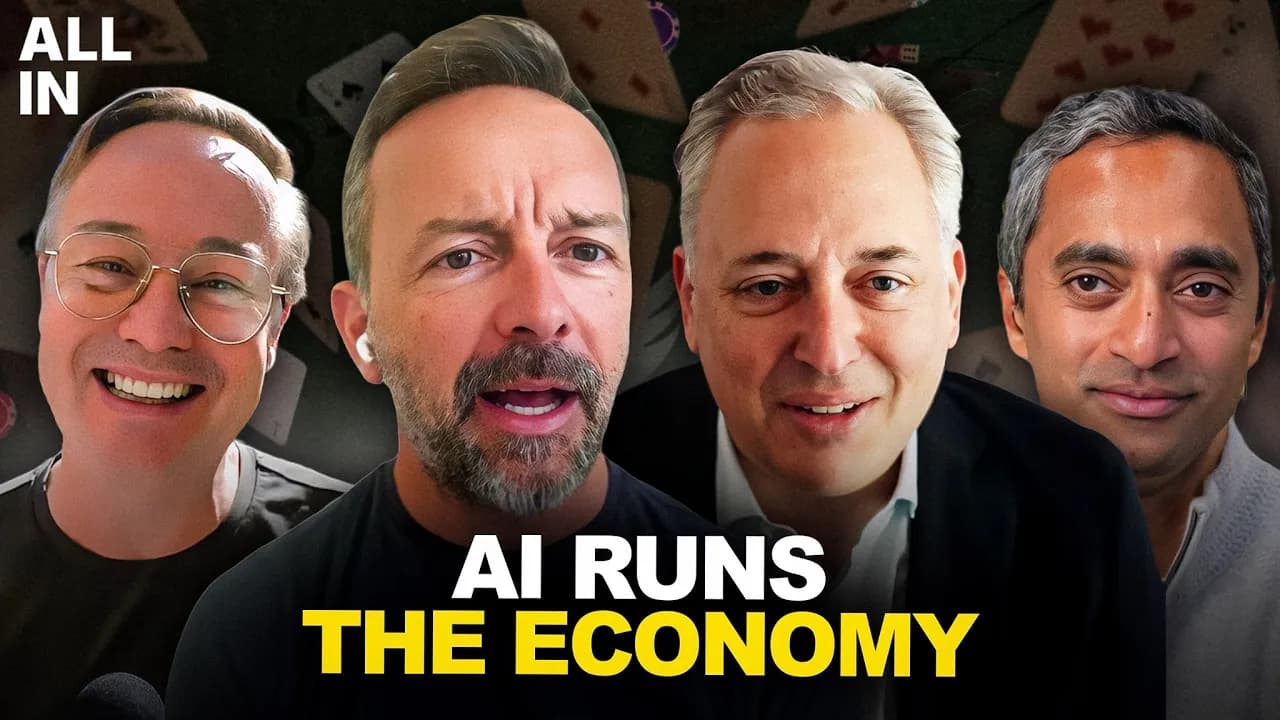
Iran War, Oil Shock, Off Ramps, AI's Revenue Explosion and PR Nightmare
In a Nutshell
Brad Gerstner highlights Trump's surprise State of the Union shout-out for Trump accounts (100K+ kids signing up daily, live July 4th), proposes a billionaire equity pledge to fund them, and sees an off-ramp from the Iran oil shock war via Trump doctrine (degrade threats without quagmire, declare victory, pivot to China summit) despite escalation risks like Strait closures and nuclear threats. AI firms like Anthropic ($14B run rate) and OpenAI ($20B) explode revenue via coding agents and enterprise adoption, but face J-curve losses ($500B+ invested), PR nightmares from doomerism (unpopularity rivals ICE), data center cancellations ($120B revenue lost), and societal disruptions shifting power to working-class voters—industry needs honest messaging on experimentation turning production. Warns against socialist wealth taxes (e.g., Washington's 9.9% millionaire tax driving exits like Schultz/Bezos) fueling class warfare; AI/entrepreneurs can solve education/housing/healthcare to avert seizures if regulations break.
These notes were generated by AI and may contain inaccuracies.
Brad Gerstner received a surprise shout-out from President Trump at the State of the Union. He had no idea it was coming; it was not in the original speech and was added by the president. Gerstner attended because Trump was expected to discuss Trump accounts. He described it as an extraordinary night, appreciating democratic institutions and traditions happening every year for 250 years. The chamber is small; he sat near the first family, Jared, and Ivanka. Gerstner sent a heart gesture to America at the right angle, avoiding any misinterpretation.
Trump accounts are signing up over 100,000 kids a day, with millions already claimed. Nearly 30 million kids in America are eligible for at least $250 if they claim their account. Accounts go live on July 4th. The shout-out accelerated interest, highlighting the program's goal to get Main Street America into capitalism by directly owning great companies.
Suggestion for a voluntary giving pledge where billionaires like Larry, Sergey, or Zuckerberg pledge 5% of their shares over 20 years to kids' accounts. This would provide fractions of shares (a tenth, hundredth, or thousandth) and be incredibly material. Gerstner noted it has come up and teased banger announcements toward July 4th.
Massive volatility in Brent crude oil over last five trading days: spiked to $84 on Friday (day 7 of war), $119 on Monday (day 10), dropped to $84, jumped to $100 after three commercial ships hit in the Strait of Hormuz on Wednesday (not oil tankers; flagged Thai, Japanese, Marshall Islands). Currently at $99.
Historical spikes: 1978 oil shock required gas lines by license plate; Gulf War hit $100 ($126 today); 2008 peak $216 in today's dollars from China demand; Russia-Ukraine invasion hit $115 ($133 today).
Iran's new Supreme Leader Mosh Taba keeps Strait closed to pressure enemy. Wall Street Journal quoted senior fellow at Middle East Institute: reopening requires ground troops. Polymarket: 27% chance US forces enter Iran by end of March, 57% by end of year.
Higher oil prices increase direct costs in consumer/enterprise products, hurt confidence. Goldman Sachs: raised PCE inflation forecast from 2.1% to 2.9%; core PCE (ex-oil) from 2.2% to 2.4%; lowered GDP forecast by 30 basis points; expect higher unemployment. S&P peaked at 24x, now 21x.
Trump doctrine pragmatic vs. neocon: limited goals to destroy/degrade threats to US national security, not spread democracy. Market may be wrong with post-traumatic stress from Afghanistan/Iraq, fearing quagmire. Trump wants regime change ideally by people rising up, not US boots on ground like Cheney doctrine.
Trump said war would be over very soon; oil dropped from $120 to $90 instantly, signaling market belief in no sustained conflict. Iranians will chest-bump to save face. March 11th: President activated IEA members; Chris Wright released 172 million barrels, coordinated ~400 million total. Another ~1 billion barrels possible from strategic stockpiles. Worst behind; now finding off-ramp.
US degraded Iran's army, navy, air force massively; declare victory and exit. Faction (largely Republicans) wants escalation: ground troops, regime change, continued pounding (e.g., WSJ op-ed). Risks: Strait closed now; worse if Iran's oil/gas hit, they retaliate against Gulf States (e.g., blew up Oman oil depot). Could target desalination plants (70% Riyadh water; ~100 million on Arabian Peninsula depend on them; soft targets). One diesel plant hit in Iran led to tit-for-tat in Kuwait. Could render Gulf uninhabitable without water.
Israel hit harder than ever (social media blackout); prolonged war could destroy it, exhaust air defenses, risk nuclear escalation. Iran has dead man's switch over Gulf economic fate/habitability. Deescalation via ceasefire/negotiated settlement needed.
Trump has high probability intel for success/off-ramp, but chaotic now. If neocons win and Polymarket sharps right (57% boots on ground), ends Trump's second term. Betrayals: starting Iran war (reason to vote Trump: no wars, no WWIII/nuclear risk); Epstein files; ICE cruelty (corrected by firing Christy Gnome); ignoring working man (inflation >3%, unemployment up 10%). Foreign affairs low priority. Family enrichment perception. Democrats sweep chance at 45%, win 2028, end MAGA/Trump 2.0 agenda.
Trump will find off-ramp per Trump doctrine (not neocon). Focus: China. End of month: 3 pivotal days with Xi Jinping. Xi incentivized for grand bargain. US declares victory (degraded capabilities, no democracy experiment), wishes Iranian people well. If Iran continues destroying cargo in Straits, neighbors/Israel get involved.
US produces/consumes 20 million barrels/day (modest problem). Massive for China/Asia/Gulf dodging missiles. Others will pressure/fight Iran if US exits. Risks weighed vs. doing nothing (Iran nuclear missile, Venezuela Monroe Doctrine breach).
All roads lead to China; Xi offers grand bargain at summit. Chinese not defending Iran, kept summit (need oil: 20% consumption from Venezuela/Iran, 100% for feedstock/transport). Their strategic reserve insufficient for 5-6 months. China hurts most; summit on means Xi wants off-ramp. 25% youth male unemployment in China; worsens without oil.
That's the unemployment rate you should be focused on, Jason.
China issue is separate. Kitchen sink didn't include the Chinese. Four very salient points. Broadside where you kitchen sinked it. Long wars are unpopular. It will hurt Republicans in the midterms or 2028 if this turns into a long war. President understands political instincts are impeccable and favors short, decisive, swift military actions, whether Midnight Hammer or Maduro raid. At or close to point where president decides next steps. Completed objectives. Don't let neocon wing expand objectives—they've always been wrong, never wanted to get out of Iraq and Afghanistan, would still be there after 20 years. Wall Street Journal is tip of the spear for neocon establishment. Ignore those voices and let president wrap it up.
Strong agreement, hope he wraps it up quickly, no more loss of life. Keep discussing ongoing breaking news in coming weeks.
Back to zone of excellence, AI and tech. OpenAI and Anthropic scaling revenue and costs faster than ever in history of business. Investors in both. Anthropic hit $14 billion run rate last month, February—grown from $1 billion to $14 billion in 14 months, 12x year-over-year, valued at $380 billion last month, feels like bargain. OpenAI ended 2025 at $20 billion annualized run rate, grown from $2 billion to $20 billion in 24 months, valued at $840 billion last month. Sam Altman has Dario in rearview mirror, could get lapped any moment. Dario closing in fast, winning business-to-business side. J curve insane. $250-500 billion or more invested before profitability.
Fantastic, bought a lot more since Sam Altman BG2 episode. What's better buy: Anthropic at $380B or OpenAI at $840B? Will they go public? Chance of that?
Love your children equally, both incredible. Anthropic has financial momentum, OpenAI too. Single most important question this year: would AI revenue show up? 60-90 days ago, tremendous skepticism, no incremental revenue from AI infrastructure. January-February nuclear moment, splitting the atom. Anthropic $6 billion in February (28-day month), more than annual revenue of Databricks and Snowflake after 12 years—greatest software companies. Could do total revenue of SpaceX this year in first four-five months.
Drivers of Revenue Growth
Crossed threshold with Opus 4.6, saw with ChatGPT 5.4. Models and agents (Claude, Codex, ChatGPT) no longer competing with IT budgets, augmenting labor, competing with labor budgets. Impossible to have $6B month displacing IT budgets. Millions of companies spin up agents, willing to pay because product worth it. Revenue and usage momentum continues in March, accelerates. Models and agents dumbest today they’ll ever be, early innings of compute and algorithmic capability.
Should go public: tons of institutional demand, need cheap access to money for compute (more compute constraint today than last 3 years). Retail investor must be in game—these most important companies in history of capitalism/America, destabilizing not public. Jensen said last week $40B recently invested in these two his last money because both going public this year. Preparing that path. Get shares in kids’ accounts for American economy future.
Revenue Quality Debate
No single good example of sustained positive margin expansion from AI in true corporate enterprise—not small test. $6B from thousands of companies checking AI box to boards, tens of thousands customers paying $200+/month. But unlike Databricks/Snowflake in critical production workflows underlying revenues/profits, AI still experimenting—know important but don’t know what to do. Can’t slot into critical workflows (healthcare misdiagnosis fines/jail, financial services lawsuits). Amazon edict: no AI in AWS without human review/approval—three-four Sev1 faults from agent-written code brought down AWS. AWS hyper-reliable (12 9s) via humans/deterministic code, enormous cost but no Sev1.
Can get to $20-40B revenue, but early industry, test budgets, will emerge into production methodically—don’t oversell.
Of $20B, strip consumer (half), how much experimental vs production? Put aside consumer subscriptions (value like Netflix, $20/month worth it even faulty/no SLA).
Individual engineers (few million) pay $200/month, company subsidizes, knows costs but no tick-and-tie review for hallucinations (Amazon FT story blast radius, controls in place).
Coined experimental run rate revenue vs annual recurring revenue. Experimentation because new, but Palantir, US government/military, Nvidia, major enterprises argue full production—existential to Iran wartime effort. March revenues continue/up prove recurring, not endless experimentation. Scratched surface of companies adopting AI, numbers to stratosphere.
On same side, want numbers to moon, but circumspect: pay models millions/year, consume more tokens daily, revenues not tripling. Leading edge team, Fortune 1000 behind. Spending triple every 3 months, no revenue triple—others similar. Ask Michael Dell Friday—he said year ago no ROI, today big ROI.
Enterprise revenue mostly coding assistance, first big breakout use case (consumer: research/writing chatbots). Demand for code highly scalable—always shortage of software engineers, even Silicon Valley. Rate-limiting for startups: not enough engineers for product roadmap. Fortune 500 hardly recruit any (all to Valley). Latent demand to generate code in large quantities, create new products as cost down. Leads to agents using generated code.
Change management in Fortune 500, McKinsey study: many pilots experimental, not successful. Beyond coding to company transformation speculative—but will happen, bullish. Breakout beyond coding: agents next. Paying per token amazing deal vs recruiting/vetting/perks. Metered before on people, now on tokens, cost down.
Disagree on labor displacement—shortage means $6B incremental not $6B layoffs. Artificially constrained engineers, now turn on like electricity—game changer, unlock economy. Augmenting human labor, not displacing—productivity gains.
Production Adoption in Startups
Look to startups, not big companies resisting (lowers headcount, implementer out of job). Startups using in production: legal work, marketing, SDRs, accounting, reviewing legal docs, HR—work normally consultants/outsource/hires. Production ready at scale in startups for blocking/tackling chores via LLMs.
J curve: when profitable? LLM industry ~$500B invested (underestimate, lot more). Tesla/Uber/Amazon took decade+ to win back. Precise math: building 1GW data center Arizona—greenlit at $4-5B, now to $10B, $15B, $20B, upwards $50B (powered shell, land, permits, infrastructure, people). Sarah Friar: every GW ~$10B annual revenue. Energy = intelligence. Per GW: 5-year payback to break-even, profit years 6-8. Shrink J curve: better silicon (Jensen in week or two, Groq partnership), open source. Now ~$50B/GW, 5-6 year payback, then $10B/year—tech must improve.
Every tech trend traction: first-gen internet e-commerce, mobile/social, now AI. Step 1: entrepreneurs A/B test raising money—AI ecosystem uses doomerism (jobs destroyed, sentient) for $10-100B. Step 2: get money, train, sell—investors demand revenue. Anthropic/Dario flip-flop: DoD partnership, then boot out (billions revenue), investors force conform, Dario apologizes.
Industry early, figuring place in society. Underestimated disruption: disrupts economic/political power of highly educated often female Democrat voters vs military/working-class. Disrupts humanity’s trained largely Democratic voters, shifts power to vocationally trained working-class often male voters—disrupts every aspect of society.
One thing underestimated: how disruptive. Disrupt economic/political power significantly of one party space, highly educated often female voters Democrat and military/working-class not supported. Believe that works politically? Insane asylum. Cannot disrupt humanity’s trained largely democratic voters, increases economic power of vocationally trained working-class often male voters.
These disruptions are going to disrupt every aspect of our society. To make this work, we have to come to an agreement on what we're going to do with the technology. How are we going to explain to people who are likely to have less good and less interesting jobs from their perspective? On the military thing, these technologies are dangerous to society. The only justification is that if we don't do it, our adversaries will do it and we will be subject to their rule of law. If you decouple this from military support, you're going to have an enormous problem explaining to the American people why we're absorbing the risk of disrupting the fabric of our society, including the most powerful parts, if it's not about maintaining our ability to be American in the near term and long term.
Sam's reaction: Fundamentally, our business and every other model provider is going to look like selling tokens. We see a future where intelligence is a utility like electricity or water and people buy it from us on a meter and use it for whatever they want.
Spectrum of messaging:
- Dario: We have a sentient super god. We're the only ones that can protect you from it, but your days are numbered.
- Alex: Hold on, you can't have it both ways. You can't say it's running the fabric of society and flip it. Be more circumspect.
- Sam: We want to sell tokens as a service.
Revenue traction has distracted people from getting on the same page and being methodical, reliable, and trustworthy in explaining and managing expansion. Fundraising gobbledegook has created breathlessness that's not useful. Industry needs more seriousness to run this business thoughtfully. Can't be a dilettante, flip-flop, or A/B test messaging in public. Stakes are high, like an enormous poker game, but need better explanation.
AI popularity: Slightly above Democratic party and autocratic state. ICE is more popular than AI.
Be honest: There's a lot of experimenting. Revenue is great, but we don't know what's real. We'll work methodically within regulated industries, not flout the law. License will still mean something. That's a better, thoughtful, mature message.
Industry has a PR problem. Surveys show AI unpopular in US, compared to China where seen as abundance. US fears: job loss, wealth disparity, rich get richer, poor get poorer.
Brad: Fair point. At start of industrial revolution (late 1800s), similar responses: violent clashes, demonstrations, robber baron movement, class warfare. Anxiety about job loss is unsurprising. Scary forecasts not helpful. Industry can do better messaging. This pivotal year to demonstrate benefits in healthcare, drug discovery, education. Need coordinated effort since Chima is deeply unpopular. Optimistic: 70% of US jobs today didn't exist 40 years ago. Digital disruption created abundance, new jobs, expanded pie. Dario notes faster disruption rate may outpace replacement.
Companies like Anthropic and OpenAI are selling pick and shovel in 1849 gold rush. Most gold rush companies went out of business. Be circumspect and honest: Way more to figure out. Not a solved problem. Tell the truth.
Brad: Data moves opposite direction. Anthropic added $5-6 billion revenue in single month, extraordinary, never seen in tech, despite open source.
Sax: Industry doing poor job with PR, scaring public. AI popularity down with Iran. US-specific: Stanford study—80% in China say AI more beneficial than harmful, US in 30s (maybe lower now). Asia optimistic, US/Western Europe pessimistic. Due to media, Hollywood dystopian films, CEOs talking about putting everyone out of business.
Some CEOs bad at comms, others strategic for regulatory capture, licensing schemes. Media favors scare stories.
New York to outlaw medical/legal advice from AI chatbots—most valuable, highest ROI for consumers, hurts poorest worst. Professionals spread FUD for protection. AI makers' doom messaging makes it easier.
Poor can't afford lawyers/doctors; AI levels playing field for eviction fights, medical issues.
Loop: AI makers say death/destruction, lawyers/doctors say slow it down, lobbyists to legislators.
Bernie Sanders: Moratorium on US data centers because AI dangerous. Used verbatim Future of Life Institute (EA-funded doomer think tank, ~$1B, Vitalik Buterin donated $600M dog coins, Dustin Moskovitz) talking point: AI less regulated than sandwich shop.
Doomer think tanks: Billions to influence discourse, behind data center FUD (electricity prices—solved, AI cos pay incremental/own power; water usage—made up, recirculate). Fund journalism fellowships/endowments writing negatively on AI.
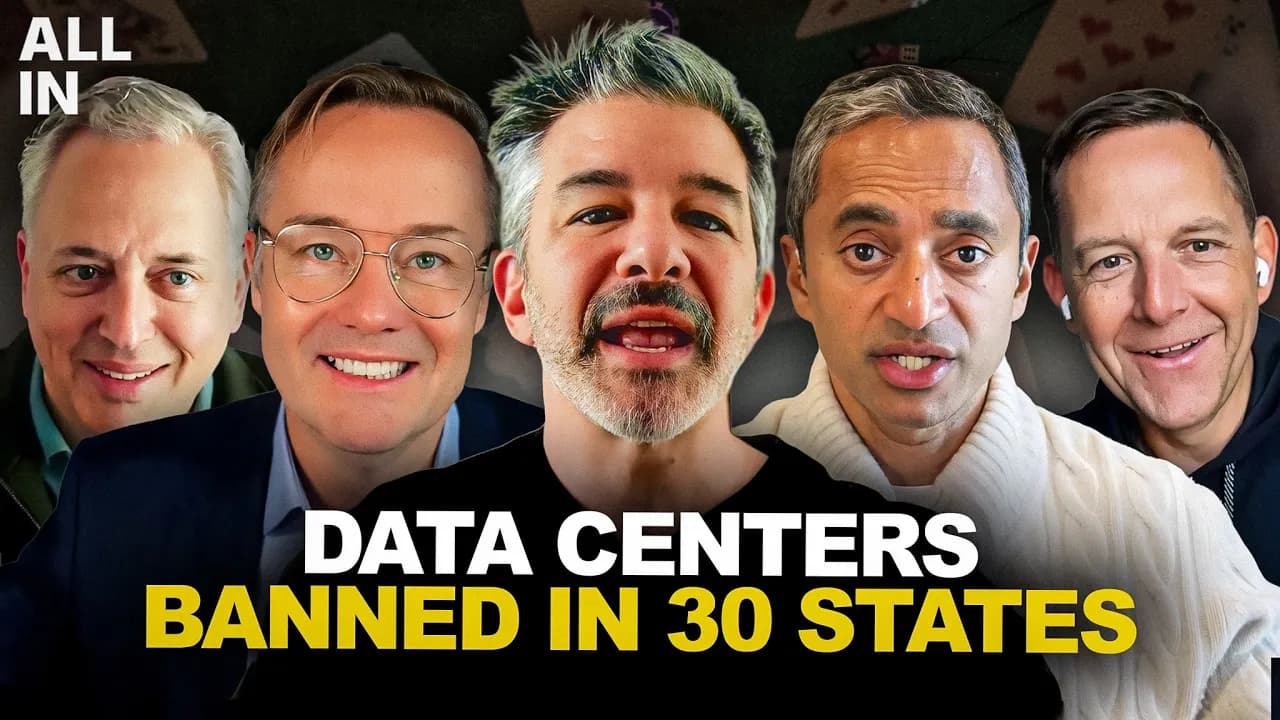
40% protested data centers cancelled. 2023: Few, ~1-2. 2024: 40% of small number. 2025: 25 cancelled, 5GW, $50B/year revenue off table (Sarah Frier's number). Taxes for govs gone. 2026 (end Feb): 100 protested, ~40 cancel, 7GW, $70B/year. 2025-26: $120B revenue off table. Wakeup call—messaging harming critical industry. National disaster if not fixed.
Cancellations mostly Virginia, Indiana. Zero in Texas (150GW requests). Come to Texas, talk to Abbott, Ted Cruz.
85% tokens from open source models. Startups use local models, paid only for tough jobs. Karpathy's auto research project: Tinkerers training open LLMs.
Brad: Enthusiastic for open source. Advanced cos plan with frontier labs, execute with open source (ensemble). Incredible open source near frontier, yet Anthropic $5-6B/month revenue. TAM dramatically bigger than thought. Like Uber, Google, Amazon.
Washington State millionaire tax: >$1M/year pay extra 9.9% from 2029. Impacts 30,000 households, $4B for schools, education, healthcare.
Same day: Howard Schultz (Starbucks) leaves Seattle after 44 years for $44M condo in Surfside, Miami. Pulled a JCL. Said he'd pay more taxes when running for president.
Bezos left 2023, speculated 7% capital gains tax.
Endgame: Politicians should learn mobile wealthy leave for Singapore/Dubai. Why enact until 60-70% rates, lose creators, become Randian?
Shimoth: West coast state politicians ineffective, not smart. Washington behind California. Hoover Institution: CA billionaire tax polling 25% needed, uphill. Monte Carlo (100k runs): 71% negative NPV, expected $25B hole. Overcounted billionaires, undercounted revenue, expected $100B but $40B. Leavers paid $3-5B/year taxes. Middle class foots $2500/household (10M households). Washington 23-hour debate—will be as bad/worse.
State money wasted. Smart people leave.
Bari Weiss on fraud in CBS report. No moral high ground to raise taxes without fraud fix.
Federal: Bernie Sanders, Roana national wealth tax—5% per year (20 years = all money). Socialism.
This is socialism, another way for the government to own everything through seizure. If you earned it and paid your taxes, the state can still decide to seize more, like retroactively taking from the Yammer sale. > Raise your hand if you believe the things you own are better off being owned by Bernie Sanders and Ro Khanna. You'd have to be an idiot to believe that.
Last time such proposals appeared was during the Gilded Age (1870-1920), targeting Carnegie and Rockefeller. It led to actual warfare, with hundreds killed in clashes like the Great Railroad Strike and Pullman Strike. Shame on politicians fanning class warfare flames. We need to lower the temperature. Fair debates exist on state resources for citizen obligations and fraud, but nuance matters.
In California, the teachers union opposes the billionaire's tax because it reduces education funding. Matt Maien, running for governor, and the current Democrat governor are against it. They must explain they're on the side of business, entrepreneurs, creativity, and economic growth—or against it. During the Gilded Age, America didn't abandon entrepreneurialism and capitalism like Europe; it leaned in.
Some unions oppose the tax only because they weren't included. Rumors say the California Teachers Association is crafting their own billionaire asset seizure version for the next election cycle. SEIU acted alone, so others didn't get a share. If this fails, they'll unite for 2028, making it more likely to pass. By 2028, a national wealth tax will be standard in the Democratic platform—table stakes. Bernie Sanders and Ro Khanna's position will be the party's. Gavin Newsom opposes California's BTA formally, saying one state can't act alone with 49 competitors, leaving room for federal action. Expect him to embrace it by 2028.
A way out of socialism: from first principles, American families want to educate kids, own nice homes, have decent healthcare, and healthy food—a small subset. AI is positioned to solve these. Entrepreneurs can disrupt regulated industries if allowed:
- Education: Break the accreditation cartel.
- Housing: Break regulations, as Texas, Nevada, and Florida have.
- Healthcare: AI and entrepreneurs can lower costs, enable self-led healthcare.
Solve homes, health, kids' education—no need for socialism or asset seizures. Entrepreneurs should focus here; government can help. Trump is the regulatory breaker: got nuclear back on agenda (no other president did), can do housing, avoid foreign wars, create houses for Americans.
Another amazing episode of the All-In podcast. Thanks to Bestie Brad. > We'll let your winners ride. We open sourced it to the fans and they've gone crazy with it. Banter includes references to Besties, dogs, driveways, habitashers, getting a room for an orgy to release sexual tension, feet, merch, and going all in.
Keep All-In Podcast in your library
Save the videos and channels worth coming back to, and find them again in one place.