Exercise Scientist Critiques the Strongest Human Alive
In a Nutshell
Dr. Mike analyzes 25-year-old South African powerlifter Colten Engelbrecht, who deadlifted 520 kg (1,146 lb) single and 500 kg double, plus a 1,036 lb squat and 573 lb bench at 264 lbs body weight. Colten's sumo deadlift technique uses extreme foot width and hip positioning to minimize range of motion, while his consistent technique across all lifts prevents injury and maximizes performance. At 25 years old, Colten is positioned to break more records as he continues training and potentially increases his body weight.
These notes were generated by AI and may contain inaccuracies.
Dr. Mike from RP Strength introduces Colten Engelbrecht, a 25-year-old South African powerlifter. Dr. Mike describes Colten as already the greatest of all time in some sense, noting that he is young and trains smart, making it likely he will continue to get stronger. Dr. Mike references his own competitive background as a bodybuilder, Brazilian jiu-jitsu grappler, and powerlifter with competition lifts of a 490-lb squat, 385-lb bench press, and 567-lb deadlift.
Colten performed a 520 kg (1,146 lb) deadlift, which is 22 lbs more than Thor Bjornsson's 510 kg record. Colten weighs 122 kg (270 lbs) and lifted using a single belt and straps. The lift occurred after completing a full powerlifting meet. Dr. Mike addresses common criticisms about sumo deadlifts, explaining that sumo provides a leverage advantage by allowing feet to slide out farther, keeping hands in, and reducing range of motion. He notes that conventional deadlifts are seen as more honest because everyone's feet and hands are roughly in the same position, but acknowledges that some people naturally have longer arms, creating unaccounted advantages.
Colten performed 500 kg (1,102 lb) deadlifts for doubles, the first time in history this has been done. Dr. Mike explains the progression of the 500 kg barrier, noting that Eddie Hall was the first to achieve it, followed by Thor, and now Colten at 130 lbs less body weight than these competitors. Dr. Mike explains human strength progression using a bell curve distribution, stating that once the first person breaks a barrier, more people will eventually follow as the population's abilities shift.
Colten uses feet pointed out wide with knees apart, which rotates the femur outward and makes it appear smaller from the side. This positioning allows the hips and center of gravity to get closer to the bar, reducing the need to leverage forward and putting the glutes, lower back, hamstrings, and quads into less optimal positions. Dr. Mike notes Colten's knees clear the bar line immediately upon starting the pull, eliminating the need to push the bar forward. His upper body remains rigid with an almost completely rigid spine, essentially performing a partial sumo leg press where the hips do the work.
Colten performed a deadlift without straps using hook grip. Dr. Mike explains the hook grip technique where fingers wrap around the barbell and also around the thumb. While initially painful, thumbs eventually go numb with practice. Hook grip functions like built-in straps and is superior to over-under grip for deadlifting maximum weights.
Dr. Mike references his own historic total of 1,200 kg at 120 kg body weight, achieving 10 times body weight total. He explains the DOTS formula used in powerlifting to compare lifters across different body weights. The formula accounts for three factors: how much is lifted, body weight, and how hard the lift is relative to body weight. Lighter lifters can lift bigger fractions of their body weight due to allometric scaling, while heavier lifters face greater difficulty. DOTS gives extra points for lifting significantly more than body weight. Colten weighs 264 lbs (120 kg) and lifts at relative ratios comparable to lifters 30-40 lbs lighter while lifting absolute loads heavier than the heaviest competitors who weigh 360 lbs.
Colten performed a 1,036 lb squat raw in a full powerlifting meet at 264 lbs body weight. Dr. Mike notes that 20 years ago during equipped powerlifting's heyday, breaking 1,000 lbs required stretchy suits and super fancy knee wraps, and competitors were typically 300+ lbs. Colten's 573 lb bench press at 264 lbs body weight is exceptional for a full powerlifting meet combining squats and deadlifts at record weights. His technique includes controlled lowering speed, strict pause bench, and clean lockout.
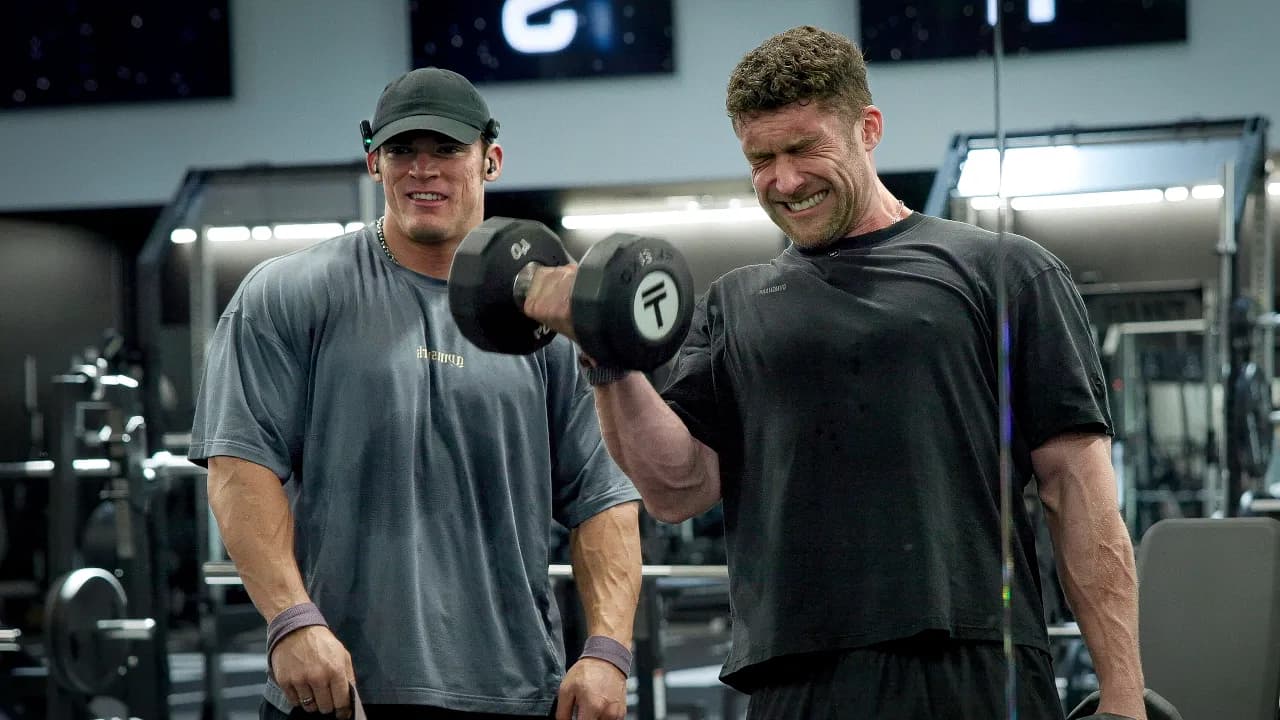
Colten performed a reverse curl with a 170 lb person, providing insight into his strength sources. Dr. Mike rules out muscle size as the primary factor, noting Colten is jacked but doesn't have enormous pecs that would be required to bench 600 lbs based on size alone. This suggests architectural differences in muscle construction, tendon insertion points, muscle pennation patterns, or superior nervous system recruitment. Dr. Mike explains that tendon insertion farther from the axis of rotation improves lever arm mechanics, and muscle fiber orientation can differ meaningfully between individuals.
Colten's bench press technique includes chest up, shoulders back and retracted, flaring, feet pinched under for stability and leg drive, glutes firmly on the bench, and controlled movement in a straight line. Dr. Mike emphasizes that each rep looks identical with no grinding, which keeps him less injured and performing better. This technique serves as a model for other lifters, demonstrating that even the strongest lifter uses proper form rather than swinging the bar or crashing on themselves.
Colten demonstrates overhead pressing ability. Dr. Mike compares his own past performance of 275 lbs for 8 reps at 240 lbs body weight against Colten's 330 lbs for the same rep count. All of Colten's reps across lifts look identical with consistent technique. Dr. Mike notes this consistency is beneficial for injury prevention and performance, and serves as a positive influence on younger lifters who might otherwise adopt risky techniques.
Dr. Mike concludes Colten is the strongest by formula lifter of all time and likely holds the all-time absolute record. At 25 years old, Colten has high probability of getting stronger if he avoids major injury or life priority changes. Dr. Mike predicts Colten will definitely squat more and bench press more, and possibly deadlift more. Colten has recently signed with RP Strength and plans to use the RP Diet Coach app to bulk up, which could further separate him from competitors if his squat and bench increase while his deadlift remains stable.
Keep Renaissance Periodization in your library
Save the videos and channels worth coming back to, and find them again in one place.