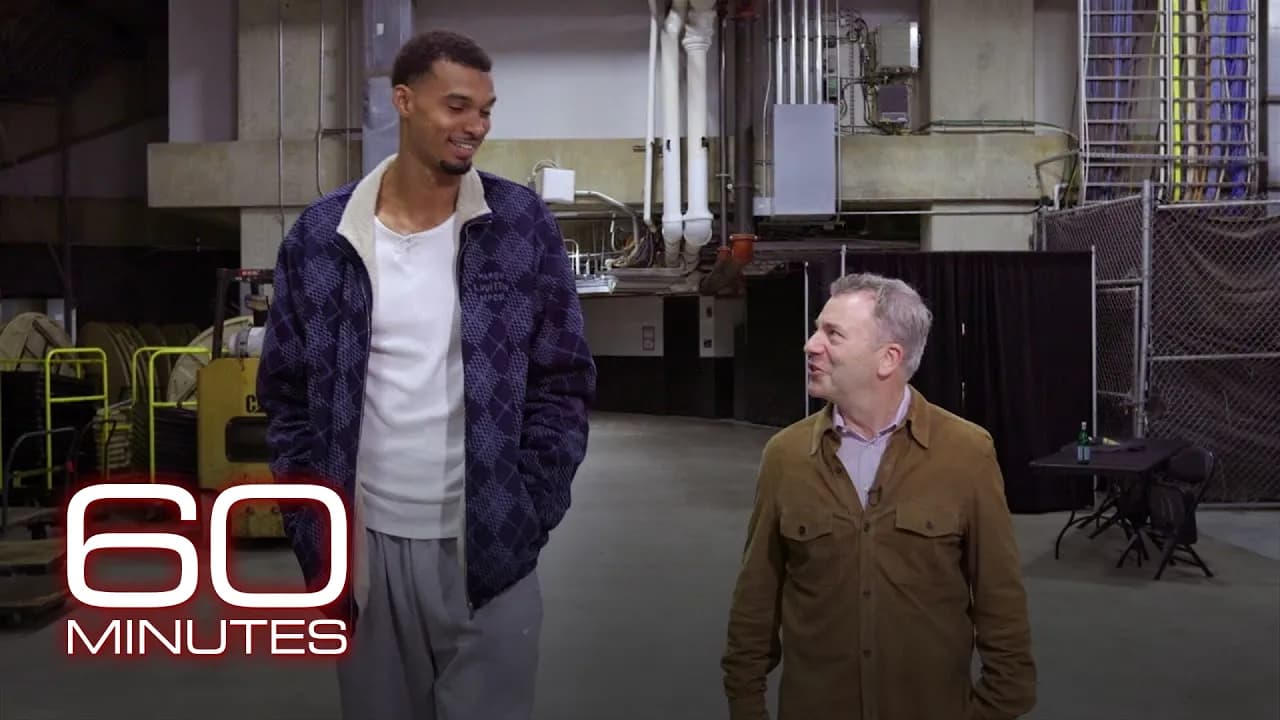
Extended Interview: Victor Wembanyama on playing style, training and life off the court
In a Nutshell
Victor Wembanyama emphasizes he has no blueprint for his unique size-skill combination, so he relies on curiosity, foot-strength training, and learning what works through constant experimentation. He values authenticity over external narratives, choosing to promote healthy habits, and credits a blood clot scare with making him more direct. His Spurs vision centers on building an intimidating, community-driven culture with a young core that competes for titles rather than lotteries.
These notes were generated by AI and may contain inaccuracies.
Victor Wembanyama described spending his past summer in France as the primary way to nourish his spirit. He emphasized being around his siblings, family, and friends almost every day. The interviewer confirmed this meant returning home rather than going to a monastery.
Wembanyama explained that in the NBA, the difficulty lies in showing up every single night over a long season. He clarified that while basketball is very demanding, it's not a hard life. The most demanding aspect is that effort alone is not enough, and being purely technical is also insufficient - a mix of both is required.
The player identified alley-oops as bringing him the greatest joy because they represent team play combined with a dunk. He noted the telepathic element between teammates when executing alley-oops. While he has thrown some alley-oops, he has been the recipient more often.
Wembanyama acknowledged that no one has played the game with his combination of size and skill set, creating no blueprint for training, pacing, or career planning. As a foreigner growing up in a different environment, he identified the key as being comfortable not knowing and finding his own answers. He described being comfortable walking through the fog and mentioned brief moments of clarity when his head peaks through to see the sun, such as the Spurs' undefeated February.
Growing up after the Spurs' championship era began, Wembanyama's impression was of the franchise with the greatest coach of all time and a significant French history. He described it as a winners franchise. Regarding Greg Popovich, he highlighted the lesson of humility: after a win, you're rarely as good as you thought you were, and after a loss, you're rarely as bad as you thought you were - never too high, never too low.
Wembanyama confirmed the NBA aligned with everything he imagined as a child. He noted that NBA players, especially stars, can shape their careers beyond on-court performance. He mentioned options including being an influencer, philanthropist, or promoting gambling and alcohol, emphasizing the freedom to choose.
Wembanyama stated his choice isn't final as he's still growing as a person, but he wants to promote healthy things - not just food, but healthy habits that make people's lives better and potentially society better in the future. He attributed this perspective primarily to his family.
Wembanyama noted that as years go by, he has fewer filters and is less afraid to say what he thinks. He mentioned the blood clot he suffered in his shoulder in 2025 had a huge impact on this shift, making him realize life's shortness and not wanting to waste it being somebody else.
When asked about his MVP comments, Wembanyama stated he should win it this year. Regarding being portrayed as a villain during last year's finals, he said it didn't bother him because players don't pay attention to such narratives during the finals. He mentioned the experience showed his limits more than anything else, emphasizing the need to play basketball rather than beat opponents.
Wembanyama identified three specific playoff moments he replays most: Game 1 in OKC, Game 7 in OKC, and Game 4 in New York. He described Game 4 in New York as the most intense heartbreak moment of his career.
Wembanyama explained the basketball-chess overlap centers on decision-making. He mentioned playing against Louise, who was tough. He remembers his chess mistakes, including blunders, turnovers, and dribbling off his knee. He plays chess more in summer than during the season.
Wembanyama described doing cardio on a bike while playing chess against front office members, with the chess board set up on a box. He mentioned intervals of four minutes on the bike with one minute rest, during which he makes his chess moves.
Wembanyama explained his training constantly changes as he learns and meets new people. He cited curiosity, wanting to do what's best, and recognizing that approaches differ for everybody. He specifically focuses on feet because big men historically have foot problems, and feet are responsible for much more than commonly understood.
Wembanyama strengthens his feet through time and practice, noting improvement over two and five years. He walks barefoot as much as possible and wears minimalistic shoes. He explained that typical shoes don't respect the natural foot shape, preventing proper force application through the toes, especially the big toe. Good foot strength and posture enable proper development of knee, hip, and back alignment.
Wembanyama acknowledged the difficulty of being the first to train this way, noting nobody similar to him has trained his methods. He described checking boxes, trying approaches, discarding what doesn't work, and moving to the next. He accepted this loneliness as part of signing up for his unique position.
Last summer, Wembanyama trained at a Chinese monastery where meditation was pushed to extreme levels, with the first day involving an hour and forty minutes of complete silence. He found it very hard, managing about 30 minutes of focus before wondering how much longer remained.
Wembanyama acknowledged briefly meditating between free throws, describing it as centering back and thinking it's just a regular shot rather than making it too technical. He aims to think about nothing or something very specifically for a second, then focus on making the shot. His free throw percentage is 82%.
Wembanyama confirmed he wanted to come to San Antonio because of the franchise and its history, stating he knew this is where he belonged. He hopes for new members, more arena seats, and inspiration from overseas for the upcoming season.
Wembanyama described wanting the Spurs to become intimidating, powerful in the community, and inspiring. He sees a new era with a young core that shouldn't be a lottery team. He wants to allow fans who want involvement to participate, aiming eventually for the intensity of PSG ultras or Panathinaikos fans.
Wembanyama hosted several teammates in Paris over the summer, wanting to show them France's refinement and how he would take care of them. He noted their visit meant more to him than to them.
When asked about living in the US, Wembanyama clarified he doesn't live a normal American life but rather the life of an athlete and rich person with everything taken care of. He stated America is the best country to be an athlete. One positive aspect is never being judged for being ambitious, while one negative is that social interactions feel more shallow than in other countries.
Wembanyama described a love-hate relationship with patience. He explained the best approach is having patience while fighting it, taking lessons patience brings while trying to prove it wrong by not waiting.
Keep 60 Minutes in your library
Save the videos and channels worth coming back to, and find them again in one place.