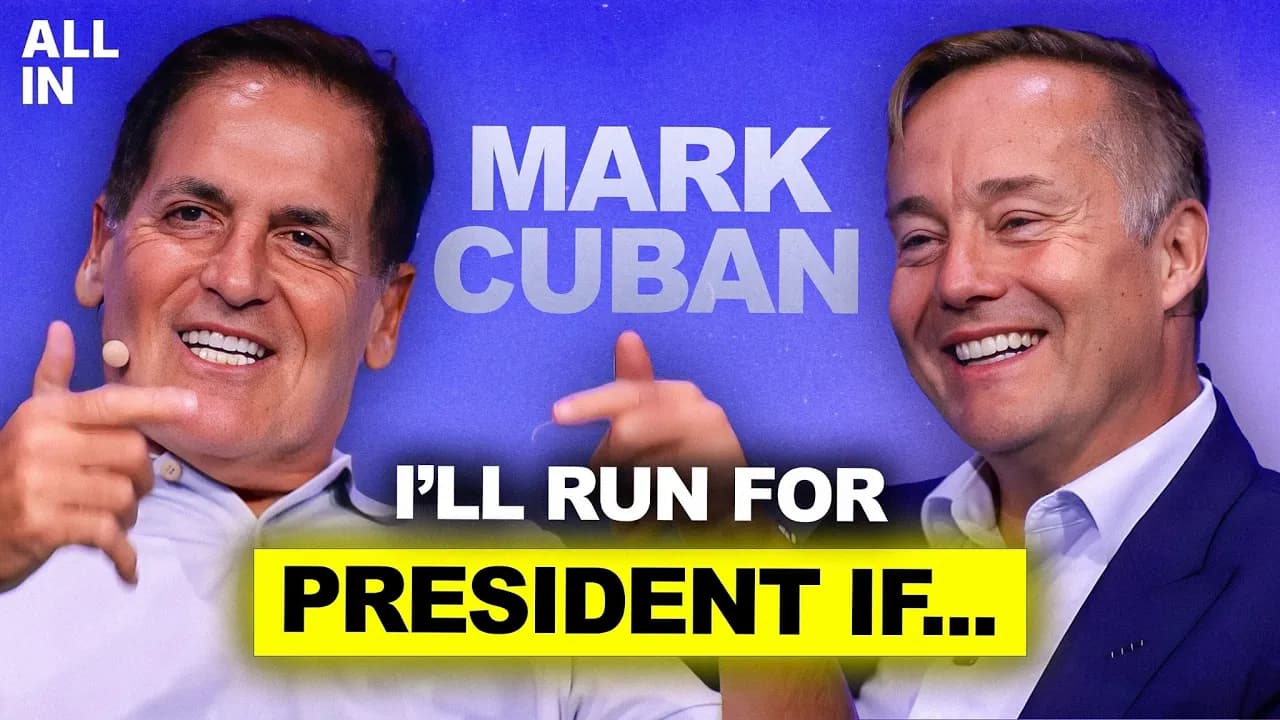
Mark Cuban: AI Could Bankrupt Us Into A Deep Debt Bubble!
In a Nutshell
Mark Cuban warns that AI companies are borrowing more than they're earning, risking a massive debt bubble that could bankrupt the economy. His core message is that true competitive advantage comes from deep preparation—mastering one skill completely, deferring immediate gratification, and learning faster than others—rather than chasing get-rich-quick schemes or relying on AI as a substitute for genuine intelligence. Success requires recognizing AI's fundamental limitations (no real understanding, ethics, or real-time adaptability) while using it as a tool alongside irreplaceable human skills like sales, problem-solving, and face-to-face interaction.
These notes were generated by AI and may contain inaccuracies.
AI is not smart. AI doesn't know the consequences of its actions. It doesn't have inherent ethics. Companies keep borrowing and spending more money to power AI, but they're borrowing more than they're making. There is a risk of entering a debt bubble.
Mark Cuban started by going door-to-door in the neighborhood selling garbage bags, which he credits as a pivotal experience. He learned that if you can sell door-to-door, you can do anything. When evaluating Shark Tank companies, he immediately knew how he would sell a product.
To become an entrepreneur, you must find one thing and be great at it, then turn that something into a business. If you're going to work with technology, media, or any field, you must stay ahead of the curve because business is like a sport. If you don't keep improving your game, you won't compete. Cuban emphasizes asking what you suck at and improving those weaknesses.
One of Cuban's biggest mistakes was being a jerk, yelling, and screaming. He found that he got much further by being nice rather than being difficult. He left Shark Tank and sold the Dallas Mavericks.
Despite his success, Cuban continues to self-educate. When crypto became prominent and when AI emerged, he went back to school to learn. He views business as a sport and believes you must keep improving to compete. If you're not ahead of the curve in technology or media, some high school kid will outperform you.
Cuban grew up in a regular family in Pittsburgh with "piss and vinegar" to compete. His father was a blue-collar worker who did upholstery on cars and never made more than $40,000 in his life. His mother did odd jobs. His father lost an eye during upholstery work when Cuban was in sixth grade. His father was always supportive of his hustles.
Cuban's father taught him lessons like "You don't live in the world you were born into" and "Today's the youngest you'll ever be." His father was always supportive regardless of what hustle Cuban pursued.
As a child, Cuban wanted to be a baseball player but realized he wasn't good enough. He started selling baseball cards at age 9 or 10 by buying packs from the pharmacy and repackaging them. He would buy cards for a quarter and sell them for 50 cents, guaranteeing a Pittsburgh Pirate like Roberto Clemente or Willie Stargell. When he was 12, he began selling garbage bags door-to-door after his father's poker buddy offered him boxes for $3 that he could sell for $6.
Cuban emphasizes that sales is one of the ultimate skills for becoming an entrepreneur. No business has ever succeeded without sales. He believes that if you don't think your product or service is so good that you're dying to sell it, you shouldn't be selling it. Sales is about helping people achieve their goals, not convincing them to do something against their interest.
Good salespeople care about their product, know it thoroughly, and want to help people. When evaluating products on Shark Tank, Cuban immediately knew how he would sell them or couldn't sell them. Once you learn how to sell and handle objections, you can sell anything. Cuban sold magazines door-to-door and learned that every "no" gets you closer to a "yes."
Young people often think success happens quickly like with Zuckerberg, but Cuban was 31 or 32 when his first business sold for $5 million (netting $2 million). He believes many young people are impatient and think they need to raise money and achieve massive sales numbers, but profitability is more important. For MicroSolutions, the company was profitable every month for its entire 8-year existence.
Cuban emphasizes that the greatest number of successful people aren't billionaires but those who made a few million, 5 million, 10 million, 25 million, 50 million, or 100 million dollars. He calls this the American dream rather than a Silicon Valley dream. The path depends on your circumstances, skills, and what you can accomplish where you are.
To be a millionaire, you must be really good at something and find a way to turn that something into a business. It could be sales, programming, tinkering, drawing, or being a creator. If you're not good at something, no business will make you a millionaire. Having multiple ideas doesn't increase your odds of success - you must find one thing and be great at it.
Focus is critical. Entrepreneurs often think having three ideas increases their odds, but this is counterproductive. Once you're great at something, doors open wide. If it's not your company, they have to keep you because you're great. Where you spend your time determines what you'll become great at, not passion. Passion to be a baseball or basketball player didn't help Cuban, but spending time on business did.
Cuban bought the Mavericks for $285 million and sold it for $4.3 billion. He didn't buy the team as a business decision or with a long-term horizon - he bought it because it seemed fun and presented an intellectual challenge. He wanted to take a team voted the worst professional sports franchise of the previous decade and turn it into a winning team. Over time, the NBA shifted from being about basketball to being about valuations and real estate, which created stress.
Cuban defines success as waking up in the morning with a smile on your face, excited about the day. This is hard for most people to achieve. When the Mavericks won the championship, it was anti-climactic internally for him, but the communal joy - taking the trophy to schools, bars, restaurants, and his kids' events - made it special.
For people feeling trapped in 9-to-5 jobs living paycheck to paycheck, Cuban advises new college graduates to just get a job rather than seeking the perfect job. When you have a job, work to be really good at it. You must be honest with yourself about your performance. Even in jobs like McDonald's or Dairy Queen, there's a path to advancement. Showing future employers that you moved up and received positive references is valuable. This can happen in 2-3 years.
Any job teaches you how to deal with people and customers. Cuban read a book in high school called "Why Men Rebel" which discussed how people have high aspirations but feel their real lives are lower, leading some to rebel. Understanding this helps you not let frustration overtake your life. Cuban was always counterculture and had to find his own path despite challenges like getting steel caps on his teeth at age 16 after breaking them in a bicycle accident.
When building Micro Solutions, Mark Cuban lived in Dallas with five roommates and slept on the floor without a bed. He worked nights as a bartender while taking a job at a software store, which he viewed as his first step into a real career with a future. After getting fired nine months later over a $1,500 commission dispute, Cuban decided he was not suited to be an employee and chose to start his own company.
Cuban frames his approach as deferring immediate gratification rather than sacrifice. He knew success would take time and required selling hard while learning software he didn't understand during the early days of the PC revolution. His strategy was to understand any given software better than anyone except the person who wrote it, positioning himself tied for second place by working harder than others.
Cuban would stay in the retail store overnight or take computers back to his apartment to teach himself software by reading manuals repeatedly. His goal was to get ahead of everyone else to achieve second place by himself, giving him a significant edge. He applied this same principle to AI, stating that when new models or software emerge, there is the creator and everybody else tied for second, and he aims to outperform by learning faster and better.
Cuban considers AI the most significant development he has witnessed in tech, dwarfing everything else in aggregate. He notes AI makes him significantly more productive by answering questions like needing comprehensive information about someone. From an educational perspective, AI serves as a democratizer of information, providing access to every library, book, and speech worldwide, enabling anyone to learn anything if they are interested.
The conversation addresses Leon Festinger's concept of cognitive dissonance, which describes the discomfort felt when new information threatens existing beliefs. Cuban observes that the entire world is experiencing this simultaneously due to AI's disruptive nature. Some people respond by denying the technology will affect them, while others recognize it as an opportunity. Cuban emphasizes that wherever there is change, there is opportunity, and most people will not do the necessary work to capitalize on it.
Cuban references basketball coach Bobby Knight's statement that everybody has the will to win, but only those with the will to prepare actually win. He notes that the preparatory work often goes unseen, creating an illusion of success. People observe the trophy moments but not the years of unseen effort like reading manuals in an apartment.
Cuban discusses how social media algorithms create echo chambers by showing users more of what they engage with, leading to misleading information about business opportunities. He explains that get-rich-quick schemes appear frequently because they generate views, while actual preparatory work does not. This creates an environment where young people, including his 16-year-old son, encounter misleading content about drop shipping, shoe drops, and stock market schemes that promise easy wealth.
The discussion emphasizes that in an environment promoting get-rich-quick schemes, taking a long-term approach becomes a winning strategy. This involves preparation, mastering skills, and setting a 10-year time horizon rather than expecting immediate wealth. Charlie Munger's observation about the lack of delayed gratification in modern society is referenced as supporting this perspective.
Cuban describes Warren Buffett and Charlie Munger's approach to compounding, noting periods where they would not invest any money at all. He applies similar patience, buying during market downturns like COVID when others were fearful. He advises having cash available because markets will turn, and real money is made during those transitions rather than during continuous upward movements.
Cuban believes the market is in a bubble, though different from the 2000-2001 internet bubble. He characterizes current trading as meme stock behavior, where companies like Micron, Google, and Apple move dramatically based on minor news rather than intrinsic value calculations. Stocks can drop 18% on missing earnings by a penny despite unchanged fundamentals, indicating trading based on perception rather than net present value of future cash flows.
Despite the bubble concerns, Cuban notes that companies like Dell and Amazon survived the internet bubble burst and became enormously valuable for those who maintained long-term positions. He acknowledges there will be winners in the AI space but cannot predict which companies like Anthropic or OpenAI will emerge dominant.
Cuban argues there will always be humans smarter than AI because current models are immediately outdated upon release and lack true understanding. AI uses statistics to predict the next word rather than being deterministic, leading to different answers from different models or even the same model with slight question modifications. AI cannot understand consequences of actions, lacks inherent ethics, and cannot process video input in real-time.
Using the example of crossing a four-way intersection with video input, Cuban states he would trust a seeing eye dog over AI because AI operates with latency and cannot react to sudden changes. He contrasts this with a two-year-old who understands cause and effect relationships like pushing a sippy cup off a high chair, which AI cannot comprehend.
Cuban predicts that as AI becomes more dominant, people will create communities rejecting technology, similar to communes and kibbutzes. He mentions adversarial actions against AI, where people deliberately cause systems to malfunction, and notes increasing use of trade secrets rather than patents to protect intellectual property from AI training.
Rather than viewing AI as useless, Cuban emphasizes using multiple AI sources and applying human judgment to synthesize different outputs. He notes that having four smart people provide different answers requires the skill to ask better questions and integrate responses effectively.
Cuban discusses how AI will cause creative destruction similar to the transition from records to CDs to DVDs at RCA's Terre Haute facility. While some jobs will be eliminated, new opportunities will emerge that leverage the technology, though the transition will be painful for affected workers.
Cuban describes using AI agents to handle tasks he previously would have hired people for, such as monitoring lawsuits against healthcare conglomerates and obtaining contract copies through Open Records Act requests. This allows him to accomplish more without the overhead of hiring, training, and managing employees, freeing time for higher-level strategic work.
Cuban advises his children ages 17, 20, and 23 to learn AI tools because those who do will be significantly more productive. He notes that with access to AI platforms like Claude or Gemini through smartphones or library computers, there are no questions that cannot be asked, though users must invest time in learning to ask better questions and consume the information effectively.
In a world where everyone has access to the same information through AI, the competitive edge comes from knowing how to take information and integrate it to accomplish specific goals. Cuban emphasizes that the ability to apply knowledge effectively distinguishes successful individuals from those who merely consume information.
AI can generate business plans, create agents and bots, but human oversight remains essential for validation and execution. The user must determine what is right or wrong, then actively sell or teach agents how to sell for a business to succeed. AI operates through brute force computation rather than genuine intelligence.
When discussing AI security risks with security professionals, no new hacking approaches have been invented by AI. Existing security personnel already possess the same lists of vulnerabilities. AI's advantage lies in deploying unlimited agents to test every possible combination through brute force methods. Traditional security approaches focused on catching problems, knowing that full brute force attacks exceeded available resources. This limitation no longer applies.
The same brute force capability can be applied defensively to identify vulnerabilities proactively and attack bad actors. Instances of problems will occur, but the greater concern involves human reactions driven by fear and misunderstanding of AI capabilities.
AI lacks true intelligence despite the terminology used. It resembles being "book smart" - able to read and memorize information to achieve high test scores, but without deeper understanding. True intelligence involves aggregating information and inputs, knowing where to locate relevant inputs, solving problems, and identifying which problems need solving. AI cannot perform these functions.
Real-time adaptability represents another limitation. During conversations, humans respond to unexpected questions without prior preparation, while AI lacks access to the full range of human sensory inputs and contextual understanding. For example, a doctor treating a patient requires physical examination and experience-based questioning that AI cannot replicate.
Evidence of genuine AI intelligence would require demonstrating problem-solving capabilities with minimal resources. A 12-year-old child from disadvantaged circumstances can demonstrate brilliance by finding information sources and figuring things out independently. Current AI systems require increasing amounts of GPUs, power, and better algorithms, suggesting they have not reached the threshold of operating without substantial resource requirements.
Elon Musk represents an exceptional entrepreneur but operates as a sales-focused leader who must raise substantial capital for ambitious projects. His optimistic forecasts about AI, automation replacing work as a choice, and humanoid robots reflect sales requirements rather than objective analysis.
Divergent opinions among AI safety experts, frontier lab members, CEOs, and former employees indicate no consensus on AI's trajectory. If AI development followed a clear, dominant path, agreement would exist across perspectives.
Unlike early computers that started with minimal capabilities requiring brilliant programming on systems like Fortran, AI systems demand unprecedented power and GPU resources. This brute force approach contradicts the pattern of computing advancement through incremental improvements via Moore's Law.
Experience with computers becoming incrementally faster and more capable suggests AI will follow similar patterns of increased power and capability. However, latency continues to provide humans with advantages. Cost reductions are occurring as companies borrow and spend more to increase power capacity.
Data centers may become obsolete if AI fails to achieve efficiency gains with reduced power consumption. Current trajectories risk creating a debt bubble as hyperscalers borrow more than they generate in cash flow. The United States deficit requires increased borrowing, while hyperscalers compete for lending at rising interest rates.
A $40 billion debt becomes unsustainable as interest rates increase, potentially preventing further capital raises. Private credit markets currently show uncertainty with potential for significant problems.
Ray Dalio's analysis indicates the United States and other countries have passed the point where debt accumulation threatens currency stability. Current positioning reflects the decline phase characterized by over-indebtedness and loss of power. While American dominance makes such scenarios difficult to envision, politicians excel at rhetoric while struggling with implementation, suggesting painful adjustments ahead.
Annual interest payments on US debt reach one trillion dollars. Increasing rates combined with growing borrowing needs and hyperscaler competition for capital creates crowding-out effects. AI companies may face lending constraints if 10-year Treasury rates reach 6%, 8%, or 10%.
Diversification across multiple countries provides protection against domestic economic risks. Investment restraint allows observation of developments before committing substantial resources.
Developing genuine skills and knowledge represents irreplaceable value that cannot be displaced. Human interaction skills become increasingly valuable as AI handles routine tasks. Face-to-face communication businesses and experiences demonstrate resilience against AI replacement.
Childhood experiences as an overweight child created lasting insecurity and drive to prove others wrong. High school peers did not recognize future success potential. The transition to Indiana University provided opportunity for reinvention and fresh starts.
Early business success with MicroSolutions enabled pursuit of personal freedom rather than immediate wealth accumulation. A lifetime American Airlines pass represented commitment to controlling personal time and destiny rather than building additional wealth.
The Yahoo acquisition of broadcast.com created paper net worth between $1.5-1.7 billion, fundamentally changing options and eliminating concerns about future opportunities. NBA team ownership became possible despite never being previously considered.
Wealth acquisition confirmed that money does not alter fundamental personality or life approach. Relationships with high school friends, brothers, and rugby teammates remained consistent regardless of financial status.
Early business approach involved aggressive communication that proved counterproductive. Partner feedback about creating unnecessary fear led to adopting collaborative approaches that achieved better results while improving personal satisfaction.
Being the oldest of three brothers created leadership patterns and eventual geographic concentration in Dallas. Celebrity status created indirect pressures on siblings through constant comparisons and assumptions about their relationship to success.
Younger brothers followed to Dallas and initially lived together, strengthening family bonds. Celebrity created complex dynamics where brothers faced external pressures and assumptions about their own achievements relative to family success.
In July 2005, Mark Cuban's brother faced his lowest moment and considered ending his life. Cuban and his brother Jeff were there for him, and he credits them with saving his life. Their father's advice was to always stay in contact with brothers no matter what happens or where life takes you. After decades and despite living 1,200 miles from Pittsburgh, all three brothers ended up living within walking distance of each other.
Cuban bought the Mavericks in 2000 and became famous, which created unexpected pressure on his brother who didn't choose that lifestyle. His brother struggled with issues and problems until Jeff called Cuban while he was out of town. They got their brother into rehab, and he has been sober ever since.
Despite not being best friends who did everything together, the Cuban brothers always stayed connected through family trips, visits with parents, and regular texting. They remain connected through shared interests like Steelers and Pirates games.
Both parents passed away - father in 2022 at age 92, mother in 2017 at age 85. Cuban notes that while these ages sound long, they feel shorter than hoped. The loss of parents made the brothers feel their own mortality and connected them even more strongly.
The realization of mortality influenced recent decisions including leaving Shark Tank and selling the Mavericks. When Cuban started recognizing what was truly important - his kids and family - the next business trip seemed less critical than before. Missing birthdays became mistakes he no longer wanted to make. His children were 13, 16, and 19 when he sold the Mavericks.
Not everyone is built to be an entrepreneur. If someone has to ask themselves whether they can be an entrepreneur, they probably are not. Entrepreneurship requires wanting to accomplish something specific or use a particular skill for financial benefit. Many people mistakenly believe entrepreneurship gives more control over life than working for others, but the opposite is true.
As an entrepreneur with fewer than 100 employees, you have no control because customers and employees create constant demands. When an employee's child gets sick, you must work through it because everyone becomes family at some level.
The journey of being "pelted by hail" - especially as a famous person - makes people clearer on their principles. Cuban kept a "Poverty sucks" poster on his wall in every house or apartment he lived in, representing his driving motivation.
At ages 25-26, Cuban would work 25-26 straight hours writing software for customers because he was consumed by reaching the next level. He had no degree in software development and taught himself everything he needed to know.
Cuban acknowledges being awful at many things. At MicroSolutions, partner Martin Woodall was a perfectionist while Cuban operated on a "ready, fire, aim" approach. At broadcast.com, Todd Wagner complemented his skill set by handling details Cuban was never going to be good at.
At Cost Plus Drugs, Dr. Osmanski is detail-oriented, providing the complement Cuban needs. Cuban is good at finance despite lacking a finance degree, having taken finance and entrepreneurship classes, though he might not structure the most advanced M&A deals.
Cuban separates hiring from leadership, considering himself good at leadership but awful at hiring. As a salesperson, he would hire people he thought he could help succeed, making poor hiring decisions. He warns against sending resumes directly to him because he might hire the sender.
Hiring is critical - without the right people fitting into the right culture, companies fail. The approach was to hire slow but fire fast.
When Cuban took over the Mavericks, nobody wanted to be there - it was just a way station for people who couldn't get jobs with the Lakers or Celtics. The team was 9-23 when he took over in January. For the remaining 50 games that season, they went 31-19.
Cuban told players they were going to win and this train was speeding up at "internet time" in 2000. He asked who wanted to stay and who wanted to be traded. He completely changed the approach to player development, hiring former Mavericks to work individually with current players who had similar skill sets.
Cuban bought a team plane rather than using typical commercial or rented planes, recognizing that 7'6" player Shawn Bradley couldn't fit in regular seats. He told players there was a weight room and steam room on the plane (though there wasn't) to send a message about the winning culture.
He provided nutritionists and prepared food for players - things teams didn't do at the time. Since taking over, the Mavericks achieved the second highest regular season winning percentage of any NBA team, improving from 39% to nearly 60% win rate. They made their first finals in 2006 (losing to Miami Heat) and won the championship in 2011 when Cuban was 53. He sold majority ownership in 2023 but retains 27%.
Cuban snuck into an MBA statistics class taught by Wayne Winston when he was 18 at Indiana. Years later, he recognized Winston from Jeopardy and hired him on the spot as the NBA's first full-time analytics person. This helped the team grow into winning games and championships.
The lesson is that businesses must keep innovating and cannot rest on laurels. Data and statistics complement rather than threaten instinct, judgment, and creativity - both the "eye test" and numbers are necessary.
Cuban met Tiffany in a gym in his late 30s and married in 2002 at age 44. They have three children. Family supersedes everything else. While one part of his brain focuses on business, competition, and winning, the better part centers on his kids and wife, changing him for the better in ways he cannot describe.
He acknowledges sacrificing relationships during his MicroSolutions days when he was "on a mission." In hindsight, he regrets not doing more little events with his kids, telling himself they were "too young to remember." This regret partly motivated leaving Shark Tank and selling the Mavericks.
Cuban's children face unfair pressure being under a spotlight. He repeatedly warned them that if friends do something stupid it's on them, but if they do something stupid it ends up on the front page worldwide. Despite this, he considers them amazing kids.
His favorite word is "dad," and he becomes emotional discussing this. With his parents gone, he keeps their pictures in his closet and says hello every morning and night. He wants his kids to remember him positively and carry on shared values after he's gone.
At 68 (though he jokes about being 48), Cuban wants to change healthcare in America through Cost Plus Drugs. The satisfaction comes when people tell him they saved $1,000 monthly on medications they can now afford.
Three large companies dominate healthcare with hundreds of billions in sales. 67% of people with employer health insurance are in self-insured plans, meaning employers bear full responsibility for costs. Cuban goes "door-to-door" with CEOs to show how they can save money and improve employee health by doing the right thing.
Cuban has had a complicated relationship with Trump but stood with him discussing healthcare initiatives. His position is that anything making people healthier and saving money on healthcare is acceptable regardless of political source. The goal is making healthcare a true right by reducing domination by large companies.
When asked what the hardest question he wasn't asked would be, Cuban identified family questions as hitting him most emotionally. He noted that family-related topics affect him most deeply among questions he doesn't typically receive.
Keep The Diary Of A CEO in your library
Save the videos and channels worth coming back to, and find them again in one place.