Fitbit Air Just Got BETTER!
In a Nutshell
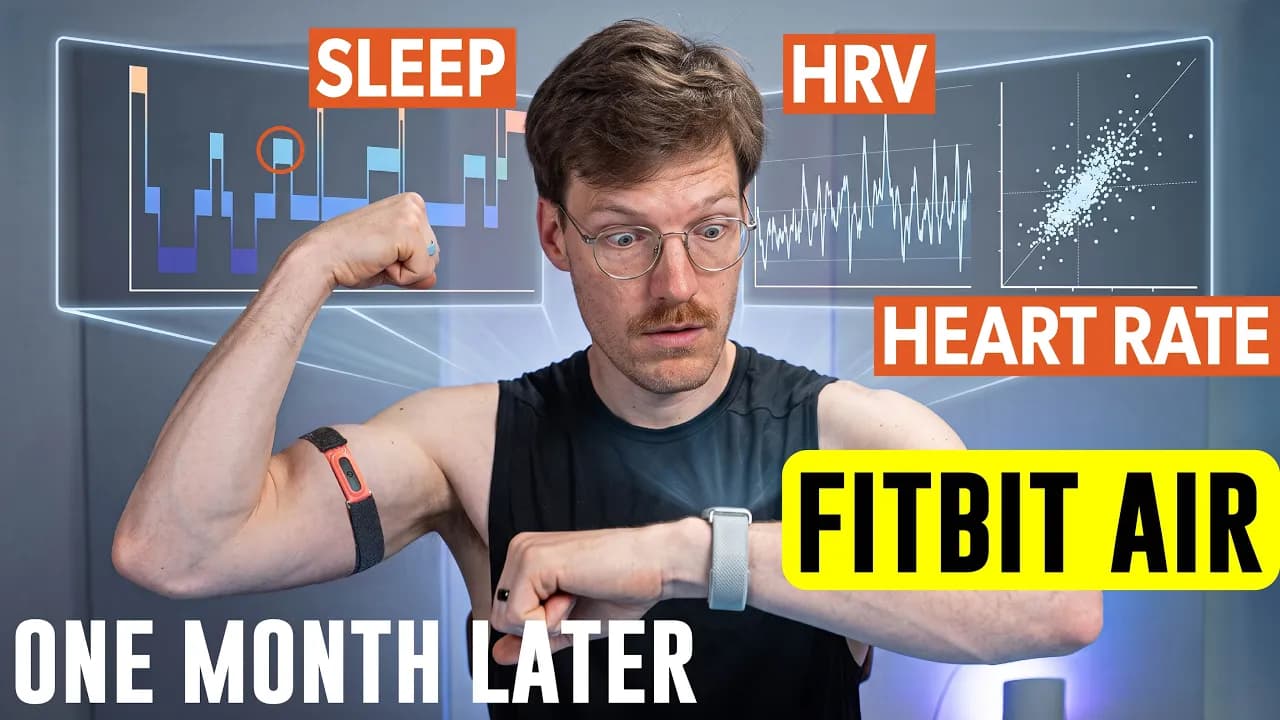
The Fitbit Air performs similarly on the wrist and biceps for nighttime heart rate, HRV, and sleep stage tracking, with both placements showing strong agreement to references. During exercise, however, the biceps placement delivers substantially better heart rate accuracy—especially in weightlifting—achieving 87-95th percentile rankings versus 55-74th for the wrist. This makes the device a competitive Whoop alternative when paired with a biceps band, which third-party options will soon support.
These notes were generated by AI and may contain inaccuracies.
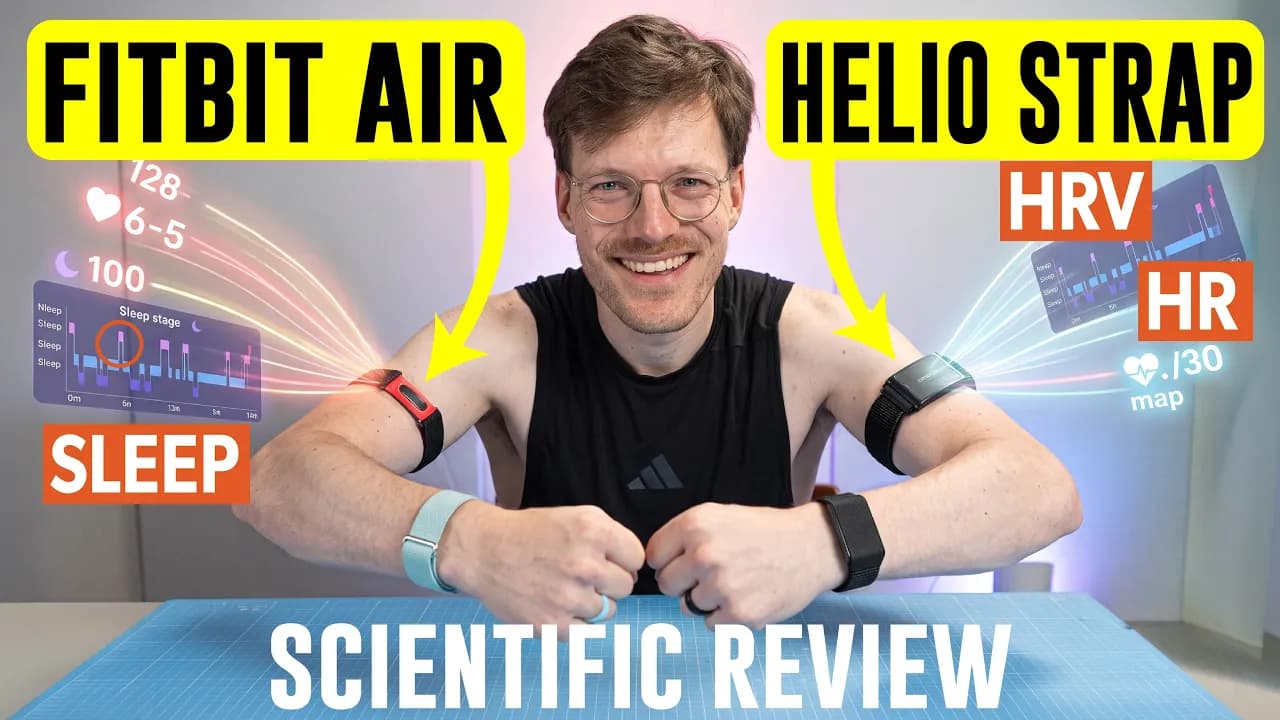
Most wearables get a much cleaner signal on the biceps than they do on the wrist. The goal is to do a first analysis to see if there's any indication that the Fitbit Air performs better on the biceps. The test compares the Fitbit Air on the wrist to the Fitbit Air on the biceps, measuring heart rate and heart rate variability during the night. This is an initial test, with a more in-depth analysis planned in a few weeks.
A custom biceps band was created for the Fitbit Air. There is concern that wearing it on the biceps might decrease performance for some features like sleep stage tracking, since the algorithm might be perfectly tuned to tracking on the wrist and not function well on the biceps.
During a night when sickness occurred, resting heart rate increased significantly and heart rate variability dropped drastically after 1.5 to 2 hours, coinciding with when symptoms began. The Fitbit Air on the wrist was compared to an ECG chest strap reference device. The reference is shown in red and the Fitbit Air in blue-green, showing almost perfect agreement with only a small, minor deviation.
This provides a first indication that the Fitbit Air can track drastic changes in heart rate and heart rate variability. The reference showed heart rate varying between approximately 47 BPM and 41 BPM, a 6 BPM difference, and the Fitbit Air showed somewhat similar patterns even in this narrow range.
For the same night measured with the device on the biceps, similar quality agreement was observed compared to the reference. One is not clearly better than the other; both are roughly in the same quality range. A second night showed the same result: good agreement on the wrist with some small deviations in a narrow heart rate range, and the same quality on the biceps.
Heart rate and heart rate variability calculations were tested using different averaging windows (average of a minute, five minutes, or 30 seconds) to find the best match with what the Fitbit Air exports, since it is not clear how Fitbit calculates these values. Examples include averaging over 900 seconds versus 600 seconds.
For heart rate variability on the wrist, Elite HRV showed slightly higher values than the Fitbit Air, but overall general patterns matched over the night. When worn on the biceps, Fitbit did not provide all the data—only the first 2 hours of the night could be exported. It is unclear why HRV data was missing, possibly due to signal quality being deemed insufficient.
For another night on the wrist, generally similar patterns appeared with somewhat higher values from Elite HRV. The biceps placement showed more or less the same patterns and the same moments of disagreement. There is no clear indication of a difference in signal quality between the Fitbit Air worn on the biceps versus the wrist.
Sleep stages were compared between wrist and biceps placements against each other rather than a reference, to assess similarity. If the stages are very similar, there would likely be no advantage or disadvantage to biceps versus wrist placement. There was concern that sleep tracking quality might be worse on the biceps because the algorithm was developed for wrist tracking.
For the first night, the wrist placement is shown on top and biceps on the bottom. Deep sleep showed almost perfect agreement, with only a tiny bit more deep sleep detected on the biceps. For the second night, segments were almost identical. RAM sleep segments were also very consistent between placements.
The algorithm finds the same sleep stages regardless of placement location, which is positive. Some other devices tested on left and right wrists have produced very different sleep stages, indicating inherent algorithm instability. Here, placements were on the same arm (left biceps and left wrist).
Sleep stage agreement between wrist and biceps was quantified: overall agreement ranged from 93% to 96%. Deep sleep agreement was approximately 93%, light sleep agreement 94%, and RAM sleep agreement 96%. Awake time agreement was about 95%. There is no clear indication that the Fitbit Air performs worse on the biceps during the night.
Good nighttime performance means the device is viable to wear on the biceps during sleep. If it also performs better during workouts, overall performance would improve.
No exercise testing had been done yet with the Fitbit Air on the biceps due to recent illness, evidenced by increased resting heart rate, drastic HRV drop, and increased temperature during the recorded night. After recovery, testing included a run, indoor cycling session, and weightlifting, comparing both placements to a Polar H10 ECG chest strap reference.
The biceps band was constructed by taking a strap designed for 42 or 46 mm watches, cutting off part of the normal strap, gluing it, and sewing it shut. It threads through the Fitbit Air and works adequately despite being slightly too wide. Flexibility is important—the band needs some give. Google now allows third-party manufacturers to create bands and straps for the Google Fitbit Air and is publishing specifications. Official third-party biceps bands are expected within approximately one month.
For indoor cycling, the Fitbit Air on the wrist showed very similar patterns to the Polar H10 reference but with some moments of deviation. The biceps placement showed basically perfect agreement. Correlation with the reference was 0.99 for the wrist and rounded to 1.00 for the biceps.
For running, the wrist placement showed several intervals with deviation, slight delay in detecting heart rate decreases, and some missing data, though overall results were already good. The biceps placement looked slightly better with fewer deviations. Correlation was 0.99 for the wrist and even closer to the reference line for the biceps, with less deviation in the lower heart rate range.
Weightlifting showed the most interesting difference. The wrist placement struggled significantly, missing most heart rate peaks during sets. The biceps placement detected basically all peaks, performing as well as any device tested. Correlation was 0.89 for the wrist (not good enough, with quite some deviation from the reference) and 0.98 for the biceps (really good, with only tiny moments of deviation).
Comparing to other devices tested over time, the wrist placement ranked at the 71st percentile for indoor cycling, 74th percentile for running, and roughly 55th percentile for weightlifting. The biceps placement ranked much higher: 95th percentile for indoor cycling, 92nd percentile for running, and 87th percentile for weightlifting. On this body, wearing the Fitbit Air on the biceps rather than the wrist pays off significantly.
To address the concern that comparing wrist and biceps to each other might not reflect true accuracy, both were compared against an EEG reference device for two nights. For deep sleep, both placements showed very good agreement with the reference, with only minor deviations. For RAM sleep, both also showed very good agreement, with all segments matching except for one slight missing segment and one slightly shifted segment.
Numerical agreement with the reference showed nearly identical results between placements. Deep sleep agreement was exactly the same at 80.3%. Light sleep agreement was 82% for the wrist and 80% for the biceps. RAM sleep agreement was 75% for the wrist and 76% for the biceps. This is based on only two nights but looks very good.
The Fitbit Air is now a true Whoop competitor, actually outperforming the Whoop in both heart rate tracking and sleep stage tracking, though not by a large margin. The Whoop app experience is still considered somewhat better. The Fitbit app, now called the Google Health app, is free for most features except AI functionality.
For non-professional athletes, the Fitbit Air combined with the Google Health app is a strong recommendation because it provides most needed functionality at a lower price point. For very active users, the Whoop app setup is still slightly preferred, though it is significantly more expensive. The Fitbit Air can be tried for six months to a year before considering Whoop.
The current biceps band is a DIY solution and not optimal. Within one to three months, third-party biceps bands are expected to be available for the Google Fitbit Air.
Keep The Quantified Scientist in your library
Save the videos and channels worth coming back to, and find them again in one place.