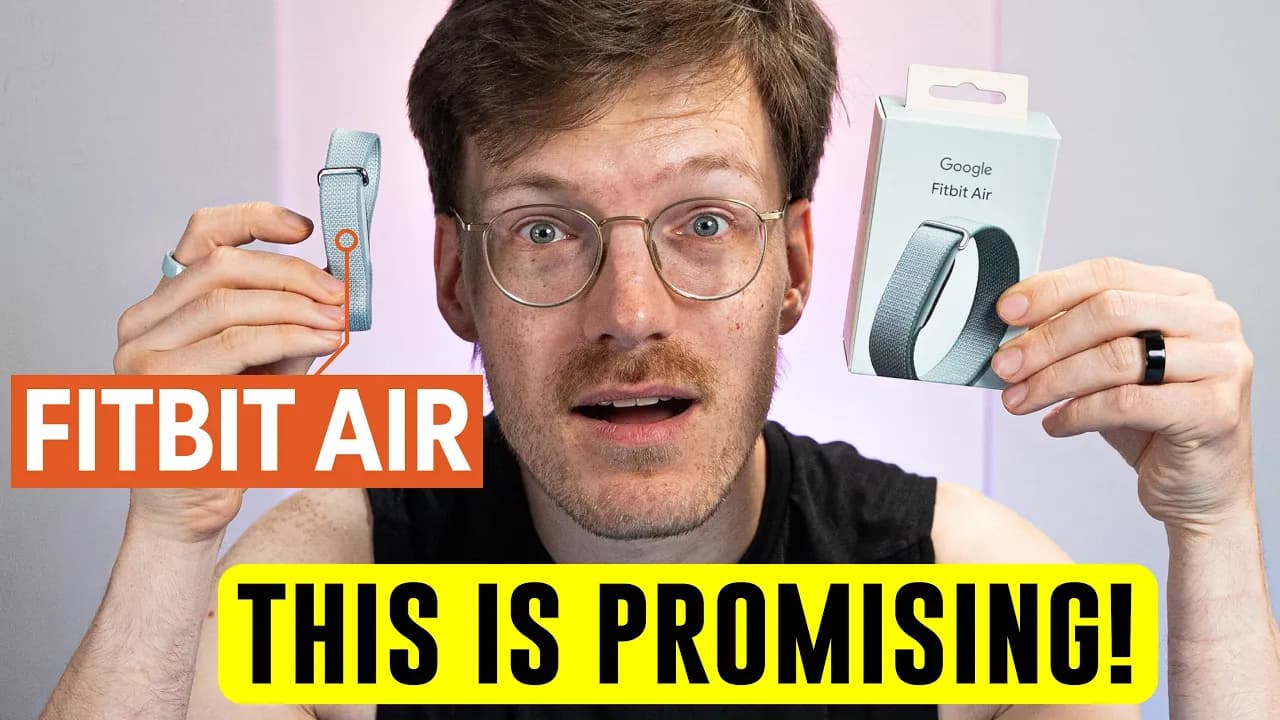
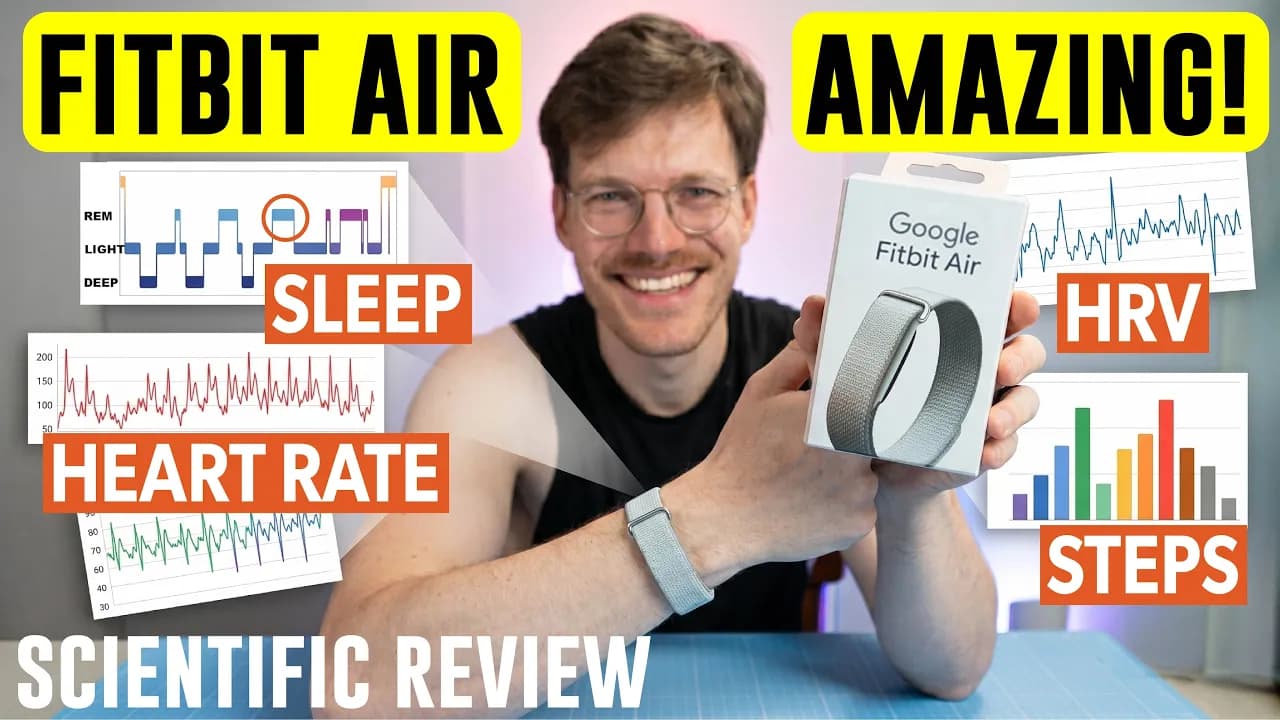
Fitbit Air: The Truth About the "Whoop Killer"
In a Nutshell
The Fitbit Air matches Whoop's screenless form factor at a lower cost—no subscription required for core heart rate, sleep, steps, calories, and workout tracking—while offering an optional $100/year premium tier with an AI coach. Whoop provides more advanced metrics like strain/recovery scores and biomarker tracking but locks functionality behind a mandatory $200–350 annual fee. In side-by-side testing with an Apple Watch, the Fitbit delivered comparable heart rate accuracy and serves as a strong middle-ground option for users who want Whoop-like data without the subscription.
These notes were generated by AI and may contain inaccuracies.
Whoop is dominant as a fitness tracker among professional and enthusiast athletes worldwide. Many ultimate frisbee teammates wear Whoop devices. It is a screenless lightweight puck in a thin band with sensors on one side worn 24/7. When the Fitbit Air launched, those same athletes immediately asked whether it is good, whether they should switch, and how the two compare.
The main reason for interest in switching is the Whoop subscription. Users buy the tracker and then pay a membership that starts at $200 a year and goes up to $350 a year forever. If subscription payments stop, the Whoop becomes useless and functions as a brick. The Fitbit Air requires no subscription at all. The optional Fitbit subscription for extra features costs $100 a year.
Athletes want to know whether the Fitbit Air is as good as a Whoop but cheaper. To answer this, both devices were worn alongside an Apple Watch during practices, games, workouts, recoveries, and sleep for nearly two weeks.
The Fitbit Air is designed to compete directly with Whoop on pricing. The Whoop is free but useless without the subscription, requiring a $200 baseline annual fee. The $99 Fitbit Air works without any subscription and provides basic tracking including heart rate, step tracking, calories burned, and sleep tracking. The full suite with AI fitness coach and workout library costs $100 a year. Launch promotions include three free months of Google Health Premium. The Fitbit wins the price battle. However, it is still a Google product from a data and ads company that wants to sell subsidized trackers to collect as much data as possible.
The Fitbit Air is given the edge in form factor. Both devices are small plastic pucks with optical heart rate sensors and are water resistant. The Fitbit Air is a longer oval shape, slightly smaller and lighter than the Whoop. Its narrow oval design makes it more discreet with a thinner band. The Fitbit uses a velcro band that is easy to adjust, while the Whoop clasp is more secure but harder to adjust. The Fitbit tracker can be easily popped out of the band to switch bands.
The Whoop has a significant advantage in accessories due to more years on the market. Available options include wristbands, bicep straps, chest straps, and Whoop-branded clothing with sensor pockets, including Whoop underwear. The Fitbit Air currently only offers wristbands. Three band materials exist: the performance loop band, the active band, and the elevated modern band. Most time was spent with the Steph Curry special edition performance loop band, a knitted fabric similar to the Apple Watch Trail Loop. This band stained during the first two weeks. It is comfortable for all-day and sleep wear but gets damp with heavy sweat. The rubber active band is better suited for high-sweat activities. The elevated modern band is considered the best for discreet, dress-up use.
The reviewer considers himself a serious competitive athlete who plays ultimate frisbee at a high level on club and pro teams. This involves frequent practices, games, workouts, cardio training, and recovery work. All activities are tracked. An Apple Watch has been the baseline device for years. The reviewer describes himself as a free agent open to switching to Whoop or Fitbit if the data and experience prove significantly better or more personalized.
The Fitbit Air connects to the Google Health app, formerly the Fitbit app. With a subscription, users can interact with an AI coach by stating goals, after which the app builds a plan. Daily information includes the previous night's sleep and weather conditions with workout suggestions. The blue button allows conversation with the AI coach for personalized answers and plan updates. The AI generally handled tricky questions well, provides sources for real-world information, and redirects extreme goals toward sustainability and maintainable changes.
The reviewer has a human personal trainer who programs workouts year-round with knowledge of goals, schedules, teams, lift capabilities, and injury considerations. The AI coach is positioned as a way for people without access to human trainers to receive similarly personalized and responsive programming.
The Whoop feature set is described as more advanced and comprehensive. During workouts, the Whoop clusters more information including live heart rate graphs. It includes a daily stress monitor, recovery score, built-in journal for pattern identification, and an advanced labs feature for uploading blood test results to track biomarkers over time. An AI assistant exists but is less prominent. The Apple Watch represents beginner mode, the Fitbit represents medium proficiency, and the Whoop is positioned for advanced users who know what data they are seeking.
Fitness trackers require calibration periods. The Apple Watch has none and begins immediately. The Fitbit Air requires a 7-day period of daily wear before full functionality. The Whoop has staggered calibration: 4 days for personalized recovery score, 7 days for health monitor, 21 days for health span, and 30 days for full calibration.
All three devices were worn simultaneously during normal weeks of practices, workouts, recoveries, and sleep. The key requirement is consistency rather than absolute accuracy. If readings vary unpredictably, they are not useful; consistent bias allows users to calibrate their own interpretation.
During a Zone 2 steady-state indoor bike workout, heart rate readings were compared across the Apple Watch Series 11, Whoop 5.0, and Fitbit Air. The Apple Watch lacks a scoring system and only counts calories. In a HIIT workout with tempo runs, the Whoop showed nearly a 45% difference in calories burned compared to the other two devices. During a 4-hour Ultimate Frisbee practice, the Fitbit split the session into two separate workouts during calibration, likely due to heart rate drops during rest periods. Numbers were combined for comparison. The Apple Watch consistently overcounts calories burned. The Fitbit Air heart rate numbers align closely with the Whoop and are slightly higher in total calories burned. The main difference lies in data summarization and presentation.
Whoop uses strain on a 0-21 scale personalized to user history and health. The Fitbit uses cardio load, which measures how elevated heart rate rises above normal and for how long. Once calibrated, the AI sets weekly cardio load goals. During the first week, the Frisbee practice was scored at 327 cardio load against a 150 weekly goal because the system did not yet know the user. The Fitbit places the AI summary at the top of workout pages rather than requiring additional clicks.
Neither device has a screen or notifications, but both have haptic motors for alarms that buzz the wrist. The Whoop vibration is more rattly; the Fitbit feels cleaner. Both alarms dismiss with a double tap. The Whoop has longer battery life at seven to eight days versus the Fitbit Air's five to six days of real-world use despite a seven-day rating.
The Fitbit Air uses a three-foot USB-C cable with magnetic pins. Charging from 0 to 100 takes 90 minutes, but five minutes of charge provides roughly one day of use. The Whoop uses a charging puck that slides onto rails and inductively charges while worn, allowing users to avoid removing the device. Charging is slower but maintains continuous data collection. The reviewer charges the Whoop during showers.
Both devices work with Android and iPhone. Whoop has an iPad app. The Fitbit defers to more specialized trackers such as Eight Sleep for sleep data or Garmin for GPS runs when those devices are present. Users can view data sources in the Google Health app. The Fitbit can currently read from Apple Health but cannot write to it; this write capability is expected in a future software update.
There is room for all three devices. The Apple Watch functions as a simple fitness device focused on closing rings and getting steps. The Whoop serves advanced users who track every metric and optimize recovery, often while training for performance goals, but uses a subscription model widely disliked. The Fitbit Air targets the Whoop with the same screenless form factor and delivers 90% of Whoop functionality without subscription while remaining user-owned.
The Fitbit Air functions as a Whoop killer for users wanting basic health and fitness tracking including heart rate, sleep, steps, calories, and workouts, all included with purchase. With the subscription, it serves as a Whoop alternative from Google. The reviewer notes that Google is a data and ads company motivated to distribute subsidized trackers to maximize data collection. Serious Whoop users optimizing performance will likely continue with Whoop. Beginners can use built-in smartwatch features. The Fitbit fits the middle ground. The reviewer has not yet decided which device to keep long-term and will determine the choice based on which tracker remains on the wrist in future videos.
Keep Marques Brownlee in your library
Save the videos and channels worth coming back to, and find them again in one place.