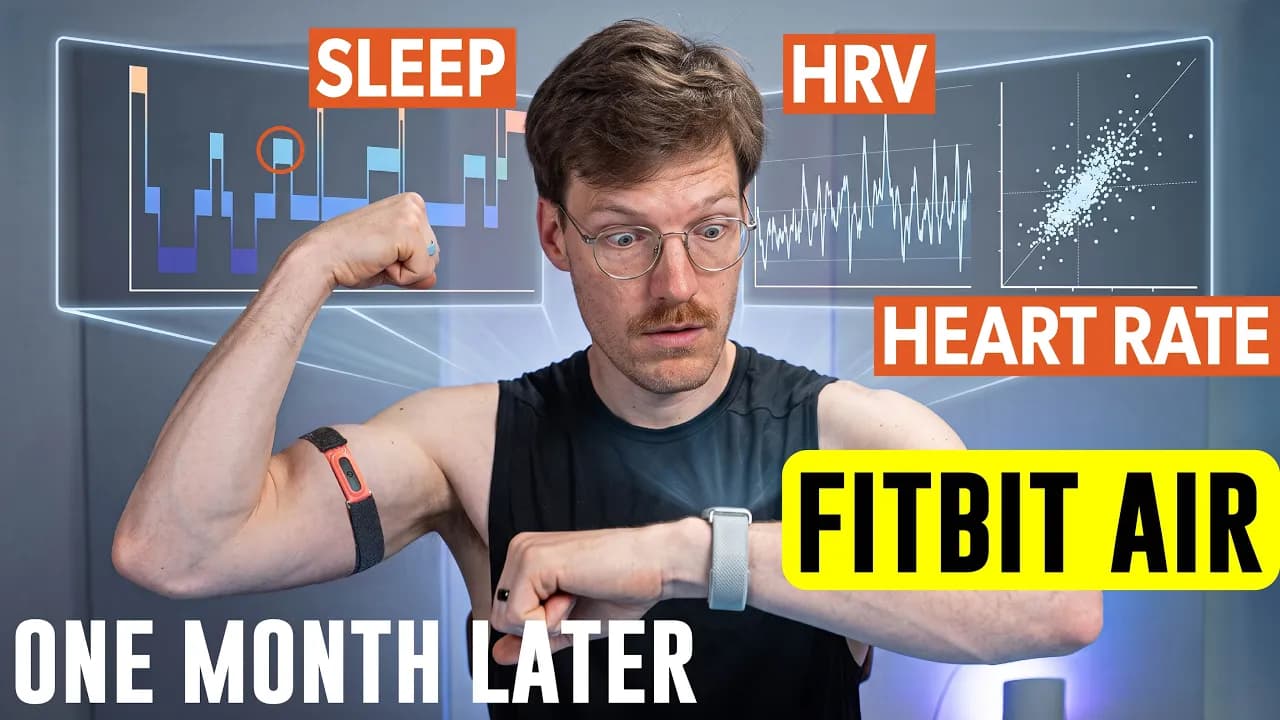
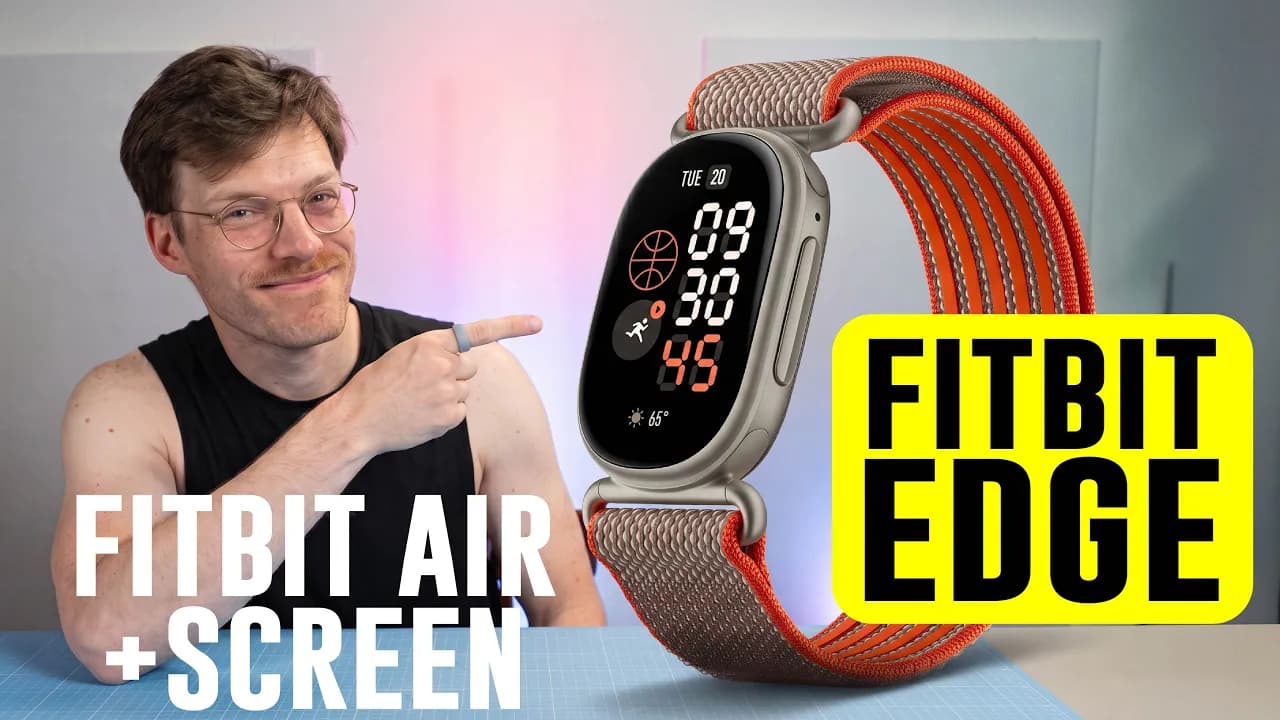
Fitbit Edge Ultimate Scientific Review!
In a Nutshell
The Fitbit Edge delivers great heart rate tracking (0.98 correlation on cycling/running) and top-tier sleep stage detection (92% deep, 72% light, 75% REM vs EEG reference) at $180, outperforming 50-70% of tested devices. GPS accuracy is average (score 55) with frequent signal loss near buildings, while step counting is very accurate (±1% error). At $80 more than the Fitbit Air, the Edge's screen and features make it worth it for users who prefer wearing a screen device, though both perform similarly when worn on the wrist.
These notes were generated by AI and may contain inaccuracies.
The Fitbit Ace device is the same size as the Fitbit Air but includes a screen and additional features including built-in GPS, altimeter, ECG function, skin temperature sensor, and a battery that lasts up to 7 days. The device is positioned as a compact fitness tracker with excellent sleep tracking capabilities. However, at $180, it costs more than double the $100 price of the Fitbit Air, and cannot be comfortably worn on the biceps, which may affect heart rate tracking accuracy compared to the Fitbit Air when worn on muscle.
The heart rate algorithm in the Fitbit Ace is nearly identical to the Fitbit Air but has been calibrated for the Ace's different shape and skin contact geometry. The sensor layout remains generally similar to the Charge 6 and Fitbit Air. Google confirmed that none of their models were trained to be worn on the biceps, though the Fitbit Air performed better when worn there.
Google claims GPS tracking accuracy has improved by 40% compared to the Charge 6 based on internal testing. However, the Ace lacks dual-band GPS and Google acknowledges its antenna efficiency is not up to Pixel Watch 5 standards. For running, the device can combine GPS data with movement data and a custom stride length model calibrated for the user, providing reasonable distance estimates even without GPS signal.
Testing used the Polar H10 ECG chest strap as reference for heart rate measurements. For indoor cycling, the correlation coefficient reached 0.98 with some deviation where the device detected very low heart rates. Individual session analysis showed the first session had the worst performance with the reference detecting higher heart rates than the Fitbit Ace. The second session showed improvement, while the third session was nearly perfect.
Running performance showed correlation of 0.98 with moments of deviation but never large deviations. The first running session was acceptable but did not fully detect heart rate drops. The second session showed possible rhythm lock where the device detected running frequency instead of heart rate frequency. The third session ended prematurely due to battery depletion and also suffered from rhythm lock.
Outdoor cycling proved more challenging due to wrist tension and vibration. The correlation coefficient was 0.96, which is lower but represents a difficult tracking scenario. Most data points remained close to the reference line. Individual sessions showed generally correct tracking with occasional delays in detecting heart rate increases. Performance was considered good for the price point, though not matching Pixel Watch 5 quality.
Weightlifting presented the most challenging conditions due to wrist pressure during exercise. The device frequently recorded very low heart rates. The first session performed fairly well with biceps and back exercises, but chest and triceps exercises caused significant tracking difficulties. Most peaks were not properly observed during these exercises.
Comparative analysis across devices showed the Fitbit Ace performing in the middle range for indoor cycling at 0.98 correlation, outperforming approximately 50% of tested devices. For outdoor cycling, it performed very well, outperforming 70% of devices. Running performance based on correlation alone placed it above 60% of devices, with potential for cadence lockout. Weightlifting performance ranked at 62% of devices tested.
Overall performance was similar to Fitbit Air worn on the wrist but not as good as wearing the Fitbit Air on the upper arm. Wearing the Fitbit Ace on the upper arm is not recommended.
The average cardio exercise score reached 97, classified as great heart rate tracking. A note was added regarding potential rhythm locking and some defects during indoor cycling. The great rating was justified by strong cycling performance where many devices typically fail.
Sleep stage tracking was compared against the Zeemax EEG device as a silver standard reference. The Fitbit Ace detected approximately 92% of deep sleep, 72% of light sleep, and 75% of REM sleep as identified by the reference device. There was slight overestimation of deep sleep, with much of what the reference considered light sleep classified as deep sleep by the Fitbit Ace. No confusion occurred between REM and deep sleep, though some REM sleep was classified as light sleep.
Example nights showed consistent deep sleep detection with some additional deep sleep identified beyond reference measurements. REM sleep alignment was strong across sleep cycles. The device missed some REM sleep near the end of one night and incorrectly expected REM sleep in the first sleep cycle, which typically contains little to no REM sleep.
The Fitbit Ace ranked at the top of devices released in 2025 and 2026. Using average sensitivity across three sleep stages and worst sleep sensitivity metrics, the device performed essentially identically to the Fitbit Air on biceps, Fitbit Charge 6, and Fitbit Air on wrist. Google products consistently performed well in the top category alongside Apple Watches, Whoop bracelet, Oura Ring, and Eight Sleep Pod.
The Eight Sleep Pod connects to wall power, enabling higher measurement frequency compared to battery-powered devices like the Fitbit Ace or Galaxy Watch. This power advantage allows collection of more data for model building. The device excels at sleep stage tracking and includes cooling and heating functions for each side of the bed independently.
Sleep stage tracking received a score of 80 based on average sensitivity levels, classified as great performance.
Overnight heart rate tracking showed good compatibility with ECG chest strap reference, with values tending to be slightly higher by approximately half a beat per minute. Nightly averages demonstrated good correlation between lower and higher heart rates. Typical nights showed near-perfect matching within the narrow range of 42-57 beats per minute.
Heart rate variability tracking showed regular deviation where the Fitbit Ace detected slightly lower values in higher variability ranges. Overnight averages maintained good correlation, allowing easy detection of low and high heart rate variability measurements. The device followed nearly identical patterns to the reference despite being slightly below reference values.
GPS accuracy testing involved running or cycling the same route multiple times, with matching signals indicating good accuracy. Running sessions showed significant deviation near a large wall area, with the device showing the user walking through buildings and losing signal temporarily. The path appeared unstable with signal loss episodes.
Cycling GPS performance showed fair signal deviation with multiple signal losses. The device showed the user walking through buildings and making strange detours. Signal acquisition was quick, which was positive. Performance deteriorated near tall buildings and at roundabouts where the device showed crossing through areas where cycling is not permitted.
GPS tracking received a score of 55, classified as average performance. For GPS tracking purposes alone, the device is not recommended for purchase. Phone GPS or devices like the Garmin Forerunner would provide better GPS tracking for running activities.
For the average runner, the total distance tracked would be acceptable, though it also depends on other metrics. If very accurate GPS measurements are needed, this device is not designed for that. Step count testing involved manually counting 4000 steps and comparing them to the Fitbit Edge's performance, tracking steps taken per minute during each exercise.
For indoor cycling, zero steps are expected, while running requires approximately 150 steps per minute. Manual step counting was performed from zero to 1000, then to 3000, and finally to 4000 steps. The Fitbit Edge recorded numbers very close to the actual 1000 steps, with an increase of between five and ten additional steps, representing a maximum of 1% increase in steps. The deviation is very slight, indicating the actual step count seems to be very good.
The step counter was held in the right hand for half the test and in the left hand for the other half. No significant difference was observed between the two. Exercise testing included cycling, indoor cycling, weightlifting, and running. For cycling, the device recorded almost zero steps per minute as expected. For weightlifting, the machine registered three to five steps per minute, which is reasonable because walking around to put on new weights and similar activities occur.
For running, between 100 and 150 steps per minute were recorded, including rest periods between rounds. The device does not count many wrong steps during exercises where walking or running does not actually occur.
Step counting is very good with no complaints. GPS tracking falls into the average category, while heart rate measurements and overnight heart rate variability are very good and highly reliable, with only minor deviations that would not affect data interpretation. Sleep stage tracking is great. Heart rate tracking received a great rating, though this is conditional due to the possibility of rhythm lockout, especially during running, and some deviations observed during indoor cycling.
Based on testing, the Fitbit Edge offers great value for its price. Whether personally buying it instead of the Fitbit Ace depends on individual preferences and device usage patterns. Better accuracy is achieved when worn on the biceps. Preference for wearable devices without a screen exists, with no issue starting workouts from the phone since it is always carried anyway.
Trade-offs to consider include the need for extra features like electrocardiogram (ECG) testing, which was not completed in this review. The screen provides convenience for not needing to take the phone during workouts and for receiving notifications and starting timers more easily. This balance favors the Fitbit Air for the reviewer, but can tip toward the Fitbit Edge for others based on different preferences.
The Fitbit Edge is $80 more expensive but remains at a reasonable price for what is provided. A friend named Stefan wears a Fitbit Air, but his girlfriend is likely to get a Fitbit Edge due to differing preferences. Overall accuracy performance is the same when worn on the wrist, with better performance from the Fitbit Air only when placed on the biceps. The choice ultimately depends on personal situation and what is being looked for.
The Fitbit Edge is definitely not a bad device and can be recommended. Affiliate links are available for purchases including the Fitbit Edge, Fitbit Air, Eight Sleep Pod, Samsung Galaxy Watch, Whoop Band, or other items from Amazon. These links provide the best possible discount without extra cost and support the channel. Videos about the Fitbit Air and the Eight Sleep Pod are recommended for viewers who enjoyed this content.
Keep The Quantified Scientist in your library
Save the videos and channels worth coming back to, and find them again in one place.