Galaxy Z Fold 8 Review: Honeymoon's Over
In a Nutshell
The Galaxy Z Fold 8 delivers a genuinely new form factor that's thinner and more usable one-handed than predecessors, but sacrifices camera quality with no telephoto lens and creates awkward speaker placement and charging limitations. Battery life is solid at 4,800 mAh with all-day endurance, though software compatibility issues persist with some apps becoming unusable due to aspect ratio constraints. At $1,900, the device appeals to those seeking novelty over objective specs, but the reviewer notes it lacks the polish and features of traditional flagship phones.
These notes were generated by AI and may contain inaccuracies.
The Galaxy Z Fold 8 launched this past week and the reviewer has been daily driving it since release. Initial impressions were extremely positive, with the reviewer practically falling in love with the device during the first impressions video. After a week of use, the honeymoon period is over, but the reviewer still really likes the phone. The honeymoon analogy is described as perfect because after the initial phase, you understand the flaws and downsides but embrace them because of the positives.
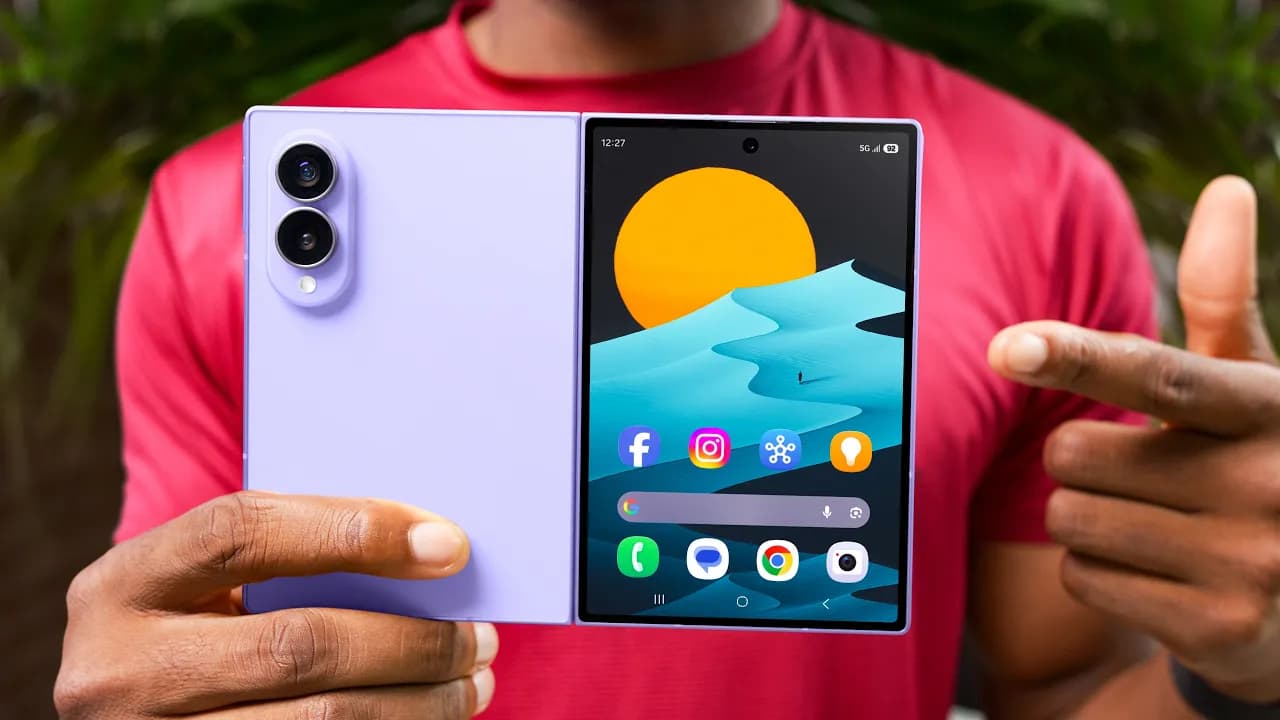
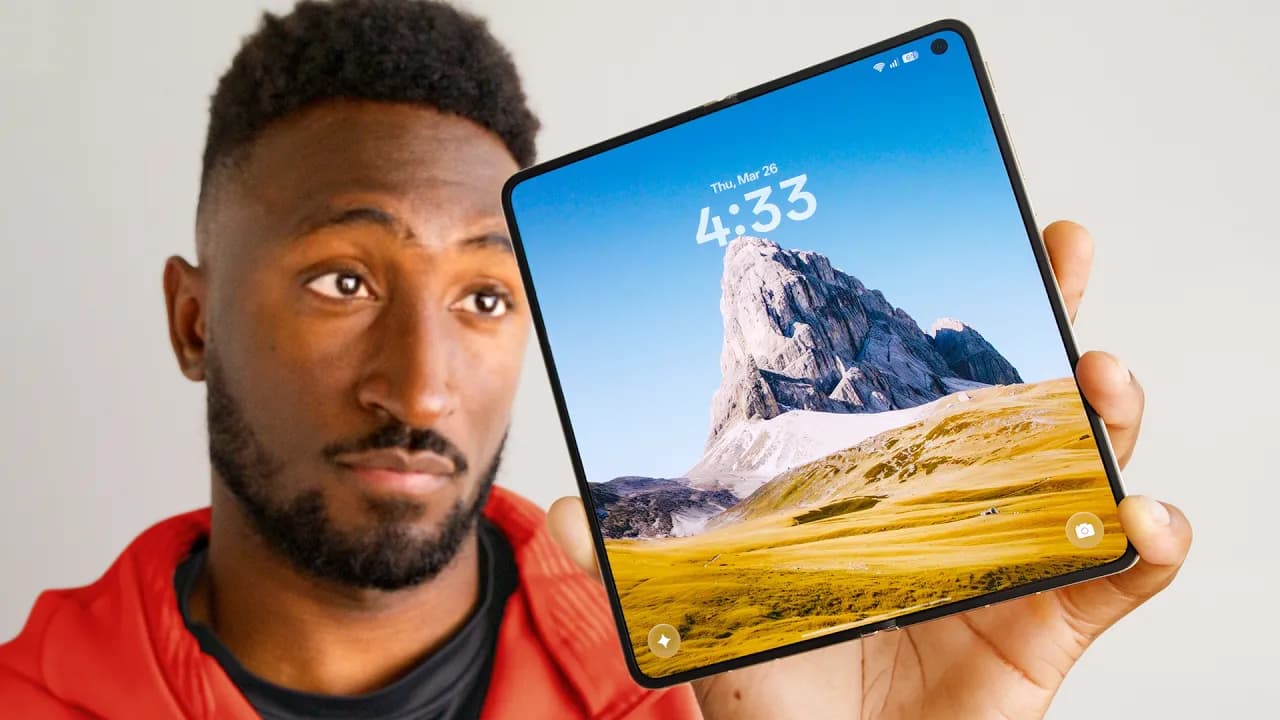
The phone represents a genuinely new form factor despite the familiar general shape with a more squat aspect ratio. It's thinner and more squared off than previous iterations. This new execution makes the device significantly better than a normal smartphone at certain tasks, but worse at others.
The front display is a 5.5-inch diagonal slightly rectangular AMOLED screen that's bright, sharp, and features relatively even bezels all around. The squared-off design makes it easy to open and close like a notebook. The power button, which doubles as a fingerprint reader, aligns perfectly with the user's finger when holding the phone normally. Despite having big hands, the reviewer finds almost the entire display reachable with one hand.
The camera UI has been optimized for one-handed use with all buttons moved to the right-hand side, making every function reachable with one hand. The viewfinder appears cut off at first but actually shows the normal photo aspect ratio without the usual blank space. This aspect ratio is slightly worse for vertical scrolling due to little black bars, which the reviewer considers technically better for reducing doom scrolling.
When opened, the device reveals a perfectly 4x3 aspect ratio display that feels like a small notebook. The screen is a higher refresh rate AMOLED with Samsung's new anti-reflective coating. The titanium flex hinge does a B+ job minimizing the crease. The display serves as an excellent canvas for productivity, supporting two side-by-side apps and being ideal for reading when turned sideways. The thin hardware makes it comfortable to hold for extended periods.
Surprisingly, the 4x3 aspect ratio plays back widescreen videos larger than the Galaxy Ultra due to being more widescreen than a square. The device also handles occasional 4x3 aspect ratio videos from online sources exceptionally well.
The phone features the new Snapdragon 8 Gen Elite for Galaxy processor. Samsung has incorporated silicon into the battery construction, achieving a 4,800 mAh battery that provides all-day usage even with heavy screen time. The device charges at 45 watts, faster than any previous folding Samsung phone.
Not every app plays nicely with the foldable's aspect ratios. Some apps show awkward black bars or blank space, while others become critically broken. Crossplay is completely unplayable because the play button is unavailable on both the front and inside screens due to the aspect ratio constraints.
There is no flex mode available. The upgraded spring-loaded hinge provides a more satisfying open and close action but eliminates the halfway open position found on the Ultra. While users can physically prop the device halfway open, there is no software mode to utilize this position.
The speaker configuration creates an awkward situation when the phone is opened. When closed, the stereo speakers at the top and bottom of the front side work fine. When opened, both speakers end up on the left-hand side, making full-screen video audio noticeably lopsided.
Wireless charging alignment is challenging, especially with chargers designed for the phone to sit upright. Many in-car chargers don't work properly. The phone lacks built-in magnets, making previously reliable chargers unusable without a magnetic case. The device is also prone to rocking on tables without a case.
The thinner, lighter design with priority given to battery capacity results in fewer cameras. The phone has a 50-megapixel primary and 50-megapixel ultrawide camera, but no telephoto lens. While these cameras aren't bad, they're not as good as flagship slab phone cameras. Most photos are just fine but lack super sharpness, incredible colors, and great low-light performance. At the $1,900 price point, this camera compromise is particularly noticeable.
The phone runs One UI 9 on Android 17, featuring a responsive lock screen clock that moves according to the wallpaper, thicker volume and brightness sliders in quick settings, and other subtle tweaks. Users can disable home screen mirroring between the front and inside displays, allowing completely separate layouts.
Looking ahead to Apple's expected folding iPhone announcement in approximately two months, the reviewer identifies three key lessons: app support will be crucial and must come from developers, with Apple having an advantage due to their developer ecosystem and prior preparation for different aspect ratios. Thinness matters significantly for user experience, making the device more enjoyable to use. The reviewer predicts Apple will not include silicon carbon batteries, similar to the iPhone Air approach. Finally, pricing will be a major factor, as this $1,900 phone is positioned as the more casual version compared to the Ultra starting over $2,000, with speculation that Apple's foldable could reach $2,500.
Objectively, the phone's specs are less compelling than traditional flagships: smaller outside screen, smaller inside screen, smaller battery, inferior cameras, and the same chip as other flagships. However, for users with disposable income seeking something that genuinely feels new, the device may justify its premium positioning.
Keep Marques Brownlee in your library
Save the videos and channels worth coming back to, and find them again in one place.