Gong CEO on How to Pick the Right Market in the AI Era | Amit Bendov
In a Nutshell
Amit Bendov argues that market size is the decisive factor in building a billion-dollar company, as a small market caps growth regardless of execution quality. Gong succeeded by creating a new category in revenue AI before competitors existed, focusing on "raving fans" through unexpected value rather than copying rivals, and maintaining a long-term product vision modeled after self-driving cars. During the 2023 downturn, Gong accelerated investment while competitors retrenched, reinforcing that early markets reward differentiation over direct competition and that true moats come from operational complexity, not just code.
These notes were generated by AI and may contain inaccuracies.
A lot of companies stall not because of external conditions but because the market isn't large enough. If your market is too small, very little else matters. In math there is the concept of local optimum: you're climbing a hill and reach the top, but you're not getting to the mountain. You can reach 50 million or 100 million but you're not going to reach a billion. Which market you play in matters more than anything else.
We've built the system over 10 years. There's a lot of complexity. You can't provide code there even with 100 engineers, otherwise why are we not seeing one right now? Why are we not seeing a competitor? If you're in an early market, which we are right now in AI, there are so many possibilities. Why would you try to one-up a competitor? Just go and keep looking. Don't go where all the other kids are going. Competition should be more like an Easter egg hunt than like a football match where you have to match every play the opponent is doing. It's not a zero-sum game in the early stages.
I'm Amit Bendov, co-founder and CEO of Gong. Gong is the leader in revenue AI, which helps companies maximize their revenue potential. We saw an opportunity in automating revenue with AI in 2016 before AI was all the rage, and today we're one of the fastest-growing companies. Our growth rate is over 50% every quarter. We're actually growing faster than the previous quarter for almost 12 consecutive quarters now.
I grew up in a very humble background with a great, loving family, but most of my family did not even go to college or university. From my family's perspective, if I was a seller at a retail store it would be just fine. My original dream as a teenager was to be a guitar player in a rock band. I was pretty good, but not top 1%, and I was in a small country, Israel. I started my career actually selling professional audio equipment at a retail store like Guitar Center. I was hoping to get close to showbiz, but I realized I didn't want to play in weddings when I'm 40. I was really intrigued by computer science, so I signed up.
My first job was as an engineer. I wrote code. Then I led an R&D team. Then I moved from Tel Aviv to the US to start my first company, ClickSoftware, which is now part of Salesforce. I became the CEO of a company called Sisense in business intelligence. We were growing pretty fast and then all of a sudden we had a quarter that wasn't great at all. I had no idea what was going on.
We were analyzing a lot of data from the CRM that everybody says is the way to manage customers and a single source of truth. There was nothing there. It actually relies on people telling it what happened, and that didn't make sense. Only 1% of the information ever actually makes its way to the CRM. It's all in people's heads. At companies, only half the salespeople are making their numbers. Nine out of 10 opportunities are not won without the company ever knowing why.
The year that AI was already beating the world champion in Go with AlphaGo and DeepMind, the thought was: can we create a system that will relieve people from the need to update CRM? That was the idea when I left Sisense. The idea was an autonomous system that automatically captures context from conversations and uses AI to turn it both into insight and action.
Are you using a meeting assistant today? We invented this. This was from my background in the music industry first. If we capture a meeting, meetings usually have multiple people, but we didn't want people to listen to 45-minute meetings. We wanted them to hear the interesting points. So things like markers, topics. Today this is pretty standard, but that did not exist.
We first drew and I plagiarized a little bit from SoundCloud. There were the play buttons and where we put in and you have those tracks. If you use GarageBand or something, you'll see there's a drum, guitar, bass. So if you look at Gong, you'll see those tracks. The concept of listen-to-talk ratio: it is the first application that was measuring how much you're listening versus talking, how it tracks competitors. We invented this thing. That was pretty innovative.
We went to raise money. I said let's start a company. I was pretty sure it was going to be a walk in the park, but it was a far cry from that. It was very frustrating and almost nobody wanted to invest in us. They obviously took a meeting and another meeting and what about this and what about that. People thought that sellers are going to hate Gong because they're going to see it as Big Brother. Google and Amazon are going to own this space. The technology is not there. When we started, AI was nowhere near where it is right now. So it was a hard job. We struggled to raise money, but finally we found a couple investors that gave us the money and that allowed us to start the company, and it was pretty smooth from that point on.
At Gong, we have our number one operating principle of raving fans. We're not happy with just happy customers. Happy is like, yeah, I could be happy with a chair. We want something people talk about that is a level above. What if I sit on the chair here in the kitchen and all of a sudden it starts to give me a back rub and it's just at the temperature of... what just happened here? You get people to talk about it, and it surprises you for the better. It does something that you don't expect.
You have to understand your mission is not feature or AI or all of that. That's what people buy. That's what they ultimately want to accomplish. First, we focus on value, not just features. So we say what does it do? We have two things that Gong will try to do. First, 75% of a seller's time is non-productive: updating CRM, doing forecast, doing training, sifting through a list. So what can we remove out of that? Second, when they're talking with customers, how do we help them be better on their job? These are the two North Star metrics.
People move from somewhat reluctant to use it (is it invasive?) to "Oh wow, she just did that." You get that wow all the time and the product surprises you in what it does, and it needs to work well and be above what you expect.
We did have a rough patch in 2023 because that was the post-COVID growth, the hangover. A lot of our customers had over-hired people and got into financial stress. So we saw higher churn. We also had competition that went in and bought a bunch of competing products and they're going to our customers and consolidating. They said we're going to do all three or four products in one. The products were not very good, but at that time customers were just looking at a spreadsheet and said okay, one, two, three. Our growth slowed down substantially in '23. I wouldn't say existential, but it was definitely not fun days.
We raised a lot of money, but we barely touched it. We just saved it for if and when we're going to need that. That gave us a lot of confidence and the ability to execute. We knew that if we struggle right now, all of our competition is struggling. If you're in an early market, which we are right now in AI, there are so many possibilities. Why would you try to one-up a competitor? Just try to go in a different direction and there are so many options. It could be way better.
I'm stealing from Jeff Bezos who said most people say they're obsessed with customer, they're not. They're really competitor-driven. They look: "Oh, they did this. I'm going to do that too and I'm going to do better." That's the wrong thing.
What do you do? We step on the gas pedal. We know that everybody's going to struggle. We have the cash and we're going to invest in engineering. I'd much rather invest in people and engineering than in office space. I remember in '99 I was stuck with an office that was all steel and plastic bags all over the area and chairs, millions of dollars. It was giving goosebumps even to watch it and say why did we do that? We spent money on real estate and not on people.
Is there anything that I could have done that would have changed the outcome? So we only do two to three-year leases. I think for now, for the first time we did a four-year lease in an office, but generally we've been in WeWork since day one and we still are. Offices either are too small, you grow so fast that you need to move out, or if you don't grow then you're stuck with a lot of space.
We built two more products. Now we are at about four. Then we started consolidating and now they're behind. I'm an amateur cyclist. When you're climbing, everybody's exhausted, then you attack. You just give it all your energy. Just psychologically it breaks your competitors. If you're good, if you're able to accelerate, then everybody just gives up because they know that they're barely breathing and now you're charging ahead. And that's exactly what we did.
A lot of companies stall not because of external conditions. It's because maybe the market isn't large enough. In math there is this thing of local optimum: you're climbing a hill and you're climbing and at first it looks very exciting and you reach the top, but now you're not getting to the mountain. The most important thing is the market, which market you're in, which market do you play in. That's more than anything else. If you get it right, then you could be okay on the others.
There are two choices. Is there to join an existing category? The advantage is it's already established, people are buying and you just need to explain why you're better. There's already budget for this. Starting categories is very compelling to people. "Oh, I'm going to start a whole new category of music or whatever." It's also hard because people don't have budget, they don't know how to think about it. So there's a lot of education, and if you want to be precise, you can start a category.
Categories by definition are a number of companies doing the same thing. If it's just you, you're not a category, you're a unique product. So you start by creating a unique product. If you're not successful, then nothing happens. If you're successful, it's guaranteed that others will try to either copy or do something better than you or something different. That's when you start to have a category. It does take time.
Today Gong is considered something like Gong, revenue AI; most companies say we need that, but it wasn't a must-have when we started. People had to find budget for it, it didn't exist. It wasn't like a CRM or a contact database. Creating a category sounds very exciting and I have no regrets, but if you're an entrepreneur, don't just think that you need to start a new category.
First understand if you're stuck, understand if it's just intrinsic to your business or something that's happening right now. There are a lot of companies that are, for example, developing solutions for SDRs. That's something don't do that. If you live in the Bay Area, you think everybody has SDRs. Companies in Wisconsin don't have. This is an example of a small market. You can get to 50 million, 100 million; you're not going to reach a billion. So understand if you're stuck because you've reached a local optimum of your market. Also, if it's a small market and it's very competitive, that's the worst thing. It's like five hungry dogs fighting for a very small piece of meat.
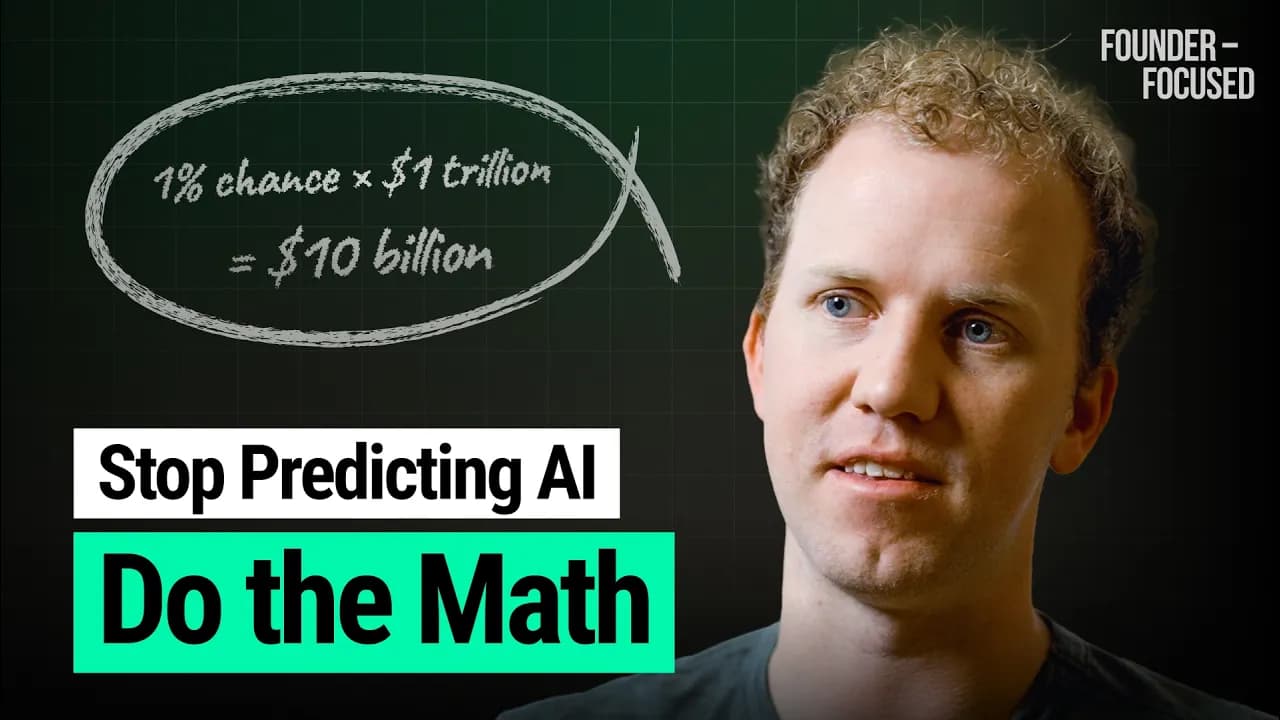
For us, we understood: we have a trillion dollar opportunity. If we don't succeed, it's not the market, it's us.
The noise that's happening right now with AI, I know it's very confusing. Just make a bet and just keep going. Ignore the noise. Right now, people are very emotional. It's almost like when people fall in love with someone, it's more like the hormones thinking versus the brain. The dust will settle. At some point, it'll be clearer. So if you have a direction, hopefully it's good, just keep going, keep plowing, do your own thing. Look a little bit to what's going on, but don't be enamored with things around you.
If I have to distill it to one, this is it: who do you cater to and what do you offer?
Let's say it's apocalypse. There's some truth in that, but it's a way overreaction of the market. Right now, it's like investors are worried if AI has this power of God, anybody can do software. So what is the moat? It's a natural question, but it's way exaggerated because most companies will probably open source their code and it will still be difficult for someone to compete with them. The code is just a part. What about running it? There's security vulnerability that you need to patch, a package, a library. Who do you call at 3:00 a.m.? Just writing the code is one part of a software company, but actually running it and supporting production, driving adoption is extremely hard. So even if Salesforce's code was out there on the internet, it would still be extremely difficult for anybody to compete with them.
CRM and HR are incredibly complex. People just underestimate it. They think you can't vibe code it even with 100 engineers, otherwise why are we not seeing one right now? Why are we not seeing a competitor?
We have to understand that sales is asymmetrical engagement. Buyers don't necessarily tell you everything. They might even lie to you. "I don't have a budget" or "I am the decision maker" even though you're not. We're looking at a few of our competitors; they might not tell you what they are, and they might not be looking at anything. So this is already like AI needs to have excellent context or data. When you negotiate, you want to lower the price, you want to increase the price.
Second, at least for us, we help mostly with B2B sales, which is complex. It's multiple people selling to multiple people. Understanding the power dynamics, the political power structure, all of that is something that AI will struggle with. Ambiguity is not where it's good. Reading the room and judgment, creativity: AI is very straightforward. It's trained on being plausible. Sometimes the creative moves aren't the ones that are plausible. It's just doing something that seems unreasonable, but still a winning place.
When you're alone, nobody cares. Once you're ahead, there's a crosshair on your back. So everybody wants to kill you, and we take it as a compliment. We've built the system over 10 years, and there's a lot of complexity.
Our vision was we thought of it as a self-driving car. When we started Gong, we wanted to build an autonomous system. Our inspiration was a Tesla. Self-driving car has five levels. Five is full self-driving, and one is getting lane keeping alerts. We thought if you want to build a self-driving car, and this is a self-managing customer management system, you need three things.
First, you need the sensors to capture all the data. In a car, it'll be the radars, the lidar, cameras. So this is our revenue graph. Second, you need to make sense of all of it. You see a red light blinking. Is it a traffic light or is it a car or motorcycle? Is it accelerating or decelerating? So this is the AI level. And then there is the application layer.
We always thought about the five levels. We said today we're like 2017, we're at level one, and when can we get to level five? So we built even though something like a lidar didn't exist or the AI wasn't strong enough to be full self-driving. We built the framework so we can plug in the technologies as they mature.
If you could vibe code it overnight, then we have a problem. But it's not easy. There is a lot of nuance and details that goes into especially deploying at a large scale. So I think it's an underestimation of what it takes to really run a company.
From the outside, when you see a company growing, it looks like this. But from the inside, there are multiple revenue sources, and you need to layer them in a way that it looks smooth from the outside, but each one is kind of S-shaped. At some point it'll hit the glass ceiling. You always need to layer those things. You need to think about two or three years in advance because when you realize that you need it, it's already too late.
Keep EO in your library
Save the videos and channels worth coming back to, and find them again in one place.