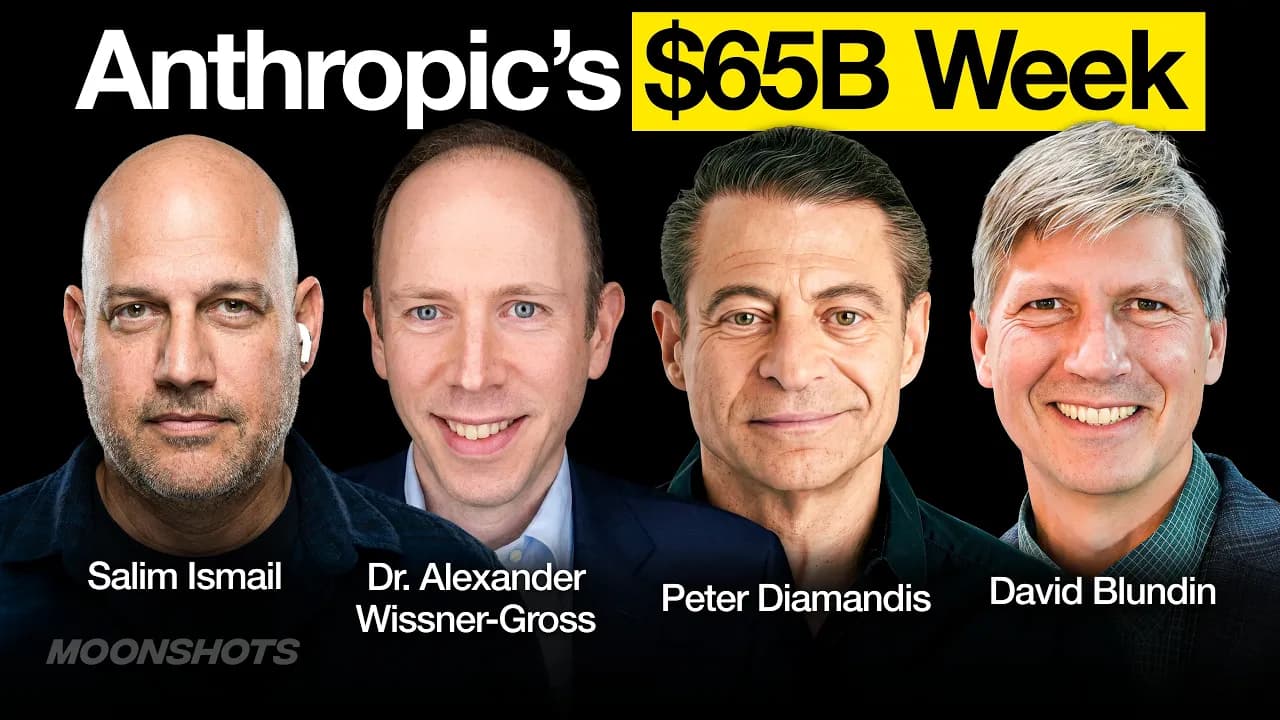
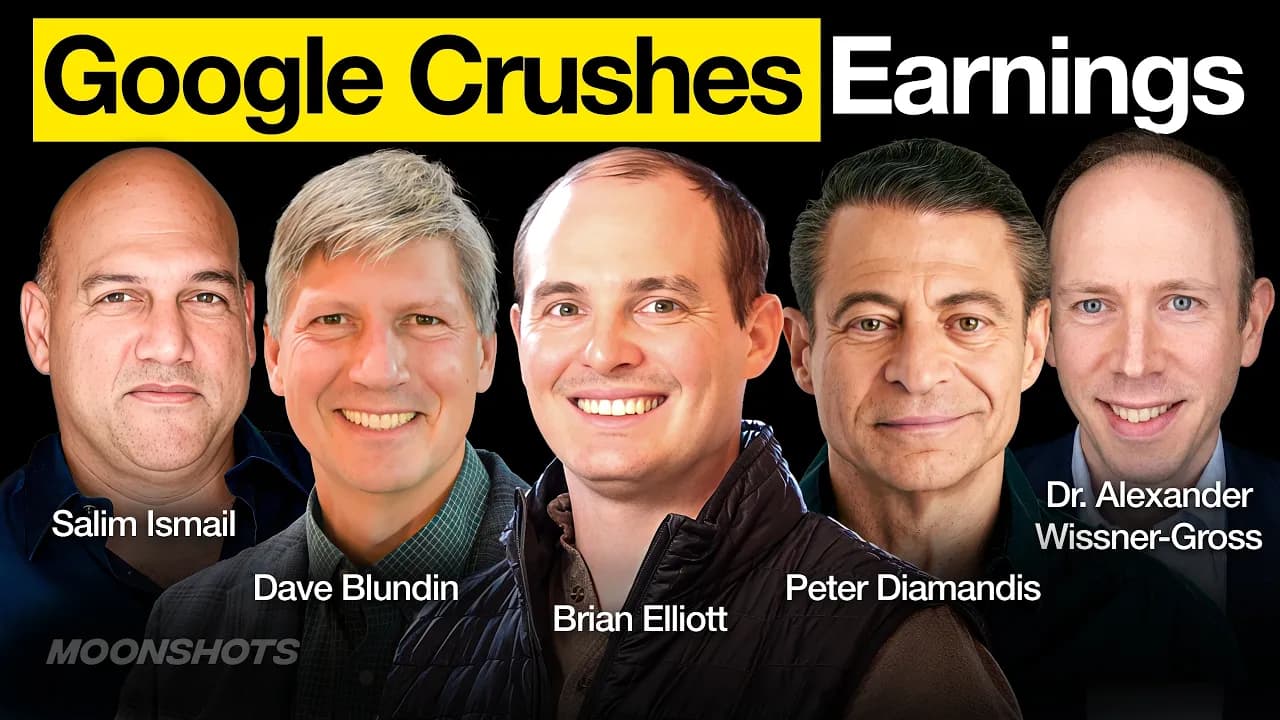
Google I/O 2026, Karpathy Joins Anthropic, and Cerebras’ $95B IPO | EP #256
In a Nutshell
Google is rapidly scaling AI infrastructure with $180-190B in annual capex and 3.2 quadrillion tokens processed monthly, while releasing Gemini Omni for advanced video generation, Gemini 3.5 Flash for high-speed performance, and agent tools like Anti-Gravity and Gemini Spark that deeply integrate across its ecosystem. Andrej Karpathy joined Anthropic to accelerate Claude's pre-training, and Cerebras achieved a record $95B IPO after demonstrating wafer-scale chips delivering up to 15x faster inference than GPU clusters. The episode underscores Google's full-stack AI strategy and the accelerating shift toward abundant, agent-driven intelligence that will transform search, shopping, science, and daily workflows.
These notes were generated by AI and may contain inaccuracies.
Five years ago, if someone had said Google would 6x its capex and the stock would go up, nobody in their right mind would have believed it was possible. The scale of the numbers—quadrillions, billions, hundreds of billions, trillions—has become numbing. There was significant conversation that Google was cooked and would not make it because its revenue engine was being massively disrupted. Instead, Google is now disrupting the disruptors. All of these numbers were inevitable.
Andre Karpathy joins Anthropic. He was the co-founder of OpenAI and left in 2017 to run full self-driving for Elon Musk. He will start a new initiative focused on using Claude to accelerate Claude's own pre-training research.
Cerebras completed a record IPO that closed up 68%, giving the company a market cap of $95 billion. CEO Andrew Feldman described it as a lifetime achievement, comparable to a Nobel Prize or Olympic gold medal that you carry for the rest of your life. Feldman joined the show as a guest.
The hosts introduced the episode of Moonshot. The team includes DB2 as emperor of AI investing, Salem as professor of all things exponential organizations, and AWG as the artificial super intelligence moonshot mate. Peter Diamandis is the host. The group wished Peter a happy birthday and discussed a surprise birthday party held the previous Saturday night for Salem, where 50 people appeared after Salem used a decoy birthday dinner as cover. Peter dropped to his knees in surprise. Dave sent a message that was appreciated.
The job of the show is to get viewers pumped about the future with no politics and no doom and gloom, focusing on the science and technology driving the singularity. This special annual recap episode covers Google's Google I/O mega event, news about Andre Karpathy joining Anthropic, Elon's defeat in the trial against OpenAI, and a conversation with Andrew Feldman, CEO of Cerebras, after its epic IPO.
Dave attended Google I/O in person along with Tyler Donahue. The vibe on AI is global but off the charts at the epicenter where everything began. The amount of new material to discuss in one hour compared to one or two years ago is crazy, with new Google brands and new AI products appearing at a baffling pace. Alex watched online in real time while dissecting the event for his newsletter, The Innermost Loop, noting high points, low points, midpoints, and some no points. Salem landed in Brazil after flying directly from LA with Peter and has meetings and presentations scheduled.
Alex is at the Cerebras headquarters and described the vibe as epic after the third biggest tech IPO in history. The team noted that it is a record IPO until the next record IPO, and the company expects to 10x the achievement this year.
Sundar Pichai opened the event noting that two years ago Google was processing 9.7 trillion tokens per month. Last year at I/O the number grew to 480 trillion tokens. Today the number has jumped seven times to 3.2 quadrillion tokens per month. Over 8.5 million people are now building new apps and experiences with Google models monthly, and the model APIs are processing around 19 billion tokens per minute.
Google now has 13 products with over a billion users each, five of which have more than three billion users. AI Overviews has over 2.5 billion monthly users. AI Mode has been a revelation as the biggest upgrade to search ever and has already surpassed 1 billion monthly users in just one year. The Gemini app grew from 400 million monthly active users last year at I/O to over 900 million today.
More than 50 billion images have been generated with Google's nano banana models to date. In 2022 Google spent $31 billion annually in capex; this year the company expects to spend approximately 180 to 190 billion, roughly six times higher. Google can now seamlessly distribute training across multiple sites and scale across more than 1 million TPUs globally, enabling the largest training cluster in the world. Both chips are more energy efficient, delivering up to two times better performance per watt.
The 6x increase in capex is remarkable given that five years ago no one would have believed the stock would rise alongside such spending. The TPUs are the lynchpin. They offer 2x power efficiency and allow Google to compete vertically from the transistor all the way through the user experience, something no one else can claim. The array of logos showing products with over a billion users is relentless. The Gemini app reaching 900 million users is striking and close to ChatGPT's user base.
Alex recalled a conversation with Larry Page 20 years ago during his interregnum when he was not CEO. Larry was asking for advice on how to get Google interested in spending $100 million on AI, which is unconscionable by today's standards. Google is now fully committed to AI as the central focus of the company, owning the full stack from chips and data centers through applications. All of the current numbers were inevitable.
If Google had not leaned in at every layer of the stack to own or lead in AI, the original search-and-ads revenue model would have been cooked. Gemini's 900 million users is slightly less remarkable because Gemini is essentially replacing Assistant, which already had traction. It is positive to have something other than a duopoly between OpenAI and Anthropic. If Google does not aggressively lean into consumer and enterprise Gemini adoption, the default outcome would be that duopoly.
Larry's early vision always included AI; he wanted to build an AI company from the very beginning. Eric Schmidt provided the adult supervision and built the revenue engine that enables Google's current capabilities. Larry's early vision also included BCI (brain-computer interfaces) and space stations. The old Google whiteboard maintained a long-term tech tree that included a Google space station, BCIs, and even a space elevator requiring a 20,000-mile carbon nanotube cable. The team manufactured about a meter of the cable. The whiteboard vision is now playing out decades later.
Alex noted that the current trajectory is speedrunning every science fiction movie ever made over the next 10 years, with every sci-fi trope happening everywhere all at once. This is the singularity. A shout-out was given to Sundar, Sergey, Josh, and the team for hitting their numbers. A year and a half ago there was widespread conversation that Google was cooked and its revenue engine was being massively disrupted. Google is now disrupting the disruptors.
Google is now an AI native operating system company with continuous sensing, execution, and adaptation. It birthed the transformer. John SM pointed out that the number of words or tokens in an average Google query followed an exponential curve over 15 years before the 2017 transformer inflection point, inevitably leading to people having full conversations with AI. Google had the exponential trajectory of user interaction, the transformer, and the compute; it was just a matter of putting the institutional pieces together.
Google is launching an entirely new family of AI models called Gemini Omni, capable of generating video clips from prompts that include text, photos, videos, and audio. Google says Omni will be the create-anything-from-any-input product. Demis Hassabis introduced the model on stage and was a rockstar. Models like VO, Nano Banana, and Genie create extremely realistic videos, images, and interactive simulations with a step change in simulating kinetic energy and gravity.
Gemini's world knowledge and reasoning shine in Omni. It can translate complex ideas into highly accurate videos, such as a simple prompt like "make a claimation explainer of protein folding" that produces detailed animations of proteins starting as chains of amino acids, folding into alpha helices and beta sheets, and forming perfect three-dimensional shapes.
Omni gives a more natural way to edit video with conversational language. Users can give it their own videos, such as a selfie, and change reality in fun ways. The crowd reaction to Demis's visuals was the best of the event, with the audience especially engaged by medicine and science use cases. The real-time morphing of himself through different places and outfits is incredible.
Alex stated that reality is getting enhanced. Google DeepMind is the only remaining American frontier lab still chasing multimodality. OpenAI has cut Sora and arguably deemphasized video. Anthropic has never been chasing multimodality and has been squarely focused on codegen. This leaves Google with the only credible frontier American video model, since video is arguably the hardest modality combined with consumer demand.
China is taking video as a modality far more seriously. From GDM's earliest multimodality announcements, there is a grand vision of modality scaling. Even though video is the most consumer-friendly and impressive demo, they are probably treating biological sequences like DNA or protein sequences as another modality. They likely have dozens of other modalities they are folding into the omnimodal model, looking for modality scaling in a way other American frontier labs are not. It is a bet that they will reach some form of super intelligence distinguishable because it handles all modalities—text, audio, video, biological sequence data, and possibly other crazier modalities—in a meta-uniform way that other labs are not achieving.
The technology is ideal for education and teaching. It would have cleared away much of the craft of presenting complex topics such as organic chemistry and medicine, allowing real-time and full 3D biological models. The real-time capability is huge. In a podcast or call, AI can create real-time graphics and visuals to fit the dialogue purely with voice. Google can do it because of token speed; others cannot keep up in real time and must wait. Access to compute determines who can deliver real-time output. AI will eventually create a soundtrack and visual track for life, always present when wanted.
Google launched Gemini 3.5 Flash, the new default for the Gemini app and AI search mode. Compared to 3.1 Pro, Flash is better across all benchmarks. It is significantly faster and in a league of its own in terms of intelligence versus output speed. It offers better handling of agentic tasks, improved agentic coding, and richer, more interactive graphics.
When compared to 3.1 Pro, Flash is better across the board on almost all benchmarks, with huge progress in coding and an extraordinary jump in GDP val, a benchmark that captures many real-world economically valuable tasks. It is a capable frontier model comparable to the best models but much faster. On the intelligence versus output speed chart, it sits in the top right quadrant in a league of its own. It is four times faster than other frontier models in output tokens per second and is a delight to use.
Alex called Gemini 3.5 Flash solidly mid. From a raw capability standpoint it does not compare favorably with GPT 5.5 high or X high or pro. However, this is a flash series model, not pro yet. Sundar noted that Gemini 3.5 Pro is coming in another month, which drew groans from the audience. The strategy appears to be positioning Google as solidly tier 1.5 in the race to raw frontier capabilities. 3.5 Flash pushes the optimal frontier in terms of throughput versus performance rather than raw capability.
It is telling that Sundar highlighted throughput versus performance instead of input or output tokens versus performance. Google picks flattering metrics, but 3.5 Flash is being compared primarily with 3.1 Pro and excels particularly on benchmarks requiring aggressive tool use. The emphasis appears to be on throughput maxing and tool use maxing rather than pushing the boundaries of the frontier. It is still a solid release and nice that Google remains in the game.
The scuttlebutt in Silicon Valley is that there is a two-horse race between OpenAI and Anthropic for the best AI in the world, with talent flooding into those two buildings in San Francisco. Nothing in the Google I/O demo or campus vibe contradicts that. Google is the one remaining horse in the race to the consumer with this very fast model that gives consumers a much better experience. The other labs have pivoted to enterprise and massive enterprise budgets. When building sophisticated AI applications, users want the smartest AI that solves the problem and will not back off to a faster but less intelligent model.
The other labs are going full bore after self-improvement. Google's unstoppable war chest of 180 billion in capex per year and rising is now more comparable to OpenAI's 120 billion cash raise and Anthropic's similar trajectory. The only disappointing thing is that the best Gemini is not yet up there with the frontier models. Google does soft sell and does not announce what is coming in four months because it does not need to. If something really big is cooking, they will wait until it is proven.
The naming nomenclature is fascinating: GPT models increment as 5.4, 5.5, 5.6 while Gemini jumps from 3.1 to 3.5. There is a clear bifurcation between premium cognition and ultra-cheap but very fast cognition that will continue. Throughput will allow a lot of marginal intelligence at costs trending toward zero.
Sundar discussed Synth ID and content credentialing, which is becoming more important as AI encroaches on reality and people need to know whether something is or is not AI generated. Since launch, Synth ID has now watermarked over 100 billion images and videos along with 60,000 years of audio.
Since launch, Synth ID has now watermarked over 100 billion images and videos along with 60,000 years of audio assets. Google is adding content credentials verification across products to show whether content originated from AI or a camera and whether it has been edited with generative AI tools. In one example, Gemini can determine a photo was captured with the Pixel camera and then edited with Google Photos. This verification system works at scale only if more partners adopt watermarking for their own AI-generated content. Nvidia signed on to Synth ID last year, and OpenAI, Cacao, and Lean Labs are now adopting Synth ID as well.
The irony is that many people worried over the past few years that society would no longer be able to distinguish what is real from what is not. The response has been that cryptographic chains of custody will eventually exist from reality capture through to what is presented to the user. This is analogous to the lock icon in browsers indicating end-to-end SSL encryption. Synth ID, originally created by Google and now also adopted by OpenAI, represents a shift where proof of reality is emerging from the synthetic side rather than from camera manufacturers. Camera makers and recording device manufacturers will be downstream adopters of the same protocol, ultimately delivering end-to-end proof of reality either way.
The pace of AI innovation outstrips Congress's ability to keep up, meaning little meaningful regulation will emerge from Washington. The industry is therefore beginning to self-regulate. Watermarking images represents an early move in this direction, with the community being asked to adopt the standard. This pattern of weekly incremental improvements will likely become the dominant mode of governance for AI rather than legislation from Washington. When intelligence becomes abundant, scarcity shifts toward trust. Scarcity creates value, and authenticity may ultimately prove more valuable than creativity. The line between something being created and knowing how it was created is now blurring due to the systems being built. Scarcity equals abundance minus trust, so solving for trust solves for abundance. Society is moving from the information age to the verification age, with trust becoming infrastructure.
Scarcity plus trust equals abundance. The cost of generating content is collapsing, so value shifts from signal creation to filtering and authenticity. Photography illustrates this shift: when each click cost a dollar, business models emerged around expensive cameras, photography courses, and composition books. With digital photography, the cost of creating images fell to zero, and the new challenge became organizing and finding the thousands of copies scattered across services. Value now resides in the filtering systems.
A raw word count of Dario Amodei, CEO of Anthropic, shows his language shifting from transformer architecture, speeds, intelligence, and benchmarks to UBI, ethics, and how the world should be governed, with papers now being written on these topics. This tracks the exponential change rate. Demis Hassabis must remain more cautious because he is technically a Google employee, though he acts independently. Both individuals are among the dominant architects shaping the future of humanity.
Watermarking is move one, act one of a larger transformation in how society will live. Trust in legacy institutions is collapsing at the same time AI is building the capability, infrastructure, and foundation for delivering trust. If the transition occurs elegantly, society will shift from scarcity to abundance rather than experiencing a messy transition.
The next product discussed is a central part of Google's plans: Anti-Gravity 2.0, a standalone desktop application built to orchestrate multiple agents to execute tasks in parallel. At its core, Anti-Gravity 2.0 is a new standalone desktop application delivering an agent-optimized experience. The product is unabashedly agent-first, focusing on agent conversations, agent-produced artifacts, and multi-agent orchestration. Internal Google teams have been using this experience to drive massive value. In one demonstration, Anti-Gravity researched, wrote over 100 lines of code, and successfully built an operating system capable of running Doom after adding the necessary video and keyboard drivers.
Anti-Gravity originated from Google's acquisition of Windsurf. It is essentially Windsurf rebranded from the Windsurf team that was hired by Google. Compared to Cursor, which shifted aggressively from a reskinned Visual Studio Code-centric editor to an agent-first interface, Anti-Gravity represents a copycat or fast-follow approach from the Windsurf team within Google DeepMind. The product moves away from direct code editing toward orchestrating fleets of code agents. The timing of the announcement at Google I/O rather than a faster follow to Cursor's earlier release represents a self-imposed constraint. Early versions of Anti-Gravity were very buggy. Version 2.0 has not yet been tested extensively, but the product is not currently used for primary development work by anyone known; development is instead happening with Claude Code, Codecs, or Cursor.
Anti-Gravity 2.0 was installed in real time during the Google I/O rollout. The new version looks almost identical to Cursor's agent-first windows. A key difference is that Anti-Gravity 2.0 completely replaces version 1.0; users cannot see the code anymore and must launch the old version if they want to edit code directly. Cursor did not go quite as far in eliminating the traditional view. The direction is clear: future development work will not involve looking at code directly. Instead, users will describe desired outcomes and debug at a higher level using evaluations and functional comparisons. No one will want to return to autocomplete code editor views. The product represents catch-up to existing tools like Codecs, Claude Code, and Anti-Gravity, with these tools leapfrogging each other.
Code is clearly going away as a human endeavor. It is being abstracted away by code agents that handle all code generation, and humans may not be trustworthy enough in the near-term future to write their own code. Recursive self-improvement represents another direction: older generation models may not be trustworthy enough to rewrite themselves and generate newer, better models. The current paradigm has existed for only a couple of months. The next paradigm is the Star Trek holodeck: real-time graphical and visual experiences where users interact in physical space using native human movements rather than regenerating interfaces after each prompt.
Gemini Spark is Google's version of an always-on AI agent, comparable to OpenClaw. It is a new always-on AI agent that can write emails, create study guides, and monitor financial fees. The agent is powered by Gemini 3.5 Flash and offers 24/7 operation. It runs on dedicated virtual machines on Google Cloud. In one demonstration, Spark drafted an email compiling information about recent Gemini Live launches and wins, then created a live RSVP tracker in Google Sheets connected to Gmail that automatically updates when recipients respond.
The integration across all Google products is very powerful. There is a cost for not being inside the Google ecosystem, which creates pressure to default to it. This situation is ironic because Google only exists due to the FTC stopping Microsoft from killing it after Microsoft had killed Netscape and integrated the browser with the operating system. The FTC lawsuit forced Microsoft to unbundle and pay a one-dollar fine. Microsoft was prevented from competing aggressively with Bing by tying it to the operating system. Google is now creating a series of products that are exact copies of existing tools but are perfectly integrated with Google products that have over a billion users. If users want an OpenClaw equivalent that works natively with Google Docs, Gmail, Android, and Pixel cameras, they must use Gemini Spark. This represents history replaying itself, with Google using tying as a competitive advantage in the same way Microsoft once did.
Gemini Spark is viewed as a lazy copycat product. It represents the minimum viable strategic response: hosting GCP VMs with Gemini Flash that integrate Google products and run headlessly. A stronger response would have shown the art of the possible, created benchmarks, and demonstrated next-generation capabilities rather than simply responding to OpenClaw. On the positive side, making agents generally available to average Google users will train hundreds of millions of people on agents. OpenClaw has room to remain experimental and power-user oriented, while Gemini Spark provides a solid entry point for people to experience an agent world, though it is considered boring and safe. It may be used to clean up Gmail inboxes but is not pushing the frontier.
There is something powerful happening because Gemini Spark gives users an operating system for their lives due to deep integration with other Google services. The next productivity jump will come from persistence, and this will create a massive enabler across the board while training many people on building and running agents. Gemini Spark is a fast follower. However, when asked on the street, most people say they have not set up an OpenClaw or Hermes because the install and onboarding experience carries too much friction. Google's distribution advantage is massive: over half the world uses Google, and if Gemini Spark is one click away from Google Search and completely integrated with Chrome, Google Search, and Android, a massive fraction of users will click the button. Their first experience with a personalized agent will occur through that click. Google does not need to push the outer boundary; being as good one day later and integrated with existing products will allow them to win. Google's magic is making products user-friendly, easy, and intuitive, and Gemini Spark will deliver on that promise.
Google is launching a brand new intelligent search box. The search box was previously a contained space, but it is now reimagined with AI. It expands with user curiosity and offers AI-powered suggestions that help formulate questions with nuances users might not have considered. Users will be able to create and manage multiple AI agents for different tasks directly in search. In one example, a user conducting apartment hunting can provide a total brain dump of criteria including location, natural light, and availability. The agent will continuously scan the entire web across sites, social platforms, and forums. The agent is persistent: whenever a question is asked, it will continue looking for the latest information, such as when a new apartment becomes available or when a product becomes cheaper. Autocomplete functionality raises questions about whether Google will drift users toward different questions than originally intended, with significant revenue implications. OpenAI has rolled out ads, but Google's version must preserve $200 billion of existing 90% margin revenue. Google Adwords is now
Google AdWords is now going to gently drift users toward different questions than originally asked. Google has a long history of steering users toward more profitable queries. The shape of the search rectangle changed after decades of armchair commentators saying Google was about to be disrupted by ChatGPT with web search. Google proved able to self-disrupt and change the shape of that multi-decade-old rectangle by building AI modalities and AI search natively into their search experience.
The speaker's first venture investment was TripAdvisor. The core quandary was how to have completely unbiased, accurate reviews while still getting paid by hotels. The solution was sorting the list so paying hotels appear at the top. Human default behavior means 80% of people click on one of the first two or three hotels. Laziness is dominant because people are buried in decisions from so many directions and must fall into default buckets. Google will steer users through default suggestions from Gemini without being overtly misleading, and Google is allergic to misguiding users into fraudulent products. People will follow the default suggestions and Google will collect revenue from whoever is willing to pay.
Google showed courage in risking disrupting their own business, which is organizationally difficult. The goal is to give an overview of what Google has done since it steers much of humanity's abilities. The mindset of curiosity is the single greatest tool, and users should play with the new AI search capabilities after listening.
There is a misconception that the main obstacle to Google self-disrupting search with modern AI was business risk or the advertising side. The main obstacle was more technical. Google engineers were concerned there wasn't a cost-effective or time-effective way to squeeze generative models into the very narrow, latency-sensitive, and cost-sensitive parameters of powering search. The models were too expensive and too slow to yield competitive search results. This is one reason Gemini 3.5 Flash emphasizes throughput so much, reflecting Google's internal dogfooding needs for ultra high throughput models to power search and internal applications.
Google is launching a universal cart that users can add products to from YouTube, search, Gemini, or Gmail. The intelligent shopping cart works across merchants including Nike, Target, Walmart, and Shopify. Users can add a product when searching on a Nike or Target site and have it monitored and bought at the same time. The universal cart finds deals, looks at price drops, gives insights on price history, and alerts users when something comes back in stock.
Every announcement relating to shopping from Google should be viewed through the lens of competing with Amazon for retail shopping. This includes creating virtual storefronts for individual retail vendors, crawling third-party e-commerce websites, and assembling virtual pages. The question is whether Amazon will contemplate complying with or adopting Google standards. The guess is not.
Shopping is moving toward a continuous function rather than something done for an instant of time. Universal cart is an early step in reinventing shopping. Today users go from human to website to shopping cart to checkout. Tomorrow the flow will be from intent to agent to transaction. Every CMO will ask how to convince 100 million agents to choose their product. Someone will create a trillion-dollar company by helping agents buy. The disruption to e-commerce is not better shopping but getting rid of shopping entirely. An ambient experience will emerge where AI notices shoes look dirty from a doorway camera and ships new shoes.
Amazon was originally nothing but consumer shopping and built its empire on it before adding AWS. AWS is now so much bigger than the entire consumer shopping business. Google was already competing with that side of Amazon through GCP versus AWS in a battle over compute, data centers, and enterprise use. Google previously tried to compete in retail with Froogle. AI is a big game changer, but the battle on the cloud and backend is bigger and already raging.
More than 900 million users come to the Gemini app every month. NotebookLM has been used to create more than 1.5 billion notebooks, podcasts, slide decks, and more. It is available in more than 230 countries in over 70 languages and now opens up immediately. Users will soon be able to pick a regional dialect. Gemini Omni is coming into the Gemini app.
One of the newest out-of-the-box agents is the daily brief, a personalized digest designed to be the first stop every morning. It synthesizes information from across the inbox and allows users to take next steps directly in line with travel information. This is an integration story across all of Google's capabilities.
When demonstrating building an entire operating system in real time by consuming trillions of tokens, the crowd response is muted. When Josh demonstrates a real human musician trying to portray herself to her fan base, the crowd goes crazy. The human aspect of AI is so dominant in people's minds even within Google.
Why Google is still branding NotebookLM as a separate product is questioned when it should be folded directly into Gemini or Workspace. Google has a reputation for launching lots of products where product managers get promotions for launching but not maintaining products. All functionality should be unified in a way that gets sustained under the spirit of more wood behind fewer arrows. Google's original branding was speaking directly, colorful, humanistic, and friendly. The request is to unify all offerings and maintain them rather than launching ten different products and product names that will be forgotten.
The daily brief is loved as a beautiful integration. Being able to know what users are doing, when they are doing it, and their intention while giving updates on flights, cheaper alternatives, or weather adjustments represents overlay intelligence that will be magical. Google Reader was abandoned despite having a rabid user base, and the same concern applies to maintaining the daily brief.
In big companies like Yahoo, teams are rewarded for getting something out there but then face strategic project managers looking across resource allocation for ten different projects. This creates a peanut butter problem where teams are spread thin across projects and do not iterate well. Apple iterates relentlessly on a small number of products. The Peanut Butter Manifesto written by Brad Garlinghouse at Yahoo mirrors this challenge of navigating limited resources in hierarchical structures.
Google's first audio glasses will arrive this fall through partnerships with Samsung and eyewear manufacturers including Warby Parker and Gentle Monster. The glasses give all-day help with Gemini spoken into the ear privately rather than shown on a display. They let users stay hands-free and heads-up for listening to music, taking photos, making calls, or tapping into phone apps without reaching for their pocket. Every millimeter counts in eyewear.
The audio glasses lack visual output on the screen. Audio might be mid, but the bigger story is that human-computer interaction becomes continuous and an ambient layer. People already pick up phones 80,000 times a day, and this continues that in an unnoticeable way. The form factor is workable.
Google should have owned smart glasses, but Meta is running away with the space while Apple plays catchup. Google Glass was one of the earliest smart glasses with battery life of about five minutes and self-bricking through operating system updates. It was prematurely released. Google could have kept iterating on smart glasses from the Google Glass era but abandoned them to enterprise and then completely. This announcement represents a complete reset without the conveniences Google Glass had. Meta has been iterating away, spending billions, and now has the lead. A competitive smart glass market between Meta, Google, and Apple is desired, with Android XR shipping much more quickly.
Society will have a huge rift around glasses because the punching in the face issue from Google Glass was real. Google wants to be a consumer-friendly brand, but rolling out a product where half of society walks around recording everything while the other half is offended creates a major problem. People will want to talk to their agent all day long and not lose touch with it. Three commencement addresses this week saw crowds boo when AI was mentioned, showing the divide outside Silicon Valley echo chambers. The glasses will be a huge forcing function in this inevitable shift.
Audio glasses may be an oxymoron but the audio feedback layer is a smart move to provide a product that works consistently and compellingly. Imaging on AR glasses is still weak with insufficient brightness. The audio interface allows the AI to say it knows a user was shopping for something and offer to order it, or identify approaching people by name and details. The consumer would rather have longer battery life than worry about devices dying every hour. This is a good temporary stepping stone before full AR displays.
Gemini for Science brings together powerful AI tools to help accelerate research. Gemini can assist in solving complex problems, and new labs prototypes streamline daily scientific tasks including staying on top of newly published papers, transforming research goals into usable code, or generating new hypotheses. AI simulations are critical for understanding and predicting dynamic systems too complex to model directly. State-of-the-art weather next models can predict hurricane paths faster and more accurately than traditional systems. At Isomorphic Labs, modeling molecular interactions is massively accelerating the development of
At Isomorphic Labs, molecular interactions are being modeled to massively accelerate the development of new medicines supported by leading industry partners. Multiple projects are now in the pre-clinical stage, including potential treatments for immune disorders and cancer. Alex reflected that this represents DeepMind at its best, tackling root node problems such as fusion and protein folding. He noted that Google does not have a deeply vested business interest in monetizing this work, viewing it more as a public benefit. Alex also highlighted portfolio companies working closely with Google on related technologies and praised DeepMind's innovations in meta science, specifically how to produce more science at the algorithmic level.
Dr. Don Mucalem, Chief Medical Officer of Fountain Life, discussed brain health. 45% of dementia cases are entirely preventable with lifestyle changes. A quarter of Fountain Life members had advanced brain age, but after 13 months of healthier eating, regular movement, and optimized sleep, brain age improved in 46% of those individuals. Members are encouraged to become the CEO of their own health and maintain cognitive clarity.
A $2 million Build with Gemini X-P Prize Hackathon was announced, offering prizes for builders creating apps that solve real-world challenges impacting at least 100,000 people. Participants have 90 days to build products using AI, with agents handling website creation, interfaces, marketing, and scaling. The winning team will be the one that builds, markets, and scales revenue the most. Google contributed $3 million total, with $2 million for the prize purse and $1 million for operations. The Future Vision X-P Prize was also mentioned, focused on creating film trailers and treatments for hopeful visions of the future. Finalists for both prizes will pitch at the Moonshot gathering on September 25th at moonshots.com, where attendees will vote on the winner.
Andrew Feldman, co-founder and CEO of Cerebras, discussed the company's record IPO. Cerebras raised $5.5 billion, marking the biggest U.S. IPO since Uber in 2019. The stock rose 68% with a market cap of $95 billion. The event was turned into a family celebration including parents, spouse, and stepdaughter. Feldman described the IPO as a generational wealth moment for the organization.
Andrej Karpathy joined Anthropic's pre-training team and launched a new initiative using Claude to accelerate Claude's own pre-training research. He stated that the next few years at the frontier of LLMs will be especially formative. Karpathy previously co-founded OpenAI, left in 2017 to lead full self-driving at Tesla, returned to OpenAI in 2023-2024, and founded Eureka Labs. On a prior No Priors podcast, he emphasized the importance of staying connected to frontier labs to avoid judgment drift and maintain understanding of how systems work under the hood. He noted his continued passion for education.
Panelists observed that Karpathy realized he needed access to significant compute resources, as his auto research repo requires far more power than he currently has. They noted he is the only OpenAI co-founder without billions in funding or a foundation lab position. The timing of the announcement on the same day as Google I/O was noted as potential marketing strategy. Andrew Feldman connected Karpathy's point to hardware, stating that if hardware builders are not engaged with one of the three major labs—Google, Anthropic, or OpenAI—their hardware will drift from what these labs need.
A federal jury unanimously rejected Elon Musk's lawsuit against OpenAI after two hours of deliberation. Jurors ruled that Musk waited too long outside the statute of limitations. Musk's team plans to appeal. Andrew Feldman described the case as a distraction and expressed that both Elon and Sam Altman should focus on building rather than battling. He called Elon a polymath and brilliant thinker and praised Sam Altman's contributions to Silicon Valley structure through Y Combinator.
Andrew Feldman shared the founding story of Cerebras. The founders previously worked together at a startup acquired by AMD in 2012. By 2015, they saw AI on the horizon and made two contrarian bets: that AI workloads would require dedicated silicon, and that the right approach was a clean-sheet design rather than a GPU derivative. They focused on memory bandwidth and built a chip the size of a dinner plate—58 times larger than any previous chip—packed with SRAM to overcome storage limitations. This approach proved 15 to 20 times faster than GPUs on inference problems. No one had built a chip this large in the 75-year history of the computer industry. After years of failures, they announced success in August 2019. Early sales were slow—12 systems in the first generation and 300-350 in the second—but demand surged in late 2024 to early 2025 as models became fast and smart enough for widespread inference use.
Alex noted that Cerebras was originally viewed as a training company. Feldman acknowledged they got many predictions wrong but correctly recognized early that AI requires both training and inference. He stated that between 2020 and 2024-2025, models were not yet smart enough to be useful, so the market focused on parameter counts. Now the measure is whether models write good code, give good answers, and perform desired tasks. Cerebras is strong at training but is currently experiencing overwhelming demand for fast inference.
Cerebras recognizes that while they excel at training, overwhelming demand for fast inference is driving significant allocation of attention and resources toward inference optimization.
The largest frontier models now reach up to 10 trillion parameters. The Wafer Scale Engine version 3 contains approximately 40-50 gigabytes of SRAM. Models of this scale must be divided across multiple chips whether using GPUs, TPUs, or other architectures. Large matrix multiplications in attention heads do not fit on a single GPU, requiring tensor model parallelism.
Cerebras takes a different approach: the model is spread over four, six, or eight chips with careful division so no single layer spans two chips. Only results vectors move between layers, which are small enough to transfer over 100 gig Ethernet. While these hops are slower, the massive speedup in calculations results in only about a 2% overall performance penalty when breaking models across 4-20 chips.
Other SRAM solutions like Groq (acquired by Nvidia) are limited to 800 square millimeters and must break large models across 2,000-3,000 chips. Each inter-chip hop degrades performance significantly. Cerebras requires only a few hops compared to thousands, creating a substantial advantage.
Cerebras announced and posted benchmark numbers for Kimi K2, a trillion-parameter open-source model. The system achieved approximately 1,000 tokens per second, roughly 15x faster than top GPU-based inference providers like Fireworks, which run at around 70 tokens per second.
When evaluating performance claims, it is critical to distinguish between aggregate throughput and per-user performance. An NVL72 system can generate 35 tokens per second per user while supporting millions of tokens in aggregate, or alternatively support only one or two users at 200 tokens per second per user. A $4 million solution supporting a single user highlights the importance of understanding whether reported numbers represent gross throughput or actual per-customer service capacity.
Elon Musk announced Terrafab, aiming to produce 50 times the current global chip output and surpass TSMC. Musk has demonstrated vision across multiple ventures including Tesla and SpaceX, often pursuing goals others dismissed. However, building fabs presents unique challenges distinct from other domains he has entered.
Fabs require 5-6 years to build and cost $40-50 billion. Even with identical ASML equipment, Samsung and TSMC operate at different nodes due to accumulated manufacturing expertise across generations. TSMC's US migration has encountered delays and unforeseen challenges. Political complications arise when projects span multiple administrations, and local ordinances can create additional obstacles, as seen with Samsung's Texas fab redesign due to fire code requirements.
Beyond fabs themselves, advanced packaging is equally critical. A wafer passes through multiple manufacturing partners including those depositing RDL on the backside, dicing, and cleaning before reaching the final assembly. When the US deprioritized domestic fabs in the 1990s, surrounding expertise in materials science, manufacturing engineering, process engineering, and deposition engineering was lost. Much of this capability now resides in Taipei, Korea, and Japan.
Cerebras has committed its 3nm design to TSMC. The company also manufactures some components at Samsung and respects their capabilities. Intel has not been used. While Lip-Bu Tan is viewed as an extraordinary leader advocating for hardware, Intel would require additional progress before Cerebras could consider moving production there.
The first Wafer Scale Engine took four years and approximately $400-500 million to develop. Inventions spanned lithography, chip architecture, packaging, cooling, power delivery, compilers, and algorithms. Packaging challenges were solved 7-8 years before competitors encountered them. Nvidia's B100/B200 faced 18-month delays due to co-packaged optics issues that Cerebras had already resolved in 2018.
Developing pioneering technology involves extended periods of high burn rate without solutions. The company spent 18 months at $8 million monthly while unable to resolve critical problems, accumulating over $140 million in additional losses. Board meetings every six weeks during these periods created significant pressure. This is Andrew's fifth startup, and he emphasizes that the ability to modulate between highs and lows is essential for survival. He describes the role as a pressure test on one's soul and notes the remarkable number of setbacks a startup CEO can absorb before lunch and still consider it a good day.
As an infrastructure builder, Cerebras focuses on enabling others rather than predicting specific future workloads. The company bets that the world will continue relying on sparse linear algebra as the foundation for AI calculations. Past infrastructure work in networking enabled unforeseen applications like WhatsApp, demonstrating that infrastructure builders create platforms upon which others innovate.
Even if compute becomes constrained, AI follows the same trajectory as previous technologies including computing, bandwidth, DNA sequencing, and solar energy. Initial scarcity and high cost give way to learning curves, infrastructure investment, Jevons paradox, rights law, and competition driving costs down dramatically. AI is not merely consuming compute but actively helping design chips, optimize infrastructure, compress models, and create recursive improvement loops.
The 10-cent lawyer thesis remains intact. Current legal and accounting business models based on selling hours are structurally misaligned with future economics. Lawyers function as gatekeepers of obscure knowledge applied to specific problems. Over time, AI-driven cost reduction may reach $2 lawyers or 50 cents before ultimately reaching 10 cents, down from current rates of $1,000 per hour.
Money and the acquisition of talent are not enough to build leadership in AI. Intel had the best fabs and the best computer architects at the time Apple approached them about building a cell phone processor, yet they destroyed tens of billions of shareholder dollars by failing to seize the opportunity. AMD faced a similar situation. Nvidia spent decades failing at everything that was not a GPU, including attempts to build an ARM processor and northbridge/southbridge components.
The question is why companies miss these opportunities. Intel was chasing margins and infatuated with its own profits. They had an ARM division that they sold off. This reflects the innovator's dilemma where successful companies become fat, happy, and lazy.
Massively transformative purpose is incredibly important for organizational success. Luck plays a significant role, but hardworking people with tremendous grit and integrity end up getting lucky more often. Luck is not equally distributed between those who work hard and those who do not. In a world that is going exponential, nonlinear outcomes are desired, and luck itself is nonlinear.
There is something very hard to buy that has to be made within organizations and talent. Talent is necessary but clearly not sufficient. The team with the biggest money does not win every year in the NFL for the same reason. This quality is difficult to articulate and cannot simply be purchased through acquisitions.
Sam Altman would likely explore heavy launch partnerships to become a counterweight to Elon Musk and SpaceX. Heavy launch is already arguably a critical element of the future compute stack. Space is becoming important for compute capacity. New Glenn is more akin to Falcon 9 and does not hold a candle to Starship, which will be making a launch attempt soon. Starship is coming in at a factor of probably a hundred times cheaper.
Sam Altman has repeatedly seen around corners that other people missed. He was trying to lock down data center capacity in space last year and the year before when other foundation labs did not see it. His ability to look at an exponential and not be afraid of what it says in two or three years is extraordinary, as is his reach.
Elon's Dyson swarm concept involves 500,000 satellites to a million satellites, requiring a launch every couple of minutes of a Starship. New Glenn is not designed for the frequency of launch required for that scale. Sam could put up a mini constellation with Bezos, but could not put up something to really compete without new launch capability. SpaceX is completely dominating mass to orbit, including historic mass to orbit.
A multi-channel strategy would include exploring a deal with Elon and SpaceX to leverage SpaceX launch for a Dyson swarm, exploring alternative launch capabilities, and considering building fabs in space. If on the singularity exponential trajectory, fabs do not need to be on the ground and could be built on the moon and in LEO, reducing dependency on heavy launch.
Building a fab on land is hard enough, requiring 40 or 50 billion dollars in five years doing something only one or two other companies in the world have ever successfully done.
China is not building massive compute capacity when measured in tokens per second. They desperately want to import from the US because they lack 5 nanometer, 4 nanometer, and 3 nanometer technology. They are bottlenecked by ASML machines and fab construction. If they had the ability, they would love to sell tokens to US users at very low prices and disrupt providers, but they simply do not have the compute.
China has chosen to invest in power infrastructure and has upgraded their grid. They have tremendous power infrastructure while the US is stuck with a grid built in the 1950s. The US has made bad decisions and has trouble politically at local, municipal, state, and federal levels doing infrastructure projects.
Enterprises purchasing tokens are not just buying the token. They are buying trust, governance, reliability, and compliance.
In the past week, there has been public reporting about China operating proxy services that are selling American tokens to Chinese users at incredibly low prices, offering 10x discounts, in order to siphon the reasoning traces for training their own models. This is quite disruptive, and Anthropic is pursuing that issue.
The episode closes with the song "We Are as Gods" by Mousad Zamani.
Keep Peter H. Diamandis in your library
Save the videos and channels worth coming back to, and find them again in one place.