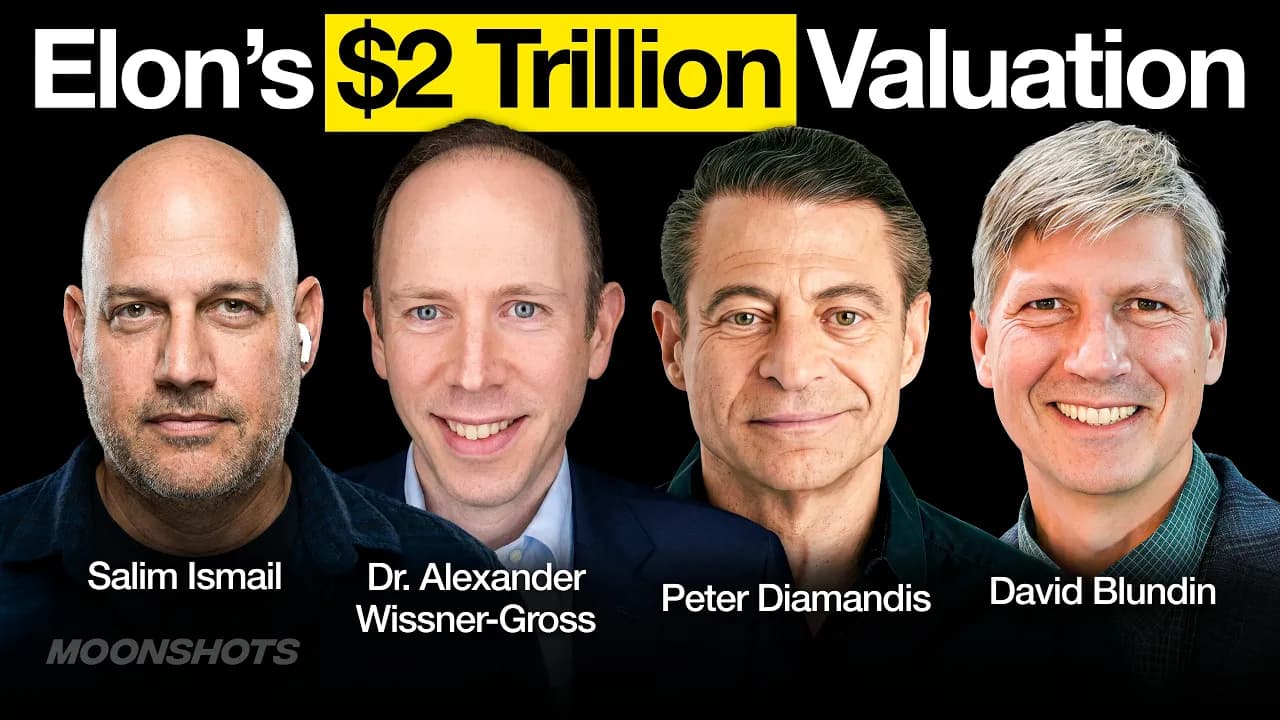
Google Invests $40B Into Anthropic, GPT 5.5 Drops, and Google Cloud Dominates | EP #252
In a Nutshell
Google invests $40B in Anthropic amid massive hyperscaler deals (Amazon $33B), TPU v8 dominance, and compute races with 960K Nvidia Vera Rubin GPUs, while OpenAI drops GPT 5.5 with multimodal leaps, 37-point reasoning gains, and math benchmarks advancing 1% monthly toward solving all pro-level problems in 4-5 years. Chinese open models like Kimi K2.6 (1T params, MoE sparsity) rival frontiers at 1/8-1/30th cost, fueling agentic booms, self-hosting, and economic value per token maxing. Biomedical breakthroughs (mRNA vaccines curing pancreatic cancer, AI clinician copilots outperforming doctors), robotics (ACE ping-pong champ, Cybercab production), UAE's agentic gov AI, and warnings on deepfakes, job shifts, and p(doom) highlight accelerating abundance vs. risks like inequality and regulation lags.
These notes were generated by AI and may contain inaccuracies.
Google commits to a $40 billion investment in Anthropic. Dario Amodei needs compute, signs up with Amazon. Google is already a shareholder in Anthropic. They're trying to maximize economic value per token. Bottlenecked at TSMC, the actual bottleneck to all of AI, only Elon talks about it. Google Cloud dominating, unveiled eighth generation of TPUs: TPU 8T for training, TPU 8i for inference. Google the winner in the long run.
OpenAI unveiled GPT 5.5, strengthens codecs. Math is cooked, other things cooked. Things moving quickly, hardest benchmarks creep up 1% per month. That's a moonshot.
Welcome to Moonshot, AI exponential tech pod. Hosts: Peter (host), AWG (orchid-filled room, DB2 in headquarters of exponential investments), Seem on the road. Seem in a car in Guadalajara, Mexico, transiting to airport, using friend's hotspot.
Peter brings up Where's Waldo. AWG: Still exclusive licensee of Where's Waldo for data mining. Used to have actor in Where's Waldo suit at trade shows: "Our neural nets can find anything in your data."
Blitzy team in Mexico raving about podcast, big fan base. At conference of 1100 people, many avid watchers. Think international, big world.
Peter did Meaning of Life session in Spanish with translator, translator fried at end. In India, speaks English, bad Hindi, can get through 50% of conversation. Almost 500,000 subscribers, push over 500,000.
15 major releases in 8 weeks, pace of two major models per week. Need to be retired to keep up. Focus on last three: Kimi K2.6, GPT 5.5, DeepSeek V4. Extraordinary releases, new capabilities.
XAI acquires Cursor. Winners provide best abstraction layer, doesn't matter what models underneath.
Dave agrees, meeting with data center company in Cambridge, effort into TPUs and Nvidia B100, B300s. Abstraction layer wastes factors of 5-10 on context window mismanagement. Much opportunity in stack, all brand new. Vertical integration, warfare stepping up. Shocking Kimi K2.6 keeping up, open source on radar.
Speed of releases competitive marketing, models already cooked, release on top of others. Anthropic holding back Mythos. Dot releases faster. US vs China, no European, UK, Japanese, Indian models; everyone else spectator.
Models self-improving, rate accelerating per singularity theory. Hard to cold start and catch up. Surprised other countries not bootstrapping with Kimi K2.6. Easy to design new neural nets using existing ones.
Chart shows leapfrogging. Down to three-way race at frontier: OpenAI, Anthropic, Google. Good generalists, not benchmaxing. Honest arms race. Chinese models because compute in US/China. Mistral missing because no compute.
OpenAI's Noam Brown pondering if weights matter less, race for compute as inference-time reasoning important. Weights less important like individual units in transformer. Space-time transformer over reasoning token space.
Race to bottom on per token intelligence density, American models 6 months ahead on closed, consistent past couple years. What matters: who has more compute for reasoning per scaling laws.
15 models over two months insane, some improvements, some new pre-trained. Cost of cognition, coordination, execution collapsing, compression density crazy.
Capabilities mind-blowing, beyond predictions 3/6/9/12 months ago. On knee curve of acceleration, raw parameter count + chain of thought to beyond human.
Average person: stuff better, cheaper, faster. Stick with one model (OpenAI, Anthropic, Google)?
Question red herring. OpenAI bet on consumers using reasoning tokens, pivoted to enterprise. Average consumer not equation short-term, enterprise cares.
For listeners (entrepreneurs, consumers): okay using ChatGPT, Gemini 3.1 Pro, latest Anthropic? Leapfrogging, okay for mom/dad/student/entrepreneur not bouncing models.
Dave uses 2-4, now many more. Coordinator model manages dozens/hundreds, wasn't true 6/3 months ago. For average consumer, models install themselves. Use latest, ask to build on laptop, explains itself. Never built software before? Think, create in hour. Massive unlock.
Moonshot AI launches Kimi K2.6, trillion parameter open-weight open-source model, activates 32 billion parameters at a time, runs 300 parallel agents. Natively processes text, image, video simultaneously, 30x less than closed models.
Moonshot AI (Beijing, founders' favorite album Dark Side of the Moon), backed by $4.7B from Alibaba, Tencent, IDG. Benchmarks beat GPT 5.4, Opus 4.6, Gemini 3.1 Pro. Trained for $46 million vs hundreds of millions/billions.
Chinese models 3-month lag not 6. Price performance: 1/8 cost on Fireworks AI vs Claude/OpenAI API, 1/30th if self-run. Caveat: possible spying/code injection, can't guarantee unlike Anthropic/OpenAI.
Helpful for enterprise self-hosting, not using AWS Bedrock (hosts GPT 5.5 + Opus). Self-host fine-tuned. Few months behind frontier. Disparity: American closed frontier vs Chinese open frontier.
Setup: Opus 4.7 orchestrator for intelligence, farm subtasks to Kimi K2.6 to save money, orchestrator checks garbage.
Dave: Moved to 4.7 (smarter, wordy/PhD-ish) + 4.6 (friendlier) in parallel.
Seem in Mexico/South America/Asia: mixture hosted big models (easy) + open source/Chinese (don't care). Conversations not sophisticated: what to do with AI. Opportunity for startups to leapfrog.
Protect against code/prompt injection? Use AI to protect against AI at scale. Guardrails from Anthropic/OpenAI cautious. Numbers work against at scale, can't review millions lines.
Kimi K2.6 uses mixture of experts (MoE). Trillion params, activates subset (e.g., coding to experts 3,7,12), saves money/time.
Sparsity endemic to frontier models, basis for human brain (most neurons inactive). Reduces memory footprint, regularizes (blast weights to avoid overfitting).
All frontier models use sparsity.
DeepSeek innovation: layer-by-layer MoE (nets 140 layers deep), routes per layer (image classification, deeper thinking, math), up to 128 experts. Optimal pathway. Dedicated experts (surgeon, artist, coder).
OpenAI unveiled GPT 5.5, 7 weeks after GPT 5.4. Greg Brockman: new class of intelligence. Natively multimodal, processes text, audio, video,
GPT 5.5 features images all in a single unified end-to-end architecture. It has a 37 point increase over 5.4 in long context reasoning. Both 5.4 and 5.5 have a million token windows, but 5.5 can remember the beginning of the million tokens and provide complete context across the entire thing. Token efficiency is 40% fewer tokens with the same latency. Hallucination is down 60% over 5.4.
Alex highlights the leap from GPT 5.4 thinking to 5.5 thinking as the biggest on Terminal Bench 2.0, a benchmark focused on agentically operating from a command line terminal, useful for code environments like Codex and Cloud Code. This leap suggests 5.5 is benchmaxed to strengthen OpenAI's Codex, though not narrowly overfitting.
Frontier Math Tier 4 is the best proxy for AIs solving professional-level research problems in math. From GPT 5.4 Pro to 5.5 Pro, there's approximately a 2% leap in the last 2 months, or 1% gains per month in research-level math. This approaches half of all Frontier Math Tier 4 problems solved. Extrapolating at current pace, all professional research-grade math problems will be solved in 4-5 years. Math is cooked.
API pricing on 5.5 is twice that of 5.4: $5 per million input tokens vs $2.50, and $30 per million output tokens vs $15.
Dave notes that chain of thought process is way ahead of expectations on intelligence. On Terminal Bench, GPT 5.5 configures entire systems, downloads software, integrates it, connects to Outlook—it just works, feeling like an incredibly capable assistant. Demis Hassabis said it's a coin flip whether existing architecture scaled up solves everything. Demis previously estimated five breakthroughs to AGI 10+ years ago, down to two at Davos, now 50/50 zero. Exponential decay of breakthroughs.
Google Cloud Next 2026 unveiled eighth generation TPUs: TPU v8T for training (3x faster training performance, 80% better performance per dollar) and TPU v8 for inference. Designed to run millions of agents in real time. Google is all in on the agentic era. Sundar Pichai: over 16 billion tokens per minute processed, 75% of Google's code now written by AI.
TPU price performance lands on top of Nvidia despite systolic array design vs GPU. Google has total chip fab through data center through model solution.
Google owns material percentage of SpaceX with massive returns on investments in SpaceX and Anthropic. Google invests for knowledge and strategic relationships; Larry and Sergey bonded with Elon, investing $1B now worth hundreds of times more.
Google accounts for approximately 25% of all AI compute. TPUs designed by TPUs—recursive self-improvement down to silicon.
Google commits to 960,000 Nvidia Vera Rubin GPUs for A5X, a bare metal virtual machine instance delivering 10x lower inference costs and 10x higher token throughput. Vera Rubin discovered first conclusive evidence of dark matter.
A5X is 2x bigger than Colossus 2 and 2.4x bigger than Stargate. Acceleration due to smart people working on hardware, space, medicine—real tech. Previously, rewards in consumer experiences or banking; now in deep tech benefiting humanity.
Google commits $40B to Anthropic: $10B cash now at $350B valuation (secondary markets at $1T, so one-third cost), another $30B if performance targets hit, plus 5 gigawatts TPU compute over 5 years (powers 3-4 million people).
Amazon invests total $33B ($25B on top of $8B prior). Anthropic commits to spend $100B+ on AWS over next decade, runs Claude on Trainium chips, gets 5 gigawatts AI compute capacity from Amazon.
Anthropic revenue projected 40-70B by year-end (previously discussed 100B), doubling/tripling monthly, limited by compute. Didn't release Mythos fully due to compute; OpenAI cut Sora likely for same reason (energy/compute bottleneck).
Everyone partnering: Anthropic with Amazon/Google, OpenAI on GCP/Bedrock. Bottlenecked at TSMC—no long-term agreements, all make it up as they go. Elon talks Terafab, locked 16-45B of Samsung capacity. Only three capable fabs: Samsung, Intel, TSMC.
Compute vs energy: currently energy (permitting, powered land) more limiting than TSMC, but medium/long-term fabs (esp. geopolitics) will stranglehold.
Invest in chips + power supply access. Legacy manufacturing power (aluminum melting) can swap to data centers for massive value increase.
Kernel-level software empowering AMD/legacy GPUs or efficient Nvidia inference is brilliant investment.
Vertical use cases: Anthropic skills use context window efficiently—define skills AI pulls in. Refactor business around 100-1000 skills as defendable IP in vertical domains.
Hyperscalers get Anthropic shares at one-third rate ($350B vs $1T) because compute is critical—sold out forever otherwise. They're hedging, buying every horse in AGI/ASI race.
Market dynamics: frontier labs hunger for compute, demand translates to supply, circular economy among top 10-12 companies diffusing economy-wide post-IPOs of SpaceX/OpenAI/Anthropic.
Anthropic Research: marketplace for SF office employees where Claude buys/sells/negotiates—drops eBay stock. Expect more such demos.
Knee-jerk fear, but AI grows around legacy economy (banks, insurance), building colossally large constructs quickly. eBay fine.
AI makes coordination easy, threatening marketplaces, customer support, listing optimization, dispute handling—huge categories become agentic workflows.
Data centers to space for free solar power, untapped planet power, but mainly no regulatory authority. Still need FCC/ITU licensing for bandwidth, debris issues with 500,000 satellites. Elon: superintelligence solves debris.
Short-term sun-synchronous orbit needs approvals; long-term moon-launched AI data centers fewer approvals. Moon manufacturing 20 years away.
Everything looks amazing from far away, but reality brings real issues; space is not the promised land without challenges. Timelines align with constraints, but between now and then, we'll solve all math and discover new physics. Peter estimates 20 years before fabs on the Moon for manufacturing and pumping into Earth orbit with mass drivers—maybe 15 years, but not in the next 5 years. Optimus robots could accelerate this. Concern over spacecraft collisions generating debris, with no mechanism for orbital debris removal.
Kessler syndrome could sabotage moon-based fabs and the next 5 years of 500,000 satellites in Earth orbit. Currently, 10,000 Starlink satellites—the most ever—with plans for 50 times that, plus Amazon, Chinese constellations, potentially doubling or tripling numbers. Humanoid robots are 5-7 years from mass scale widespread adoption minimum; fab lab on the Moon is 15 years minimum. It's a question of when, not if.
Anthropic avoids triggering SaaS apocalypses; little economic motivation. All projects explained by maximizing economic value per token. Claude codegen is highly valuable per token—more than video or cat images. Everyone now focuses on codegen for per-token value. Project Deal—running a marketplace—is Anthropic seeking new ways to increase per-token economic value.
Elon vs. Sam/OpenAI trial begins in Oakland Federal Court; jury selection happening now. Discovery reveals texts and emails both sides would rather keep private. Sad it reached court instead of settling earlier; reminiscent of Bill Gates vs. Steve Jobs Apple-Microsoft era. Likely iconic struggle for Hollywood treatment like Aaron Sorkin movie.
In Guadalajara, no recognition—soap opera drama; positions hard-baked. Unraveling OpenAI's for-profit shift: revert to nonprofit? What about $122 billion invested recently? Pressure against Elon winning. Trial in two phases: first decides if Elon's claims hold; second determines awards. Judge takes jury as advisory, decides final award from bench.
Jury members aware of Elon's entanglements with present administration, potentially viewing negatively; political influence in selection. Not broadcast live, but court reporters provide details. Personal texts emerging unusually. For Elon to win, just slow OpenAI—3 months loss in singularity means defeat.
OpenAI Chronicle uses agents on o1 models to build memories from screenshots. Background agents take periodic snapshots of screen, sent to OpenAI servers. OCR and visual analysis extract context every minute; structured memory files stored locally. Camel's nose under the tent for replacing workers; major privacy concerns.
Microsoft's Recall launched then retracted as privacy nightmare and litigation bait. No pushback on Chronicle. Architectural kludge—should be built into OS/hardware, Apple-style: OS understands rendering via window manager/compositor. Ambient AI monitors everything, enabling utility.
Gave open Claude with Skippy access to everything (granola, WhatsApp, email, calendar)—makes it telepathy-like. AI lacks visibility into screen issues; this unlocks help like "I see what you're doing wrong, let me do it." 70-80% iPhone users never change defaults due to confusing menus. Expert always over shoulder; constant screenshots to AI now manual.
Convenient video feed for AI dialogue: "This doesn't look right, fix it." Privacy loss due to poor architecture—fix with secure enclave, hardware crypto keeping data local. Willing to give up all details for powerful AI. 44% Gen Z workers sabotage AI by inputting wrong data to avoid automation; exacerbates Big Brother fears.
Engineering firm AUP AU lost $25 million in 2024; Hong Kong employee authorized wire transfers on video call with AI deepfake CFO/colleagues. Similar in Singapore. Deepfake losses: $130 million (2019-2023), $400 million (2024), $1 billion (2025), projected $40 billion by 2027.
World ID/Orb (retina photo) integrates with Zoom for real-time face authentication via selfie/video, verifies human, adds verified human badge. Still requires scanning eyeball in Orb (popular in Africa). Personal story: Controller sent $300,000 (only $75,000 crossed border, FBI involved) based on fake emergency wire to China during company meeting break.
Digital fraud solvable with logging; more worried about chemical/biological/radiological. Minority Report-style; Apple Face ID on face, but retina better. World evolves from Worldcoin crypto to human verification—bigger seller. AI scaling makes verified human identity more valuable.
Grok creates realistic AI French woman with reflective ID (viral video by Dr. David Lutke). Few months, video ID verification unreliable. Need centralized database for IDs as single source of truth (not blockchain). Hardware-level cryptography, chain of custody for video/images from real world.
Market will unlock solutions if deepfakes cause societal problems. Bipartisan bill in House for deepfake fingerprinting requiring AI-generated video identification.
Startup CEOs token maxing: brag spending more on AI compute than hiring humans—marker of growth. Jensen factor: half salary in tokens. Advice: 50/50 payroll-to-token use by year-end; 10x force multiplier. Get everyone on AI now, burn tokens, optimize later. Raw spend fine initially; better metric is tokens reducing iterations/maximizing efficiency, compressing cycles. Dollars per token economic value. Flying miles bad metric for salesperson productivity; zero miles means no sales.
A salesperson proud of a million-mile year shows pride in their work, even if not the right metric. Token maxing is similar.
Alex notes varied asset allocations between humans and AIs, framing tokens to humans. Pessimists see replacement theory; optimists see empowerment for higher per capita productivity. Key question: where does it end? Current ratios at frontier labs are 1:2 or more asymmetric. Will it trend to 1:infinity, phasing humans out of service labor for all tokens and no humans? Capitalism demands it. Until humans merge with tokens—token prneuron.
UAE Prime Minister, ruler of Dubai, Sheikh Muhammad announces new government model: within two years, 50% of all government sectors/services/operations run on agentic AI. First government globally at this scale of autonomy.
Speaker gave a talk to His Highness 3-4 years ago; Minister Al Olama is a friend of Peter and speaker. UAE moving full speed—benefits of benevolent dictatorship with 100% alignment. Example: speaker got golden visa as test case, authorized/issued in 5 hours (Singapore takes 5 days). Cuts through legacy thinking for massive competitive advantage. Working with prime minister's office folks.
"AI is no longer a tool. It analyzes, decides, executes and improves in real time. It will become our executive partner in enhancing services, accelerating decisions, and raising efficiency."
Absolute monarchy enables speed without parliamentary approval or public debate. Will Western democracies keep up? Likely in Saudi, Singapore, other Middle Eastern nations. In US, example: wind turbine approval in western state (Colorado?) took 6 months, now 30 seconds via GIS on Google Maps plotting power lines, water mains, flight paths. Economic impetus for AI in prescriptive workflows like policy enforcement—fully automatable.
Dave: US hasn't copied good ideas from other countries since Revolution (stole British legal system). Monarchy moves fast; regulation/services need AI speed. UAE system will be copied to US, but bet against Congress adopting it.
New wave of biomedical innovation for longevity escape velocity and health span revolution.
Demis Hassabis convinced we'll cure cancer and solve all disease in 5-10 years (hopefully 5-year side).
Free AI co-pilot to all US clinicians (physicians, nurses, PAs). Outperforms human doctors: HealthBench benchmark 59 vs 43.7 for humans. Validated on 700,000 model responses; 99.6% accuracy (physicians evaluating AI vs human). Will uplevel medicine; malpractice to diagnose without AI in loop. Humans can't analyze 200 gigabits data (genome, imaging, microbiome, metabolome, 140 blood biomarkers) at Fountain Life—AI can.
Professions are cooked. Widely expected release; leaks predicted it. Next: law, management consulting, financial work. OpenAI used GDP val to map knowledge work verticals, knows relative strengths post-training. For clinicians, crowded market (OpenEvidence, Epic's UpTo-Date). Release as reference design to ensure capabilities in foundation models, maintain status for clinical/biological work. Free now, but valuable as distribution for medical knowledge/self-diagnosis data. Upsell to biomedical enterprise/life sciences (real money). Also data aggregation from million+ clinicians—verified vs self-reports.
86,000 physician shortage next 10 years. Medical training: decade+, $500k-$1M. Will MDs be needed, or nurse + AI? Optimus robot surgery?
Not replacing doctors: detect thousands more things early, extend longevity. Number of doctors may increase as tasks explode 100-1000x.
Of course replacing: automates medical practice, nursing, HMOs, drug design/delivery. End-to-end solution, not meat puppets.
Ideal: cognitive exoskeleton expands intuition. But regulated industry—Texas banned telemedicine (must see doctor in-person for hand spot). Fierce backlash from vested interests (healthcare #3 worst immune system after religion/education/academia).
Clinicians hate EMRs (Epic) for distracting from patients, yet all systems adopted them. Can't resist AI outperforming humans. EMRs are add-on documentation aid; AI replaces 10-year cognitive training—huge regulatory/immune backlash. AI labs use healthcare/China as reasons not to slow down (lose lives).
Clinicians hate EMRs but love AI helping do better job—framed as EMR solution until it takes jobs.
4,000 patients need cardiac transplant; 103,000 need any transplant (kidney/liver/lung). Donor on table: 15 minutes at 2AM to assess viability. Heart world: only 1/3 chosen.
TopHeart (NYU/Stanford): analyzes 20 variables (vs physician's age/drug history/CAD). Second opinion to add 500 hearts.
Abundant organs via synthetic biology: bioprinting, xenotransplantation (pig organs, antigens replaced—George Church at eGenesis, Martine Rothblatt at United Therapeutics).
Other advances: national organ market vs state markets; vitrification/cryopreservation. Painful zero-sum (one dies for another). Prefer donor organs unnecessary.
eGenesis (Dean Kamen's company?): skin cell → iPS cell → regrow heart/liver/lung/kidney by end of decade.
Fewer organ donors with autonomous cars (fewer accidents); motorcycles still #1 source.
mRNA cancer vaccines (120+ trials: lung/breast/prostate/melanoma/pancreatic/brain). Pancreatic 5-year survival historically 13% (death sentence). 8/16 patients with strong immune response: 87.5% alive after 6 years.
Process: surgery removes tumor → sequence → ID 20 unique mutations → personalized mRNA activates killer T-cells against cancer.
Raymond McCauley (Singularity biotech): "mRNA vaccines are the first battle in the last war against disease." Moderna got bad rep on COVID mRNA, but this is holy grail: cancer → life-saving injection. Universal solution like AI for all math.
mRNA politicized griping. Retrospective: Eric Drexler/Engines of Creation promised nanobots via nanotech initiative → got lipid nanoparticles/mRNA (fat nanoobots, not diamondoid/silicon). Using own machinery.
Immunotherapies known 100+ years (virus/bacteria shrank tumors). Prediction: 10 years, Apple Watch detects tumor DNA/RNA → daily mRNA to programmable implant. Regular sampling/implantables to find early.
Personalized medicine operational—huge inflection.
100% cancer-free after single shot (unexpected). 20 patients: MRD-negative within 2 months; median 15.3 months follow-up, no recurrence.
Process:
- Doctor finds melanoma (scan regularly, esp family history; Fountain uses visual).
- Draw blood → extract T-cells.
- Genetically engineer: insert gene for CAR (chimeric antigen receptor) targeting melanoma protein.
- Reinject hundreds of millions T-cells → slay melanoma.
First time using "cure" for this therapy.
Discussion on advancing immunotherapies from current "horse and buggy era" to fully autonomous intracellular environments in individual cells.
MRSA (methicillin-resistant Staphylococcus aureus) infects 2.8 million people yearly in the US, killing 35,000. First-line antibiotics (methicillin, penicillin, amoxicillin) failed; even vancomycin (antibiotic of last resort) no longer works. Candesartan, an FDA-approved blood pressure medication, inhibits MRSA infection. Repurposing existing approved drugs leverages known safety protocols.
David Fagenbomb, featured at Abundance summit, contracted rare Castleman's disease in 2010 as a 25-year-old medical student. Faced four near-death experiences and last rites. Self-experimented, discovered hyperactivation of mTOR pathway, treated with rapamycin, achieving 12 years remission-free.
Founded EveryCure.org nonprofit using AI to repurpose 4,000 FDA-approved drugs for 18,000 recognized diseases.
Citizen science example: personal problem leads to hacking solutions with AI.
This enables solving any problem by focusing AI on it—impossible 5-10 years ago. Off-target effects, once undesirable, become assets with AI cell/body models for repurposing and combining drugs.
Senjam Therapeutics (portfolio company) uses AI for repurposing medications as anti-inflammatories.
ACE robot, world ping pong champion, uses nine cameras and three vision systems, won 3/5 games. Nimble, lacks top spin. This is its worst performance; will improve.
Not like Deep Blue or AlphaGo—lower dimensional game (ball position, linear/angular momentum, trajectory modeling, Monte Carlo tactics). Surprising it took so long to reach human performance.
Barrier: vision/feedback systems now cheap/easy (solved by 1-2 people in weeks). Applies to home/factory robots, tennis robot, ball machines.
Correlation: successful entrepreneurs (including hosts) from MIT tennis team.
Production started April 24th, goal 2 million/year. No controls, steering wheel, pedals; operating cost 20 cents/mile; priced at $30,000. Buy 10 for passive income in community.
Two-seater (matches Uber average 1.2 people/load). Interior like a love seat. For groups, summon multiples.
Vs. Waymo ($100k-$150k+ per vehicle due to LiDAR/cameras). 80-90% part reduction vs. gas car. Tesla drivetrain: 17 moving parts vs. 2,000 in combustion engine. Short range OK—recharges autonomously.
First electric air taxi from JFK to West 30th Street Heliport (NYC): 16 miles in 7 minutes vs. 1+ hour drive. Seats 4 passengers + 1 pilot + luggage; flies 1-3,000 ft; 100x quieter than helicopters, zero emissions.
FAA green light for phase; commercial fleet targeted within 1 year. eVTOLs (flying cars) delayed from 2015 Back to the Future II expectation.
Bottlenecks: regulatory (e.g., FAA like NASA's 20-year processes), not tech.
Robotics abundance imminent; bottlenecks (vision, feedback control, regulations) create jobs—solved by AI models.
Sponsor: Blitzy—autonomous software dev with infinite code context. Thousands of AI agents handle enterprise codebases (millions of lines). Generates plans/code for 80%+ of sprint work; 5x velocity as pre-IDE tool.
Traditional pyramid (junior labor for analysis/decks) destroyed by AI. Winners: intelligence platforms + domain expertise + change management, agentic workflows, benchmarks, governance. Consulting shifts from expert rental to transformation operating system.
AI automates ideation (e.g., Henry Intelligent Machines / meet Henry.ai, backed by 0x1T Capital). Humans as taste makers filter AI-generated micro-business ideas for fleets of AI-run ventures.
Alternatives: Pulsia.ai scans background/passions to generate ideas/websites. Idea generation never limiting; execution was.
Not like "eliminating babies." Traditional apprenticeships (e.g., glass blowing) obsolete in fast-changing singularity. Meta: 10% layoff (insiders say 30%), no entry-level hires—AI codes.
AI as ultimate teacher compresses training (e.g., med school + residency from 8 years). Expanding economy creates daily new opportunities.
AI does any job long-term, but people prefer human interfaces. Tech destroys/recreates layers (internet killed travel agents, spawned social media managers, app devs, YouTubers).
Focus: passion + AI delivery. Human layer persists. Jobs recent invention; most work for survival. In universal high income future (demonetized abundance), pursue what you love.
Achieved AGI (per Nick Bostrom/Ben Goertzel) by summer 2020 vs. Kurzweil's 2029. Singularity (interval, not point) now vs. his 2045 superintelligence > all humanity.
Benchmarks confirm ahead; Kurzweil agrees in parts. Interview him soon.
Estimates: Musk/Hinton 10-20%, Emad 25%, Altman ~10% (nonzero). CEOs deem unacceptable but stopping research lets China advance. They trust themselves to win race responsibly.
Musk and Amodei have suggested a six-month pause, but it wouldn't work. At the same time, they say it will never work and won't happen in the real world. The plan is to keep moving as fast as possible. They 100% agree this is completely unacceptable and ridiculous, and the lack of government involvement across the world is utterly insane. That doesn't solve it, but it's what's actually happening and will continue. Continually shocked, as is Alex, by the inability to get any government reaction. A year ago, it maybe wasn't 100% obvious, but now it is, yet still so slow.
Do you think that they believe their own estimates here? Or is this a case of revealed preference where they think maybe it's more socially acceptable to estimate a higher number, but actually through their actions they're revealing a preference that suggests their internal estimate is much lower?
Think it's lower, though not sure if much lower. They all have the same view: chemical, biological, radiological terrorism is the number one risk. Probably lower, but not like 0.001% low.
When white-collar jobs are erased, where does the consumer demand come from to buy from all these new entrepreneurial ventures? From T. Tilman.
This is the central political economy question of AI. If productivity explodes but income does not flow to the people, demand collapses and the system becomes unstable. Capitalism needs customers. Need new distribution mechanisms, lower costs, new ownership models, AI dividends, equity participation, sovereign funds. On the optimistic side, AI makes goods and services cheap while giving individuals more leverage to create income. The pessimistic side is extreme concentration and massive collapse of the economy. The path taken is a governance and institutional design choice, not a law of nature. Governance and institutions need to wake up and smell the roses. Have to rethink this whole thing. The social contract is essentially being wiped out. Can be optimistic, but the pessimistic case has a very big downside.
How can a new CS engineer get experience to become a lead AI engineer if you can't get a job in the first place? From James Williams.
Getting a job is the old model: do well in high school, get a good college, get a diploma, get hired as a junior, work your way up. That model is vaporized. The option now is build yourself outside the job. Build in public. Find something passionate based on massive transformative purpose. Launching an X-Prize in this area very shortly. Use tools available today to build and ship. GitHub is now your resume. Companies increasingly hiring based on what you've done, not college degree. Elon said, "I don't care if you have a college degree. I care about what you've done. That is your degree now. That is your resume. Show me that you're brilliant in what you build, not what you happen to learn in some college or graduate degree or entry-level job."
Build in public. Barrier to entry has never been lower to build something extraordinary that shows capabilities. Once done, unlikely to go after a job; probably want to partner with friends and build a product, company, service yourself.
Advising universities, including an engineering university asking what an engineering degree is. The engineering degree of the future will be go build some stuff, and at the end, what did you build? Get a degree granted on not what you learned but what you built.
If haven't done anything yet other than listening to the podcast, add Alex's innermost loop to daily regimen first thing in the morning. That alone will inspire shifting gears. For those who want to read the innermost loop, go to alexw.org, which provides links to Substack, X, Spotify, etc.
Outro music: "Aitopia" by Hitham Said.
Lyrics excerpt: Everyone living with no needs in sight. A home made to order with fancy little lights. No need to worry, it's paid for. Don't scared. The mortgage is dead. No debt will you bear. Energy is endless. We harness the sun combined with safe atoms forever in fun. Needs to make widgets far. No punching a clock. It's all just bots and models will take on the pain for us to live heaven on earth once again passing the time and thoughts and desires enjoying the peace.
Thank you to brilliant moonshot mates AWG. Wish a beautiful week. Can't wait to see next Monday, all together physically at MIT at the book launch of We Are as Gods. Recording a podcast episode there face-to-face.
May the fourth be with us.
Check out world vision camera identity camera right above. Surrealist camera, omni camp. Just a surveillance camera. Not easy standing in Guadalajara airport holding a laptop at eye level; nowhere to put it down. Did pretty well as mobile. Got exercises for the day. Had to shift positions, shift hands, lean on something. Nowhere to sit easily, didn't want to risk losing connection.
If got an outro song or intro song, send to [email protected]. Love to hear, see, potentially play it. Thank you for subscribing. Thank you to all fans; run into you on the street, airports, events. If you see us, come up and say hi, though not too many.
If made it to the end, consider you a moonshot mate. Every week, moonshot mates spend energy and time to deliver the news that matters. If subscriber, thank you. If not, please consider subscribing to get news as it comes out.
Invite to weekly newsletter Metatrends. Research team spends the entire week looking at meta trends impacting family, company, industry, nation. Put into a two-minute read every week. To get access, go to diamandis.com/metatrends.
Keep Peter H. Diamandis in your library
Save the videos and channels worth coming back to, and find them again in one place.