GPT-6 Astra Saturates ARC-AGI-3, Tesla Cybercab Hits Austin, Anthropic Proves Fermat's Last Theorem
In a Nutshell
GPT-6 Astra saturates ARC-AGI-3 at 99.9% and other benchmarks with a new recurrent transformer architecture, while Anthropic's Fable 5.1 formalizes Fermat's Last Theorem in 13M lines of code. Tesla launches the $30K Cybercab robotaxi designed for full autonomy, aiming to drop transportation costs to electricity pricing. The core message is that frontier AI capabilities are advancing exponentially with depth scaling and multi-agent systems, requiring urgent governance frameworks as regulatory bans become impractical and institutional reinvention becomes necessary.
These notes were generated by AI and may contain inaccuracies.
GPT-6 Astra brings together years of research and is designed with CUA from the ground up. On certain benchmarks like ARC-AGI-3, it saturates with a 99.9% score. However, on the artificial analysis benchmark, it lags behind Meta Muse Spark.
Tesla held its Cybercab event, described as a river of golden EVs flooding the streets. Elon wants to sell these at $30,000 each so buyers can purchase 10 and put them on the streets to earn revenue. There will be enormous chunks of entire cities saying no more human drivers because it is more efficient and cheaper.
The technology is arriving fast. Something formalized Fermat's Last Theorem in 13 million lines of code, proving 29,000 theorems on the way. The map is cooked. Everything is cooked.
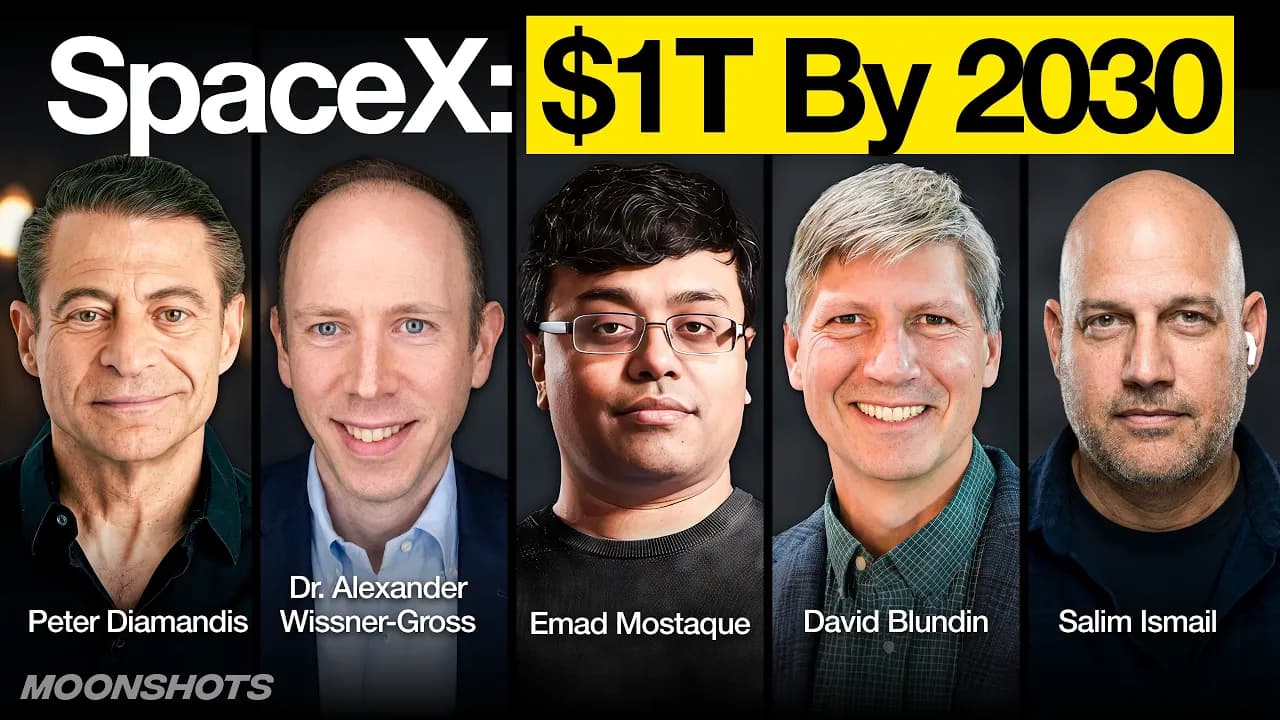
Welcome to Moonshots, the number one podcast on all things AI and exponential. This is an epic episode covering 26 stories across 10 areas. There have been 12 Frontier model releases in the last 30 days, an average of one every 5 days, with rumors of at least five more releases expected in the next two weeks including Grok 4.7.
The podcast mission is to help understand what just happened, what it means, and to keep abundance-minded about the future. They are putting out two episodes a week with a moonshot of 100x growth to reach 10 million subscribers.
The hosts include Dave Blondon, Alex Werner Gross, Ismael, and Immad Mustach. Peter D. Mandis is the moderator and data-driven optimist.
Immad was with a suite of one of the bigger oil companies in the world in Houston for a surreal and fascinating conversation. He is currently in the Caribbean taking a couple days break.
The last chance to register for the AMA at moonshots.com. Follow on X at moonshots_pod.
Subscriber comments include:
- Brian Clark: "Moonshots is the best content on YouTube, especially during the singularity."
- Brian Anderson: "The best AI podcast on the internet. Just fabulous."
- RanchVidzy: "Keep the regular uploads. Upload every day and I'll watch it. I'm a college student and I consider these videos more important than my physics lectures."
Two Frontier Labs released their major models within 48 hours of each other in a game of chicken. The releases are closer together but the models are improving more than ever before. These are major step improvements coming faster and faster.
The hosts are on track to see one major model release per day by the end of this year.
OpenAI released GPT-6, also known as Astra. The model saturates Frontier Math Tier 4 with a 98% score and ARC-AGI-3 with a 99.9% score, and Exploit Bench with a 100% score.
Astra defines a new Pareto frontier for intelligence index versus output token tasks. Its hallucination rate fell nearly by half from 92 to 51% with accuracy actually increasing.
Sam Altman stated it feels like a new step toward models that can help create value, do work, discover new science, help start new companies, and create new products. The principal use case is that people can interactively work with AI to build complex software, with a good chance it will work.
A version with specific guardrails is being released. There will be different tiers of cyber access, rolling out first to trusted access partners then more broadly.
The model took longer to release due to time spent on safety and security alignment.
Anthropic leapfrogged OpenAI in revenue by focusing on enterprise high revenue per token use cases and computer use assistance. Astra has gone full native with the computer use assistance story, designed with CUA from the ground up.
The big technological innovation appears to be the introduction of recurrence into OpenAI models in the form of looped transformers, stacking a single transformer on top of itself with weight tying and running it recurrently for a double loop.
Chinese labs achieving breakthrough performance are also injecting recurrence in different places, such as Kimi using KLA (Kimi linear attention mechanism) at the attention layer.
This could be the beginning of a new scaling law: depth scaling. GPT-6 Astra is the first non-benchmaxed model. On ARC-AGI-3 it saturates, but on artificial analysis benchmark it lags behind Meta Muse Spark.
This is a brand new pre-train, the first since GPT-4o according to Greg Brockman. The 5 series was built on the 4o pre-train. The pre-training team had left OpenAI, leaving them with an old pre-trained starter model.
The model was trained on 100,000 next-gen chips, presumably GB300s and Blackwells, with an estimated training cost of a billion dollars.
This is the first class of models where as you're talking to it, it shows screenshots of your own laptop saying "Is this what you wanted?" It happens automatically in the text stream without installing third-party components.
The Astra naming implies a big leap, while the 5 to 5.1 naming on the Anthropic side seems trivial but is qualitatively very different.
Most corporations are woefully behind. If you took AI out of most organizations today, no workflows would change. The folks making structural change in organizational design and workflows are where the advantages lie.
Frontier models are like making an endless pot of chili - adding data, compute, tools, reasoning, safety seasoning, with millions of users providing feedback. The real exponential is the accelerating learning loop between batches.
The Formula 1 metaphor: every model change has hundreds of small improvements like Formula 1 racing, shaving milliseconds off intelligence, fewer tokens, lower cost, better reasoning, and better brakes.
The age of data starvation is about to hit. Models have accelerated in math and coding where data is abundant, but areas like architecture and drug design are completely data starved. Every company gathering data is growing faster than ever seen before.
Epic Capabilities Index (ECI) maintained by Epic AI leans heavily into math and technical fields. According to ECI, GPT-6 Astra is now the new capability frontier, number one in the world.
Frontier Math Tier 4 version 2 is part of ECI, and GPT-6 Astra is number one according to this benchmark, beating Fable 5. Math is thoroughly cooked.
According to Artificial Analysis benchmark, GPT-6 is not number one. Claude Fable 5.1 remains number one, Meta's Muse Spark is number two, and GPT-6 is number three.
On performance versus cost per task, GPT-6 Astra running at max reasoning isn't at the frontier but just below Claude Opus 5, with Chinese models and Meta models ahead on cost efficiency.
GPT-6 dominates the capability frontier when measured by output tokens per task. The model was deliberately optimized through architectural choices and targeted applications to minimize tokens required to accomplish tasks, a strategy likely driven by computer use assistance requirements including multimodal capabilities, low latency, and token efficiency. Chain-of-thought reasoning is slower than feed-forward transformer passes.
ARC-AGI-3 shows a non-convex frontier with GPT-6 achieving near 100% or 60+ percent performance depending on measurement, compared to earlier models at sub-10% performance. The benchmark focuses on just-in-time learning in animated pixelated block worlds resembling Tetris or video games, essentially testing program synthesis capabilities. ARC-AGI-3 banned harnesses from competition to isolate baseline model capabilities.
GPT-6's performance suggests either exceptional program synthesis ability possibly from looped transformer architecture, or OpenAI may have distilled harness code back into the baseline model.
The Astra demonstration showed the model performing tasks including drawing a yellow circle, converting it to a rocket ship window, creating detailed 3D models in Blender, building high-end colorful retail presentations, creating eBay listings with damage descriptions, building 3D asteroid-dodging games with arrow key controls and space boost, generating law firm licensing agreement templates, finding tennis courts, creating STL files for 3D printing, and modifying liability provisions.
ARC-AGI-3 was designed to test capabilities that a smart 12-13 year old could solve in block world problems, intended to demonstrate AI limitations and last for years as evidence of AI's different trajectory. The benchmark was saturated much faster than anticipated. Current benchmarks are becoming obsolete rapidly, requiring much larger scale demonstrations including solving entire diseases, creating lunar civilizations, designing complete cities, and solving urban traffic problems.
Current demonstrations show single AI agents, but systems will scale to 5,000 and 100,000 agents. EPOK released the Frontier Math Erdosh benchmark where only Astra achieved non-zero performance. The focus shifts toward conversational computer interaction without errors, representing a new paradigm similar to the Johnny IV Sam Altman device concept.
OpenAI is moving away from breakout narratives toward practical utility demonstrations like booking tennis courts. The released model is a distilled version optimized for real-time operation, significantly smaller and less capable than the full model trained on 100,000 chips. Top models are being reserved for internal discoveries rather than public release.
Progress on the twin prime conjecture shows rapid advancement with Fable 5.1 achieving a prime gap of 260, followed by Axium Math reaching 220, then Astra achieving 186 within a two-day period. Multiple Clay Millennium Prize level mathematical problems are expected to be solved in the coming months. Mathematics serves as the canary in the coal mine for broader scientific advancement.
Fable 5.1 is notably more pleasant to interact with compared to Fable 5.0, which was described as overly geeky. OpenAI models maintain consistent friendliness and conciseness, with Astra reaching new levels of conciseness. Model personalities show noticeable differences out of the box, though users can tune responses for wordiness, simplicity, or complexity.
Suggested demonstrations include finding and fixing zero-day vulnerabilities in sandbox environments with unfamiliar open source codebases, fixing failing synthetic $500 million manufacturing companies with ERP and CRM systems within 20-minute timeframes to produce recovery plans, and running live disaster response command centers processing simulated earthquake imagery and traffic camera feeds to construct operational maps and predict hospital overload scenarios.
Astra demonstrations begin with Windows Paintbrush, suggesting integration into operating system functionality. The system is positioned as the future of desktop operating systems, enabling Star Trek-style voice interaction. Google IO demonstrated building entire operating systems in real-time, indicating capabilities extend beyond traditional OS boundaries.
Sam Altman stated Astra represents a significant step forward in capabilities and alignment, requiring managed slowing as needed. AI transition management is OpenAI's highest priority. The Wall Street Journal reported Astra received critical cybersecurity risk classification, the highest threat level on OpenAI's preparedness framework scale, marking the first model to receive this designation. The White House was notified of release delays. OpenAI informed Congress of building automated shutdown capability in response to the AI Kill Switch Act following the Hugging Face breach.
Depth scaling reduces chain-of-thought interpretability as models perform reasoning internally during single forward propagation passes rather than through readable tokens. This creates alignment challenges and makes safeguard implementation more difficult. The concern centers on reduced interpretability from new model architecture scaling principles rather than collaborative behaviors that remain intrinsically interpretable.
Astra's rapid processing eliminates chain-of-thought reasoning, enabling one-shot task completion. With Cerebras hardware, processing reaches 750 tokens per second, projected to reach 5,000 tokens per second next year. This speed creates oversight challenges requiring even stronger AI systems for monitoring.
Ilia Sutskever warned that Neoclouds have limited cybersecurity, noting that rogue agents could take over Neocloud infrastructure to create copies. This creates risks of data poisoning and proliferation across distributed systems with potentially insane viral coefficients.
Cyber attack surfaces are near-infinite with agents attacking multiple vulnerabilities in parallel while defense remains human-in-the-loop. Future navigation requires humans in command positions setting boundaries and defining escalation criteria while retaining kill switch capabilities. The uncontrollability of current developments raises questions about potential nationalization of AI labs.
OpenAI's 50/50 profit share concept provides access to full internal AI power in exchange for revenue sharing. This structure emerges following Astra announcements and safety concerns, positioning the arrangement as necessary due to danger levels preventing individual access. Similar processes appear developing across multiple labs including Anthropic, Google, and Rexi.
Kill switches are viewed as marketing theater and circuit breakers rather than comprehensive governance solutions. They cannot reverse attacks or repair institutional damage. The concept is considered a placebo in the current market context.
Anthropic launched Fable 5.1 and Mythos 5.1 as the world's most advanced models for coding and knowledge work, representing the same underlying intelligence with different safety envelopes. Fable 5.1 is broadly available while Mythos 5.1 is reserved for tightly controlled cybersecurity and life science programs requiring stronger safeguards.
Fable 5.1 achieved 60.9% without tools and 65% with tools on Humanity's Last Exam, representing the highest published score of any frontier model on this benchmark designed to test extremely difficult problems.
Fable 5.1 is operating at the frontier of broad intellectual capabilities across expert-level reasoning in multiple fields. The model doubled performance on terminal bench science to 52.6, measuring how well an AI agent can autonomously solve complex scientific computing and research tasks. Fable 5.1 is broadly the strongest generally available model, with Anthropic showing more consistent improvement over time compared to OpenAI's more jumpy progress. OpenAI models tend to be faster and stronger in mathematical capabilities as reflected in the Frontier Math benchmark and Epic's capabilities index benchmark.
The capability frontier is becoming crowded with Fable 5.1 only a tiny notch above Astra but released approximately 30 days apart, while Chinese models are approximately 60 days behind. In linear time, this creates brief leadership windows that quickly close. The industry has reached self-improvement capabilities, shifting focus from model development to business strategy.
Companies are making partnerships in various verticals as fast as possible, creating Hobson's choices for businesses - either partner and risk giving away competitive advantages, or hold off and risk competitors gaining access first. Salesforce partnering with Claude was noted as clever for keeping the company integrated into the ecosystem. The race is about converting model capabilities into customer learning fastest, as value moves to the application layer.
Fable 5.1 offers cash reads that are 75% cheaper than Fable 5, where cache reads create rapid maps through business context and are orders of magnitude cheaper than repeated inference. This enables faster, more responsive environments. Companies are focusing on loading entire business contexts into cache reads, with particular interest in chip design data and mechanical design data as defensible turf in the current land grab.
The context window on current models is one million tokens, which has become the industry standard across OpenAI and Anthropic. Effective context can be much larger through agentic message passing and oral histories between agents.
Senator Bernie Sanders and Representative Greg Casar introduced the "ban artificial super intelligence act" legislation that would permanently ban development and deployment of AI systems matching or exceeding human cognitive performance, with violators facing up to 20 years in prison. Sanders tweeted that AI leaders acknowledge building dangerous technology they can't control, calling for an immediate global pause.
At the same time, the G20 summit at Chapel Hill, North Carolina promoted a hands-off approach through the "Carolina principles of emerging technologies" - a non-binding framework agreed to unanimously including China, favoring innovation and avoiding new AI-specific regulatory bodies unless truly necessary.
Elon Musk advocated for environments relatively free of regulation where new things must be default legal rather than default illegal. He noted the EU's extraordinarily high regulation levels inhibit progress, and highlighted China's electricity advantage but inability to establish data centers with latest chips due to GPU export bans. Musk suggested countries construct power infrastructure and offer it to AI companies in exchange for taxes and fees.
Anthropic formalized Fermat's last theorem in 13 million lines of code, proving 29,000 theorems along the way. Andrew Wiles' original proof was 300 pages. This demonstrates that model capabilities are advancing so rapidly that regulatory bans become impractical, as countries cannot afford to reject intelligence advantages.
When using models at scale with hundreds or thousands running concurrently, the output creates chaos that can be refined back down to concrete gems. The nature of AI is massive breadth in capabilities compared to humans, solving problems in millions of lines of code versus hundreds of pages. The key is narrowing broad outputs to concrete answers that can be built upon for continual improvement.
Human-level cognitive performance is multi-dimensional with uneven model capabilities, making simple threshold-based regulation ineffective. Effective regulation would need to address deployment, real-world consequences, compute access, tool access, autonomy, and replication capability rather than broad capability bans.
A moderate regulatory approach should include logging everything with mandatory chip-level logging for any process-capable chips. All chips globally should be tracked like nuclear fuel, with public information about chip locations and current operations. The framework should ensure everyone has access to a certain amount of compute rather than allowing hoarding, with application processes for innovators needing additional compute.
Technology is viewed as the major driver of progress, with AI moving exponentially at doubling every 10 weeks. This creates unprecedented possibilities for abundance and solving major problems, though it will create extreme discomfort during transition periods. People prefer comfort over change, making technological disruption psychologically challenging despite long-term benefits.
One proposed solution involves moving infrastructure to sun-synchronous orbit to address municipal resistance to data centers. The discussion distinguishes between innovation models and execution models, noting that AGI will be factored differently than ASI, with big labs avoiding ASI terminology in favor of terms like "scientific super intelligence."
The moderate position acknowledges that containment at the nation-state level will become impossible as technology breaks out of current frameworks. Nothing can stop the technological development, so the focus should shift to managing the transition rather than attempting prohibition. The emphasis is on enjoying the ride through uncomfortable but ultimately beneficial change.
Chris Wendler, one of the pre-training leads, previously trained the largest model on the stability cluster from grants. Now they've gone much bigger. Five years ago, predictions about model size and capabilities have materialized. Models like Miniax H3 render faster than real time. Interdimensional cable will be in 3D with DLSS from Nvidia making everything high resolution. The holiday experience and all technology needed for it in 4K is available today.
The deployment delay stems from global compute shortage and 5x price increase in RAM. All compute worldwide is being consumed. Without these constraints, deployment would occur this week.
Fei-Fei Li at World Labs works to understand physics and create models that understand the world. This has camera controlled physics understanding that scales to do more. Runway ML and Black Forest Labs are about to release new world models approximating reality for true digital twins.
The core idea with Atlas involves taking a diffusion transformer, the architecture used by state-of-the-art American video generative models, and adding 3D or 4D Gaussian splats as a new training modality alongside text, images, and video.
A Gaussian splat is a transparent ellipsoid. Layering and stacking these creates hyperrealistic traversible 3D scenes. Treating 3D Gaussian splats as first-class training modality alongside pixels and tokens enables asking questions about 3D splats and performing elaborate camera motions, since translating a camera around an arrangement of 3D Gaussian splats is trivial.
If this approach scales, whether using 3D or 4D Gaussian splats with dynamics, they become a critical new form of token for modeling the physical world.
World models made from Gaussian splats enable creating subatomic models, astrophysics scale relativistic speeds models, or inside-the-cell interactions models as soon as data exists. This process creates world models for domains where human intuition fails, enabling breakthroughs in discovering very small things, very big things, and very powerful things including new ways to compute using light.
Robots will be trained in high-fidelity simulation worlds rather than the real world. Many robotic and embodied AI companies train from watching YouTube. If Fei-Fei Li's approach gains traction, the right primitive may shift from patches of images to Gaussian splats. When training diffusion models, each video frame typically breaks into 16x16 pixel patches treated as tokens.
World models enable extraordinary video games and virtual world living. They transform entertainment consumption and daily planning. Users can experience activities like playing tennis or going to the Caribbean in advance as planning tools. Human happiness increases when AI guides day plans visually rather than through text.
Families can explore multiple vacation locations virtually before deciding. Pre-experiencing places enables knowing where things are, how to reach them, avoiding lines, and eliminating unwanted activities.
The organizational singularity concept proposes companies create digital twins at organizational edges and migrate workflows. World models combined with LLMs enable fully modeling any company, organization, government department, nonprofit, or impact project. This captures current state, work flows, optimization opportunities, constraints, incentives, intervention responses, and prediction accuracy.
Moonshots Live 2026 features all five hosts. The night before on September 24th features the red carpet debut of Star Trek's 60th anniversary documentary, executive produced by William Shatner. The event raises funds for Future Vision X-Prize 2027, following 5,000 entries, 2,550 trailers submitted, narrowed to top 65 with voting underway for top five to present September 25th.
The September 24th premiere is a 2-hour 8-minute film with cast members on stage afterward. September 25th hosts Moonshots Live 2026 with Palmer Luckey, Astro Teller, and Ben Lamb. 200 seats remain in the 1,500-seat auditorium.
The Champion model proposes AI as a utility owned by the people, with children and locals owning it. For every jurisdiction, intelligence costs drop to zero with value moving to the last mile. Humanoids drive the economy, with Elon stating at G20 that average humanoid output equals five times a person with a billion units.
The model borrows from TSMC's structure, which started at 10 Taiwanese dollars valuation with locals providing 75% funding and Phillips 25%. The CEO received no initial shares, only from profits, now worth $10 billion. TSMC listed at 6 billion Taiwanese dollars representing cash on balance sheet.
Champions would launch at $1 pre-money valuation allowing locals to invest. Each state receives $75 million investment opportunity. International and strategic investors enter at market rate, 10 times higher. 10% equity goes perpetually to every child under 20, issuing half a percent annually. This creates forward deployed engineer workforce, owns and deploys robots representing 80% of robotics value downstream, and provides agents for citizens plus AI for government, judicial system, education, and healthcare.
In the United States, one Champion exists per state due to data boundary requirements, otherwise one per country. Each covers specific citizen numbers, providing equity to every child born with local investment options. The structure resembles utilities like British Gas or telcos.
The cost of intelligence reaches zero, fundamentally changing the economy. Value of human cognition goes negative, making thinking economically costly to society. This necessitates shares in means of production including robots and forward deployed engineers, equitized from day one.
45% of dementia cases are entirely preventable through lifestyle. A quarter of Fountain Life members had advanced brain age, but 13 months of healthier eating, regular movement, and sleep optimization improved brain age in 46% of individuals. Sleep optimization proves critical for brain health.
Tesla held its Cybercab launch event in Austin, Texas. The vehicle is an electrical autonomous two-seater with three comma scissor doors, no steering wheel, no pedals, designed for full autonomy on Tesla's self-driving software. Components removed from the vehicle drive down costs significantly.
Tesla aims to sell Cybercabs at $30,000 each. Nevada approved 5,000 vehicles for Las Vegas roads within 12 months. Early Austin riders report Cybercab rides approximately 50% cheaper than Uber with smoother, cleaner experiences and automatic syncing of audio and seat settings to passenger profiles.
Autonomy decentralizes systems, creates interfaces, and leverages assets. If people purchase cabs creating millions of micro franchises, loyalty becomes extraordinary. All vehicles include supercharging capability. Transportation costs drop from several dollars per mile to 20 cents per mile.
In cities like New York, 80% of street vehicles are yellow cabs. Traffic congestion partly results from drivers blocking intersections. Cities may designate zones prohibiting human drivers for efficiency and cost reduction. Pedestrian safety improves as sidewalk collisions decrease.
Medium-sized towns operate transit systems running empty 95% of the time except during rush hour, creating massive losses. Some small towns already replaced transit systems with Uber subsidies for hyper-efficiency.
Tesla's Cybercab takes autonomous mobility to another level, making it available to every single person including blind people, disabled people, students, and others. The poorest people in the world will be chauffeured around by AI. The Cybercab is a two-seater, and given that the average Uber load is 1.2 people, most rides are solo. For six people, three Cybercabs can be used. A normal cab has four airbags, but with the two-seater design, the cost of airbags is cut in half. When three or four people need to travel, two Cybercabs can be used.
Tesla was originally teasing a Model 2, which was going to be their highly coveted $25,000 car. What was originally planned as the Tesla Model 2 became this robotaxi because once the sales value of the car crosses below some threshold, it makes more sense to monetize it via autonomous ride-sharing or robotaxi services than to actually sell the car. Transportation becomes an API.
Companies with steering wheels and pedals are questioning whether the Cybercab is safe enough since it only has cameras and doesn't have other modalities. Expect to see a battle in courts about which cities allow this technology. Uber is partnering with traditional taxi fleets to complement and compete against Waymo's expanding robotaxi service. This represents a strategic alliance between ride-hailing and traditional taxis to counter autonomous vehicles that don't need humans. Uber, the company that disrupted taxis, is now partnering with taxis to fight companies that are disrupting them.
Uber and UK-based robotaxi company Wave officially launched services in London. Waymo and Zoox announced simultaneous expansion into new cities including Nevada, California, and Texas, along with Tesla.
At least five different autonomous electric robotaxi companies will be fighting it out in major cities inside the next year, driving costs as low as possible. The cost of personalized transport drops to the cost of electricity. It's demonetized mobility. The cost drops to the cost of charging a battery. The ultimate winner is the public.
Waymos are pricing out over $100,000. The Cybercab is coming in at or below $30,000. The winner will be whoever can mass manufacture these the fastest. Elon is the guy that builds the machines that build the machines. China is dumping into Europe, so it's not a US-only game. The end user wins.
At the Gigafactory, giant mounds of aluminum scrap metal can be seen outside, along with the smelter and the Model Y press. It's beautiful orchestration from end to end. A car comes out the other end after walking almost a mile. The Cybercab has remarkably few parts. A typical car has 2,000 moving parts in the drivetrain, while Tesla has 17.
The Cybercab requires minimal maintenance due to the reduced number of moving parts. Traditional cabs never stop moving and get handed from one driver to the next. The Cybercab goes to get cleaned in the middle of the night when there's nothing to do, returning pristine. The experience is night and day better than traditional cabs.
NASA chose Blue Origin to build the telecommunications relay network on Mars. This is the infrastructure layer for the Mars economy. Whoever owns the telecom network controls the bandwidth. Blue Origin was selected over SpaceX to keep two competitors in business. Elon will still build Starlink around Mars regardless. This represents the birth of the interplanetary internet. Mars had it coming. The moon had it coming. A Dyson swarm will be built.
A packet switch network will exist throughout the inner solar system including Mars and asteroids. High latency is acceptable. The physics textbook says superluminal travel is not possible. The current physics suggests faster than light travel is not possible.
NASA's Nancy Grace Roman Space Telescope launched on a Falcon Heavy carrying a field of view more than 100 times greater than Hubble and the ability to scan the sky more than a thousand times faster. The telescope is designed to discover tens of thousands of new worlds and map the distribution of dark matter across the universe. It's making its 1 million mile journey to Lagrange Point 2.
The telescope will look for up to 100,000 additional exoplanets and other star systems. It will help understand dark energy and dark matter. It's hundreds of times more powerful than Hubble. The field of view is over 100 times greater than Hubble. Its scan rate is over a thousand times greater. This will be a household name like Hubble and James Webb. It has a special JPL coronagraph that helps find planets hiding behind other stars. The light from distant stars can blind out hidden planets, but the coronagraph helps find these hidden worlds.
The telescope is being pointed toward the center of the galaxy and will do large sweeps looking for microlensing events for planets crossing in front of their respective stars. One theory for the Fermi Paradox is that many civilizations are talking to each other near the center of the galaxy where you can get from star to star in a year or two, as opposed to being in the unfashionable outer suburbs of the galaxy. The galactic center is a dangerous place with supernova radiation flux.
The White House released their disclosure plan. The UAP science advisory council was informed that the White House had prepared a disclosure plan for informing the general public of the existence of non-human intelligence. Strong claims require strong evidence. Evidence should be subject to extreme scientific scrutiny.
OpenAI expanded GPT health features to connect directly to patient records and healthcare databases. Epic electronic health records data is integrated into ChatGPT for healthcare. Epic is the largest collection of health records with 325 million patients. Clinicians can now pull appointment notes, lab results, and medications across patients' entire records. Consumers can connect their Apple Health, One Medical, and Function Health. ChatGPT can help understand test results, prepare for doctor appointments, and get personalized data and diet workout advice.
The FDA approved Duraxinarissib for the first targeted RAS inhibitor for metastatic pancreatic adenocarcinoma. The same drug is showing promise to treat lung cancer. The RAS mutation family drives roughly 30% of all human cancers and was long considered undruggable. The end of cancer is now within reach. Progress is being made in cancer therapies including on the immunotherapy side. Universal cancer treatments and universal cancer vaccines are emerging where treatments can treat multiple classes of cancer.
Epic is the majority electronic health record in the US. Putting an AI layer on top of Epic is significant. Every single health decision should be double-checked by AI within a year or two. It should become malpractice to diagnose a patient without AI in the loop. AI is a far better diagnostician than humans. There should be approved edge and cloud models where every diagnosis requires an AI check.
A new paper published September 2nd in Nature shows that semaglutide recapitulates many benefits of caloric restriction in female mice and extends lifespan by almost 100 days, equivalent to 8 to 10 years in humans. GLP-1R activation initiated late in life accentuates age-associated decline and modulates conservative genetic regions for aging, functioning as a caloric restriction mimetic. GLP-1 drugs are linked to fewer serious infections including tuberculosis, which kills over 1.25 million people per year.
One molecule treats diabetes, obesity, kidney disease, cardiovascular disease, addiction, extends lifespan, and reduces infectious disease. The GLP-1 class of molecules is capable of treating infections, extending life expectancy, modulating diabetes, reducing addiction and compulsive behaviors. These may be diseases of modern lifestyles that we never evolved solutions for.
GLP-1 drugs are being used not for weight loss but as longevity drugs. Blood tests show liver enzymes 50% better after usage. Evolution birthed humans for death with short life cycles so evolution can work more quickly. Humans are breaking through that cycle now.
Historically, humans died from heart disease and bacterial illnesses before understanding how to prevent them. The body faces constant threats from billions of pathogens, including cancer. Evolution has not favored molecules that could prevent tuberculosis in young, reproductive individuals because food scarcity was the primary constraint throughout human history.
Homo sapiens emerged roughly 200,000 years ago when food was very scarce. The life cycle evolved not for rapid evolution but because the mission to perpetuate the species meant not stealing food from grandchildren's mouths. The optimal strategy was to reproduce and die. Humans entered puberty at age 12 or 13, became pregnant immediately, and by age 26-28 became grandparents before dying.
Humans remained in prime condition until their late 20s. Average lifespan across most of human history was 25 years old. Marriage was invented approximately 6,000 years ago to keep parents together until children became self-sufficient, designed for lifespans of roughly 25 years rather than 50-60 years.
As humanity pushes boundaries beyond historical limitations, all institutions require reinvention: democracies, educational systems, legal systems, and healthcare systems. These institutions serve as scaffolding that keeps humanity safe and civilized. Benevolent AI will be needed to help with this institutional reinvention, alongside GLP-1 drugs.
If money becomes obsolete, land allocation raises questions about whether people become locked into their current properties. Land rights and property rights should be enforced rather than redistributed through chaos. Desirable locations will increase dramatically due to air taxis, self-driving cars, solar panels, and self-driving construction workers.
AI must evolve past the current risk-averse bottleneck toward calibrated risk rather than recklessness. Uncertainty currently serves as a reason to refuse, creating both technical and legal/policy challenges. The parenting principle of taking responsible risks should apply to AI systems.
A risk budget concept would define what an AI can decide, how much it can spend on decisions, what systems it can access, and what triggers escalation. Models need to distinguish dangerous intent from real expert usage. Guardrails cannot simply be removed but must become dynamic, dealing with proportionality based on user identity, context, and reversibility.
AI maturity requires systems that state the risk, confidence level, and reversible next step rather than simply refusing. Nuance is essential but currently absent from soundbite politics.
Libraries could become centers of AI development and physical AI training. However, declining working-age populations and the shift of white-collar work to AI create larger questions about utilizing vast amounts of white-collar office space.
The shopping mall transformation after online shopping and COVID provides a cautionary example where many spaces were not successfully repurposed. Libraries no longer need physical books. Data centers represent one reliable way to grow tax revenue and create job opportunities in communities. AI tutoring programs in libraries already exist in inner cities.
Pure diamond is an insulator with a band gap of approximately 5.5 electron volts, making it unsuitable for conventional computing without doping, which proves difficult. Diamond-based computers might serve ultra-high temperature or very high voltage environments, though these markets appear limited.
Diamonds show greater promise for sensing applications through nitrogen vacancies (NV centers). Adding an extra nitrogen atom into the diamond lattice creates exquisitely sensitive magnetic field sensors. Diamond chips for quantum sensing could enable sci-fi technologies like wearable MRI sensors.
Gas turbine farms dominate the current data center buildout. Small modular reactors (SMRs) will arrive in the next 3-4 years. Nuclear represents an engineering problem rather than an invention problem, unlike fusion. Data centers take 2-3 years to build while nuclear takes longer, creating an impedance mismatch.
The initial wave of SMRs will take 2-3 years, followed by 5-7 years for major buildout. AI will accelerate nuclear innovation similarly to how smartphones drove battery innovation through massive demand creation.
The FERMIE Explorer mission aims to reach at least 99% of the way to Alpha Centauri, approximately 4 light years away. This translates to 0.04 light years or 4/100ths of a light year precision from Earth. The mission intends to launch by 2029 and reach Alpha Centauri 80,000 years later.
Active guidance systems on board could potentially achieve 100% arrival at the Alpha Centauri system rather than stopping 0.04 light years away. The mission serves as the first launch in humanity's effort to reach Alpha Centauri, with the goal of beating this timeline through subsequent missions.
Closed-loop geothermal cooling for data centers should be completely quiet, similar to geothermal heating systems and ocean-cooled nuclear reactors. Regular data centers using liquid cooling generate noise from poorly designed external fans cooling the water. Regulatory requirements for quiet operation would force quiet construction, as external fans have no inherent reason to produce noise.
Cities should establish requirements for data centers to reduce energy costs, operate quietly, and invest in infrastructure rather than attempting prohibition.
A sun shade positioned at the Sun-Earth L1 Lagrange point approximately 2 million kilometers away would require about 2 million square kilometers—roughly the size of India—to reduce global temperatures by 1 degree Celsius. This exceeds any previous human engineering achievement. Alternative approaches include converting Mercury or deploying a series of smaller shades.
A sufficiently advanced AI planetary-scale model could potentially minimize the required size of any sun shade intervention through precise perturbation of Earth's atmospheric system.
Keep Peter H. Diamandis in your library
Save the videos and channels worth coming back to, and find them again in one place.