Greetings, Earthlings: Philip Johnston of Starcloud on Data Centers in Space
In a Nutshell
StarCloud, founded by Philip Johnston, has launched the first space data centers (StarCloud 1 sent "Greetings, Earthlings"), exploiting 24/7 solar power (8x more efficient than Earth), no land permitting, and falling Starship launch costs (<$500/kg breakeven) to undercut terrestrial data centers at <$5M/MW and <0.5¢/kWh. Marginal costs drop with scale, projecting a trillion-dollar annual capex market in 10 years, with 50%+ of new AI inference compute shifting to orbit by 2028-2030 via dispensers launching 10 MW per Starship flight. Key challenges like radiation-hardened chips and radiative cooling are solved, starting with space-edge workloads before hyperscaler dominance; Earth constraints make space inevitable.
These notes were generated by AI and may contain inaccuracies.
The problem with building data centers on Earth is that the marginal cost increases for every additional data center because easy places for energy projects are already used. In space, marginal cost decreases for every additional unit due to manufacturing at scale and cheaper Starship launches. There is a crossover point where it makes zero sense to build on Earth. Close to a trillion dollars per year of capex will be deployed in space within 10 years, the largest market opportunity ever.
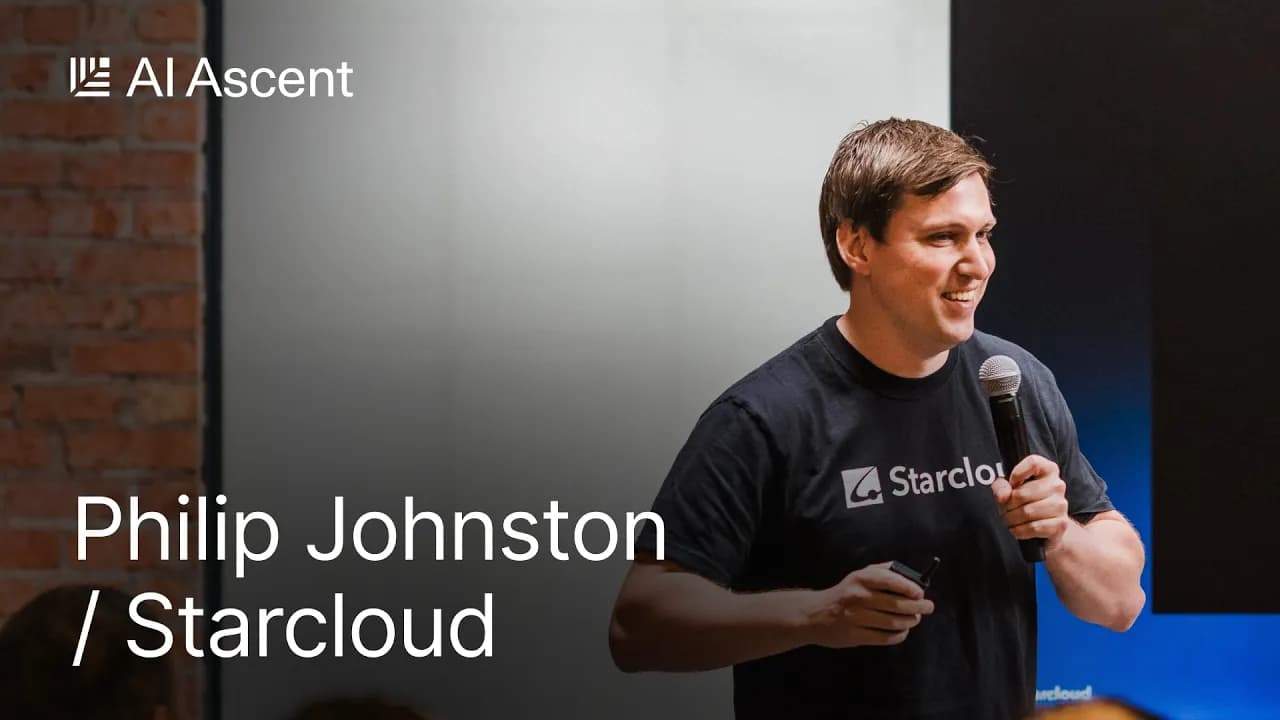
Philip Johnston, founder and CEO of StarCloud, launched the first data centers in space. StarCloud 1 sent back the message "Greetings, Earthlings" a few months ago.
Why Build Data Centers in Space?
Philip has been interested in space his whole life. He spent years at McKinsey with space agencies of governments worldwide, noticing launch costs dropping rapidly. Three years ago, he visited Starbase, Texas, blown away by SpaceX's gigafactories planning three Starships per day. This enables new businesses. With co-founder Ezra (from the UK), they considered space-based solar with huge panels beaming power to Earth (idea since Isaac Asimov in the 1940s). Problem: most energy lost in transmission. Most new Earth energy projects power data centers, so better to move data centers to space, consume power near source. This led to a 2024 white paper starting the company.
Terrestrial Constraints
Running into constraints on building new energy projects for data centers. New 100 MW project has 5-10 year permitting lead time in North America. Covering 10 square kilometers with solar annoys people. Already built in easy places, hitting a brick wall.
Even without regulatory constraints, space is cheaper below certain launch costs. Terrestrial solar costs: permitted land, battery storage/backup, solar cells. In space:
- No permitted land.
- No batteries (24/7 sun).
- 8x less solar needed (1 sqm in space produces 8x energy of 1 sqm on Earth).
Break-even at $500/kg launch cost; rises toward $1,000/kg as land costs increase. Even with zero land cost, space wins below a few hundred dollars per kg.
Operate like Starlink satellites initially: no robotic maintenance. Redundancy on critical systems, overprovision failing components like solar panels (lose few % per year). Chips must not fail more in space than on Earth (major cost). 70% engineering time on heat, 30% on chip reliability.
Testing: two rounds at Cyclotron proton beam accelerator in Knoxville, one at heavy ion accelerator in Brookhaven National Lab (simulate 5 years radiation in 24 hours). Informs shielding, software for bit flip mitigation.
StarCloud 1 has H100 on orbit: no restart failures from chip. Issues in power delivery, SSDs, but GPU workloads resilient due to stochastic nature (e.g., ChatGPT poem about space gives different outputs of same quality; bit flips don't affect).
Space is cold (advantage far down rabbit hole), but vacuum insulates like thermos. Only dissipate via infrared radiation (everything glows in IR proportional to T^4 temperature differential).
Run radiators as hot as possible: avoid hot chips (shortens life); use heat pipes/heat pumps (e.g., 60°C chip fluid to 100°C radiator).
StarCloud 1: submerged motherboard/power/GPU in phase change material (solid to liquid; proof-of-concept, not continuous).
StarCloud 2 (later this year): deployable radiator, liquid-cooled custom heatsinks next to GPUs. Tested in thermal vacuum chambers; scales simply by upsizing.
Currently five Nvidia GPUs on first satellite (H100 gets press).
StarCloud 2: ~8 kW.
StarCloud 3: 200 kW, 3 tons, 50 per Starship via PEZ dispenser door; 10 MW per launch. At rate: hundreds/month, several GW/month, tens GW/year. All for inference.
Latency same as Starlink (<50 ms on Earth); fine for Zoom (200 ms unnoticeable). Enables voice agents, back-office, video generation, ChatGPT.
With $1 trillion for AGI compute backbone: 100% into space. Within 5-10 years, at least half new compute in space. Earth marginal costs rise; space costs fall with scale/Starships. Crossover when Starship flies frequently (mid-late 2028 for first commercial payloads).
Mesh network solved by Starlink, Amazon Kuiper, Kepler. Own optical backhaul possible.
Each PEZ dispenser is own data center. Docking later for large training (need 300 MW+ like Earth largest; moving goalpost to 3 GW). Training <1% workloads; not ideal market. Showed docked concept provocatively to prove possible.
No maintenance for small 200 kW inference nodes. Robots for large structures, e.g., Optimus on Moon (space suit handles thermal/radiation). Not for small nodes (too small; docking then maybe).
Useful life: 5-6 years (matches chips); possibly longer (zero marginal energy cost). End-of-life: de-orbit like Starlink, or graveyard orbit.
Core challenges: thermal, radiation.
Thermal team: NASA JPL engineer (Europa Clipper, Firefly Luna lander, three NASA payloads); Amazon Kuiper lead; SpaceX people.
Radiation: Co-founder Ali (launched GPUs, particle testing).
Surprises: core IP, tight-lipped.
Positive on alternatives, but SpaceX far ahead (best company ever). Need reusable upper stage for cost parity: Stoke, Relativity, Blue Origin New Glenn (hiring heat shield engineers), Rocket Lab not trying (5-10 year dev cycle).
SpaceX launch partner via Rider program; fosters ecosystem (launches competitors like OneWeb, Kuiper; open-sources patents).
SpaceX building own data centers (lower cost via owned launch). StarCloud: agnostic box (power, cooling, connectivity; customer chips) like Equinix; SpaceX like AWS for own workloads (Grok, Tesla).
Hyperscalers in 3 years (Starship frequent): pay SpaceX, build own (unlikely; e.g., Google pays Planet Labs for 2027 demo), or partner with advanced like StarCloud for quick scale.
Starcloud will be the most advanced in deployed orbital capabilities, engineering team, and IP, making them an interesting partner—not just acquisition target—with leading cloud providers. They provide infrastructure and energy, while partners handle cloud services.
Why Equinix model over AWS or similar? Starcloud prefers infrastructure and energy over being a full cloud provider. Core IP is building satellites that dissipate heat and protect from radiation. AWS has 20 years of application layer development; customers want that functionality. Chips are the most expensive part—let others finance them and choose architectures. Initially, they may need to offer cloud services to prove reliability, as no one trusts them with chips yet. Long-term cloud offering possible, but infrastructure is higher margin.
Currently first-come, first-serve. Starcloud filed for a constellation of 88,000 satellites with the FCC (required for US ground stations; otherwise, any global regulator under ITU). FCC's role is a legacy from satellite communications and RF spectrum management.
In 10 years, most valuable slots will be filled; first holders will have rights to sell them.
Precedent: Starlink satellites used by Ukraine military. Russia wants to take them out but finds it easier to blow up a Virginia data center than one moving at 27,000 km/h in LEO. Attacking would be an act of war. Starlink now flies lower, avoiding Kessler syndrome chain reactions. US Space Force builds interceptors to deter threats.
Space is vast. Starcloud uses dawn-dusk sun-synchronous orbit over the poles: never casts shadow on Earth, never in Earth's eclipse, only visible at dawn/dusk. Benefits astronomy, avoids blocking light—no Dyson sphere dimming atmosphere.
Thermal issues solvable. Cost equations using Falcon 9 prices are outdated—launch costs will drop, making this potentially the biggest business ever. Key challenge: chips must not have higher failure rate in space than on Earth (even 10% higher wipes out energy savings).
Ideal Space Data Center Components
Much simpler than typical satellites (no phased array antennas):
- Solar panels
- Radiators
- Bus/box
- Chips (with memory, motherboard, power system)
- Small batteries (buffer, not 24-hour storage)
- One reaction wheel (unusual; most have 3—heavy for attitude control. Gravity gradient stabilizes long satellite.)
- Two lasers for communication
Strips out land-based needs: chillers, cooling towers, batteries, backup power, AC-DC converters.
Cost Savings:
- Energy: <0.5 cents/kWh all-in (including launch); signed 3 cents/kWh deals.
- Infrastructure: <$5M per MW vs. $15-20M per MW on Earth (just solar panels, radiators).
First satellites (StarCloud 1 launching this year, StarCloud 2 and 2.1 next year) provide edge/cloud for spacecraft (military/government, Earth observation). Already running workloads on StarCloud 1. High value: 1,000x terrestrial GPU rates. Keeps business viable even if Starship delays 2-3 years.
StarCloud 3: first cost-competitive with terrestrial data centers, ramps with Starship.
Why space customers need it? Downlink bottleneck: SAR satellite collects 5 GB/s but transmits 1 Gb/s via RF—throw away 90% data. Optical links to transport layer (e.g., SDA) enable shipping terabytes in space for inference (e.g., vessel ID in 10 TB ocean data). No on-board processing power.
Initial workloads: space-collected data processed in space.
Almost certainly aliens in galaxy/universe history, but no intelligent life now.
Fermi Paradox: 400B stars, 4T planets in Milky Way, habitable 10B years. Possibilities: staggeringly rare (we're first), or intelligent life short-lived.
Great Filters:
- Past: single to multi-cellular life.
- Future (his belief): superintelligence leads to self-destruction (e.g., million killer AI drones). We're building that—may not pass in centuries/millennia.
Unlikely we're first on 4T planets over 10B years. Galaxy colonizable in 1-2M years (Voyager to Alpha Centauri: 50k years). No Dyson spheres, evidence of intelligence.
Alternatives: Ants on road (irrelevant to advanced life)—but Dyson spheres would be obvious.
Follow Elon's roadmap: moon first (mass drivers for AI satellites—strong incentive), then Mars. Optimus program struggling, but executable. Cities on moon, people on Mars in his lifetime.
Best Space Businesses (data centers #1):
- Asteroid mining.
- Tourism: LEO/lunar hotels (Skyrift ~$200k; SpaceX positioned).
- Manufacturing: crystals (e.g., Varda for medicine/microgravity); later energy-intensive refining (lunar/asteroid materials).
- More comms.
AI (trillion trillion x humanity) will understand universe better, maybe explain consciousness (hard problem: qualia, intentionality in humans).
Internal AI Use: Mining model recommendations for infra/tools. Engineers pushed to spend $10k/month on tokens (e.g., approve $300/month Grok 4 heavy).
Gemini picked Starcloud as top space data center investment.
End State: 99.9% GDP on inference (Dyson sphere = physical economy). Compute electricity to 99.9%. Next decades: charts show unstoppable rise.
Keep Sequoia Capital in your library
Save the videos and channels worth coming back to, and find them again in one place.